

The insurance required to enter Georgia won’t pay to repair a damaged rental car. Since January 1, 2026, tourists must have health and accident insurance with at least 30,000 GEL in cover. That requirement is separate from protection under a rental agreement, a key distinction when choosing Georgia road trip travel insurance.
One policy shouldn’t be assumed to protect you at the border, cover medical costs and handle rental-car damage. Medical insurance covers eligible expenses for the insured traveller; rental-car protection applies to the vehicle under the terms of the rental agreement. Trip protection may address other travel disruptions, depending on its policy terms.
This guide explains how these types of cover differ and gives you a practical checklist for comparing limits, exclusions, deductibles and claims requirements. You’ll also learn what to check on your medical-insurance certificate and rental documents before setting off. E-COVER provides online travel medical insurance policies designed to meet Georgia’s stated visitor requirements, with a digital certificate you can keep alongside your rental paperwork.
Key Takeaways
- Georgia road trip travel insurance involves distinct protections for medical emergencies, rental-car risks and trip disruptions.
- Use the rental agreement to identify the vehicle protection that applies, then note its deductibles, exclusions and claims steps.
- Compare policy limits, assistance conditions and proof requirements side by side to identify gaps and avoid assuming that similar benefits overlap.
- Before departure, match traveller details and policy dates to your documents, and keep your certificate and rental agreement accessible.
- E-COVER provides online visitor medical insurance certificates designed for Georgia’s stated requirements. Keep yours with, not in place of, rental-car documents.
Georgia road trip travel insurance: what protection does a driver actually need?
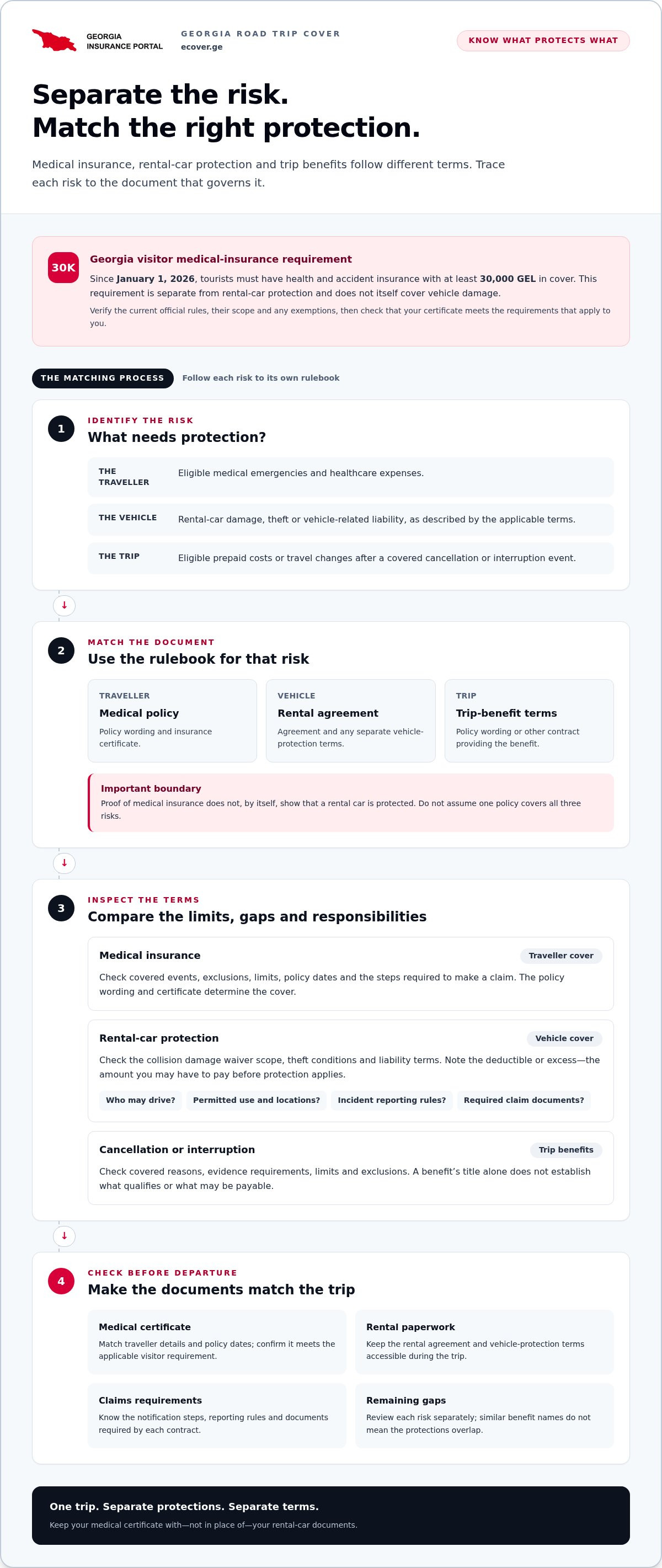
A road trip can involve three separate types of protection: medical cover for the traveller, rental-car protection for vehicle-related risks, and trip benefits for eligible cancellations or interruptions. Don’t assume one policy covers all three. When arranging Georgia road trip travel insurance, identify which person, vehicle or prepaid arrangement each type of cover is intended to protect.
What does Georgia travel medical insurance protect?
Travel medical insurance covers eligible medical emergencies during a trip, subject to the policy’s terms, limits and exclusions. The policy wording explains which expenses may be covered and what steps you must follow to access benefits. An overview of comprehensive travel insurance can explain common benefit categories, but your certificate and policy wording determine the cover you have.
Georgia’s visitor-insurance requirement, introduced on January 1, 2026, concerns health and accident insurance, with a stated minimum of 30,000 GEL. This medical requirement doesn’t itself provide cover for a rental vehicle. Before travelling, verify the current official rules, including their scope and any exemptions, and check that your certificate meets the requirements that apply to you.
Medical cover and motor-vehicle insurance are different: medical cover relates to eligible healthcare expenses for an insured traveller, while motor-vehicle protection relates to specified risks involving a vehicle, its use or liability. Proof of medical insurance doesn’t, by itself, show that a rental car is protected.
Why a road trip can need more than one type of protection
Consider each risk separately. If you need eligible emergency care, the relevant terms are in your medical policy. If the rental vehicle is damaged or stolen, or a vehicle-related liability arises, the applicable protection and your responsibilities are set by the rental agreement and any related vehicle cover. If you have prepaid travel arrangements, cancellation or interruption benefits may apply only to events defined in a separate policy.
Limits, deductibles, exclusions, eligible events and claims procedures can differ between contracts. For example, a rental agreement may leave you responsible for a deductible even when some damage protection applies. A medical policy may have its own exclusions and requirements for notifying the insurer. Read each document for the risk it addresses rather than assuming a benefit applies across policies.
For the entry requirement, read our guide to mandatory Georgia travel insurance for a focused explanation of visitor medical cover. Review your rental agreement and any trip-protection terms separately before departure.
Does travel insurance cover a rental car in Georgia? Separate the protections
Treat medical insurance and rental-car protection as separate. A travel medical policy shouldn’t be assumed to pay for damage to a rental vehicle or liability arising from its use. For Georgia road trip travel insurance, compare each type of protection with the document that governs it, then identify what remains uncovered.
| Protection | What it may address | Where to find the terms | Limitations to check |
|---|---|---|---|
| Travel medical insurance | Eligible medical expenses for covered emergencies during the insured trip. | Policy wording and insurance certificate. | Covered events, exclusions, limits, dates and required claims steps. |
| Rental-car protection | Vehicle damage, theft or liability only as described by the applicable protection and agreement. | Rental agreement and any separate vehicle-protection terms. | Deductible or excess, exclusions, authorised drivers, permitted use and reporting rules. |
| Cancellation or interruption benefits | Eligible prepaid costs or travel changes if a covered event occurs. | Travel-policy wording or other contract providing the benefit. | Covered reasons, evidence requirements, limits and exclusions. |
Rental-car protection: what to look for in the agreement
A collision damage waiver may limit what you owe for specified damage to the rental car, but the agreement determines its scope. The excess or deductible is the amount you may have to pay before protection applies. Theft protection concerns vehicle theft under stated conditions; liability terms address responsibility for injury or damage to others. These labels don’t guarantee the same protection across agreements.
Read the exclusions and check who may drive, where and how the vehicle may be used, and what to do after an incident. Reporting deadlines and required documents can affect a claim. Keep the agreement and any protection terms accessible during the trip.
Travel medical and trip benefits: where the boundaries are
Medical benefits address eligible healthcare costs under the policy. Cancellation or interruption benefits apply to specified trip disruptions, while vehicle-related protection is governed by rental terms or a separate vehicle policy. A benefit’s title alone doesn’t establish what qualifies, what is excluded or how much may be payable.
For visitor medical-policy context, the U.S. Embassy in Georgia outlines the mandatory health and accident insurance requirement. This is distinct from rental-car protection. E-COVER provides online visitor medical insurance designed for the stated requirements, so you can arrange that cover and keep its certificate with your separate rental documents. Explore online medical insurance for Georgia visitors.
How to compare Georgia road trip insurance without paying for overlapping cover
Compare the protections in sequence. First, establish the medical cover required for your visit. Next, understand the protection and responsibilities in your rental agreement. Then decide whether other trip benefits address risks that remain. This can help you avoid paying twice for benefits that sound similar but respond to different events. Compare the contract wording rather than relying on a benefit name alone.
A five-step policy and rental-agreement comparison
- Step 1: Confirm the visitor medical-insurance rule. Check the current official requirements, including their effective wording, scope, minimum cover and any exemptions that may apply to you. Match the policy dates and certificate details to your trip.
- Step 2: Read the rental agreement. Identify the vehicle protection already provided, the deductible or excess, and any costs or responsibilities that remain yours. Check whether theft, damage and liability are addressed, and under what conditions.
- Step 3: Compare exclusions and limits. Check what each contract excludes and the maximum benefit it may pay. Similar labels don’t mean the same events or amounts are covered.
- Step 4: Check assistance and claims requirements. Record how to report an incident, which party to contact, what evidence is required and when notice must be given. Check what assistance is available and any conditions for using it.
- Step 5: Organise proof documents. Keep the medical certificate, rental agreement, vehicle-protection terms and relevant contact details accessible. Make sure names and dates are consistent across documents.
Put the findings in a simple comparison note: risk, contract, limit, deductible, exclusions, claims steps and proof required. This makes gaps easier to spot before you accept optional protection.
Questions to answer before confirming a rental
- Who is authorised to drive, and what use of the vehicle is permitted?
- Which incidents or types of damage are excluded, and what deductible or excess could apply?
- What reporting steps, deadlines and documents are required after an incident?
- Do benefits from a payment card or separate policy cover the same vehicle, drivers, events and locations under their actual terms?
Count protection as overlapping only when the covered event, trigger, insured person or vehicle, and exclusions genuinely align. A card benefit may have different conditions from the rental agreement, while a medical policy addresses eligible healthcare costs rather than vehicle damage. Review the documents together, but don’t assume one replaces another. This comparison helps you shape Georgia road trip travel insurance around your needs and keep the medical certificate separate from rental-car paperwork.
What to check before a self-drive trip in Georgia
A short document check before departure can help prevent delays if you need medical care, report vehicle damage or show proof of insurance. Review the current official visitor-insurance requirements for your circumstances. Rules can change, and this guide is practical information, not legal advice.
Documents and details to prepare before departure
Keep your medical-insurance certificate and rental agreement available on your phone, and save offline copies in case you can’t access the internet. Store a backup separately from the originals. Check each traveller’s name against their identity document, and make sure the insurance dates cover the full stay, including arrival and departure dates where required.
- Medical insurance: Check the insured names, coverage dates, certificate details and relevant policy terms. Make sure you can open the certificate offline.
- Rental documents: Keep the rental agreement and vehicle-protection terms accessible. Confirm that each intended driver is listed or otherwise authorised, and note any required identification.
- Contacts and procedures: Save the insurer’s stated emergency and claims instructions, along with the rental company’s incident-reporting process and contact details.
Repeat the check for every traveller and every driver listed on the agreement. A mismatch in names, dates or authorised drivers can complicate a request for assistance or a claim. For questions about presenting a certificate at entry, consult the existing guide to Georgia border-entry insurance proof and verify document requirements against current official information.
What to do if an incident changes your plans
Different events may require different notifications. A medical emergency may involve the procedure in your health policy; vehicle damage may require prompt reporting under the rental agreement; a trip interruption may be handled under separate policy terms. Don’t assume one notification covers every contract.
Follow the relevant instructions as soon as practical. Record what happened, keep receipts and reports, and save copies of messages and documents. Before travelling, note any deadlines and evidence requirements stated in each policy or agreement. The correct process depends on the event and the applicable wording.
Preparing these records is part of arranging Georgia road trip travel insurance, but medical cover remains separate from rental-car protection. E-COVER provides online travel medical insurance for visitors to Georgia, with a digital certificate to keep alongside your rental paperwork. Arrange online medical cover for your Georgia trip.
Arrange compliant medical cover for your Georgia road trip
A complete road-trip plan treats medical insurance, rental-car protection and trip benefits as separate decisions. Arrange visitor medical cover for eligible medical expenses under its policy terms, then review the rental agreement for vehicle-related risks and any separate trip policy for cancellation or interruption benefits. One document doesn’t automatically replace the others.
How E-COVER fits into a road-trip insurance plan
E-COVER provides online travel medical insurance for foreign visitors to Georgia, with policies designed for the stated visitor requirements beginning in January 2026. The digital process issues a policy certificate online. Keep it with your travel documents, but don’t use it as a substitute for rental-car paperwork: medical cover is separate from protection for the rental vehicle.
E-COVER is operated by LLC Insurance Broker WeInsure, licensed by Georgia’s Insurance State Supervision Service under license N012063. This is a licensing detail, not a claim of government endorsement. For broader context on visitor medical policies, consult the existing Georgia visitor travel medical policy guide.
If you’re arranging Georgia road trip travel insurance, use the medical policy for the traveller-related protection it describes, and assess vehicle and trip risks under their own contract terms. Keeping those protections separate makes it easier to see what each document is intended to cover.
Final checks before you travel
- Verify the current official medical-insurance rules, including effective dates, scope, minimum requirements and any exemptions that may apply.
- Check that the policy covers the full stay and that traveller details match identity documents. Keep the certificate accessible online and save an offline copy.
- Read the policy wording for limits, exclusions and claims instructions. Review the rental agreement separately for vehicle protection, deductibles, permitted drivers and incident-reporting steps.
These checks help you prepare, but official requirements can change, so rely on current government information for the rules that apply to your trip. Once you’ve reviewed the details, arrange visitor medical cover and keep its certificate alongside, not in place of, your rental documents.
Arrange online medical insurance for your Georgia trip.
Set off with your cover clearly organised
Keep the three protection categories distinct: medical insurance relates to eligible healthcare expenses, rental-car protection follows the rental agreement, and cancellation or interruption benefits depend on their own policy terms. Don’t assume one document covers every risk. Before departure, compare limits, exclusions, deductibles and claims steps, then keep your medical certificate and rental documents accessible.
E-COVER provides online travel medical insurance for foreign visitors to Georgia, with a digital policy certificate you can store alongside your rental paperwork. It’s operated by LLC Insurance Broker WeInsure, licensed by Georgia’s Insurance State Supervision Service under license N012063. This licensing detail doesn’t imply government endorsement, and the policy certificate doesn’t replace rental-car cover.
Arrange the medical-insurance component of your Georgia road trip travel insurance online, then review current official requirements and your rental terms before travelling. Arrange your Georgia travel medical insurance online.
Frequently Asked Questions
Does travel insurance cover rental-car damage in Georgia?
Not automatically. Travel medical insurance covers eligible medical expenses under its policy terms, not rental-car damage. Vehicle damage, theft and liability depend on the rental agreement and any separate vehicle-protection terms. Before driving, check what protection applies, the deductible or excess, exclusions, authorised drivers and incident-reporting steps. Don’t assume that a travel policy or a benefit with a broad title covers damage to the rental vehicle.
Is travel medical insurance mandatory for visitors to Georgia in 2026?
Yes. From January 1, 2026, tourists entering Georgia are required to hold health and accident insurance with at least 30,000 GEL in coverage for their full stay, including arrival and departure dates. Proof may be electronic or physical and must be in English or Georgian. Requirements can include conditions on scope and exemptions, so verify current official information for your circumstances and check that your certificate meets the applicable conditions.
What insurance do I need for a road trip in Georgia?
Plan for separate risks: visitor medical insurance for eligible health expenses, rental-car protection under the rental terms, and optional trip cancellation or interruption benefits under a policy that provides them. Georgia road trip travel insurance isn’t necessarily one all-in-one product. Review each contract’s limits, exclusions, deductibles, claims process and proof requirements. This helps identify gaps without assuming medical insurance also protects the vehicle or prepaid travel arrangements.
Can my credit card cover a rental car in Georgia?
Possibly, but the card’s benefit terms determine whether it applies. Check whether you must pay for the rental with that card, which drivers and vehicle types qualify, whether Georgia is covered, and whether protection is primary or secondary. Review exclusions, deductibles and claims deadlines too. Compare the benefit wording with the rental agreement before relying on it, and don’t assume it covers liability, every kind of damage or all rental situations.
What happens if I have a medical emergency while driving in Georgia?
For an urgent emergency, call Georgia’s emergency number, 112, and follow the instructions of local responders. If it’s safe, stop in a secure place and provide accurate information about your location and condition. Contact your insurer according to the policy’s emergency instructions, since notification and claims steps vary. Keep medical records, receipts and reports where possible. Whether an expense is covered depends on the policy wording, limits and exclusions.
Does mandatory Georgia visitor insurance cover trip cancellation?
No. The visitor health and accident insurance requirement concerns medical cover; it doesn’t itself provide trip cancellation benefits. Cancellation or interruption protection, if purchased, is governed by its own policy terms. Check which events qualify, what prepaid costs may be considered, applicable limits, exclusions and documentation requirements. Don’t rely on a medical insurance certificate as proof that cancelled bookings or other travel losses are covered.
How can I prove I have travel medical insurance for Georgia?
Keep your insurance certificate available in physical or electronic form, and make sure it’s in English or Georgian. The certificate should clearly show the insured traveller’s full name, policy number, insurer details, covered territory including Georgia, health and accident risks, coverage limit and coverage dates. Save a copy offline before travelling. Check that names match identity documents and that the policy dates cover the full stay.


