

What if a policy that meets Georgia’s entry requirement doesn’t cover a medical emergency linked to a condition you already have? Since January 1, 2026, foreign visitors need valid health and accident insurance for their stay. Compliance alone, however, doesn’t explain how a policy treats pre-existing conditions. If you’re comparing pre-existing conditions travel insurance Georgia options, read the policy wording as closely as the coverage summary.
It’s understandable to wonder whether a diagnosis could affect a claim, or whether a policy covers urgent treatment, routine care, or both. A diagnosis alone doesn’t determine the outcome. Definitions, look-back periods, exclusions, and the circumstances of the medical event can all matter. This guide explains how to review those terms, distinguish emergency benefits from routine treatment, and assess whether any waiver applies to your situation. It also covers what to check on entry-compliant documents, including policy dates and the certificate. E-COVER provides online travel medical insurance for visitors to Georgia, with digital certificates for compliant policies.
Key Takeaways
- A diagnosis alone doesn’t determine whether a claim is covered under pre-existing conditions travel insurance Georgia.
- Policy wording defines how stable conditions, flare-ups, and acute medical events are treated.
- Review exclusions, emergency benefits, and documentation requirements before choosing a policy.
- Assess entry compliance separately from whether the policy suits your medical needs.
- Answer health questions accurately and keep your policy documents accessible before departure.
Pre-existing conditions and travel insurance in Georgia: what visitors should understand
A health history can make choosing travel insurance feel uncertain. You may wonder whether a diagnosis automatically prevents a claim, or whether an entry-compliant policy will meet your needs. The answer depends on the policy wording and the medical event, not just the name of a condition.
A pre-existing condition is a health issue that existed before the travel insurance policy took effect, as defined by that policy. An insurer may consider more than a formal diagnosis. Symptoms, medical consultations, treatment, or prescribed medication before departure may also affect how the condition is assessed. This overview of a pre-existing condition describes the general concept, but the policy’s definition determines how its terms apply.
What does pre-existing condition mean in travel insurance?
Start with the policy’s definition. Its look-back period, meaning the time before the policy starts that the insurer reviews, may differ from one policy to another. Stability requirements can also vary. One policy might focus on changes in symptoms or treatment; another may use different criteria. Don’t rely on a diagnosis label or assume a condition is covered or excluded without reading the wording.
For example, a person with a documented condition but no recent symptoms may be treated differently from someone who recently sought care or changed medication. This example doesn’t predict a claim outcome. Timing, symptoms, treatment history, and the circumstances of an incident can all matter.
Does Georgia’s 2026 entry requirement answer the coverage question?
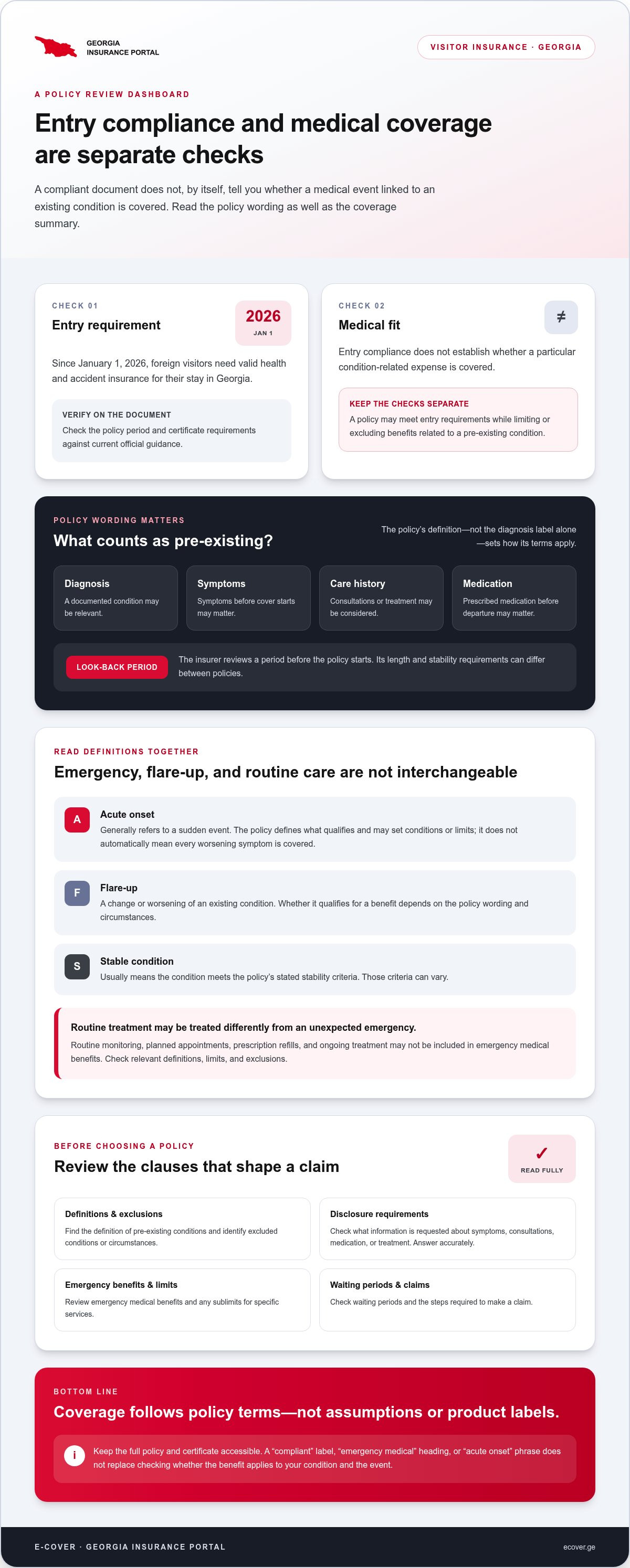
No. As of January 1, 2026, foreign visitors entering Georgia are required to hold valid health and accident insurance. That entry requirement is separate from whether a particular condition-related expense is covered. A policy can meet entry requirements while limiting or excluding benefits related to a pre-existing condition. Likewise, broader medical benefits don’t by themselves establish that a policy’s documents meet the entry rules.
Many policies designed to meet the minimum entry requirement exclude pre-existing conditions, so review the exclusions and benefits instead of relying on a “compliant” label. Check the policy period and certificate requirements against current official guidance before travelling. For a fuller overview of entry rules, consult the related guide to Georgia’s mandatory travel insurance requirements.
In short, pre-existing conditions travel insurance Georgia questions involve two separate checks: whether the insurance satisfies the entry requirement, and whether its terms fit your medical circumstances. Review both before departure.
How policy wording treats pre-existing conditions, flare-ups, and emergencies
A policy may use terms such as “stable condition,” “flare-up,” or “acute onset,” but these labels aren’t interchangeable and don’t have one universal meaning across travel insurance. Exclusions, benefit limits, waiting periods, and eligibility requirements depend on the exact wording. For pre-existing conditions travel insurance Georgia, read the definitions alongside the exclusions. A benefit heading alone doesn’t show whether an event linked to your medical history qualifies.
What is the difference between acute onset and ongoing treatment?
Acute onset generally refers to a sudden event, but the policy defines what counts and may set conditions or limits. It doesn’t automatically mean that every worsening symptom is covered. A flare-up describes a change or worsening of an existing condition, while a stable condition usually means the condition meets the policy’s stated stability criteria. The insurer’s definitions determine how each term applies.
Routine monitoring, planned appointments, prescription refills, and ongoing treatment may be treated differently from an unexpected emergency. Don’t assume emergency medical benefits include routine care, or that an emergency involving a known condition is covered. Check the policy wording for the relevant definitions, limits, and exclusions before relying on a benefit.
Which clauses should travelers read closely?
Read the sections defining pre-existing conditions, identifying excluded conditions or circumstances, and explaining what information you must disclose. Then check emergency medical benefits, any sublimits for specific services, waiting periods, and the steps required to make a claim. If the policy asks about symptoms, consultations, medication, or treatment, answer accurately. Missing or incomplete information could affect a claim under the policy’s terms.
Coverage follows policy terms, not assumptions based on product labels. A phrase such as “emergency medical” or “acute onset” doesn’t replace checking whether a benefit applies to your condition and the event that occurred.
Georgia’s entry requirement is separate from these medical definitions. The U.S. Embassy in Georgia provides information about mandatory travel insurance for Georgia. Meeting the entry requirement doesn’t, by itself, establish that a specific condition-related claim is covered. Review the full wording and keep your policy documents accessible. E-COVER provides online travel medical insurance for visitors to Georgia, with digital certificates for compliant policies. Explore Georgia travel medical insurance online as part of your preparation.
How to compare Georgia travel insurance when you have a medical history
Compare policy documents side by side, rather than comparing only product names or broad benefit headings. For pre-existing conditions travel insurance Georgia, assess entry compliance and medical suitability separately. An entry-compliant certificate addresses a regulatory requirement, but doesn’t establish that a condition-related expense is covered. A policy with medical benefits also needs to meet Georgia’s current entry rules.
Use the same questions for each policy. Record the exact wording and any limits or conditions. If a term or benefit is unclear, mark it as “policy-dependent” rather than assuming it matches another plan. The CDC travel health guidance also supports reviewing policy details as part of trip preparation.
What should a policy comparison table include?
Copy the relevant wording into a comparison like this. Fill in each column from the policy documents, including limits and conditions, rather than relying on a summary or sales label.
| What to compare | Policy A | Policy B |
|---|---|---|
| Condition definition | Exact definition and triggers | Exact definition and triggers |
| Look-back and stability rules | Period and criteria, or policy-dependent | Period and criteria, or policy-dependent |
| Emergency treatment | Covered events, limits, and conditions | Covered events, limits, and conditions |
| Exclusions | Relevant condition and treatment exclusions | Relevant condition and treatment exclusions |
| Claim documentation | Required records and notification steps | Required records and notification steps |
Compare like with like. A benefit for emergency medical treatment isn’t necessarily equivalent to routine monitoring or planned care. Medical benefits are also distinct from trip cancellation, baggage, and other trip-protection benefits. Review each category separately, noting any sublimits, eligibility rules, or claim deadlines.
How do entry compliance and personal coverage needs differ?
Confirm current official entry requirements, including minimum coverage, required dates, and acceptable proof. Requirements can change, so use current official guidance instead of carrying figures over from an older policy summary. Then assess whether the medical terms address your concerns. Neither check replaces the other.
For a separate explanation of entry rules and covered categories, see the guide to what Georgia mandatory health coverage includes. Use it alongside the policy wording: a certificate may demonstrate compliance, while definitions, exclusions, and claim conditions determine how benefits apply to a medical event.
Buying travel insurance with a pre-existing condition
Gathering your health information before comparing policies can make the process clearer and help you answer application questions accurately. For pre-existing conditions travel insurance Georgia, use the insurer’s questions and policy definitions as your guide. Don’t assume every diagnosis must be disclosed in the same way, but don’t omit information the application requests.
- Gather your health details. Make a private, accurate record of diagnoses, current medicines and doses, recent symptoms, consultations, treatment, and relevant dates. Note material changes in your health, such as a new symptom or medication adjustment. The insurer’s questions determine which details are relevant to disclose. You don’t need to share sensitive medical information publicly or provide unrelated details without a reason.
- Review the application questions carefully. Read each question in full and answer using your records. If it asks about symptoms, treatment, or medical advice within a certain period, use the dates to give a complete answer. If a question is unclear, don’t guess or provide an answer you can’t support. Inaccurate or incomplete responses may affect eligibility or how a later claim is assessed under the policy.
- Compare the terms against your needs. Check the policy definition of a pre-existing condition, any stability requirements, exclusions, and rules for emergency treatment. Separate these medical benefits from routine care or planned treatment. A policy label or entry-compliant certificate doesn’t establish how a particular condition-related claim will be treated.
- Check the certificate before departure. Confirm that the insured travelers’ names and travel dates are correct, Georgia is shown as the destination where applicable, and the certificate reflects the policy you purchased. Check the policy period and certificate details against current entry requirements.
- Save the documents where you can reach them. Keep the insurance certificate, full policy wording, emergency contact instructions, and relevant medical records together. Store digital copies on your phone and save accessible offline copies in case you can’t connect to the internet. Know where to find the exclusions and claims sections.
This preparation can’t guarantee that a condition is covered, but it can help you make a more informed decision and keep essential information available if you need medical assistance. Once you’ve reviewed the checklist, view E-COVER travel medical insurance for Georgia and review the applicable policy documents before your trip.
Get Georgia travel medical insurance and review the terms before you travel
A diagnosed condition and a covered claim are not the same thing. A policy assesses an event according to its definitions, exclusions, eligibility rules, and benefit limits. For pre-existing conditions travel insurance Georgia, don’t infer coverage from a diagnosis alone or from a general label such as “travel medical.” Read the terms that apply to the specific medical event you’re concerned about.
How does E-COVER support visitors preparing for Georgia?
E-COVER provides online travel medical insurance for foreign visitors to Georgia. Policies are issued online, and digital certificates are available for policies designed to meet the government requirement effective January 2026. Entry compliance is an important part of trip preparation, but it doesn’t establish that a pre-existing condition or related medical event is covered. That depends on the applicable policy wording.
E-COVER is operated by LLC Insurance Broker WeInsure, licensed by the LEPL Insurance State Supervision Service of Georgia under License N012063. This identifies the company’s licensing status; it isn’t government endorsement of a particular policy or a guarantee that a specific claim will be paid.
What should travelers keep with their policy?
Before departure, compare the certificate with your booking and policy documents. Check that the insured traveler details are accurate and the policy dates match your full planned stay. Review the certificate details against current official entry requirements, which may change.
- Save the insurance certificate in an easy-to-find place on your phone.
- Keep an offline copy in case you can’t access the internet.
- Store the complete policy wording, including definitions, exclusions, and benefit limits.
- Keep emergency instructions and contact details with your policy documents.
Before relying on a specific benefit, check how the wording treats your condition, the circumstances of treatment, and any limits or claim steps. The certificate confirms policy details, while the full terms explain how benefits apply. If you need ongoing medication or have had a recent change in your health, keep relevant records accessible and follow the policy’s instructions for seeking assistance.
Prepare calmly and keep your documents within reach. Arrange travel medical insurance for your Georgia trip, then review the applicable terms and save your digital certificate before you travel.
Prepare your Georgia insurance documents with confidence
A medical diagnosis alone doesn’t determine whether a claim is covered. For pre-existing conditions travel insurance Georgia, the policy’s definitions, exclusions, and benefit limits determine how a particular event is assessed. Review those terms alongside your medical history, and treat entry compliance and benefit suitability as separate checks.
Before departure, check the certificate details and policy dates. Save the certificate, full wording, and emergency instructions where you can access them during your trip. E-COVER provides online travel medical insurance policies for foreign visitors to Georgia, with digital certificates for policies designed to meet the government requirement. E-COVER is operated by LLC Insurance Broker WeInsure, licensed by the LEPL Insurance State Supervision Service of Georgia, License N012063.
Review the applicable policy terms before relying on any specific benefit. Get travel medical insurance for your Georgia trip and keep your documents ready. Clear information and accessible paperwork can help you prepare for your trip.
Frequently Asked Questions
Can I get travel insurance for Georgia if I have a pre-existing condition?
A pre-existing condition doesn’t automatically determine whether an insurer can issue a policy or whether related treatment will be covered. For pre-existing conditions travel insurance Georgia, review the application questions, eligibility rules, exclusions, and any specific emergency provisions. A general emergency medical benefit doesn’t necessarily include treatment connected to your medical history. Read the full policy wording before purchase and answer health questions accurately and completely.
Does travel insurance for Georgia cover pre-existing conditions?
Coverage depends on the policy’s definition, exclusions, eligibility rules, and the circumstances of the medical event. Some policies may provide limited benefits for a sudden emergency involving an existing condition, but that doesn’t mean they cover ongoing treatment, routine monitoring, or known symptoms. Compare the full wording rather than relying on benefit headings or marketing summaries. Don’t assume a benefit applies if the relevant wording doesn’t clearly describe it.
What is acute onset of a pre-existing condition?
Acute onset is a term some policies use for a sudden, unexpected event related to an existing condition. Its definition and limits vary, so it doesn’t automatically mean every flare-up or worsening symptom is covered. Check the policy’s eligibility rules and any applicable age limits, condition restrictions, or emergency requirements. Confirm whether the wording distinguishes an acute event from ongoing treatment or symptoms that began before the trip.
Does Georgia require travel insurance in 2026?
Yes. Georgia requires international travelers to have health insurance starting in January 2026, according to current company information. Before departure, check current official guidance for the rule’s scope, exceptions, and documentation requirements. Make sure your certificate and travel dates meet the applicable requirements. Entry compliance is separate from coverage for treatment related to a pre-existing condition, so review the certificate requirements and full policy terms separately.
Should I disclose a pre-existing condition when buying travel insurance?
Answer every application question accurately and completely. The questions determine which details the insurer needs, so keep diagnoses, medication information, consultations, symptoms, and relevant treatment dates available as you apply. Don’t assume a stable condition is irrelevant if a question asks about it. Incomplete or inaccurate answers may affect eligibility or a later claim under the policy. Share medical information through the application process, not in public forums.
What documents should I carry when travelling to Georgia with a medical condition?
Keep your insurance certificate, complete policy wording, emergency instructions, and relevant medical information accessible during your trip. Store digital copies on your phone and, where practical, keep offline copies in case you can’t connect to the internet. Check that the insured names and travel dates are correct. These documents don’t change coverage exclusions, but they can help you find applicable benefits and follow the insurer’s claims instructions.
Is mandatory travel insurance the same as pre-existing-condition coverage?
No. Mandatory insurance addresses Georgia’s entry requirement, while condition-related benefits depend on the policy’s definitions, exclusions, and terms. An entry-compliant certificate doesn’t by itself show that treatment connected to your medical history is covered. Review current official requirements and the full policy wording separately. Pay particular attention to definitions, emergency benefit limits, and exclusions that may apply to your condition or the circumstances of treatment.


