

What if a medical emergency isn’t the only consequence of arriving in Georgia without insurance? Since January 1, 2026, foreign tourists have been required to hold valid health and accident insurance, and officials may ask for proof at the border. The risks of traveling to Georgia without insurance can include more than unexpected medical bills: travelers who can’t provide the required proof may face a fine or be denied entry.
Visa-free entry and health insurance are separate requirements. An existing health plan only helps if its terms apply to your trip and the care you need. Even a policy that meets Georgia’s minimum requirement may not cover every expense or travel disruption.
This guide explains the practical legal, medical, and financial risks of traveling uninsured in 2026. It covers what to verify before departure, including your policy dates, territory, language, and coverage details, and how to prepare proof in an accepted format. E-COVER provides online policies designed to meet Georgia’s applicable travel insurance requirements, so you can arrange your documentation before you travel.
Key Takeaways
- The risks of traveling to Georgia without insurance include entry-related complications and greater personal exposure to medical costs.
- Travel medical insurance offers protection subject to policy terms. Having a policy doesn’t guarantee payment for every illness, injury, or expense.
- Before departure, review your policy dates, territory, coverage details, and proof requirements so you’re prepared to show your documents if requested.
- Check current Georgian official sources for the insurance rules that apply to your trip, then save your policy documents where you can access them during travel.
- E-COVER issues travel medical insurance policies online for foreign visitors to Georgia, designed to meet applicable government requirements.
Risks of traveling to Georgia without insurance
Meeting Georgia’s insurance requirement and protecting yourself from medical costs are related, but they aren’t the same. A policy may help you meet an entry requirement, while its financial protection depends on the terms, limits, and circumstances of a claim. Without suitable insurance, you could face both a documentation problem and personal responsibility for medical expenses that aren’t covered.
The risks of traveling to Georgia without insurance fall into three categories: legal, because you may not meet the applicable visitor requirement; medical, because illness or injury may require care; and financial, because expenses not covered by a policy may have to come from your own funds.
Could traveling without insurance affect entry into Georgia?
As of January 1, 2026, foreign tourists are required to have valid health and accident insurance under Georgia’s tourism law. Missing or unsuitable proof may create a compliance issue at the border or during travel arrangements, but it shouldn’t be treated as an automatic refusal of entry. Requirements and enforcement can change, so confirm the current rules with relevant official Georgian sources before departure, including which coverage and proof are accepted.
An insurance certificate is not a visa, passport, or substitute for other entry documents. It documents insurance for your stay. Keep it accessible in the required format and check that its details match your travel dates and destination.
What medical and financial exposure can arise?
A sudden illness, an injury during an excursion, or an unplanned medical assessment can disrupt a trip and lead to expenses. If you’re uninsured, you may need to pay eligible charges yourself. If you have a policy, payment still depends on its terms and the circumstances. Having insurance doesn’t guarantee that every service or expense will be covered.
Georgia’s healthcare arrangements may differ from what you’re used to at home. The overview of the healthcare system in Georgia offers background, but it doesn’t confirm that a visitor’s care will be free or covered by public services. Check your own policy and travel documents rather than assuming your home-country arrangements apply.
In brief: Legal risk means possible difficulty showing that you meet the current insurance rules. Medical risk means needing care while away from home. Financial risk means paying expenses yourself when you’re uninsured or when your policy doesn’t cover them.
How can travel insurance help during illness or an emergency in Georgia?
Travel medical insurance provides policy-based financial protection for eligible medical events during a trip. If you become ill or are injured, the policy may help with expenses or explain how to seek assistance, depending on its wording. The process varies: some policies require you to contact an assistance service before arranging care, while others describe how to claim for expenses you’ve already paid.
A policy document can also serve as proof of insurance if it meets Georgia’s current requirements. Keep it accessible and learn how to use it before you need care. The UK government healthcare advice for Georgia notes that UK travelers don’t have a reciprocal healthcare agreement with Georgia, so they should expect to pay for medical treatment. Travelers from other countries should check which arrangements apply to them rather than assume their home coverage extends to Georgia.
What changes when a traveler has a valid policy?
With suitable documentation, you’re better prepared to show that you meet applicable insurance requirements if asked. If an illness or injury falls within your policy, its terms explain which expenses may be considered and whether you need to follow a specific assistance or claims process. A valid policy doesn’t mean every clinic, treatment, or charge is automatically covered.
Before departure, find the policy’s emergency instructions and claims contact details. Save a copy somewhere you can access without an internet connection, and make sure anyone traveling with you can find the insurer’s guidance if they need to help.
What insurance cannot guarantee
Coverage depends on the policy’s limits, exclusions, eligibility rules, and claim conditions. For example, the wording may set requirements for how and when you report an incident or submit supporting documents. Read those instructions before traveling, and follow the stated assistance process if you need help. If a situation is urgent, prioritize appropriate medical care while following the policy’s instructions as soon as circumstances allow.
Insurance can’t prevent an illness or accident, guarantee a particular medical outcome, or ensure reimbursement for every expense. It can reduce financial exposure, but it doesn’t remove travel risks. That distinction matters when weighing the risks of traveling to Georgia without insurance: a policy may provide financial protection for eligible events, but that protection is always subject to its terms.
Visitors preparing their documentation can obtain E-COVER travel medical insurance for Georgia online. E-COVER’s policies are designed to meet applicable government requirements. Review the policy wording and keep the issued documents accessible before departure.
Traveling insured versus uninsured: what practical differences matter?
Insurance doesn’t guarantee an easy trip. A policy can provide documentation and instructions to follow if something goes wrong, while traveling without one may leave you without either. The comparison below is general: outcomes depend on Georgia’s current requirements, your policy wording, and your circumstances.
| With compliant insurance | Without a policy |
|---|---|
| You can present policy documentation if requested, provided it meets the current requirements. | You have no insurance evidence to present, which may create a compliance issue if proof is required. |
| You can refer to the policy for assistance instructions and claims procedures. | You’ll need to arrange next steps without instructions from a travel insurer. |
| Eligible expenses may be considered under the policy, subject to its terms and claims process. | You may need to meet eligible medical expenses yourself. |
| You can check policy details and emergency contacts before departure. | You won’t have policy guidance or insurance-based financial protection for the trip. |
Before departure: proof and preparation
A policy is useful for compliance only if it meets the rules in force for your trip. Check current requirements through official Georgian sources, then review the document for accurate traveler details, destination, and coverage dates, including your full stay in the country. Confirm which document formats are accepted instead of assuming a digital or printed copy will meet the rules.
For a fuller explanation of the entry requirement, see Mandatory Georgia Travel Insurance: 2026 Entry Guide. Keep any required proof accessible, and retain a separate copy in case you can’t reach the original file.
If a medical issue happens during the trip
With insurance, consult the policy to find out whether you should contact an assistance service, what information to collect, and how to submit a claim. A traveler without insurance must make arrangements independently and may have to pay eligible care expenses personally. Neither situation guarantees a particular provider, treatment, payment method, or outcome.
In short, the risks of traveling to Georgia without insurance include having no policy evidence to present and no insurance-based support for eligible expenses. Before you leave, confirm that your documents fit current requirements and understand the procedures in your policy.
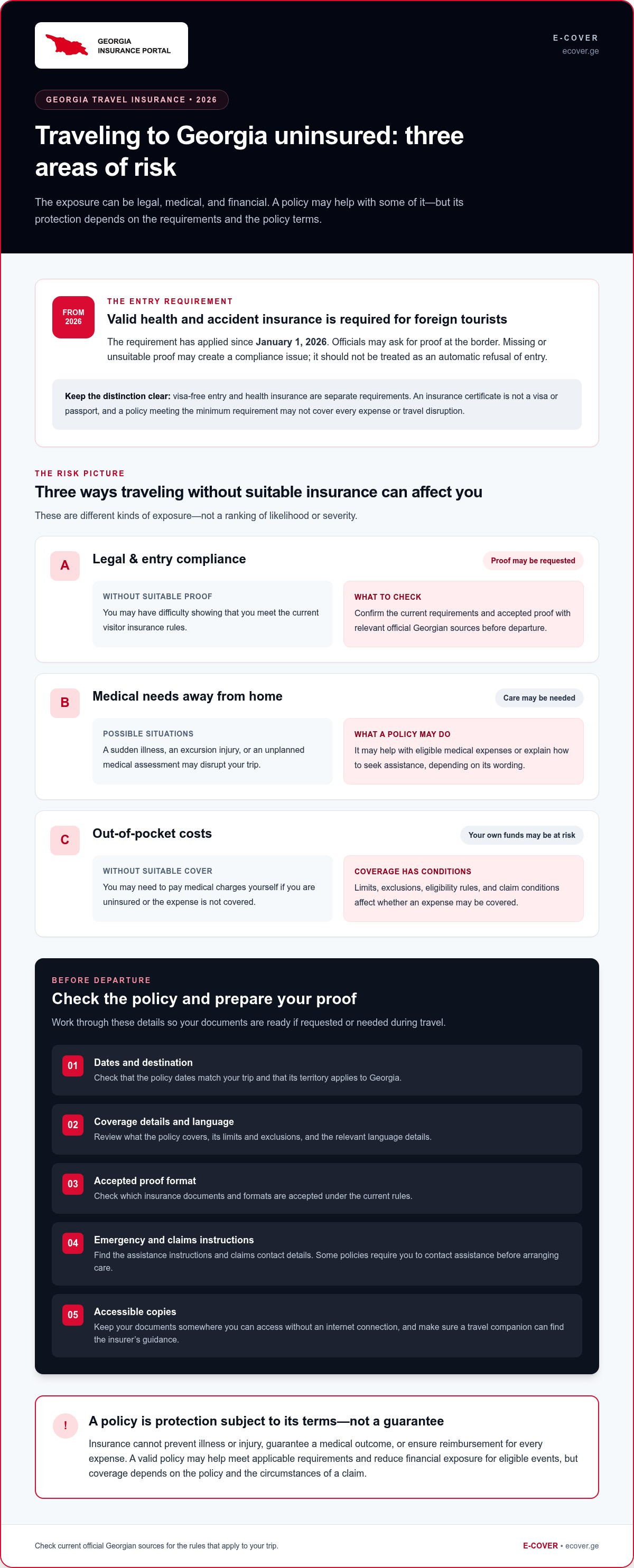
How to reduce uninsured travel risks before and during your trip
Preparation makes it easier to show your insurance documents and follow the right steps if you need medical care. Rules and acceptable proof can change, so use current official Georgian sources rather than relying only on old travel advice. This checklist can help you avoid preventable problems, but it can’t prevent an emergency or guarantee that a policy will cover every expense.
A pre-departure insurance checklist
- Verify the current rules. Before departure, check the applicable insurance requirement, when coverage must begin and end, and what proof is accepted through relevant official Georgian sources. For updates and background, see Georgia Mandatory Insurance Law: 2026 Requirements for International Visitors.
- Review your policy document. Check that traveler names and other details are accurate, the insured dates cover your full stay, and the policy applies to your destination. Read the wording to understand covered events, limits, exclusions, and any steps required to request assistance or make a claim.
- Save accessible copies. Keep a digital copy of the policy and related documents somewhere you can reach while traveling. Save an offline copy in case you can’t connect to the internet. Confirm that the document format you plan to present meets current official requirements.
- Locate the assistance details. Before you leave, find the insurer’s contact information and instructions in the policy. Make sure a travel companion can access them if you need help.
What to do if you need medical help
If you need immediate help, prioritize appropriate emergency care and follow local emergency instructions. Once the urgent situation is addressed, use the assistance channel and process described in your policy. Don’t assume you can choose any facility and have every expense covered. Support, payment arrangements, and reimbursement depend on the policy and its terms.
When contacting the insurer, have key details ready, such as your name, policy number, current location, a brief description of what happened, and the medical provider’s name if available. Keep relevant medical records, invoices, and receipts, then follow the policy’s instructions about what to submit and when. These records can help document the event, but they don’t guarantee a claim will be paid.
These steps can reduce the practical risks of traveling to Georgia without insurance by helping you check requirements and prepare to use your coverage. To arrange travel medical insurance documentation online, get an E-COVER policy for Georgia.
Meet Georgia's insurance requirement with an online E-COVER policy
After checking the current entry rules and considering the limits of insurance protection, arranging the required documentation is a practical next step. E-COVER provides online travel medical insurance policies for foreign visitors to Georgia. Its policies are designed to meet applicable government requirements. Compare the issued policy with current official rules and read its terms before relying on it.
Insurance can help with compliance and may provide financial protection for eligible events, subject to the policy wording. It can’t prevent an illness or injury, guarantee entry, or ensure that every expense will be covered. Preparing carefully helps address the risks of traveling to Georgia without insurance without treating a policy as a guarantee against every travel problem.
What to prepare before obtaining a policy
Have accurate traveler and trip information ready for the online application. Check each traveler’s details carefully, and make sure the requested coverage dates match the intended period in Georgia. An incorrect name or date could raise questions about whether the document applies to your trip.
After the policy is issued, review the documentation rather than simply saving the first confirmation you receive. Check the insured details, dates, covered territory, and policy wording. Keep a copy somewhere accessible during travel, including an offline version if possible. Confirm through official Georgian sources that the policy documentation and terms align with the requirements in force for your visit.
A clear next step for visitors to Georgia
Before departure, verify the latest rules and avoid traveling without valid insurance if it’s required for your circumstances. For broader visitor information, consult Health Insurance for Tourists in Georgia: 2026 Guide. E-COVER issues policies online for international visitors, making it possible to obtain documentation before setting out. Its parent company, LLC Insurance Broker WeInsure, is licensed by Georgia’s Insurance State Supervision Service under License N012063.
Review the policy’s conditions, dates, and documents once issued. When you’re ready to prepare your insurance documentation, obtain a travel medical insurance policy through E-COVER. A policy designed to meet applicable requirements is a practical part of trip preparation, not a promise of entry or payment for every claim.
Prepare your insurance documents before you travel
The risks of traveling to Georgia without insurance can involve more than paying medical expenses yourself. Missing or unsuitable documentation may also create a compliance problem, while a valid policy can provide proof and guidance for eligible events, subject to its terms. Before departure, verify current official requirements, check your policy dates and details, and keep the documents easy to access.
E-COVER provides online policy issuance for international visitors to Georgia, with policies designed to meet applicable government requirements. Review the wording and issued documents before relying on a policy. E-COVER’s parent company, LLC Insurance Broker WeInsure, holds Georgian Insurance State Supervision Service License N012063.
Take this practical step before your trip: Get your Georgia travel medical insurance online with E-COVER. With your requirements checked and documents prepared, you can set out with greater confidence and focus on enjoying your time in Georgia.
Frequently Asked Questions
Is travel insurance mandatory for visitors to Georgia in 2026?
Yes, foreign tourists generally need valid health and accident insurance for Georgia in 2026. The requirement took effect on January 1, 2026, and applies even to visitors who can enter visa-free. Certain categories may be exempt, so check current official Georgian sources to see whether an exception applies to you. Before departure, verify the required coverage, dates, and accepted proof rather than relying on an older policy or travel advice.
What happens if I arrive in Georgia without valid travel insurance?
Arriving without required insurance or acceptable proof may create a compliance problem. Border officials may request evidence, and consequences can include a fine or possible refusal of entry, but neither outcome should be assumed in every case. The risks of traveling to Georgia without insurance depend on current rules and your circumstances. Check official Georgian sources before departure, and don’t treat a visa or passport as a substitute for insurance documentation.
Can I travel to Georgia using insurance from my home country?
Possibly. A policy from your home country can be suitable if it meets Georgia’s current requirements and covers your entire stay. Check that it includes the required health and accident coverage, applies in Georgia, and shows accurate traveler details and dates. Confirm that its language and proof format are accepted under current rules. Don’t assume that a general health plan or travel benefits card automatically satisfies the requirement.
What medical costs could I face in Georgia without insurance?
Without insurance, you may have to pay eligible medical expenses yourself. These could arise from an unexpected illness, an injury, a doctor’s assessment, diagnostic tests, or further treatment recommended by a medical professional. The cost depends on the care you need and the provider. Don’t assume that your home-country healthcare arrangements apply in Georgia. Review your existing coverage before traveling so you understand what, if anything, it may pay for abroad.
Does travel insurance cover every illness or accident in Georgia?
No. Coverage depends on the policy’s terms, including its limits, exclusions, eligibility rules, and claim conditions. A policy may consider eligible expenses for a covered illness or accident, but it doesn’t guarantee payment for every treatment, provider, or charge. Read the wording before departure and note whether you must contact an assistance channel before arranging care. Insurance can reduce financial exposure, but it can’t prevent an incident or guarantee a medical outcome.
Can I buy travel insurance for Georgia shortly before departure?
You can obtain travel medical insurance online through E-COVER, which issues policies for foreign visitors to Georgia. If you’re buying close to departure, allow time to review the policy and issued documents before traveling. Check that the traveler details and coverage dates are correct and that the policy aligns with current official requirements. Don’t assume coverage applies before its stated start date or that buying a policy guarantees entry or claim approval.
What should I do if I need medical help in Georgia without insurance?
If you need urgent care, prioritize medical help and follow local emergency instructions. Without insurance, you may need to arrange payment yourself, so ask the provider about its payment process when you’re able. Keep medical records, prescriptions, invoices, and receipts, and retain copies of any documents about the care you receive. If you have another form of assistance or coverage, review its instructions and contact channel, but don’t delay urgent care to do so.


