

Does working remotely from Georgia mean you need a special visa, or does visa-free entry settle everything? Choosing insurance for remote work visa Georgia starts with separating two questions: which immigration route applies to you, and what insurance that route requires. Your nationality, length of stay, and work arrangement can all affect what you need to verify.
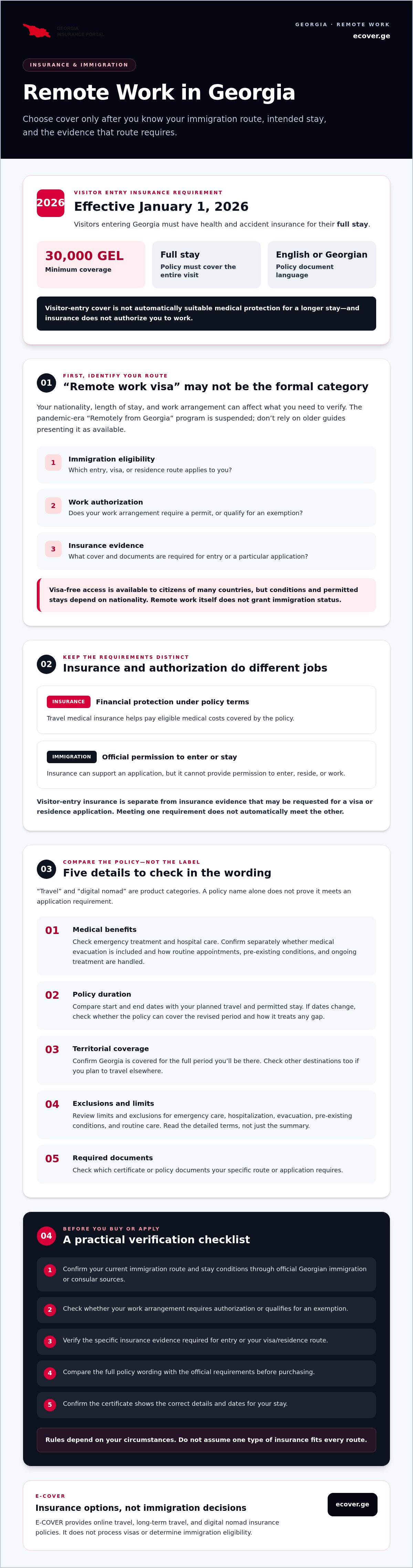
It’s understandable to assume one travel policy will cover every stage of a stay. But from January 1, 2026, visitors entering Georgia must have health and accident insurance for their full stay, with at least 30,000 GEL in coverage and a policy document in English or Georgian. Entry cover may not be suitable medical protection for a longer stay, and insurance doesn’t determine whether you’re authorized to work.
This 2026 guide explains how to check official immigration requirements for your circumstances, distinguish visitor insurance from longer-term cover, and compare policy duration, exclusions, territorial coverage, and documents. You’ll also find practical checks to make before buying a policy or submitting an application, so you can assess your options without assuming one type of insurance fits every route.
Key Takeaways
- “Remote work visa” may not be your formal immigration route. Confirm the route that applies to your nationality, stay, and work arrangement through official sources.
- Choose insurance for remote work visa Georgia by checking policy duration, territorial coverage, exclusions, medical benefits, and the documents your application requires.
- Don’t assume visitor travel insurance will satisfy a longer-term visa or residence application. Verify the specific evidence required for that route.
- Before buying cover, compare the policy wording with official requirements and confirm the certificate shows the correct details for your stay.
- E-COVER provides online travel, long-term travel, and digital nomad insurance policies, but it doesn’t process visas or determine immigration eligibility.
Insurance for a Remote Work Visa in Georgia: Start with the Right Immigration Route
“Remote work visa” is often used informally, but it doesn’t necessarily name a Georgian visa category. Georgia’s pandemic-era “Remotely from Georgia” program is suspended, so don’t rely on old guides that describe it as an available route. First establish how you can enter and stay, and whether your work arrangement requires separate authorization. The right insurance for remote work visa Georgia depends on those answers, not just on your job title.
Keep three questions separate:
- Immigration eligibility: Which entry, visa, or residence route applies to you?
- Work authorization: Does your work arrangement require a permit or qualify for an exemption?
- Insurance evidence: What cover and documents are required for entry or for a particular application?
Visa-free access is available to citizens of many countries, but permitted stays and conditions depend on nationality. The Visa policy of Georgia offers a high-level overview. Confirm your current eligibility and stay limits with Georgia’s official immigration or consular sources before making plans. Remote work itself doesn’t grant immigration status.
Does Georgia have a specific remote work visa?
Don’t assume that “remote work visa” is an official application category. Check the current route and terminology with Georgian authorities, including the Ministry of Foreign Affairs or the relevant immigration service. Rules may depend on your nationality, intended stay, and application type. If your work may require a permit, check the official labour migration portal at labourmigration.moh.gov.ge. Insurance can support an application, but it cannot provide permission to enter, reside, or work.
Why insurance requirements depend on your status
A short visit and a longer stay can call for different cover. Visitor-entry insurance is separate from any insurance evidence requested for a visa or residence application. Meeting one requirement doesn’t automatically meet the other. In 2026, Georgia also introduced work-permit rules and later exemptions for certain services performed for non-residents in connection with operations outside Georgia. Check whether an exemption applies to your situation rather than assuming all remote workers are treated alike.
Travel medical insurance helps pay eligible medical costs under the policy; visa or residence authorization is official permission to enter or stay. One is financial protection, while the other is an immigration decision. For entry-specific coverage details, see the guide Mandatory Georgia Travel Insurance: 2026 Entry Guide. Then verify any route-specific insurance evidence before purchasing or applying.
What Remote Workers Should Compare in Georgia Insurance Policies
Once you know your immigration route and intended stay, compare the policy itself, not just its marketing label. “Travel” and “digital nomad” describe product categories, but they don’t show whether the coverage or documents match a particular application. A policy name alone doesn’t prove that the policy meets an application requirement. Check the current official rules alongside the full policy wording before you buy.
Medical benefits: Check what the policy says about emergency treatment and hospital care. Confirm separately whether medical evacuation is included, and how routine appointments, pre-existing conditions, and ongoing treatment are handled. These benefits may be limited or excluded, so review the specific terms.
Policy duration: Compare the start and end dates with your planned travel and permitted stay. If your dates change, check whether the policy can cover the revised period and what the wording says about any gap in coverage.
Territorial coverage: Confirm that Georgia is covered for the full period you’ll be there. If you’ll travel elsewhere, check whether those destinations are included too.
Exclusions and limits: Review exclusions and benefit limits, especially for emergency care, hospitalization, evacuation, pre-existing conditions, and routine care. Don’t assume a broad phrase in a summary overrides the detailed terms.
Required documents: Check which certificate or policy document is issued, which languages are accepted for your application, and whether the document shows the details authorities may need to see.
Check the wording and certificate together
Before applying or travelling, check that the insured names match your identity documents and that the certificate shows accurate dates, territory, and coverage details. Compare those details with the official requirements for your route. The certificate can summarize a policy, but the wording sets out its coverage and exclusions.
For a broader policy-selection overview, see Digital Nomad Insurance for Georgia: 2026 Buying Guide. You can also review E-COVER’s online insurance options after confirming what your circumstances require. E-COVER provides travel, long-term travel, and digital nomad insurance. It doesn’t process visas or confirm that a policy will be accepted for a specific application.
Will Travel Insurance Meet Georgia Visa or Residence Requirements?
Not necessarily. A travel insurance policy may provide useful medical protection and may meet a visitor-entry requirement, but that doesn’t automatically make it acceptable evidence for a visa or residence application. Treat these as separate checks: confirm the insurance rule for entry, then find out what the authority handling your application requires.
For entry, the U.S. Embassy in Georgia announced that from January 1, 2026, foreign tourists and visitors must have health and accident insurance covering their full stay, with at least 30,000 GEL in coverage and documents in English or Georgian. Check current official guidance to confirm how the mandate applies to your circumstances. For more detail, consult Georgia Mandatory Insurance Law: 2026 Requirements for International Visitors.
Entry insurance is not automatically visa evidence
Border-entry rules and application rules may require different coverage, policy periods, or proof. For example, a certificate that meets the entry rule may not satisfy a residence application that specifies other evidence. Don’t infer acceptance from the policy category or entry requirements alone. Ask the relevant Georgian authority what it requires for your route, then compare that information with the policy wording and certificate.
Compare cover against your stay and healthcare needs
The policy category to investigate depends on how long you plan to stay and what medical protection you need. Use these descriptions as starting points, not legal determinations:
| Policy category | May suit | Verify before relying on it |
|---|---|---|
| Visitor travel insurance | A trip or shorter stay | Full-stay dates, required entry benefits, minimum coverage, and accepted certificate language |
| Long-term travel insurance | An extended trip or longer time abroad | Maximum policy duration, renewal terms, territorial scope, exclusions, and any application-specific evidence |
| Digital nomad insurance | A remote worker comparing cover for an extended stay | Whether the policy’s actual benefits, dates, and documents meet the relevant official requirements |
| Locally required health coverage | Applicants whose route specifies a particular form of health cover | Which type of coverage is required, who may provide it, and what proof the authority accepts |
Long-term or digital nomad cover may be worth comparing if a short-trip policy doesn’t match your intended stay or healthcare needs. Neither label establishes compliance. If the rules are unclear, request written confirmation from the authority handling your application and ask the insurer to explain the relevant policy terms in writing. This helps you assess insurance for remote work visa Georgia without treating entry cover as a universal solution.
How to Verify Your Policy Before Applying or Travelling
Use this checklist before buying cover or submitting an application. Start with the official requirements for your immigration route, then check that the policy and its documents match. This helps you identify gaps before you rely on a policy label or a general summary.
A practical policy verification checklist
- Confirm your route. Check with the Georgian authority responsible for your entry, visa, or residence process. Verify which requirements apply to your nationality, application type, and intended stay.
- Record the required insurance evidence. Find out whether you need insurance, the period it must cover, any required benefits or minimum limits, and which document or language the authority accepts.
- Match the dates. Compare your planned travel and permitted stay with the policy’s effective dates. Check for gaps, including time before coverage begins or after it ends.
- Check the insured details and territory. Make sure the certificate identifies the correct insured person and confirms coverage in Georgia for the relevant dates. Check other destinations too if your plans include travel outside the country.
- Read benefits and exclusions. Compare the policy wording with the official requirements. Review emergency care, hospitalization, evacuation, pre-existing conditions, routine care, and ongoing treatment rather than assuming these are included.
- Review the certificate. Confirm that names, dates, territory, and coverage details are accurate, and that its language and format meet the authority’s instructions.
- Keep your records together. Save the full policy wording, certificate, payment confirmation, and insurer contact details. Keep copies accessible when travelling or submitting documents.
What to do if the requirements are unclear
If an official page doesn’t answer a specific question, contact the authority handling your route and ask which policy features and documents it accepts. Be specific about the coverage period, benefits, limits, and certificate language. Keep the response for reference.
Ask the insurer to clarify uncertain policy terms in writing. If the certificate doesn’t clearly show territorial coverage or policy dates, for example, request confirmation or corrected documentation before relying on it. An insurer can explain its coverage, but that response isn’t immigration approval. Only the relevant authority can clarify application requirements.
After confirming what you need, review E-COVER’s online insurance options and compare the available policy wording and documents with your checklist. E-COVER provides travel, long-term travel, and digital nomad insurance, not visa processing or immigration advice. Recheck the official requirements and policy details before you apply or travel.
Choosing Online Insurance for Remote Work in Georgia
Choosing cover is easier when you follow the right order. Confirm your immigration route with the relevant official authority, decide how long you plan to stay, compare policy benefits and exclusions, then check that the certificate and wording match the requirements. This helps you choose insurance for remote work visa Georgia based on your circumstances rather than assuming a product label guarantees acceptance.
When E-COVER may fit your insurance search
E-COVER provides digital nomad and long-term travel insurance for foreign visitors to Georgia. Its online platform can issue policies and certificates, giving you a way to arrange insurance after identifying the cover and documents you need. Before purchase, review the current policy wording, territorial coverage, duration options, exclusions, and certificate details. For more points to consider when comparing cover, see Digital Nomad Insurance for Georgia: 2026 Buying Guide.
Keep the roles clear: E-COVER sells insurance, not visa processing or immigration advice. An online certificate documents insurance. It doesn’t confirm that you’re eligible for a particular route or that an authority will accept the policy for an application. Verify those matters through official sources.
Your next steps before purchase
Before completing an insurance purchase, work through these checks:
- Confirm the official requirement. Check the current instructions for your route and note the insurance period, benefits, limits, and evidence requested.
- Match the policy to your needs. Compare available coverage with your intended stay and healthcare needs. Review emergency benefits, exclusions, and any terms for pre-existing conditions or routine care.
- Check the dates and details. Make sure the insured names and coverage dates are correct, and verify that Georgia is included for the period you need.
- Review the documents. Confirm the certificate contains the details required by the authority and is in an accepted language. Keep the certificate and complete policy wording for reference.
- Resolve gaps before relying on cover. Ask the insurer to explain unclear policy terms. If you’re unsure whether the policy meets an application rule, ask the responsible official authority. An insurer’s explanation is not immigration approval.
Once you’ve confirmed your route and requirements, compare E-COVER’s online travel, long-term travel, and digital nomad insurance options against your checklist. Explore E-COVER insurance options, and verify current official requirements and policy details before relying on a policy for travel or an application.
Prepare Your Georgia Stay with the Right Cover
The right insurance for remote work visa Georgia starts with confirming your immigration route, not choosing a policy by its label. Check official requirements for your circumstances, then compare the coverage period, benefits, exclusions, territorial scope, and required documents. Entry insurance and evidence for a visa or residence application may serve different purposes, so verify each separately.
E-COVER offers online travel medical, long-term travel, and digital nomad insurance policies, with digital policy access. Before relying on an option, review its current terms and confirm certificate availability and details. E-COVER provides insurance, not visa processing or immigration approval.
Once you’ve confirmed your requirements, explore E-COVER insurance options for Georgia and compare the policy wording with your needs before purchase. Prepare your documents and check the details before you travel or apply.
Frequently Asked Questions
Does Georgia have a remote work visa?
The former “Remotely from Georgia” program is suspended, so don’t rely on older articles presenting it as an active route. “Remote work visa” may be informal wording rather than the name of a current visa category. Your options depend on factors such as nationality, intended stay, and work arrangement. Check current visa, residence, and work authorization rules with the relevant Georgian authorities before travelling or applying.
Do I need health insurance for a remote work visa in Georgia?
Visitors entering Georgia have been required to hold health and accident insurance since January 1, 2026, subject to how the rule applies to their circumstances. That entry requirement is separate from any insurance evidence requested for a visa or residence application. Confirm both sets of requirements through official sources. The right insurance for remote work visa Georgia depends on your route, planned stay, and the documents the authority requires.
Can travel insurance satisfy a Georgia visa or residence application?
It may, but don’t assume it will. A policy that provides visitor-entry cover doesn’t automatically meet the evidence requirements for a separate visa or residence application. Check the official instructions for your route, then compare them with the policy wording and certificate, including dates, territory, benefits, and any specified limits. If the instructions are unclear, ask the authority handling the application and request clarification from the insurer.
What insurance should a remote worker compare for a longer stay in Georgia?
Compare policies based on your intended stay and healthcare needs, not just labels such as “travel” or “digital nomad.” Review maximum duration, territorial coverage, emergency medical benefits, hospitalization, exclusions, and terms for pre-existing conditions, routine care, and ongoing treatment. Check whether the policy can cover your planned dates and whether its certificate provides the evidence your route requires. Long-term or digital nomad cover may be options to assess, not automatic immigration solutions.
Does Georgia’s 2026 visitor insurance requirement apply to remote workers?
The requirement applies to foreign tourists and visitors entering Georgia, including people travelling for remote work, according to the current guidance. From January 1, 2026, the policy must cover the full stay, provide at least 30,000 GEL in health and accident coverage, and be in English or Georgian. Check official guidance before travelling to confirm how the requirement applies to your circumstances and which documents to carry.
What documents should I check on my insurance certificate?
Check that the certificate shows the insured person’s name correctly, the policy’s start and end dates, territorial coverage, and relevant coverage details. Confirm that its language and format meet the instructions for your entry or application. Keep the full policy wording too, since the certificate may not show every exclusion or condition. Save your payment confirmation and insurer contact details, and request corrections before relying on inaccurate documents.


