

The insurance that suits a short visit may not fit a teaching stay. If you’re choosing health insurance for teaching English in Georgia, consider your work arrangement, eligibility, and how long you’ll remain before deciding what type of cover to investigate.
Meeting an entry requirement doesn’t automatically mean a policy covers paid teaching or all the healthcare you may need. Visitor medical insurance, longer-term travel cover, student insurance, and employer-arranged insurance can have different eligibility rules, benefits, and exclusions.
This guide compares those options and explains what to check before you buy. Use your teaching plans and expected stay dates to review eligibility, coverage dates, benefits, exclusions, territory, and certificate details. Check current Georgian requirements for your specific status before you travel, start work, or extend your stay. Online visitor and long-term travel policies may be worth reviewing, but read the policy wording and confirm it fits your circumstances before relying on one.
Key Takeaways
- Your teaching arrangement and expected stay length help determine which type of cover to investigate.
- Compare travel medical, student, long-term travel, and employer-arranged cover by intended use, eligibility, and policy terms.
- For health insurance for teaching English in Georgia, check whether paid teaching affects eligibility rather than assuming visitor cover applies.
- Before choosing, confirm your coverage dates, benefits, exclusions, territory, and required certificate details.
- E-COVER describes its visitor policies as meeting Georgian state requirements from January 2026. Check the current scope and whether a policy fits your circumstances.
Health insurance for teaching English in Georgia: why your situation matters
“Health insurance for teaching” can mean several different arrangements. A teacher visiting Georgia briefly, staying for an extended period, or working under an employment arrangement may need to investigate different types of cover. The relevant option depends on your status, the policy’s eligibility rules, and any requirements that apply to your circumstances.
Separate two questions: what insurance, if any, applies to your entry status, and what cover suits your healthcare needs during your stay. An entry-compliant certificate doesn’t automatically meet an employer’s requirements or confirm that every treatment you might need is covered. For background on how care is organized in the country, see this overview of Healthcare in Georgia.
Check current official information to understand Georgia’s visitor-insurance requirements and how they apply to different statuses. Don’t assume a rule for visitors applies in the same way to someone studying, working, or residing in the country.
Does teaching English make visitor insurance unsuitable?
There isn’t a universal yes or no. A visitor policy’s suitability depends on its wording and your circumstances. Ask the insurer whether paid teaching, an extended stay, or other planned activities affect eligibility. If the policy terms aren’t clear, request written confirmation. Even if a certificate meets an entry requirement, that alone doesn’t confirm cover for all medical needs or work-related circumstances.
Visitor cover, student cover, and longer-term insurance
Travel medical insurance is generally visitor-oriented, but benefits, eligibility, coverage dates, and exclusions vary by policy. Student and long-term insurance are categories to investigate if you’re studying or staying longer; neither is automatically right for a teacher. If you’ll study as well as teach, review the student health insurance requirements guide and confirm how its information applies to your status.
For a practical comparison, write down your planned activities, expected stay dates, and any requirements shared by an employer or educational institution. Check each policy against those details. Confirm whether teaching is permitted, which medical services are included, where the cover applies, and whether the certificate meets any relevant current requirement. The phrase health insurance for teaching English in Georgia doesn’t point to one standard policy. Your circumstances and the policy wording determine what to consider.
What health insurance options can English teachers in Georgia compare?
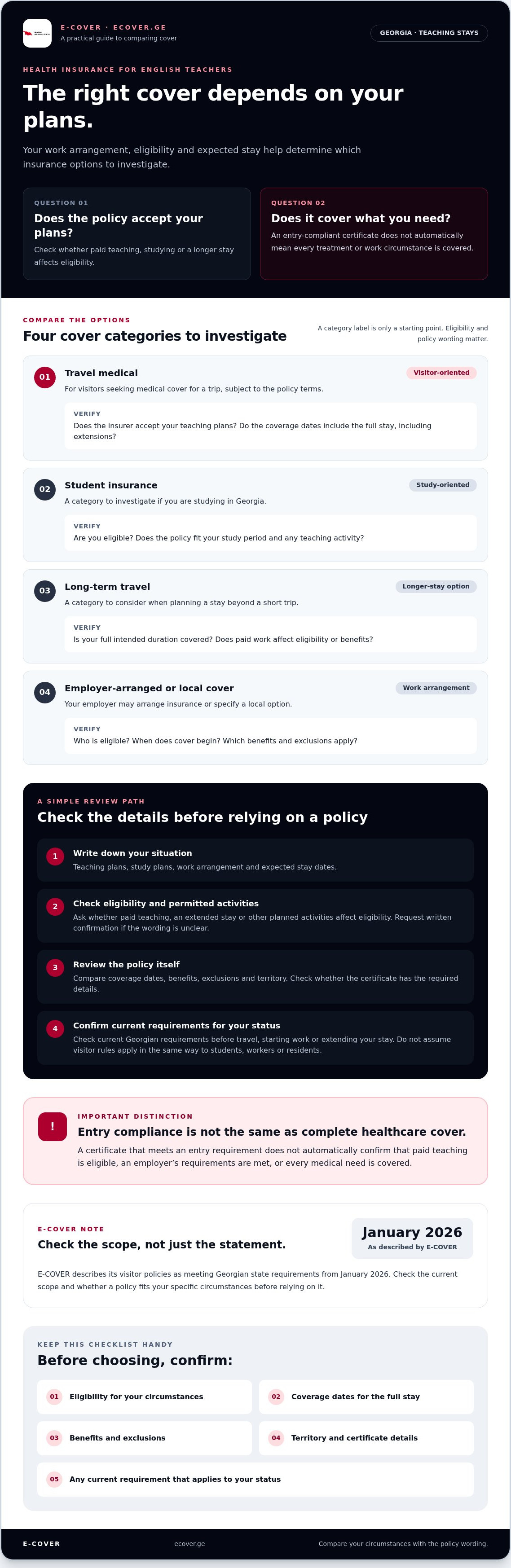
Compare cover by its intended use, not just its label. Travel medical, student, long-term travel, and employer-arranged insurance each raise different questions. As a starting point, check whether you’re eligible, how long you need cover, and which benefits the policy includes.
| Cover category | Intended user and likely use | Questions to verify |
|---|---|---|
| Travel medical | Visitors seeking medical cover for a trip, subject to policy terms | Does the insurer accept your teaching plans? Do dates cover the full stay, including extensions? |
| Student insurance | People studying in Georgia who need to investigate student-oriented cover | Are you eligible, and does the policy fit your study period and any teaching activity? |
| Long-term travel | People planning a longer stay who need cover beyond a short trip | Is your full intended duration covered? Does paid work affect eligibility or benefits? |
| Employer-arranged or local cover | Teachers whose employer may arrange insurance or specify a local option | Who is eligible, when does cover begin, and what benefits and exclusions apply? |
This comparison is a starting point, not confirmation that a category is available to you. Ask your employer what cover it provides and request the details in writing. If a local arrangement or authority requirement may apply, confirm it with the relevant employer or authority rather than assuming travel insurance replaces it. The U.S. Embassy health information for Georgia provides practical context on medical care for foreigners, including facility access and payment expectations.
When might travel medical insurance be worth considering?
It may be worth reviewing if you’re a visitor and the policy accepts your circumstances. Check that its coverage dates match your entire journey, including any planned extension, and ask whether teaching affects eligibility. For an overview of visitor rules, read the mandatory Georgia travel insurance entry guide. Verify current official requirements separately for your status.
When should teachers investigate longer-term or employer cover?
If your stay extends beyond a visit, compare long-term options and ask insurers whether paid teaching changes eligibility. If you’ll work remotely rather than teach under a local employment arrangement, your circumstances may differ; review the digital nomad insurance buying guide for that situation. You can also review E-COVER travel insurance options if visitor or long-term travel cover may suit your plans. Check the policy wording before deciding.
Does Georgian visitor insurance meet an English teacher's needs?
It may, but an entry requirement and a teacher’s full insurance needs are separate questions. A policy could meet an applicable visitor requirement while not covering paid teaching, the full length of your stay, or particular medical services. Check the exact policy terms and confirm which current official rules apply to your status. Don’t assume every teacher or residence category follows the same rules.
An insurance certificate can document that a policy was issued; it doesn’t, by itself, show that every treatment or work-related circumstance is covered. The certificate and policy wording serve different purposes, so review both. The UK government healthcare advice offers further context for visitors planning how they’ll meet potential medical costs.
Visitor cover may be useful if you’re eligible and its dates and benefits fit your plans. It may be unsuitable if the policy excludes your activities, ends before your stay does, or lacks benefits you need. Don’t judge suitability by the policy label alone.
What should teachers check in the policy wording?
Read the full policy document, not just a summary or certificate. Check eligibility, the insured territory, start and end dates, and any restrictions related to work or other activities. Review covered emergency treatment, exclusions, claims procedures, and the documents you may need to submit. Note each benefit limit and exclusion, then ask the insurer how it applies to your circumstances if the wording is unclear.
What the 2026 visitor requirement does, and doesn’t, answer
E-COVER describes its visitor policies as meeting Georgian state requirements applicable from January 2026. That doesn’t replace checking current official guidance, including whether the requirement applies to your status. Don’t infer that visitors, teachers, students, and people with residence arrangements all follow identical rules. For broader visitor context, see the Georgia mandatory insurance law requirements.
Before relying on a policy, check its eligibility rules, coverage dates, benefits, exclusions, and certificate details against the current wording. Verify any separate requirements with your employer or the relevant authority. This is especially important if you’ll be teaching for pay or staying beyond the period covered by a visitor policy. These checks help you assess both whether a policy satisfies an applicable entry rule and whether its protection suits your plans for health insurance for teaching English in Georgia.
How to choose health insurance before teaching English in Georgia
Use a consistent comparison process before buying. For health insurance for teaching English in Georgia, be ready to explain your plans to an insurer or employer, especially if paid teaching could affect eligibility. Check current official guidance for rules that apply to your status rather than relying on older articles or informal advice.
A five-step insurance comparison checklist
- 1. Define your status. Record whether you’re visiting, studying, staying long term, or teaching under an employment arrangement. Note other planned activities that could affect policy eligibility.
- 2. Confirm your dates. Write down your intended arrival and departure dates, plus any likely extension. Check for gaps between your travel dates and the policy’s start and end dates.
- 3. Check other cover first. Ask your employer, university, or another relevant organization whether it provides insurance, who qualifies, and when cover begins. Request the details in writing.
- 4. Compare policy terms. Review eligibility, benefits, exclusions, insured territory, claims process, and certificate availability. Compare the policy documents, not just product labels.
- 5. Keep the records. Save the policy wording, insurance certificate, insurer’s written answers, and relevant employer information where you can access them during your stay.
Documents and questions to prepare before purchase
Have your travel dates and accurate details about your plans ready when you contact an insurer. Ask directly: “Does teaching English, including paid teaching, affect my eligibility or cover?” If the answer is unclear, request written confirmation that addresses your circumstances. If employer insurance may apply, ask about its start date and who is covered.
Before relying on a certificate, check that its dates match your intended stay and that the policy wording supports your planned activities. Keep emergency contact details and instructions for making a claim with your documents. If you extend your stay or your work arrangement changes, contact the insurer or employer to check whether your cover remains suitable. Don’t assume an extension or change is automatically included.
Once you’ve defined your needs, you can review E-COVER visitor and long-term travel insurance options if that type of cover may fit. Check eligibility, coverage dates, benefits, and exclusions in the current policy wording before choosing.
How E-COVER may help teachers arrange Georgia travel medical insurance
E-COVER provides online travel medical insurance for foreign visitors to Georgia. Its visitor policies are described as meeting Georgian state requirements applicable from January 2026. Treat this as a starting point for review, not confirmation that a policy fits every traveler or teacher. Check current official guidance to understand the scope of any requirement and whether it applies to your status.
For health insurance for teaching English in Georgia, the key question is whether your circumstances fit the policy wording. E-COVER visitor cover should not be assumed to cover paid teaching, every stay length, or employment and residence arrangements. Nor should it be treated as a substitute for any separate employer, student, or local insurance requirement.
When to review E-COVER policy options
Consider E-COVER if the policy’s stated eligibility fits your plans. Before purchase, compare the coverage dates with your full intended stay and check the benefits, exclusions, insured territory, and certificate details. If your teaching role, employment arrangement, or residence status changes, ask the provider whether that affects eligibility or cover. Check any official requirements with the relevant authority as well.
Be specific when asking questions. Explain whether your teaching is paid, how long you expect to stay, and whether you may extend your trip. If the policy wording doesn’t clearly address your situation, request clarification before purchasing. Keep any written response with your policy documents.
How to proceed with confidence
Make two final checks: read the current policy document and verify current official requirements for your status. Check that the certificate shows the correct coverage dates and details, but don’t rely on it alone to establish which medical expenses or activities are covered. If an employer or institution has its own insurance conditions, confirm those directly.
E-COVER provides online policy issuance and insurance certificates. Review the applicable wording and eligibility details before completing an application, then retain the certificate and policy documents once issued. An online process can make it easier to review an option, but you still need to confirm that the policy suits your circumstances.
If visitor or long-term travel cover may fit your plans, check E-COVER insurance options and verify eligibility and policy terms before purchase.
Choose cover that fits your teaching plans
The right health insurance for teaching English in Georgia depends on your status, stay length, and policy eligibility. Keep entry requirements separate from your personal medical needs, then check dates, benefits, exclusions, and any work-related restrictions in the policy wording. If an employer or institution may provide cover, confirm its terms directly.
E-COVER offers online travel medical policy issuance and certificates for foreign visitors to Georgia. The company states that its visitor policies meet Georgian government requirements applicable from January 2026. Verify current official requirements and whether a specific policy fits your circumstances. E-COVER is licensed by Georgia’s Insurance State Supervision Service under License N012063.
If visitor or long-term travel cover may suit your plans, check E-COVER insurance options and confirm eligibility and policy terms before purchasing. Review your plans, compare the wording, and take the next step only when you understand what the policy covers.
Frequently Asked Questions
Does an English teacher need health insurance to work in Georgia?
It depends on your entry status, employment arrangement, and any applicable residence requirements. E-COVER reports that Georgia introduced a visitor-insurance requirement effective from January 2026, but check current official guidance to confirm its scope and application to your circumstances. A visitor rule doesn’t automatically determine what insurance you need for employment or a longer-term stay. Ask your employer about separate cover or conditions, and confirm requirements with the relevant authority.
Can travel insurance cover me while I teach English in Georgia?
It may, but only if the policy accepts your circumstances and its terms cover your planned activities and stay. Before buying, tell the insurer whether you’ll teach, whether the work is paid, and how long you expect to remain. Ask whether those details affect eligibility, benefits, or exclusions, and request written clarification if needed. Don’t assume visitor insurance covers employment just because you receive a certificate or meet an entry requirement.
What is the difference between travel medical insurance and student health insurance in Georgia?
Travel medical insurance is generally intended for visitors, while student insurance is a category for people studying, with eligibility, duration, and benefits set by the relevant policy. Neither category automatically replaces the other or fits every teacher. If you’re enrolled in a course as well as teaching, check your institution’s requirements and the policy terms for both activities. For student-specific questions, consult the student health insurance requirements guide.
How long should health insurance cover me while teaching in Georgia?
Your policy should cover the period you need protection, provided you’re eligible for that duration. Compare its start and end dates with your arrival, departure, teaching plans, and any possible extension. Don’t assume a policy renews automatically or remains valid after its stated end date. If your stay changes, contact the insurer before the existing cover expires and confirm whether an extension or new policy is available and appropriate.
Does Georgia's 2026 visitor insurance requirement apply to English teachers?
There isn’t a reliable one-size-fits-all answer without confirming your status and the current rule. E-COVER reports a visitor-insurance requirement effective from January 2026, but visitor status, employment, study, and residence arrangements may not be treated identically. Check the latest official guidance before travel and confirm how it applies to you. Don’t assume a visitor requirement settles your employer’s insurance conditions or your needs during a longer stay.
What should I check before buying health insurance for teaching English in Georgia?
Check eligibility, coverage dates, insured territory, medical benefits, exclusions, claims steps, and certificate details in the policy wording. Disclose your teaching plans accurately and ask whether paid work affects cover. If an employer may provide insurance, confirm its terms separately. The right health insurance for teaching English in Georgia depends on your circumstances and the actual contract, not just a product label or a certificate that may satisfy an entry requirement.
Can my employer provide health insurance while I teach in Georgia?
An employer may arrange insurance, but ask whether you’re eligible, when cover begins, and what benefits and exclusions apply. Confirm whether dependants are included, if relevant, and whether there could be a gap between arrival and the start of cover. Request the terms in writing and compare the dates with your plans. Employer cover doesn’t automatically replace a separate entry requirement, so verify current official rules for your status as well.


