

What if a hospital estimate covers only part of the bill? If you’re asking how much does a hospital stay cost in Georgia, the answer depends on the care you need, the facility, and which services the estimate includes. A planned admission and an unexpected emergency can lead to very different charges.
It’s reasonable to want a clear figure before agreeing to treatment, but a hospital stay may generate separate bills from the hospital and other medical providers. The final amount can also change with your length of stay, procedures, insurance coverage, and complications.
This guide explains the main factors behind hospital charges in Georgia and what to ask for when requesting an estimate for non-emergency care. It also covers how to compare cost information, check your travel insurance documents, and prepare for expenses that may not be covered. A policy may help with eligible medical costs, but coverage depends on its wording, limits, and exclusions.
Key Takeaways
- Here, Georgia means the country, and there’s no single price for every hospital stay. The answer to “how much does a hospital stay cost in Georgia” depends on the treatment and services involved.
- When comparing public and private hospitals, review what each estimate includes, payment arrangements, and available language support. Don’t assume one option is always cheaper.
- For planned, non-emergency care, share the proposed treatment and request a written estimate before agreeing to proceed.
- Ask whether the estimate includes all expected services and charges, and which items could be billed separately.
- Check your travel insurance policy’s wording and claims process. Meeting an insurance requirement doesn’t mean every treatment or hospital bill is covered.
How much does a hospital stay cost in Georgia? Why there is no single bill
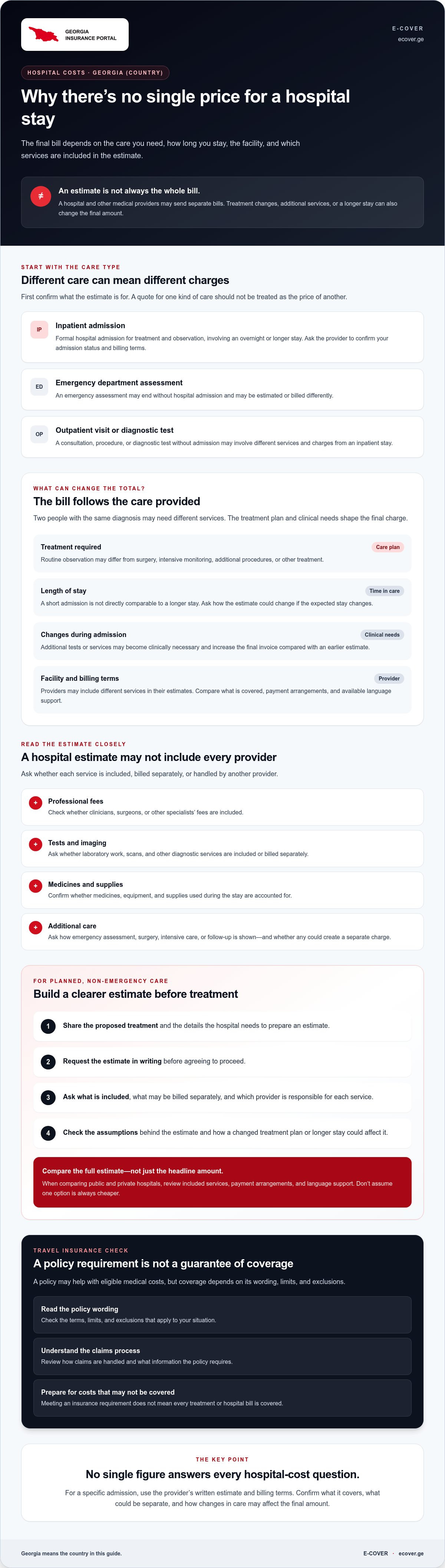
There isn’t one price for every hospital stay in Georgia, the country. The answer to how much does a hospital stay cost in Georgia depends on the care provided, the hospital, the time spent there, and the patient’s clinical needs. A short admission for one condition isn’t comparable to a longer stay involving surgery or additional treatment.
First, confirm what kind of care you’re asking about. An inpatient admission differs from an emergency department assessment, an outpatient appointment, or a diagnostic test performed without admission. These services may be estimated and billed differently, so don’t treat a quote for one as the cost of another.
Working definition: In this guide, a hospital stay means inpatient care involving formal hospital admission and an overnight or longer stay. This is a practical description, not a guarantee of how a particular provider classifies or bills a service. Ask the hospital to confirm the admission status and billing terms for your case.
What does a hospital stay usually mean?
During inpatient care, the hospital admits a patient for treatment and observation. An emergency assessment may end without admission, while an outpatient consultation or procedure may take place without an overnight stay. The distinction matters because each type of care may involve different services and charges. Before treatment, ask which parts of your care are classified as inpatient and which may be billed separately.
Why does one hospital bill differ from another?
The type of treatment, length of stay, provider, and care required all influence the final charge. The patient’s condition may also change the treatment plan after admission. For example, additional tests or services that become clinically necessary may increase the final invoice compared with an earlier estimate. Ask what assumptions the estimate uses and how the hospital will explain changes.
Georgia’s healthcare system provides useful context, but a general overview can’t predict an individual patient’s charges. For background on the country’s healthcare system and how it is structured and financed, see Healthcare in Georgia. For a specific admission, the provider’s written estimate and billing terms are more useful than a broad national figure.
No single figure answers every visitor’s question: the bill depends on the treatment received, how long care is needed, and what the provider includes in its charges. An initial estimate may not be the final invoice. Confirm whether it covers only the hospital’s services or also other providers involved in your care, and ask how additional treatment could affect the total.
What determines the cost of a hospital stay in Georgia?
The diagnosis is only one part of the calculation. The treatment plan, the patient’s clinical needs, and the services required during admission all affect the final charge. Two people with the same diagnosis may need different tests, procedures, medicines, or monitoring, so their bills may not match.
How treatment and length of stay affect the bill
A stay may involve routine observation and treatment, or more complex care such as surgery, intensive monitoring, or additional procedures. These aren’t universal price categories: what’s required depends on the individual case and the provider’s billing practices. If care needs change during admission, extra services or a longer stay may add charges. Ask how the estimate could change if the treatment plan or expected length of stay changes.
Which services may be billed separately?
A hospital estimate may cover only the facility’s charges, rather than every service involved in treatment. Before relying on it, ask whether it includes each item below and whether another provider may bill separately. Billing terms and arrangements vary, so confirm them directly with the hospital.
- Professional fees: Ask whether clinicians, surgeons, or other specialists’ fees are included.
- Tests and imaging: Check whether laboratory work, scans, and other diagnostic services are included or billed separately.
- Medicines and supplies: Confirm whether the estimate accounts for medicines, equipment, and supplies used during the stay.
- Additional care: Ask how emergency assessment, surgery, intensive care, or follow-up is shown, and whether any of these services could create a separate charge.
Request an itemized estimate and ask which provider is responsible for each listed service. This helps distinguish the hospital’s quote from other charges connected with an admission. If the hospital can’t confirm a cost in advance, ask what could trigger it and how you’ll be informed.
Payment arrangements also matter. The U.S. Embassy in Georgia advises travelers that most local providers require cash payment and that U.S. insurance is generally not accepted. Review its medical information for travelers, then confirm accepted payment methods with the provider and check your policy’s terms. Reimbursement or direct payment depends on the policy, its limits and exclusions, and its claims process.
Once you understand which charges could arise, review travel medical insurance options for visitors to Georgia and check the applicable policy wording to see which eligible expenses may be covered.
Public and private hospitals in Georgia: compare the full estimate
Public and private hospitals may differ in services, estimate formats, payment arrangements, and language support. That doesn’t mean one category is always cheaper or better. To compare options fairly, request estimates for the same proposed treatment and expected length of stay, then check what each quote includes. A lower headline figure may leave out services listed in another provider’s estimate.
What should visitors compare between providers?
Ask each provider for an itemized estimate based on the proposed treatment plan. Confirm whether it’s provisional, what assumptions it uses, and which clinical or scheduling changes could affect it. Before deciding, check when and how payment is due, which payment methods are accepted, what documents are required, and whether staff can communicate in a language you understand.
Use the table as a checklist. An item is confirmed as included or excluded only when the provider’s written estimate or billing terms say so. A blank entry doesn’t mean a service is free or included in the quoted amount.
| Estimate item | Confirmed inclusion | Confirmed exclusion | Confirm with provider |
|---|---|---|---|
| Proposed treatment and hospital services | Only if listed in the written estimate | Only if expressly identified as excluded | Whether the quote matches the planned care |
| Clinicians, tests, medicines, and supplies | Only if individually listed or clearly covered | Any item the estimate says is billed separately | Which charges may come from other providers |
| Payment and documents | Terms stated in writing | Any payment method or document the provider says it can’t accept | Payment timing, accepted methods, and required paperwork |
Keep the estimates and written replies together. They’ll help you compare the proposed costs rather than relying on a single figure when assessing how much does a hospital stay cost in Georgia.
Does public healthcare cover international visitors?
Don’t assume that access to a public healthcare program or benefits available to residents also applies to you as a visitor. Eligibility and covered services may depend on your status and the rules in force. Before relying on public coverage, confirm your eligibility and the specific services covered with an official source or the relevant program administrator. Then ask the hospital how your status affects its estimate and payment requirements.
How to estimate a hospital stay in Georgia before treatment
For planned, non-emergency care, a written estimate can help you understand likely charges before agreeing to treatment. It may not be a fixed final bill, so clarify what it covers and how the hospital will update it if your care changes. If you need emergency care, don’t delay treatment to request or compare a price estimate.
Questions to ask before a planned admission
Contact the hospital’s billing or patient administration team and use this process to request a quote you can assess:
- Describe the planned care. Share the proposed treatment or procedure and any information the provider requests to prepare an estimate.
- Request a written, itemized estimate. Ask which hospital services, clinicians, tests, medicines, supplies, and accommodation are included. Ask which items are excluded or may be billed separately.
- Check the assumptions. Confirm the expected length of stay and whether the estimate is provisional. Ask which clinical changes, such as additional monitoring or procedures, could increase charges.
- Ask how changes are communicated. Find out whether the hospital will provide a revised estimate if the treatment plan or expected stay changes, and who will explain the update.
- Confirm payment arrangements. Ask when payment is due, which payment methods are accepted, and what documents you need to provide. Request these details in writing and in a language you understand.
Keep the hospital’s reply with the estimate. If a service or charge is described in unfamiliar terms, ask the provider to explain it before treatment. This makes it easier to see what the quoted amount covers and what remains uncertain.
What documents should you keep?
Save the estimate, admission paperwork, itemized invoices, receipts, and relevant medical records. Keep copies together with your insurer’s contact details and policy documents. Ask your insurer which documents its claims process may require, since requirements depend on the policy and type of claim. A policy may help with eligible expenses only as set out in its terms, limits, and exclusions.
If you’re checking what insurance rules may apply to your visit, read this guide to mandatory Georgia travel insurance. Requirements and medical coverage are separate questions: meeting an insurance requirement doesn’t by itself confirm that a particular treatment or bill is covered.
Before travelling, review travel medical insurance options for Georgia and the applicable policy wording so you can understand the coverage terms and prepare the documents you may need.
Can travel insurance help with a hospital bill in Georgia?
Travel medical insurance may help with eligible medical expenses, but it doesn’t automatically pay every hospital bill. Whether the insurer pays a provider directly or reimburses you later depends on the policy wording, limits, exclusions, and claims process. The question “how much does a hospital stay cost in Georgia” is only part of your planning. Check what your specific policy may cover and what you might need to pay yourself.
An insurance requirement and insurance coverage are separate matters. Meeting a requirement that applies to your trip doesn’t mean every treatment, provider, or charge is covered. From January 2026, Georgia requires international travelers to have mandatory health insurance. Before travelling, review the current policy documents and confirm applicable requirements through official information. Don’t rely on a certificate alone as proof that a particular hospital expense is eligible.
What should you check in a travel medical policy?
Read the policy wording, not just a short summary. Check the covered medical expenses, exclusions, limits, applicable conditions, and how emergency assistance works. Confirm whether you or someone acting for you must contact the insurer before treatment, and whether the policy requires specific forms, medical records, or receipts. For a broader overview, see this guide to health insurance for tourists in Georgia.
If any term is unclear, ask the insurer to explain how it applies to your situation before departure. In particular, establish whether a claim is handled through direct payment or reimbursement, and what steps you must follow. These arrangements depend on the policy and circumstances, so don’t assume a hospital will bill your insurer directly.
How can visitors prepare before travelling?
Keep practical details accessible, including when you’re offline. Save a copy of your policy certificate, insurer contact details, and emergency instructions on your phone, and keep another copy with your travel documents. If you receive treatment, retain itemized bills, receipts, prescriptions, and relevant medical records. Contact your insurer when required by the policy, and follow its instructions about evidence and claim submission.
Being prepared won’t guarantee that a claim is accepted, but it can help you follow the correct process and provide requested documents. Review E-COVER’s online travel medical insurance information and check the applicable policy wording, limits, exclusions, and contact procedures before making a decision.
Prepare before you need care
There’s no single answer to how much does a hospital stay cost in Georgia. Your bill depends on the treatment, length of stay, and which services each estimate includes. For planned care, request a written, itemized estimate and confirm payment terms and possible additional charges directly with the hospital.
Before travelling, review your insurance documents rather than assuming every hospital expense is covered. Check eligible expenses, limits, exclusions, and the claims process, including whether you must contact the insurer before treatment. Keep your certificate and insurer contact details accessible, along with receipts and medical records if you need to make a claim.
E-COVER provides online travel medical insurance policies and certificates for visitors to Georgia. Starting in January 2026, international travelers are required to have health insurance to enter Georgia. E-COVER offers online policies designed to meet the state’s coverage requirements. Coverage depends on the applicable policy wording, so review its terms before choosing a policy. Review E-COVER travel medical insurance options for Georgia and prepare for your trip.
Frequently Asked Questions
How much does a hospital stay cost in Georgia?
There’s no single price for every hospital stay in Georgia, the country. The cost depends on the diagnosis, treatment, length of stay, provider, and services included. A hospital’s estimate may not include separate charges from clinicians, laboratories, imaging providers, or pharmacies. For planned care, request a written, itemized estimate and confirm what it covers, what may be billed separately, and how changes to your treatment could affect the final amount.
Is hospital care free for foreigners in Georgia?
Don’t assume hospital care is free for international visitors. Eligibility for public healthcare programs and covered services may depend on your status and the rules that apply to your circumstances. Before relying on public coverage, confirm eligibility with an official source or program administrator. Also ask the hospital directly about charges, payment arrangements, and whether your status affects the estimate. Resident benefits don’t guarantee that visitors receive the same coverage.
Does travel insurance cover a hospital stay in Georgia?
It may cover eligible expenses, but coverage depends on your specific policy’s wording, limits, exclusions, and claims process. Check whether inpatient treatment is included and whether you must contact the insurer before receiving care. Some policies may require you to pay first and claim reimbursement, while others may have different arrangements. An insurance requirement for travel doesn’t guarantee that every treatment, provider, or hospital bill is covered.
What affects the cost of a hospital stay in Georgia?
The main factors include the condition being treated, the treatment and medically necessary services, the length of admission, and the level of care required. Tests, medicines, procedures, additional monitoring, and clinical changes can also affect the total. The hospital’s estimate may cover only its own charges, while clinicians or other providers bill separately. Ask for an itemized breakdown to identify included services, exclusions, and possible additional charges.
Can I get a hospital cost estimate before treatment in Georgia?
For planned, non-emergency care, ask the hospital for a written estimate based on the proposed treatment. Request itemized charges and confirm whether clinician fees, tests, medicines, and accommodation are included. Ask what could change the estimate, how the hospital will communicate revisions, and which payment methods it accepts. Estimates may be provisional. Don’t delay emergency care to request or compare a price. Discuss billing when it’s appropriate to do so.
What should I do if I receive a hospital bill I do not understand?
Request an itemized statement from the hospital and ask its billing team to explain unfamiliar charges. Compare the bill with your estimate, admission documents, receipts, and records of services received. If another provider billed you separately, contact that provider for its own breakdown. If you plan to make an insurance claim, contact your insurer and ask what documentation it requires. Keep copies of all correspondence and follow the policy’s claim instructions and deadlines.


