

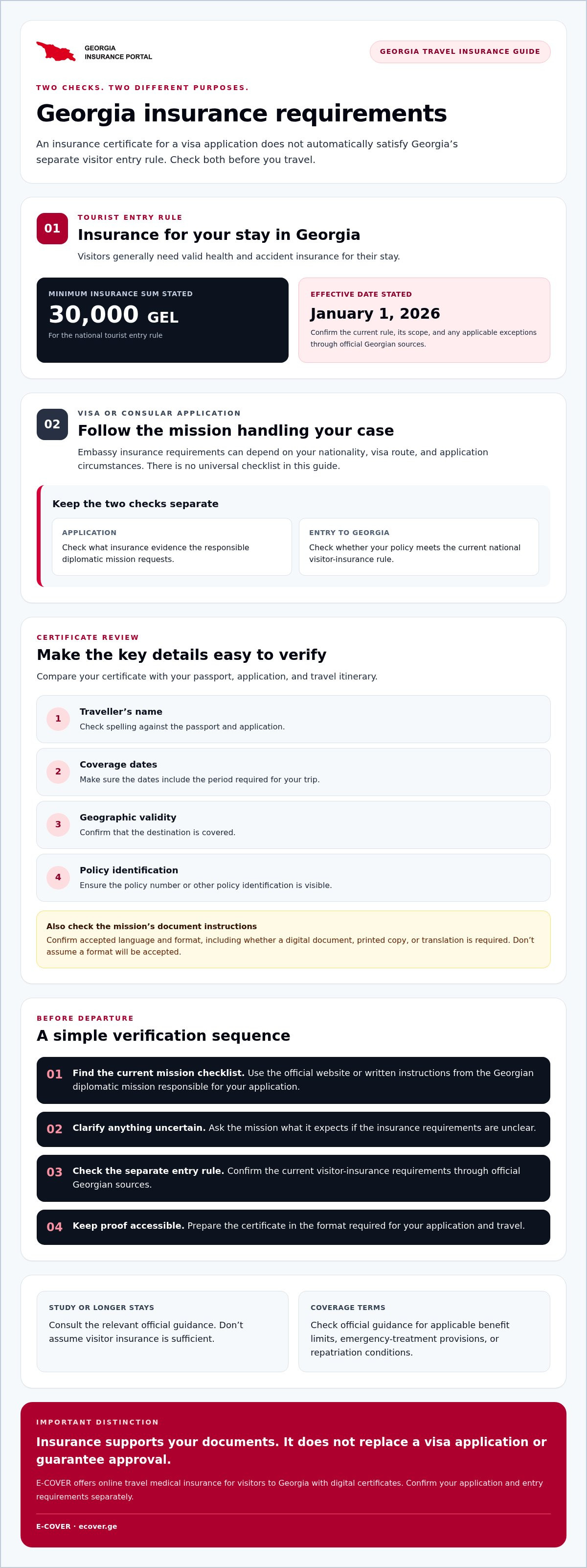
Don’t assume one insurance certificate automatically satisfies both a visa application and entry checks. The Georgian embassy insurance requirements for your application may depend on the instructions of the diplomatic mission handling it, while Georgia’s separate tourist entry rule has applied since January 1, 2026. Check both before you travel to help avoid preventable document delays.
For tourist entry, visitors generally need valid health and accident insurance for their stay, with at least 30,000 GEL in coverage. An embassy may have separate document instructions for your nationality, visa type, or application. Don’t treat these checks as interchangeable.
This guide explains where to confirm the rules for your application, what to check on an insurance certificate, and how to keep proof accessible for travel. It also distinguishes insurance from visa-processing services: arranging cover doesn’t replace a visa application or guarantee approval. Confirm the requirements before departure so you can prepare the right documents.
Key Takeaways
- Georgian embassy insurance requirements are application-specific. Check the current instructions from the mission handling your case.
- Check visa documents separately from Georgia’s national visitor-insurance rules. Meeting one requirement doesn’t automatically meet the other.
- Review the certificate for the insured traveller’s name, coverage dates, geographic validity, and policy identification.
- For study or longer stays, consult the relevant official guidance instead of assuming visitor insurance is sufficient.
- E-COVER offers online travel medical insurance for visitors to Georgia with digital certificates. Buying insurance doesn’t replace a visa application or guarantee approval.
Georgian embassy insurance requirements: what travellers should clarify first
Embassy insurance requirements are instructions to check for a specific visa or consular application. They tell you what evidence the responsible mission may ask you to submit. This application check is separate from the insurance rules that may apply when you enter Georgia, so don’t assume a document suitable for one purpose automatically meets the other.
E-COVER reports that Georgia’s national visitor-insurance mandate took effect in January 2026. The current rule applies to tourists, but travellers should confirm its scope, any applicable exceptions, and the exact policy criteria through official Georgian sources. Check both the consular guidance for your application and the current entry rules before travelling. This helps you distinguish visa document requests from border requirements and avoid overlooking either one.
Does every Georgian embassy ask for the same insurance documents?
Don’t rely on a universal checklist. Requested documents may depend on your nationality, visa route, and application circumstances. Start with the official website or written instructions from the Georgian diplomatic mission responsible for your application, and follow its current checklist. If the insurance requirements aren’t clear, ask the mission what it expects before submitting your documents.
If you’re checking whether you need a visa, the Visa policy of Georgia offers a broad overview of visa-free access and visa requirements by nationality. Use it as a starting point, then confirm your situation and any insurance-document instructions with official Georgian sources. Your visa status alone doesn’t tell you what certificate a mission may request.
Embassy instructions versus Georgia’s visitor entry rules
A consular application concerns the documents required for a visa or other application process. Entry rules concern the conditions that apply when a traveller seeks to enter Georgia. These are separate checks: submitting insurance evidence for an application doesn’t establish that your policy meets the national visitor-insurance rule, and carrying a policy for entry doesn’t automatically satisfy an embassy’s application checklist.
For more detail on the separate national rule, read Georgia Mandatory Insurance Law: 2026 Requirements for International Visitors. Then check the official guidance for your trip and application. Keep the two requirements distinct and confirm each with the appropriate authority.
What a Georgian embassy insurance certificate should help you prove
An insurance certificate is supporting evidence, not a decision on your visa application. The relevant Georgian mission’s current checklist determines whether you must submit insurance proof and what form it should take. Even a complete certificate can’t guarantee visa approval, so treat it as one part of your application, not a substitute for the mission’s other requirements.
Use the certificate to make key details easy to verify: who is insured, when coverage applies, where it is valid, and which policy it refers to. The official Georgian government insurance requirements set out criteria for the national visitor-insurance rule, including required policy information. That is separate from any insurance evidence requested for your application.
Details to compare between your policy and application
Before submitting your documents, compare the certificate with your passport, application, and travel itinerary. Check that each traveller’s name is spelled consistently, the coverage dates include the period required for your trip, and the destination is covered. Make sure the policy number or other policy identification is visible so the document can be matched to the correct cover.
Then check the mission’s instructions for language and format. It may specify whether it accepts a digital document, requests a printed copy, or requires a translation. Don’t assume an English certificate or a particular file format will be accepted without checking the current checklist for your application.
Which coverage terms need official confirmation?
Don’t infer required benefits from a policy’s general description. Check official guidance for any applicable medical-expense limit, emergency-treatment provision, or repatriation condition, and distinguish embassy application instructions from the national entry rule. For tourist entry, the government announcement specifies a minimum insurance sum of 30,000 GEL and identifies policy details that must be stated. Confirm that the rule applies to your circumstances and check the latest official wording before relying on it.
If you’re comparing a policy with a required benefit category, read the policy wording alongside the relevant official guidance. A travel policy may not meet every condition simply because it includes medical cover. E-COVER offers online travel medical insurance for visitors to Georgia, with digital certificates. After confirming the applicable rules, you can review online visitor insurance for Georgia as one option. Buying insurance doesn’t replace your visa application or guarantee that a mission will accept a particular document.
How visa type and travel purpose can affect Georgian embassy insurance checks
Your travel purpose can shape which application instructions you need to follow, but it doesn’t establish a universal insurance rule. A short visit, a study period, and a longer stay may involve different forms or document checks. Before buying cover, identify your application route and confirm the insurance instructions that apply to it.
Tourist and short-stay applications
If you’re travelling for a short visit, start with the current visa checklist from the Georgian mission responsible for your application. Check whether it asks for insurance evidence and, if so, compare the policy dates with your planned arrival and departure dates. A policy that ends before your trip does may leave a gap, so make sure the dates align with the period the relevant instructions require.
Keep this application check separate from the national entry rule. The U.S. Embassy guidance on Georgia’s insurance law describes the requirement for tourists, while your application checklist comes from the mission handling your case. For more context on the national rule, see Mandatory Georgia Travel Insurance: 2026 Entry Guide, then verify current requirements through official sources for your circumstances.
Student, long-stay, and remote-work situations
A study plan, extended stay, or remote-work arrangement is a reason to check whether a different insurance category or separate institutional or residence-related condition applies. Don’t assume a policy intended for visitors automatically meets those requirements. Confirm the relevant rules with the authority or institution responsible for your status, as well as the Georgian mission if you’re applying for a visa.
For students, check any insurance instructions from the educational institution and the official application guidance for your case. If you’re travelling as a digital nomad or planning a longer stay, confirm the relevant category and policy conditions before choosing cover. These labels alone don’t determine eligibility or required benefits, so don’t rely on general travel advice in place of official instructions.
Once you’ve confirmed your route, compare the policy’s scope and dates with the specific requirements you’ve been given. E-COVER offers travel medical insurance for foreign visitors to Georgia, but a visitor policy shouldn’t be treated as a substitute for student, institutional, or residence-related insurance unless the relevant authority confirms it meets the applicable conditions. Insurance also doesn’t replace a visa application or guarantee approval.
How to verify Georgian embassy insurance requirements before departure
Use a short verification process rather than relying on a general checklist. The Georgian embassy insurance requirements for your application may depend on your route and circumstances, while national entry rules are a separate check. Official guidance can change, so confirm it close to your application date and departure.
- Identify your application route. Confirm whether you need a visa and which application process applies to your travel purpose. This helps you find the correct checklist and authority.
- Check the responsible Georgian mission. Read the current instructions from the official diplomatic mission handling your application. Note exactly what it says about insurance evidence, language, and format.
- Verify national entry rules. Check current Georgian government information for the visitor-insurance requirements that apply to your trip. Don’t assume the mission’s visa checklist covers every border requirement.
- Inspect your certificate. Compare the insured names, policy dates, destination, and policy identification with your passport, itinerary, and the requirements you’ve confirmed.
Where to confirm current requirements
Use the relevant Georgian mission and official government sources as your primary references. Insurer summaries can help explain policy documents, but they don’t replace official instructions. Note the page or document you checked, its publication or update date, and when you reviewed it. This makes it easier to revisit the guidance if your application or departure is later.
If official sources appear to conflict, don’t guess which instruction applies. Contact the authority responsible for that specific check, such as the mission about application documents or the relevant government source about entry rules. Describe your travel purpose and application route, and ask for clarification in writing when possible. Ask your insurer to explain unclear policy wording, but confirm regulatory requirements with the authority that issued them.
A final document check before submitting or travelling
Open the certificate and confirm it’s readable, complete, and consistent with your passport details and planned travel dates. Check the mission’s instructions for accepted language, translations, and whether it requires a digital copy, printed evidence, or both. For travel, keep proof accessible in the format required by current official guidance. If a benefit or policy term is unclear, ask the insurer what it means, then verify that it meets the relevant authority’s stated condition.
For another focused review, consult Valid Health Insurance for Georgia Border: Verification. Once you’ve confirmed the requirements, review online visitor medical insurance for Georgia as an option for arranging cover. Insurance does not replace a visa application or guarantee approval.
Arrange Georgian visitor insurance and keep your embassy documents ready
Once you’ve confirmed which rules apply, follow a clear sequence: choose suitable visitor cover, compare the issued certificate with the official criteria, and keep proof accessible for your application and journey. Georgian embassy insurance requirements may differ from national entry rules. Use the relevant mission’s instructions for application documents and official Georgian sources for entry conditions.
What to confirm before purchasing a policy
Check that the policy dates cover the full period required for your trip. Compare the policy wording with the criteria that apply to your circumstances, including any stated coverage categories, geographic validity, and certificate details. Don’t rely on a general product description if the official instruction names a specific condition.
After the certificate is issued, check that names and dates are accurate and the document is legible. If a coverage term is unclear or a certificate detail appears incomplete, contact the insurer before submitting documents or travelling. If your question concerns what an embassy or entry authority accepts, confirm it with that authority too. Buying insurance alone doesn’t confirm acceptance.
Keep proof accessible throughout your journey
Save the certificate on your phone and keep an offline copy so you can access it without an internet connection. Check the relevant authority’s instructions on digital proof, and carry a printed copy if that authority or your airline requests one. Keep your policy details with your travel documents, and make sure the copy you can access is the final, correct certificate.
E-COVER provides online travel medical insurance for foreign visitors to Georgia, with digital issuance. Its policies are described as designed for the national visitor-insurance requirements effective from January 2026, but you should still verify the current official criteria and review your certificate. E-COVER provides insurance, not visa processing or travel-agency services. A policy doesn’t replace a visa application or guarantee approval.
After confirming the requirements for your trip, review E-COVER’s visitor insurance options and check the policy details before purchasing.
Prepare your insurance proof before you travel
Treat consular application documents and Georgia’s entry rules as separate checks. Confirm the instructions for your application route, then compare your insurance certificate with the official criteria, including the traveller’s details, coverage dates, and destination. Recheck current guidance before submitting documents and again before departure.
Georgian embassy insurance requirements may differ between applicants, so follow the relevant mission’s instructions rather than relying on a general checklist. E-COVER provides online travel medical insurance policies for foreign visitors to Georgia, with digital issuance. Its parent company is licensed by Georgia’s Insurance State Supervision Service under License N012063. Insurance does not replace a visa application or guarantee approval.
Once you’ve confirmed what applies to your trip, check E-COVER travel medical insurance for Georgia and review the policy details before purchasing. Preparing your documents in advance can help you travel with greater confidence.
Frequently Asked Questions
Does the Georgian embassy require travel insurance for every visa applicant?
Not necessarily. Insurance-document requests can vary by nationality, visa route, and application circumstances, so don’t assume one checklist applies to every applicant. Check the current instructions from the Georgian diplomatic mission responsible for your application. If the checklist doesn’t clearly say whether insurance is required or what evidence to submit, contact the mission before applying rather than relying on a general travel-insurance guide.
Is travel insurance mandatory to enter Georgia in 2026?
For tourists, Georgia’s visitor-insurance requirement took effect on January 1, 2026. The policy must cover health and accident expenses, provide at least 30,000 GEL in coverage, and remain valid for the full stay, including arrival and departure dates. The policy document must be in English or Georgian. Confirm current criteria and any applicable exemptions with official Georgian sources before departure.
What should a Georgian embassy insurance certificate include?
Start with the mission’s checklist, since it determines what evidence your application needs. Check that the certificate clearly identifies each insured traveller, policy dates, geographic validity, and the policy itself. For Georgia’s national visitor-insurance rule, the policy information must also identify the parties, covered territory, insurance subject, dates, insured risks, and coverage amount. Confirm language, translation, and format requirements with the relevant mission.
Can I use one insurance policy for both my visa application and entry into Georgia?
Possibly, if the same policy independently meets both sets of applicable criteria. A certificate that satisfies the Georgian embassy insurance requirements for an application doesn’t automatically prove compliance with the visitor-entry rule, and entry-compliant cover may not match a mission’s document instructions. Compare the policy wording, dates, coverage, and format with each official source. If any condition is unclear, ask the responsible authority before relying on the policy.
How do I check whether my insurance is accepted by a Georgian embassy?
Review the current checklist from the Georgian mission handling your application and compare it with the policy certificate and wording. Check the required benefits, coverage dates, destination, language, and submission format. If the mission doesn’t explain whether a particular policy or document is acceptable, contact it directly with your application route and the relevant policy details. An insurer can clarify its wording, but the mission confirms its own application requirements.
Does buying Georgian travel insurance guarantee visa approval?
No. Insurance is supporting documentation when requested, not a decision on your visa application. Approval depends on the application requirements and assessment by the relevant authority. E-COVER provides online travel medical insurance for foreign visitors to Georgia, but purchasing a policy doesn’t replace a visa application or guarantee approval. Confirm the mission’s full checklist and submit all required documents, not just insurance evidence.
Can I show a digital insurance certificate to the Georgian embassy?
Check the mission’s current submission instructions before sending or presenting a digital certificate. Some application processes may specify a format, printed copy, or translation, so don’t assume a file accepted for border entry will also meet visa-document rules. For tourist entry, official guidance permits physical or electronic proof. Keep the certificate legible and accessible, and consider an offline copy for travel if you’ll need to show it without internet access.


