

The policy that satisfies Georgia’s entry rules may not be enough for your full remote-work stay. Since January 1, 2026, foreign visitors must have health and accident insurance for their entire stay, with at least 30,000 GEL in coverage. If you’re searching for travel insurance for digital nomads in Tbilisi or elsewhere in Georgia, separate this entry requirement from the broader health protection you may need over time.
It’s understandable to want one policy that covers every concern. But entry compliance and longer-term protection serve different purposes, and a certificate alone doesn’t show the full scope of cover. This guide explains how visitor travel medical insurance fits into your plans, what to consider for an extended stay, and how to prepare and keep the right documentation before departure.
We’ll compare entry-focused cover with digital nomad and long-term travel insurance, then walk through a practical checklist for reviewing policy terms and preparing your certificate. E-COVER provides online visitor travel medical insurance with digital policy documents, helping you include insurance in your travel preparations.
Key Takeaways
- Identify whether your priority is entry documentation, medical protection during travel, or both before comparing policies.
- Review the difference between visitor travel medical insurance and longer-term health cover so you can choose with a clear view of each policy’s purpose.
- Compare eligibility, covered events, exclusions, policy dates, and certificate details. Then distinguish required criteria from optional benefits.
- Use a pre-travel checklist to verify current rules, align policy dates with your trip, check each insured person’s details, and save the digital certificate.
- Learn how E-COVER’s online process can help you arrange visitor travel medical insurance and keep your policy documents digitally.
Digital Nomad Travel Insurance for Georgia: Start With Your Stay and Travel Needs
Before choosing a policy, decide what you need it to do: provide documentation for entry, help with eligible medical events during your trip, or address both needs. These purposes can overlap, but they aren’t interchangeable. Travel medical insurance generally covers eligible medical events during a trip, as defined by the policy. Read the wording for eligibility, covered events, exclusions, and the dates the cover applies.
“Digital nomad” describes a way of travelling and working, not one universal insurance category. A remote worker travelling between countries for short periods may have different needs from someone staying abroad for an extended period. The label alone doesn’t establish what a policy covers. For a useful introduction to the term, see What is a Digital Nomad?
Travel medical insurance is designed for eligible medical events during a trip; ongoing health insurance is intended to address healthcare needs beyond that temporary travel context, subject to its own contract terms. Treat this distinction as a starting point, not a substitute for reading the policy. A visitor policy may address travel-related medical needs without providing the breadth of ongoing health protection you expect for a longer stay.
What does a digital nomad need to plan before travelling?
Map your expected stay, work routine, and travel dates first. Note whether you’ll remain in one country or move during the policy period, and check whether your work pattern affects eligibility under the contract. Then separate immediate travel-document preparation from broader healthcare planning. The first is about having the required policy documentation ready. The second is about understanding how you’ll manage healthcare over time. Coverage and eligibility depend on the policy terms.
- Stay: Estimate your time abroad and identify whether your plans are short-term or extended.
- Routine: Check how your work and travel pattern fits the policy’s eligibility wording.
- Dates: Match the cover period to your travel schedule and review what the policy says about changes.
- Healthcare: Decide whether travel-focused medical cover meets your needs or whether you need a separate, ongoing arrangement.
Why does the 2026 Georgia requirement matter to remote workers?
Georgia has stated that mandatory visitor insurance applies from January 2026. Requirements can depend on the traveler and current official rules, so don’t assume your nationality, length of stay, or remote-work status determines what applies. Before departure, verify the current scope, required policy terms, and acceptable proof through official sources. An insurance label alone doesn’t establish compliance.
Keeping the rule separate from your longer-term healthcare decision makes planning clearer: first establish what documentation is required for your trip, then assess whether that cover suits your wider needs as a remote worker. For a focused explanation of the visitor requirement, consult the Georgia visitor insurance entry guide and compare its guidance with current official information before arranging your policy.
Entry-Compliant Travel Medical Insurance Is Not the Same as Long-Term Health Cover
A policy can meet a visitor’s travel-document needs without functioning as comprehensive health insurance for an extended stay. Compare what each type of cover is meant to do, then read the policy wording rather than relying on labels such as “travel,” “health,” or “nomad.”
Travel medical insurance is generally designed for eligible medical events during a trip, subject to the contract. Domestic health insurance is typically structured around healthcare access within a particular country or system, while longer-term travel cover is intended for people spending an extended period away from home. These categories can differ in eligibility, covered services, exclusions, and how claims are handled.
Cover type | Intended use | Duration to consider | Policy wording to review
Travel medical insurance | Eligible medical events during a trip | The period stated in the policy | Covered events, exclusions, eligibility, and claim conditions
Domestic health insurance | Healthcare under a country-specific arrangement | According to the plan terms | Where cover applies, access conditions, and services included
Longer-term travel cover | Travel-related protection during an extended stay | The policy’s available period and your planned dates | Eligibility for extended travel, covered events, exclusions, and claims
Use this comparison to identify questions, not to assume that one category automatically includes another. A visitor policy that satisfies an entry requirement doesn’t, by itself, establish that routine care, ongoing treatment, or other continuing healthcare needs are covered. Policy suitability depends on the contract, the traveler’s circumstances, and the planned dates of cover.
What can travel medical insurance be designed to cover?
The answer depends on the policy. Review the insured events and benefits stated in the documents, along with exclusions, eligibility rules, and claim conditions. Don’t assume travel medical cover includes routine appointments or continuing treatment simply because it relates to healthcare. If a particular service matters to you, find it in the policy wording and note any conditions attached.
When should a nomad consider longer-term insurance needs?
Use your expected stay and existing healthcare arrangements as prompts. For example, an extended stay may lead you to consider how you’ll handle routine care as well as unexpected medical events. Residency, employment, and visa matters are separate from purchasing travel insurance; a policy doesn’t determine your status or resolve those requirements.
For broader policy-planning considerations, the digital nomad insurance guide for Georgia can help you think beyond entry documentation. If visitor travel medical cover fits your immediate travel needs, E-COVER lets foreign visitors arrange it online and receive policy documents digitally. Explore online travel medical insurance as one step in your planning.
How to Compare Digital Nomad Insurance for a Georgia Stay
Compare the policy documents, not just the product labels. For remote workers, start with eligibility and dates, then check which medical events are covered, which exclusions apply, and whether the policy provides a certificate you can keep as proof. No policy is automatically the “best” choice for every traveler. It needs to match your circumstances and the current requirements that apply to your trip.
Eligibility
Who can be insured under the policy? Check whether the stated conditions fit each traveler, including any requirements tied to age, residence, or travel plans.
Covered events
Which medical events or services does the contract describe? Use the policy wording to understand the scope rather than assuming a general label includes a particular benefit.
Exclusions and claims
What situations are excluded, and what steps or documents are required to make a claim? Note any conditions that could affect whether a benefit applies.
Dates
Does the insured period cover the full planned trip, including arrival and departure dates? Check the dates shown in both the policy documents and certificate.
Certificate
Can you access proof of cover, and does it clearly identify the insured person and policy period? Save a copy somewhere you can retrieve it while travelling.
Keep mandatory compliance separate from optional features. First, identify the current official requirements for your circumstances and check whether the policy documents explicitly address each one. Then consider additional benefits that matter to your plans. This order helps prevent a useful extra feature from distracting you from an unmet requirement, or an entry-focused policy from being mistaken for broad healthcare protection.
Which policy details should remote workers compare?
Read the certificate alongside the full policy wording. If your booking changes, for example, confirm whether the amended dates appear in the insurance documents. Check every insured person’s name and details for accuracy, and locate the claim instructions before departure. Don’t infer an answer from marketing language if a key point isn’t clear in the documents.
How can readers check compliance without guessing?
Build a short checklist from current official sources before selecting cover. List each applicable requirement, then match it to a specific term in the policy or a clear detail on the certificate. If you can’t find a direct match, treat that item as unresolved rather than assuming it is covered. The Georgia mandatory insurance law guide can help frame your review, but verify current rules through official sources before relying on them.
- Confirm the current requirements that apply to your trip.
- Match each requirement to explicit policy wording or certificate details.
- Check eligibility, covered events, exclusions, claim instructions, and dates.
- Retain the policy documents and certificate for travel preparation.
This process gives you a clear basis for comparing options without relying on an unsupported “best” claim or assuming that one policy suits every remote worker.
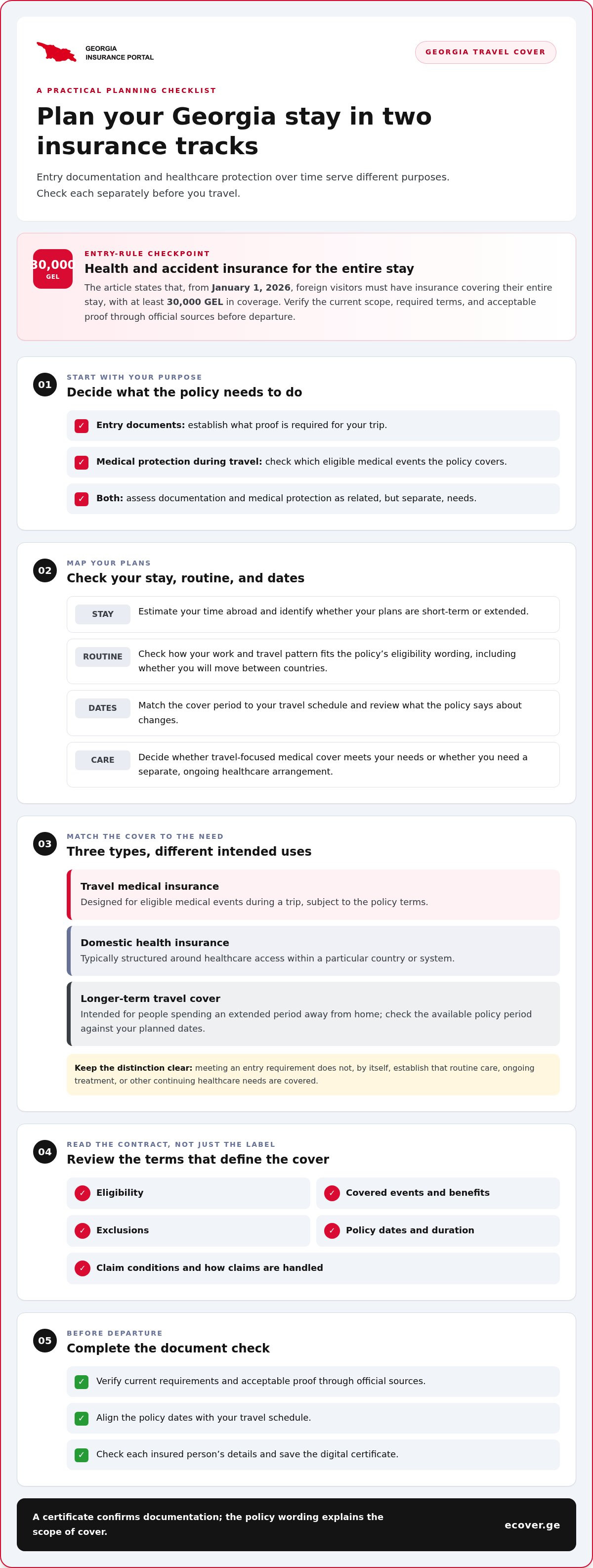
A Practical Checklist for Arranging Insurance Before a Remote-Work Trip
Turn insurance preparation into a short sequence. Start with the rules that apply to your trip, then compare them with the policy documents and certificate you receive. This helps catch mismatched dates or traveler details before departure, rather than relying on a policy name or assumptions about what it covers.
What should a traveler prepare before purchasing?
Gather the information needed to complete an application accurately. Keep your planned travel dates, intended stay duration, and each traveler’s details together. Before submitting them, read the insurer’s stated eligibility and application requirements. An error in a name or date can make it harder to use the documents when you need to demonstrate your cover.
- Check current official requirements. Confirm the rules that apply to your circumstances through official sources before choosing a policy. Requirements can change, so verify them again before departure.
- Set your travel period. Use your itinerary to establish the full dates you need. Include arrival and departure, and account for planned changes before you apply.
- Prepare traveler details. Collect the information for every person to be insured. Check spelling against travel documents and follow the application’s instructions.
- Review eligibility and terms. Read the policy wording for eligibility, covered events, exclusions, and claim conditions. Compare the applicable official requirements with explicit details in the policy documents.
- Complete the application carefully. Enter the details as shown on each traveler’s documents. Review the information submitted before you finish the application.
- Save the issued documents. Keep the policy and certificate in an accessible digital location, and retain the policy instructions for making a claim.
What should be checked after the policy is issued?
Review the documents as soon as they’re available. Check each insured person’s name, the policy number, the period of cover, and the certificate details against your travel documents and itinerary. Address any discrepancy before travelling. Also locate the policy terms, exclusions, emergency instructions, and claims contact information so you know where to look if an issue arises.
Keep a digital copy somewhere you can access while travelling, not only in an inbox that may be difficult to reach. If you prefer, retain a second copy in a separate secure location. E-COVER provides online travel medical insurance for foreign visitors to Georgia, with policy documents and certificates issued digitally. Review the certificate alongside the full policy wording; it doesn’t replace your responsibility to understand the terms.
Use this final check before departure: requirements are current, dates cover the trip, every insured person’s details are correct, and the policy instructions are easy to retrieve. For online visitor travel medical insurance, arrange cover with E-COVER as part of your preparation.
Arrange Georgia Travel Medical Insurance Online With E-COVER
Once you’ve identified the cover and documentation your trip requires, E-COVER offers foreign visitors a direct online way to arrange travel medical insurance for Georgia. The platform issues policies and certificates digitally, giving you documents to review and retain as part of your travel preparation. For remote workers, treat the certificate as one item in a wider checklist, not as a substitute for reading the full policy or checking current official requirements.
What to expect when arranging a policy online
Use E-COVER’s online platform to arrange visitor travel medical insurance. Follow the application process presented there and enter traveler and trip information accurately. Once the policy is issued, review the digital policy documents and certificate. The certificate is useful for checking key details and keeping proof accessible, but the policy wording governs the insurance contract. Eligibility, covered events, exclusions, and claim conditions depend on the terms that apply to your policy.
Compare the issued documents with the information you provided. A remote worker planning an extended trip, for example, should make sure the dates shown reflect the intended travel period rather than assuming the policy automatically follows itinerary changes. Read the policy instructions so you understand what they say about claims and what information may be needed if you use the cover.
Keep two questions distinct: does the policy meet your insurance needs, and does it satisfy the current requirements that apply to your entry? The certificate can help you show policy details, but it doesn’t promise acceptance at a border or replace official guidance. Confirm requirements through current official sources, then compare them with the certificate and full policy terms before you travel.
A final pre-travel insurance check
Before departure, confirm that the policy period matches your planned trip, including arrival and departure dates. Check every insured person’s details against their travel documents, and review the policy number and certificate information. Recheck official requirements close to departure because rules can change. Keep the certificate somewhere accessible while travelling, along with the policy wording and instructions for claims.
- Review eligibility and the policy terms that apply to your circumstances.
- Match the dates on your policy to your travel schedule.
- Check the certificate details for every insured person.
- Verify current official requirements and retain the relevant documents digitally.
These checks help you arrange visitor travel medical insurance with a clearer view of its scope and documentation. They also keep entry preparation separate from decisions about longer-term healthcare, which may require additional planning. If you’re ready to arrange visitor cover online, get travel medical insurance for your Georgia trip.
Make Your Insurance Plan Travel-Ready
Your insurance plan should keep pace with your itinerary. If dates shift, your stay extends, or another traveler joins, revisit the policy documents and current official requirements rather than assuming your original arrangements still fit. Making this review part of trip planning can help you spot gaps before departure and keep the right records close at hand.
For digital nomads planning a stay in Georgia, choose cover based on your actual plans and read the terms that apply to you. E-COVER provides online travel medical insurance policies for foreign visitors to Georgia. It is operated by LLC Insurance Broker WeInsure, licensed by Georgia’s Insurance State Supervision Service under License N012063.
Before arranging cover, have your travel dates and insured-person details ready, then review the policy wording and certificate once issued. This gives you a practical basis for preparing your documents without treating insurance as a substitute for checking official rules.
Arrange travel medical insurance online with E-COVER, and take your next travel-preparation step with greater confidence.
Frequently Asked Questions
Is travel insurance mandatory for digital nomads visiting Georgia in 2026?
Yes. From January 2026, Georgia requires international travelers to have mandatory health insurance, so remote workers visiting as foreign travelers should plan for this requirement. Don’t assume that working online or entering visa-free creates an exemption. Before departure, verify the current official rules for your nationality and circumstances, since requirements can change. Keep insurance planning separate from any work, residence, or visa obligations that may apply to your situation.
Can travel medical insurance meet Georgia's visitor insurance requirement?
Yes, if the policy meets the requirements currently applicable to your trip. A product label alone doesn’t establish compliance. Compare the official criteria with explicit information in the policy wording and certificate, and check that the insured person and policy period match your travel details. If a required detail isn’t clear in the documents, don’t assume it’s covered. Resolve the uncertainty before departure and retain the documents you used to verify your cover.
What is the difference between digital nomad insurance and travel insurance?
“Digital nomad insurance” describes cover marketed for people who work remotely while travelling, while “travel insurance” is a broad category for protection during trips. Those labels don’t define the benefits on their own. When comparing travel insurance for digital nomads in Tbilisi, examine who is eligible, which events are covered, and whether the policy fits your planned stay. Read the contract, not just the product title, and don’t assume a nomad label guarantees particular benefits.
How do I check whether my insurance certificate meets Georgia's current requirements?
Start with current official guidance and write down the requirements that apply to your trip. Then compare each item with the certificate and policy documents. Check that the certificate identifies the insured traveler and policy period, and look for the specific details required by the official rules. Keep the full policy wording as well, since the certificate may not show every condition. Recheck the rules before departure in case they’ve changed.
Does travel insurance cover routine healthcare during an extended stay?
Not necessarily. Travel medical insurance may focus on eligible medical events during a trip, while routine appointments or ongoing care can be treated differently or fall outside the cover. If you expect to need regular medication or follow-up visits, look for the relevant terms rather than assuming they’re included. Review exclusions and eligibility, and consider how you’ll arrange continuing healthcare during your stay. The policy contract determines which benefits apply.
What happens if my travel dates change after I buy insurance?
A date change may affect whether your policy covers the full revised trip, so don’t assume the original certificate updates automatically. Check the policy’s amendment instructions and follow the stated process to request any change. Once updated documents are issued, compare the new dates with your itinerary and save the revised certificate. If your travel starts earlier or ends later than the insured period, address the gap before relying on the policy.
Can I arrange Georgia travel medical insurance online before travelling?
Yes. E-COVER provides online travel medical insurance for foreign visitors to Georgia, with policies and certificates issued digitally. If you’re arranging travel insurance for digital nomads in Tbilisi, enter accurate traveler and trip details, then review the issued documents against your plans and current official requirements. Keep the certificate accessible and retain the full policy wording for its terms and claim instructions. Online documents support preparation, but don’t replace official guidance.


