

Imagine landing in Tbilisi, bags in hand and excitement building, only to be stopped at the border because your paperwork is missing one specific detail. Since January 1, 2026, this isn't just a travel "what-if"; it's the reality for visitors who haven't secured Georgia mandatory health coverage before arrival. Whether you're heading to the Caucasus mountains or the cobblestone streets of the capital, the new Law of Georgia "On Tourism" makes specific insurance a non-negotiable entry requirement for all foreign tourists.
We understand that navigating foreign legal mandates feels overwhelming, especially when you're unsure if your existing global policy meets local standards or if you've even found the right "Georgia" on a map. You want to focus on your itinerary, not worry about being turned away at border control. This guide ensures your trip remains legal and stress-free with the definitive 2026 checklist of mandatory health insurance requirements. We'll break down the 30,000 GEL minimum coverage limits, explain how to present verified proof to authorities, and show you how to secure a compliant digital policy that satisfies every regulation in minutes.
Key Takeaways
- Understand the specific 2026 legal mandates and why the LEPL Insurance State Supervision Service now requires all foreign visitors to hold valid medical insurance.
- Learn the exact 30,000 GEL minimum limits and repatriation clauses required to satisfy Georgia mandatory health coverage at the border.
- Identify the common pitfalls of standard global policies and why a locally licensed broker is necessary for guaranteed entry.
- Prepare for the immigration check with a clear guide on presenting documentation in both digital and physical formats to avoid logistical delays.
- Discover the streamlined path to obtaining an instant, government-compliant certificate that ensures your journey remains stress-free and legal.
Understanding the 2026 Georgia Mandatory Health Coverage Law
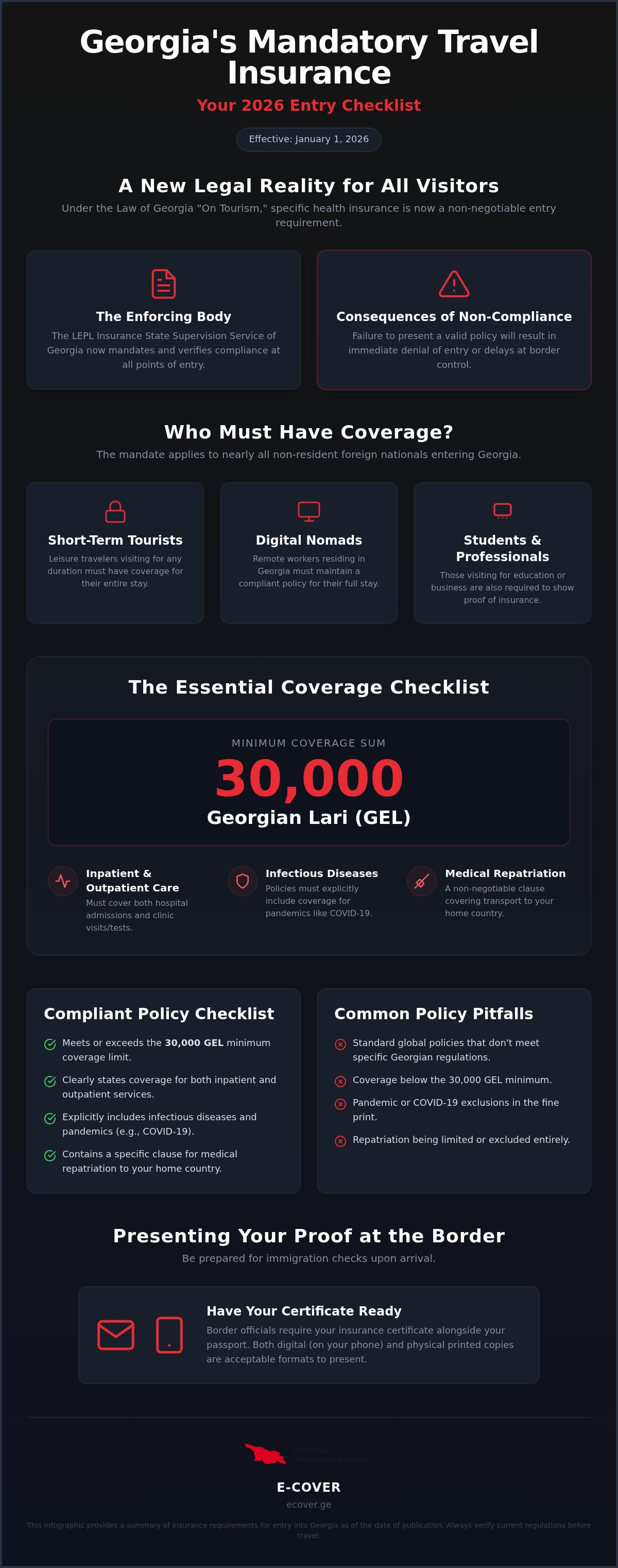
January 1, 2026, changed the entry landscape for every international traveler visiting Georgia. Under the Law of Georgia “On Tourism,” health and accident insurance is no longer an optional travel add-on. This mandate requires every foreign visitor to maintain valid coverage throughout their entire stay. The LEPL Insurance State Supervision Service of Georgia is the primary body enforcing these rules, ensuring that every policy provides a safety net for travelers while respecting local legal frameworks.
If you plan to cross the border, you must understand that compliance is checked at the point of entry. Border officials have the authority to request your insurance certificate alongside your passport. If you don't have it, the consequences are immediate: you'll likely be denied entry or held at the border until a compliant policy is secured. This regulation ensures that Georgia mandatory health coverage isn't just a recommendation but a pillar of the country's modern border security.
Why Georgia Introduced Mandatory Coverage
The introduction of this mandate serves several practical purposes. First, it guarantees that visitors have immediate access to high-quality medical care without the stress of unexpected financial burdens. If an accident occurs, the insurance covers the costs, protecting the traveler’s finances and the Georgian public healthcare system from unpaid medical bills. This shift also brings the nation's travel standards in line with global safety protocols. By formalizing these requirements, Georgia provides a more secure environment for the millions of tourists who visit its historic sites and mountain ranges each year.
Who is Affected by the New Mandate?
The law applies broadly to almost everyone entering the country for non-resident purposes. You must comply if you fall into any of these categories:
- Short-term tourists: Leisure travelers visiting for a few days or weeks must have coverage for their entire stay, including arrival and departure dates.
- Digital Nomads: Remote workers staying for months must ensure their policy remains active for the full duration of their stay.
- Students and Business Professionals: International students and those attending conferences are required to show proof of insurance that meets specific 2026 criteria.
Before you depart, it's vital to review Georgia's visa and entry policies to see if your specific passport or status grants any rare exemptions, though most travelers will find the insurance requirement applies to them. Aligning your documentation with these rules before you fly is the only way to ensure a seamless arrival.
The Essential Coverage Checklist: Minimum Requirements for Entry
Meeting the legal standards for Georgia mandatory health coverage isn't just about having a piece of paper; it's about matching specific financial and medical criteria. According to the official Georgian government announcement, every policy must provide a minimum coverage sum of 30,000 Georgian Lari (GEL). This amount ensures that the traveler has sufficient funds for emergency medical care without exhausting local resources. Border officials are trained to look for this specific figure, and any policy offering less will be deemed non-compliant.
Your Georgia mandatory health coverage must be comprehensive to satisfy immigration checks. It needs to account for both inpatient hospital services, where you're admitted for treatment, and outpatient care, such as clinic visits or diagnostic tests. Additionally, the mandate specifically includes coverage for infectious diseases, including COVID-19. If your current policy excludes pandemics or specific viral outbreaks, it won't be accepted at the border. You must ensure these risks are explicitly listed in your policy wording to avoid complications.
Medical Repatriation: A Non-Negotiable Requirement
Repatriation is often the most overlooked part of travel insurance, yet it's a core requirement for Georgian entry in 2026. While medical evacuation moves you to the nearest adequate hospital, medical repatriation covers the high cost of transporting you back to your home country for long-term recovery. The Georgian government mandates this inclusion to prevent visitors from becoming stranded in the local medical system during a crisis. Don't assume your global health plan includes this; many standard policies limit repatriation to "medical necessity" or exclude it entirely. You'll need to verify that your certificate specifically mentions repatriation to your country of residence.
Technical Standards for Your Policy
The format of your documentation is just as important as the coverage limits. To avoid delays at immigration, your certificate must be issued in either English or Georgian. If it's in another language, you'll need a notarized translation. The validity period must cover your entire stay, from the moment you land until the day you depart. Presenting a policy that expires even one day before your departure can lead to entry denial. Most importantly, border officials now look for instant verification features, such as QR codes or unique policy numbers, to confirm the document's authenticity in real-time.
Securing a policy that ticks every box on this technical checklist is simple when using a dedicated platform like ecover.ge, which automates the compliance process for you.
Identifying Compliant vs. Non-Compliant Policies
Distinguishing between a standard travel insurance plan and Georgia mandatory health coverage is critical for a smooth entry. Many travelers assume their current global policy or premium credit card coverage will suffice, but the 2026 regulations are highly specific. As highlighted in a recent U.S. Embassy travel alert, the Georgian government now requires proof of insurance that meets local legal standards. If your policy certificate lacks specific phrasing or falls below the mandated financial thresholds, it will be rejected at the border.
One of the most common pitfalls involves credit card insurance. While these plans offer convenience, they often include high deductibles or "reimbursement-only" models that don't satisfy the immediate coverage requirements of Georgian law. For a deeper look at how these rules impact your arrival, consult our Mandatory Georgia Travel Insurance: 2026 Entry Guide. To ensure your documentation is valid, it's safer to use policies issued by brokers licensed by the LEPL Insurance State Supervision Service, as these are pre-configured to meet all 2026 entry criteria.
The Problem with Global 'Generic' Insurance
Generic international policies often fail the 2026 test because they don't use the state-mandated wording required by Georgian authorities. Border agents need to see clear, unambiguous terms regarding health and accident coverage. If your policy is from an obscure international provider, the agent may struggle to verify its authenticity in real-time. Additionally, many global plans have deductibles that exceed the limits allowed under the new mandate, effectively invalidating your Georgia mandatory health coverage for legal entry purposes.
Verification Steps Before You Fly
You can avoid border delays by performing a few simple verification steps before you head to the airport. Follow this checklist to confirm your policy is compliant:
- Check the License: Ensure the provider is registered or partnered with a licensed Georgian insurer.
- Explicit Territory: The certificate must explicitly state "Georgia" as a covered territory; "Worldwide" is sometimes deemed too vague by strict immigration officers.
- 24/7 Local Support: Verify that the policy includes a local or accessible contact number for emergency assistance within the country.
- No Hidden Exclusions: Read the fine print for clauses that exclude "unforeseen" events or specific infectious diseases, as these are mandatory inclusions for 2026.
How to Present Your Insurance Proof at the Georgian Border
Arriving at the Georgian border is usually a straightforward process, but the 2026 regulations mean Georgia mandatory health coverage is now a standard part of your interaction with immigration officials. When you reach the counter, the officer will likely request your passport and your proof of insurance simultaneously. They are specifically looking for the 30,000 GEL coverage limit and the validity dates that match your travel itinerary. This check applies at all international airports, including Tbilisi, Batumi, and Kutaisi, as well as land crossings like Sarpi or Kazbegi.
You should prepare both digital and physical formats of your policy. While a digital certificate on your smartphone is widely accepted, technical issues can arise. Phone batteries die, and airport Wi-Fi isn't always reliable. Having a printed copy ensures that you can present your documentation even if your device fails. If your insurance is deemed insufficient or non-compliant upon arrival, you face the risk of being denied entry or being forced to purchase a policy at the border. Buying insurance at the airport is the riskiest option; these kiosks often have long queues and may charge higher rates than online platforms.
Digital Certificate Readiness
To ensure a smooth transition through the border, save your PDF policy directly to your phone's local storage or a digital wallet. This allows for offline access without needing an internet connection. Check that the QR code on your certificate is clearly legible; immigration officers use scanners to verify the policy's authenticity in the national database. If you're traveling in a group, share the policy files with your companions or family members so multiple people have copies available in case of an emergency.
Troubleshooting at the Border
If you discover you've lost your document or forgot to purchase coverage, don't panic. Most border zones have limited Wi-Fi access that allows you to retrieve documents from your email. If you cannot find your insurance document, your first step should be to contact your provider's emergency hotline. For those who realize they lack compliant coverage while standing in the immigration line, you can use the E-COVER instant portal for emergency last-minute issuance. The system provides a valid certificate in under two minutes, acting as a safety bridge to get you through the checkpoint legally.
Don't leave your entry to chance; secure your government-compliant insurance policy before you fly to ensure a seamless arrival in Georgia.
Securing Your Compliant Policy with E-COVER
E-COVER acts as the essential safety bridge between your travel plans and the 2026 legal requirements. Licensed by the LEPL Insurance State Supervision Service of Georgia, our platform ensures every policy meets the strict standards of Georgia mandatory health coverage. We've removed the guesswork by designing certificates that border officials recognize instantly, featuring the necessary QR codes and specific legal wording required for entry. By choosing a locally licensed facilitator, you eliminate the risk of documentation being rejected at the immigration counter.
Efficiency is our priority. The application process takes less than two minutes from start to finish. You simply enter your travel dates and personal details, complete a secure payment, and receive your border-ready certificate via email immediately. This instant delivery is vital for last-minute travelers or those who realize they've missed a requirement while already in transit. Once the PDF arrives in your inbox, you have a fully compliant legal document ready for presentation to Georgian authorities.
Tailored Plans for Every Traveler
We offer specific categories of insurance to match your unique visit type. Our short-term travel insurance policies are ideal for tourists exploring Georgia’s heritage sites for a few days or weeks. For those planning a more permanent stay, our long term travel insurance policies and digital nomad insurance provide the extended protection required by law. We also offer specialized student insurance, ensuring that those coming for academic purposes satisfy their visa and residency requirements without technical delays or gaps in Georgia mandatory health coverage.
Why E-COVER is the Preferred Choice
Choosing a local expert means you're backed by direct knowledge of the Georgian regulatory environment. Our status as a licensed broker allows us to offer transparent pricing with no hidden deductibles, so you know exactly what your coverage limits are before you land. Beyond the border check, we provide 24/7 assistance for medical emergencies within Georgia. If you need a doctor or hospital care during your stay, our local team is available to guide you through the process in English. This ensures you receive the support you need without linguistic or administrative barriers, allowing you to focus on your journey with total peace of mind.
While travel insurance covers your personal health, those visiting for business purposes may also need to discover E&A Insurance Group for comprehensive commercial solutions to protect their professional interests.
Secure Your Journey to Georgia Today
It's time to move from planning to action. Get your 2026-compliant Georgian travel insurance instantly with E-COVER to ensure your documentation is 100% border-compliant. As a broker licensed by the LEPL Insurance State Supervision Service, we provide instant digital certificate delivery so you can focus on your itinerary instead of administrative hurdles.
Georgia's landscapes and hospitality are waiting for you. With your legal requirements settled, you can step off the plane with the confidence that your trip is secure and fully protected.
Frequently Asked Questions
Is health insurance really mandatory for all visitors to Georgia in 2026?
Yes, health and accident insurance is mandatory for all foreign tourists entering Georgia as of January 1, 2026. This legal requirement applies to everyone visiting for leisure, business, or short-term stays under the Law of Georgia “On Tourism.” Failure to provide proof of insurance can lead to denied entry at the border. While certain diplomats and official passport holders are exempt, the vast majority of travelers must secure coverage before arrival.
What is the minimum coverage required by the Georgian government?
The Georgian government requires a minimum insurance coverage sum of 30,000 Georgian Lari (GEL). This amount must cover both emergency medical expenses and accidents throughout your entire stay. Your policy must explicitly state this limit to be considered valid by border authorities. Ensuring your policy meets this financial threshold is the only way to satisfy the legal standards for Georgia mandatory health coverage at immigration checkpoints.
Can I use my existing international health insurance for entry?
You can use existing international insurance only if it meets all 2026 Georgian legal requirements. The policy must provide at least 30,000 GEL in coverage, include medical repatriation, and be available in English or Georgian. Many global policies lack these specific details or don't explicitly name Georgia as a covered territory. If your current provider cannot issue a certificate with these exact parameters, it's safer to obtain a locally recognized policy.
What happens if I arrive at the Georgian border without insurance?
Arriving without valid insurance puts you at risk of being denied entry into the country. Border officials are authorized to verify your documentation during the immigration process. If you don't have proof of insurance, you may be required to purchase a policy at the border before proceeding. However, airport kiosks often have long wait times and limited options, making it much more efficient to secure your certificate online before your flight.
Does the mandatory insurance cover COVID-19 treatments?
Yes, compliant policies must cover the treatment of infectious diseases, which includes COVID-19. The 2026 mandate ensures that travelers have access to medical care for unforeseen illnesses during their visit. When reviewing your policy, check the fine print to ensure there are no exclusions for pandemics or specific viral outbreaks. Policies designed specifically for the Georgian mandate, like those from E-COVER, automatically include these necessary protections to ensure full legal compliance.
How do I verify if my insurance policy is valid for the 2026 mandate?
To verify your policy, check that it lists a minimum coverage of 30,000 GEL and includes medical repatriation. The document must be in English or Georgian and clearly state your arrival and departure dates. Additionally, look for a verification feature like a QR code or a policy number registered with a licensed provider. Georgia mandatory health coverage is strictly monitored, so ensure your provider is recognized by the LEPL Insurance State Supervision Service.
Can I buy the mandatory insurance online before my trip?
Yes, you can and should purchase your insurance online before you travel. Platforms like E-COVER allow you to complete the application process in under two minutes and receive a digital certificate immediately via email. This approach ensures you have your documentation ready for inspection the moment you land. Buying online in advance is the most reliable way to guarantee that your policy meets every technical requirement set by the Georgian government.
Is medical repatriation included in the E-COVER policies?
Yes, medical repatriation is a standard inclusion in all E-COVER policies to meet the 2026 Georgian entry requirements. This clause covers the cost of transporting a patient back to their home country if a medical emergency requires long-term care outside of Georgia. Since the government mandates this specific coverage, we've integrated it into our plans to ensure every traveler receives a 100% border-compliant certificate that satisfies local immigration laws.


