

Could a single missing document at the border end your study abroad journey before it even begins? Starting in January 2026, international students arriving in the country of Georgia face a significant regulatory shift. Securing the correct student health insurance Georgia requires is no longer just a recommendation from your university. It's a legal mandate for entry. We understand that distinguishing between the requirements of the U.S. state and the nation of Georgia is confusing enough without the added pressure of a new government deadline.
You likely feel the urgency to get your documentation right to avoid visa delays or being turned away at the border. This guide ensures you master the 2026 mandatory regulations so your transition is seamless. We'll provide a clear checklist of the mandatory coverage limits and explain how to obtain a certificate of insurance that's instantly verifiable by border officials. By the end of this article, you'll have a roadmap to a plan that satisfies both your university enrollment and your residency permit application requirements.
Key Takeaways
- Understand the new January 2026 mandate that transforms health insurance from a campus recommendation into a legal entry requirement for the country of Georgia.
- Identify the specific minimum coverage limits for emergency and inpatient services required to satisfy Georgian border and visa authorities.
- Learn why private student health insurance Georgia offers the necessary flexibility for residency permit applications compared to standard university plans.
- Discover how to use an instantly verifiable insurance certificate to ensure a hassle-free D-category visa process and border entry.
- Secure a state-compliant policy online to guarantee your documentation meets all national regulations before your journey begins.
The 2026 Mandatory Health Insurance Law for Students in Georgia
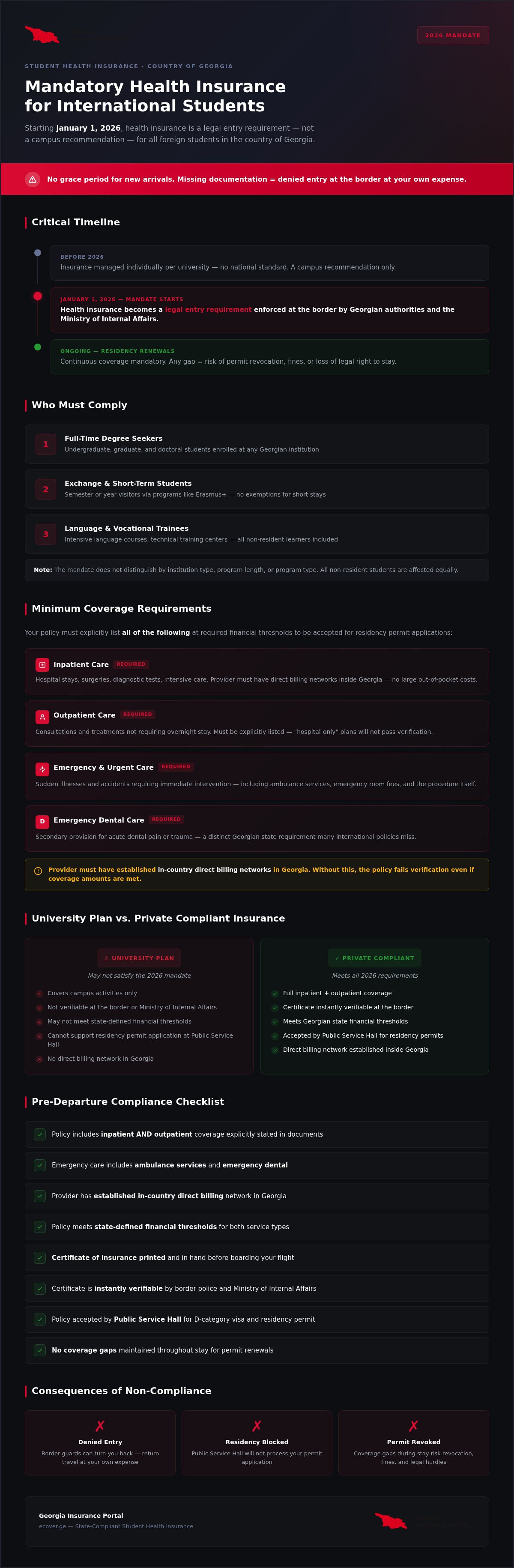
Starting January 1, 2026, the country of Georgia is implementing a nationwide legal requirement for all foreign visitors. This move shifts student health insurance Georgia from a campus administrative step to a strict border control prerequisite. Previously, insurance was often managed through individual universities, but the new mandate centralizes these requirements under national law. The primary objective is to ensure that every international student has guaranteed access to medical services without placing an undue burden on the local public healthcare system. This systemic change protects both the visitor and the state's infrastructure.
It's essential to understand that your university's internal health plan might not automatically satisfy the state's new entry requirements. While a university plan covers you for campus activities, the 2026 mandate requires a specific level of coverage that is verifiable by border police and the Ministry of Internal Affairs. If you fail to present a verifiable certificate, the consequences are immediate. Border guards have the authority to deny entry, meaning you'll be sent back to your point of origin at your own expense. Additionally, the Public Service Hall requires this specific insurance for residency permit applications. Without it, you can't secure the legal right to stay in the country long-term.
Who is Affected by the 2026 Mandate?
This law applies broadly to any non-resident pursuing education within Georgia's borders. The mandate doesn't distinguish between the type of institution or the length of the program. Specifically, the following groups must secure compliant coverage:
- Full-time degree seekers: Students enrolled in undergraduate, graduate, or doctoral programs.
- Exchange and short-term students: Those visiting for a single semester or academic year through programs like Erasmus+.
- Language and vocational trainees: Individuals attending intensive language courses or technical training centers.
The Timeline: Starting January 2026
The mandate officially begins in January 2026. You must have your policy active and your certificate of insurance printed before you board your flight. Border officials will verify your documentation upon arrival. For students already residing in Georgia before the deadline, you're required to transition to a compliant plan by the time your current residency permit or insurance policy expires. There's no grace period for new arrivals; compliance is mandatory from day one of the new year. Maintaining continuous coverage is also vital for residency permit renewals. Any gap in insurance could result in the revocation of your legal stay, leading to complicated administrative hurdles or fines.
Minimum Coverage Requirements for Georgia Student Insurance
To satisfy the 2026 mandate, your student health insurance Georgia policy must do more than simply exist; it must meet rigorous state-defined financial thresholds. The Georgian government requires that every international student maintains a policy that covers a broad spectrum of medical needs, from sudden accidents to long-term hospital stays. These regulations ensure that students have access to the country's private healthcare infrastructure without facing personal financial ruin. If your policy fails to explicitly list coverage for both inpatient and outpatient services at the required levels, it will not be accepted for your residency permit application.
Inpatient care requirements focus on the costs associated with hospital stays, including surgeries, diagnostic tests, and intensive care. Conversely, outpatient care must cover consultations and treatments that don't require an overnight stay. Georgian authorities are particularly strict about these distinctions. They require that the insurance provider has established networks within the country to facilitate direct billing, which prevents you from having to pay large sums out of pocket. If you are looking for a plan that is pre-verified to meet these standards, you can secure state-compliant coverage that aligns with the January 2026 requirements.
Emergency and Urgent Care Standards
The 2026 mandate places a heavy emphasis on emergency medical services. Your policy must provide substantial coverage for sudden illnesses and accidents that require immediate intervention. This includes not only the medical procedure itself but also the ambulance services and emergency room fees. Furthermore, the Georgian state requires a secondary provision for emergency dental care, which covers acute pain or trauma. To be compliant, your insurance provider must offer 24/7 assistance services. This ensures that you can receive immediate authorization for treatment at any hour, a critical factor during border inspections where officials may verify the accessibility of your support hotline.
Medical Repatriation: A Legal Necessity
Medical repatriation is perhaps the most critical component of the new insurance law. Border officials specifically look for clauses that cover the cost of transporting a student back to their home country for medical reasons or in the event of a fatality. This is a non-negotiable legal necessity because the Georgian state does not cover these logistical expenses for foreign nationals. Your policy must include a dedicated financial limit for repatriation that is separate from your general medical coverage. E-COVER plans are specifically engineered to include these repatriation clauses, ensuring that your certificate passes the scrutiny of both border police and the Ministry of Internal Affairs during the residency permit process.
University Plans vs. Private Compliant Insurance
Choosing between a university-sponsored plan and private student health insurance Georgia requires a careful look at the legal fine print. Many students prefer the simplicity of a university plan, often bundled into tuition fees. However, these institutional policies are primarily designed for campus medical needs, not for the strict administrative requirements of a national border. If your university plan doesn't meet the specific 2026 mandate standards, you'll still need to purchase a separate policy to cross the border or apply for your residency permit. This can lead to double-paying for insurance if you don't verify the policy's state-compliance beforehand.
Evaluating the cost-benefit ratio is also essential. While university plans might seem cheaper at first glance, they often have higher deductibles or limited provider networks. Private insurance that is state-compliant usually offers broader access to private clinics nationwide. This depth of coverage is vital when you're in a foreign country and need immediate, high-quality care without navigating complex university-specific referral systems. You want a policy that works as effectively in a regional medical center as it does in a major city hospital.
Pros and Cons of University-Offered Plans
University plans offer the benefit of ease. You sign up during registration, and the costs are clear. But there are significant drawbacks. These plans often contain "holiday gaps," meaning you might not be covered during summer breaks or winter holidays if you aren't actively enrolled in classes. Additionally, university plans frequently restrict you to a small network of local clinics. If you travel outside your university's immediate area, you might find yourself without a direct-billing provider, forcing you to pay out of pocket and seek reimbursement later.
Advantages of Private State-Compliant Insurance
Private student health insurance Georgia provides a level of flexibility that university plans can't match. One of the biggest advantages is portability. If you decide to transfer to a different educational institution or change your program, your private policy remains active and compliant with your residency permit. Most importantly, private providers offer instant issuance of the digital certificate required for border entry. This certificate is specifically formatted to meet the 2026 mandate, ensuring that border officials can verify your coverage in seconds. This prevents the administrative delays that often occur when trying to prove a university-specific plan meets national legal standards.
How to Verify Your Policy for Visa and Residency
Securing your student health insurance Georgia policy is only the first step; you must also ensure it's presented correctly to satisfy various government bodies. Whether you're applying for your D-category student visa or entering the country for the first time, your insurance certificate serves as a primary proof of compliance. If the documentation is missing key details or isn't formatted to state standards, your application will face immediate rejection. Officials at the consulate and the Public Service Hall cross-reference your policy against the 2026 mandate to confirm that all coverage limits are met before they grant legal stay.
Your insurance certificate must clearly state your full name as it appears in your passport, the policy's validity dates, and a summary of the coverage limits. Georgian authorities are particularly focused on the inclusion of medical repatriation, as discussed in previous sections. If you're unsure if your current documents will pass inspection, you can get a pre-verified certificate here that is guaranteed to meet all state requirements. Having the right paperwork ready prevents stressful delays at the Justice House and ensures your residency permit process remains on track.
The Border Entry Checkpoint
When you arrive at the border, the police will ask to see your insurance documentation. While digital copies on a smartphone are often accepted, it's highly recommended to carry a physical, printed copy. This avoids issues if your phone battery dies or if the officer requires a hard copy for their records. You must ensure the policy is written in English or Georgian; policies in other languages aren't officially recognized and will require a notarized translation. The validity period of your student health insurance Georgia must cover the entirety of your intended stay or, at the very least, the first year of your degree program.
Residency Permit (TRP) Documentation
The Temporary Residency Permit (TRP) application at the Public Service Hall is the final hurdle in establishing your legal status. For this step, your insurance must be active for at least six to twelve months from the date of your application. If your policy is set to expire shortly after you apply, the officer may reject your residency request. Common reasons for insurance rejection include:
- Missing repatriation clauses or limits below the state mandate.
- Incomplete coverage for outpatient services or emergency dental care.
- Lack of a verifiable QR code or digital signature on the certificate.
- Discrepancies between the name on the insurance and the passport.
Maintaining continuous coverage is a legal obligation. If you let your policy lapse, your residency permit can be revoked, leading to fines or deportation. Always initiate your renewal at least two weeks before your current policy ends to ensure there are no gaps in your legal standing.
Securing Your Compliant Student Insurance with E-COVER
E-COVER streamlines the process of obtaining student health insurance Georgia by providing a platform specifically designed for the legal landscape of 2026. Because we focus on the national mandate, our policies eliminate the guesswork involved in matching university requirements with state law. Policies are issued instantly online, allowing you to move from inquiry to a completed certificate in minutes. This speed is essential for students facing tight visa deadlines or those who need to provide immediate proof of coverage at the border. Our system generates bilingual documentation, ensuring that both foreign consulates and local Georgian authorities can verify your status without linguistic barriers.
Choosing a plan through E-COVER means you're selecting a policy that is guaranteed to be accepted by the Public Service Hall and the Ministry of Internal Affairs. We understand that the transition to a new country is complex. Therefore, our service acts as a bridge, translating technical legal requirements into a simple, digital-first experience. By securing your insurance before you arrive, you eliminate the risk of being turned away at the border or having your D-category visa application rejected due to insufficient coverage limits.
Why E-COVER for International Students?
Our plans are not generic travel policies; they are engineered for the Georgian regulatory environment. We operate with local expertise under WeInsure, which is licensed by the LEPL Insurance State Supervision Service of Georgia. This institutional credibility is vital when your residency permit depends on the validity of your insurer. We offer affordable rates tailored for student budgets, ensuring that the cost of compliance doesn't hinder your educational goals. Our deep understanding of local protocols means that every policy includes the necessary repatriation and emergency limits discussed in earlier sections of this guide.
Get Your 2026 Compliant Certificate Today
The application process is designed for maximum efficiency. There is no requirement for a medical exam, and you don't need to navigate complex paperwork. Once you provide your basic details and complete the secure payment, your certificate is delivered as a PDF to your inbox immediately. This digital certificate is ready for your visa interview or for presentation to border police upon arrival. Don't wait until you reach the border to discover your documentation is insufficient. You can Secure your student health insurance for Georgia now and ensure your focus remains on your studies rather than administrative hurdles.
Ready for Your Academic Journey in Georgia?
Preparing for your studies in the country of Georgia requires more than just academic readiness; it demands administrative foresight. By understanding the shift to the January 2026 national mandate, you ensure that your arrival is defined by excitement rather than legal complications. You now know that student health insurance Georgia must include specific repatriation clauses and meet state-defined coverage limits to satisfy both border police and the Public Service Hall. Choosing a policy that aligns with these national standards is the most efficient way to secure your residency permit and maintain your legal status.
Don't risk a border rejection or a visa delay by arriving with insufficient documentation. E-COVER provides a solution that is 100% compliant with the new 2026 law and is issued by a provider licensed by the LEPL Insurance State Supervision Service. With our system, you receive your documentation immediately, allowing you to focus on your education with the security of a state-verified plan.
Get Your State-Compliant Student Insurance Certificate Instantly and enjoy the benefit of 100% law compliance with instant digital delivery. We look forward to welcoming you to Georgia for a successful and secure academic year.
Frequently Asked Questions
Is health insurance mandatory for all students entering Georgia in 2026?
Yes; health insurance is strictly mandatory for every international student entering the country beginning January 1, 2026. This national mandate applies to degree-seekers, exchange participants, and language school attendees alike. You must present a valid policy to border officials to gain entry. Failing to do so will result in immediate entry denial at the border checkpoint, causing significant disruption to your study plans.
What are the minimum coverage limits required by the Georgian government?
The Georgian government requires specific minimum coverage limits for emergency medical services and inpatient hospital care. While exact figures are subject to official updates, policies must cover sudden illness, accidents, and medical repatriation. It's vital that your student health insurance Georgia policy explicitly lists these categories on the certificate. If your documentation lacks these specific limits, the Public Service Hall will reject your residency application during the verification process.
Can I use my domestic health insurance from my home country?
You can only use a domestic policy if it meets every requirement of the 2026 Georgian mandate and includes medical repatriation. Additionally, the certificate must be in English or Georgian and provide a 24/7 contact for local verification. Most domestic plans don't include these specific international provisions. It's often more efficient to secure a local, state-compliant policy to ensure guaranteed acceptance at the border and the Justice House.
Will my insurance certificate be checked at the Georgian border?
Yes; border police will verify your insurance certificate upon your arrival in the country. They check for the validity dates, coverage limits, and the inclusion of repatriation clauses. You should carry a printed copy of your certificate to avoid delays if your phone battery fails. If you can't provide a verifiable document, you risk being denied entry and sent back to your home country at your own expense.
Does student insurance in Georgia cover medical repatriation?
Yes; medical repatriation is a non-negotiable legal requirement for all student policies under the 2026 law. This clause covers the costs of transporting you back to your home country for medical reasons. Georgian authorities won't accept any insurance plan that excludes this specific coverage. E-COVER plans are designed to include these clauses automatically to satisfy both border and residency requirements, providing you with total administrative security.
How do I renew my health insurance for a long-term residency permit?
You should renew your insurance online at least two weeks before your current policy expires. Continuous coverage is essential for maintaining your legal status at the Public Service Hall. If there's a gap in your insurance, your residency permit could be revoked. Simply purchase a new term through our portal to receive an updated certificate that's instantly verifiable for your renewal application and avoids any legal complications.
What happens if I enter Georgia without valid health insurance in 2026?
Entering without valid insurance in 2026 will lead to immediate entry denial by border police. You'll be required to return to your home country at your own expense. Beyond the border, you won't be able to apply for a D-category visa or a residency permit. This lack of compliance creates significant legal and logistical hurdles that can disrupt your entire academic year and lead to additional fines.
Is E-COVER insurance accepted by the Georgian Public Service Hall?
Yes; E-COVER insurance is fully accepted by the Georgian Public Service Hall for all residency permit applications. Our policies are designed to meet the 2026 mandate and are issued by a locally licensed provider. The digital certificates we provide include all the necessary legal terminology and coverage limits required by Georgian officials. This ensures your student health insurance Georgia documentation is processed without administrative rejection or the need for notarized translations.


