

What if the insurance document you prepared for a Georgia visa is checked at the border? From January 1, 2026, most foreign visitors, including travellers who don’t need a visa, must have valid health and accident insurance for their stay. That makes proof of insurance for Georgia visa applications and travel more than a formality. However, buying a policy does not guarantee visa approval or entry.
It’s understandable to be unsure whether insurance is a visa requirement or a separate entry requirement, and whether a digital certificate will be accepted. Georgia’s current rules allow proof in digital or printed form, in English or Georgian. The certificate still needs to show the required information and cover your full stay, including your arrival and departure dates.
This guide explains what insurance proof can demonstrate and how to check its territory, dates, insured risks, and limits before submitting documents or travelling. You’ll also find practical steps for preparing visitor insurance documentation, including through E-COVER’s online policy process. Checking your documents against the policy and current official requirements can help you spot gaps before they become a travel complication.
Key Takeaways
- Use proof of insurance for Georgia visa purposes as evidence of an active policy, not as evidence of visa approval.
- Check that the certificate clearly identifies you and the insurer, and states the coverage dates, territory, and benefits.
- Compare your policy and certificate with current official Georgian requirements before submitting documents or travelling.
- Save the issued certificate for offline access and keep the insurer’s contact details in case you need to clarify your coverage.
- E-COVER offers an online option for obtaining visitor travel medical insurance documentation, but buying a policy does not guarantee visa approval or entry.
What Does Proof of Insurance for a Georgia Visa Actually Prove?
An insurance certificate is evidence that a policy has been issued. It identifies the insured person and states the coverage and dates under that policy. It can help demonstrate that you hold visitor insurance, but it does not prove that you qualify for a Georgian visa or have permission to enter the country.
Keep the requirements separate. Visa rules depend on your nationality, travel purpose, and personal circumstances. Visitor insurance is a separate entry requirement: from January 1, 2026, foreign visitors generally need valid health and accident insurance, including travellers from visa-exempt countries. Certain categories, including some diplomatic and special visa or passport holders and people covered by specific international treaties, may be exempt. Check current official Georgian guidance to confirm whether the rule applies to you and whether an exception covers your circumstances.
Is insurance proof the same as a Georgian visa?
No. A policy document does not grant a visa, residence status, or entry permission. If you need a visa, check the official requirements for your circumstances and prepare those documents separately. If you’re visa-exempt, you may still need to meet applicable entry requirements, including insurance rules. Treat visa eligibility and insurance compliance as two separate checks.
Why might a traveller be asked to show insurance evidence?
A certificate can show that an insurance contract names you and states a coverage period and benefits. It may be requested with a visa application if the applicable process calls for it. Separately, proof may be requested during travel or at the border under current entry rules. Neither check means the certificate itself determines your visa or admission.
Before relying on a document, confirm that the policy is active and that its dates match your full planned stay. Then check current official requirements for your traveller category, coverage, and any exceptions. An insurance certificate can support evidence of coverage, but authorities make visa and entry decisions under their own rules.
For a broader explanation of the entry requirement and how to review it before travelling, see the 2026 Georgia travel insurance entry guide. Georgia’s visitor requirements sit within a wider tourism context. The overview of Tourism in Georgia provides background, not official guidance. For decisions about your trip, use current information from Georgian authorities.
Which Details Should a Georgia Travel Insurance Certificate Show?
Review both the certificate and the full policy before travelling. A clear certificate helps show who is insured, the coverage period, and the territory stated in the document. Its appearance alone does not establish that it meets every current entry rule. Use the checklist below, then verify legal requirements against official Georgian guidance.
The certificate must agree with the underlying policy. A summary cannot expand or change the coverage the contract provides. If the certificate and policy appear inconsistent, ask the insurer to clarify or correct the documents before departure.
How should names, policy dates, and destination be checked?
Compare the insured traveller’s name with the passport, including spelling and the order of names. If you find an error, contact the insurer to request a correction rather than relying on an explanation at the airport. For a family or group policy, check that every traveller who needs coverage is named or clearly included under the policy terms.
Next, compare the policy’s effective dates with your itinerary. Confirm that the coverage period includes your entire intended stay. A purchase receipt or booking confirmation is not a substitute for the issued certificate. Check the territorial wording too: it should explicitly show that Georgia is within the covered territory. Verify the required dates and territorial scope against current rules for your situation.
How can travellers check coverage wording and insurer details?
Use this checklist to inspect the certificate, then confirm any legally required fields with current official sources:
- Traveller identity: The insured person’s name and any identifying details shown should correspond to the passport.
- Insurer information: Find the insurer or underwriter, policy reference, and contact details so you can identify the issuing company and ask questions if needed.
- Coverage dates and territory: Check the start and end dates, and confirm that the wording includes Georgia.
- Coverage stated: Review the listed benefits, insured risks, and limits. Verify required coverage types and minimum amounts against official guidance rather than assuming a general travel policy is sufficient.
- Contract details: Check that the certificate identifies the insured parties and matches the policy wording, including any conditions relevant to the stated coverage.
For rule-level detail, compare your document with the Georgia mandatory coverage checklist and current information published by Georgian authorities, including the Law of Georgia 'On Tourism' reference. Requirements can change, so confirm them close to your travel date.
If you’re arranging visitor cover online, review the available travel medical insurance information, then check the issued certificate against this list. Buying a policy does not guarantee visa approval or admission.
How Can You Verify Insurance Proof Against Georgia’s Current Rules?
Start with current official Georgian requirements, not an insurer’s summary or an old travel checklist. Confirm that the rule applies to your traveller category, travel dates, and purpose of stay. The Consular Department’s official insurance requirements for tourists describes the rule taking effect on January 1, 2026, and states a minimum coverage amount of 30,000 GEL. Verify the date and limit against the latest official guidance before relying on them, and check whether any listed exemptions apply to you.
Then compare the official wording with both your policy and its certificate. A certificate can look complete while leaving an important question unanswered. Check the policy’s actual coverage, not just a familiar heading or a stated amount, when assessing proof of insurance for Georgia visa purposes.
What should you compare with official requirements first?
Use this sequence and note anything that needs clarification:
- Confirm your status: Check whether current rules apply to your nationality or traveller category, planned dates, and reason for travel. Verify any exemption directly with an official source.
- Check coverage: Compare the required types of coverage, exact limits, and insured risks with the policy wording. Verify the 30,000 GEL minimum stated in current guidance. Don’t assume a different currency or benefit description is equivalent without checking.
- Match the territory: Look for explicit wording that includes Georgia, then compare it with any territorial requirement in the official rule.
- Confirm document conditions: Check whether the rule specifies insurer eligibility, certificate language, or digital or printed presentation. Don’t assume a format is accepted simply because it’s convenient or commonly used.
Check the source close to your departure, since dates, limits, exceptions, and accepted formats need official confirmation. The insurance verification guide for Georgia’s border can provide additional context, but use official Georgian information to confirm the current rule.
What should you do if a certificate appears incomplete?
Contact the insurer or issuing intermediary if a name, date, territory, limit, or coverage description is missing or unclear. Ask for an explanation or corrected certificate, and keep the updated document with the policy. Don’t edit, translate, or alter an issued certificate yourself unless the insurer approves the change. Unofficial alterations can make it unclear whether the document matches the contract.
A certificate alone does not guarantee compliance. The policy must be active, apply to your trip, and match the requirements that apply to you. Once the details align, keep the certificate accessible for travel and recheck official guidance if your itinerary or policy changes.
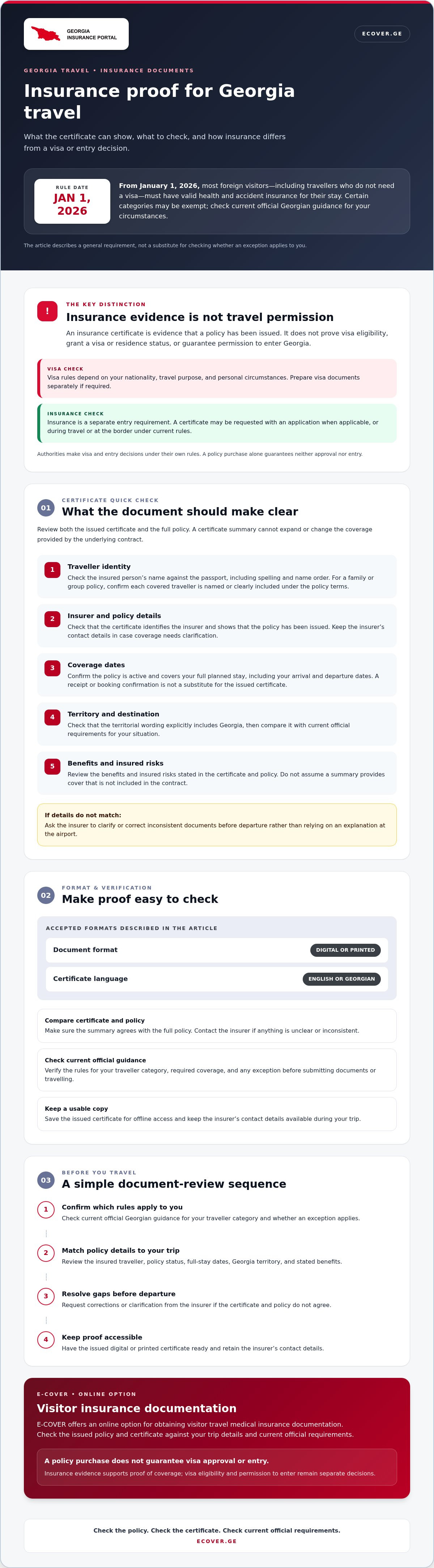
How Should You Prepare and Present Insurance Proof for Georgia Travel?
Prepare your insurance documents for two possible checks: a visa application, if one applies to you, and travel or entry procedures. Instructions can differ. A visa application channel may specify how to submit supporting documents, while authorities may have separate requirements for presenting proof during travel. Confirm the format with the relevant authority or application channel instead of assuming one method works for both.
Should you carry a digital or printed insurance certificate?
Save the issued certificate as a readable file on your device for offline access. Don’t rely only on an email attachment link or an online account that may need an internet connection. A printed copy can be a practical backup if your phone battery runs out or the file is difficult to display.
These are preparation steps, not a guarantee that either format will be accepted. Check current instructions for your visa application, if applicable, and separately confirm how insurance proof should be presented during travel or at the border. Follow any stated requirements for language, file type, or paper copies.
What should you recheck before departure?
Give the issued document one final review against your current travel details. If your plans have changed since you bought the policy, confirm that the certificate still reflects the trip you’re taking. Keep the certificate and related records together so you can find them without searching through messages or relying on a network connection.
- Match each insured name to the traveller’s passport.
- Check that the policy dates still cover the planned stay.
- Confirm that the destination and policy reference are clear on the certificate.
- Save the policy wording, insurer contact details, and any correspondence about corrections with the certificate.
- Recheck official instructions for the document format required by the relevant application channel or authority.
If you find a discrepancy, contact the insurer or issuing intermediary and request clarification or corrected documentation before departure. Keep the response with your policy records, and don’t alter the issued certificate yourself. For current-rule context, review the Georgia mandatory health-insurance rules guide, then confirm applicable instructions with official sources.
Once the file is ready, open it offline to make sure it’s readable and save a backup where you can access it during travel. If you still need visitor travel medical insurance documentation, explore E-COVER’s online insurance options. Having a policy document prepared does not guarantee visa approval or entry.
How to Obtain Visitor Insurance Proof Online Through E-COVER
Once you know what to check on a certificate, an online application can be a practical way to arrange visitor cover. E-COVER provides online travel medical insurance policies for foreign visitors to Georgia. It is not a visa-processing service, and buying a policy does not guarantee visa approval, border admission, or official acceptance of a document.
Before applying, review current Georgian requirements for your traveller category and travel dates. Don’t rely on a general label such as “travel insurance” as confirmation that a policy meets those rules. Compare the actual coverage, policy wording, and certificate details with the official requirements that apply to your trip.
What should you check before completing an online policy application?
Enter each traveller’s details and trip information carefully, following the application instructions. Use the name shown on the traveller’s passport, and provide accurate travel dates and other requested information. An error in these details may mean the certificate needs clarification or correction.
After the policy is issued, review the documents promptly rather than waiting until departure. Check the insured names, policy dates, territory, stated coverage, and policy reference against your travel plans and current official rules. Read the policy wording as well as the certificate, since the certificate is a summary and does not replace the contract. If anything is missing, unclear, or incorrect, contact the relevant insurer or issuing intermediary and ask for guidance or corrected documentation.
Keep the issued certificate and policy wording together, and save copies where you can access them offline. That gives you time to address a discrepancy before travelling. If your itinerary changes, check whether the policy dates and details still match your trip.
Where can you get help with insurance documentation?
E-COVER provides online insurance policies for foreign visitors to Georgia. Use the information provided during the application and on your issued documents to understand the policy and identify the relevant contact for questions. If you’re unsure about compliance, compare the policy with current official Georgian guidance. Proof of insurance for Georgia visa purposes is useful only when its details match the requirements that apply to you.
For visitor insurance documentation, get visitor insurance documentation through E-COVER. Review the policy and certificate before relying on them for a visa application or travel check. Insurance documentation supports evidence of coverage, but visa and entry decisions are separate.
Prepare Your Georgia Travel Documents With Confidence
Keep visa requirements and insurance rules as separate checks. Proof of insurance for Georgia visa purposes shows details of a policy, not visa approval or permission to enter. Before travelling, compare the certificate with the underlying policy and current official requirements, paying close attention to the insured traveller, dates, destination, and stated coverage.
E-COVER provides online travel medical insurance policies for foreign visitors to Georgia and is licensed by Georgia’s Insurance State Supervision Service under License N012063. Review the policy wording and certificate details carefully. Buying a policy alone does not guarantee visa approval, entry, or official acceptance.
Ready to explore an online option for visitor cover? Check visitor insurance options and prepare your Georgia travel documents. Compare the issued documents with current official requirements before relying on them for your trip.
Frequently Asked Questions
Do I need proof of insurance for a Georgia visa in 2026?
Generally, foreign visitors entering Georgia must have valid health and accident insurance from January 1, 2026, including travellers who are visa-exempt. Certain categories may be exempt, so check current official Georgian guidance to confirm whether the rule applies to you. Insurance is separate from visa eligibility: check the visa requirements for your nationality, travel purpose, and circumstances independently.
What should proof of travel insurance for Georgia include?
Check that the certificate identifies the insured traveller and insurer, shows the policy dates and territory, and describes the coverage, insured risks, and limits. Current guidance specifies a minimum coverage amount of 30,000 GEL, but verify the applicable limit and required certificate details with official sources before travelling. Compare the certificate with the full policy wording, since a summary may not show every condition.
Can I show a digital insurance certificate when travelling to Georgia?
Current guidance allows proof in digital or printed form and states that the document should be in English or Georgian. Still, confirm the latest instructions for your circumstances before departure. Save the issued certificate on your device for offline access, check that it opens clearly, and consider carrying a printed copy as a backup. Don’t rely solely on an online link that may need an internet connection.
Does travel insurance proof guarantee a Georgia visa or entry?
No. An insurance certificate is evidence of a policy and its stated coverage, not a visa decision or entry permission. Visa eligibility and border admission are determined separately under the rules that apply to you. Buying a policy also does not guarantee that authorities will accept the document. Check current visa and entry requirements, then make sure your policy and certificate match the applicable insurance rules.
What happens if my insurance dates do not cover my full stay in Georgia?
Your policy may not meet the requirement if its dates leave part of your stay uninsured. Check that coverage includes your arrival and departure dates as well as the days between them. If the dates don’t match your itinerary, contact the insurer or issuing intermediary before travelling to ask about an amendment or updated policy documents. Verify the current rule with Georgian authorities rather than assuming a short gap is acceptable.
Is an insurance booking confirmation enough, or do I need the policy certificate?
A booking confirmation may show that you started or completed a purchase, but it may not provide the policy information needed to demonstrate coverage. Request and review the issued certificate and policy wording. Check the insured person, policy reference, dates, territory, and stated coverage. If the certificate hasn’t arrived or contains an error, contact the insurer or issuing intermediary before departure.
Can I use insurance from my home country as proof for Georgia?
Potentially. Current guidance allows policies from Georgian and foreign insurers if they meet the applicable requirements. Check that your home-country policy explicitly covers Georgia, applies for your full stay, and states the required risks and limits in a verifiable way. Review the certificate and full policy wording, and confirm current insurer, language, and document-format rules with official Georgian sources before relying on it.


