

Can a telehealth visit help you refill a prescription without going to a clinic? In Georgia, it may, if the provider is authorized to prescribe remotely and the medication can be prescribed under applicable rules. Some emergencies and controlled substances may require an in-person visit. To understand how to get a prescription filled in Georgia, first check what your prescription requires.
A refill also depends on whether refills remain on your prescription and whether the pharmacy can process it. If no refills remain, your healthcare provider may be able to send a renewed prescription electronically to your chosen pharmacy.
This guide explains telehealth refills, electronic prescriptions, and filling an out-of-state prescription in Georgia. It also covers the details that help a pharmacy locate your prescription and how pharmacy records support the refill process, so you can plan your next step.
Key Takeaways
- Learn what needs to happen for an electronic prescription to reach a Georgia pharmacy and be accepted for dispensing.
- Find out what details to include when requesting a refill and when a telehealth visit may be part of the process.
- Understand how Georgia pharmacies handle valid prescriptions from out-of-state prescribers, including controlled-substance limits.
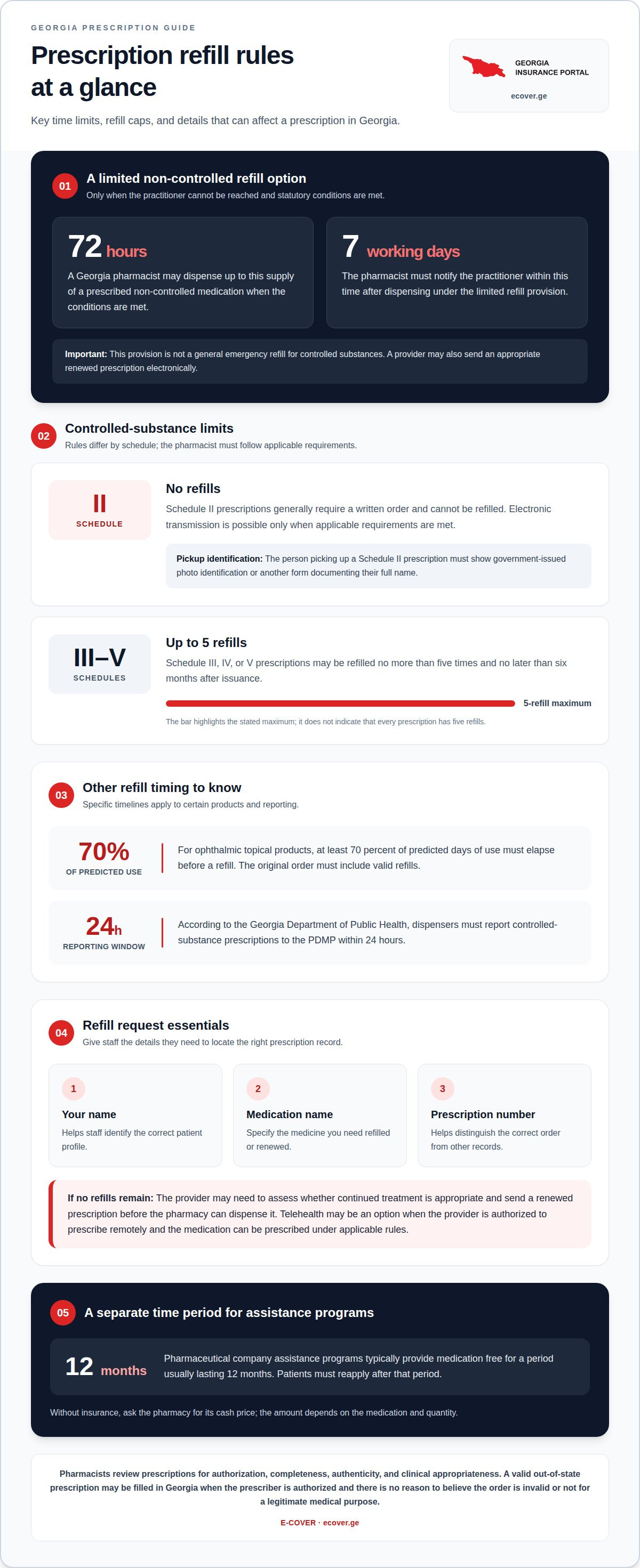
- See how refill records are maintained and why, according to the Georgia Department of Public Health, dispensers must report controlled-substance prescriptions to the PDMP within 24 hours.
Electronic prescription transmission to a pharmacy
Electronic transmission sends a prescriber’s order directly to a pharmacy. For a non-controlled prescription, the pharmacist checks that the prescriber is authorized and the order is complete, authentic, and clinically appropriate. Schedule II controlled-substance prescriptions may be transmitted electronically only under applicable requirements, including 21 C.F.R. 1306 and Georgia Code 16-13-41. A pharmacist must not dispense an order they know, or reasonably should know, is invalid or not for a legitimate medical purpose.
Pharmacist professional judgment is the review used to assess whether an order is valid and appropriate to dispense. A Georgia pharmacist may dispense up to a 72-hour supply of a prescribed non-controlled medication when the practitioner can’t be reached for refill authorization and statutory conditions are met. The pharmacist must notify the practitioner within seven working days. A healthcare provider, rather than the pharmacy, may electronically send an appropriate renewed prescription.
Controlled-substance filling follows additional safeguards. Schedule II prescriptions generally require a written order and cannot be refilled. Schedule III, IV, or V prescriptions may be refilled no more than five times and no later than six months after issuance. Anyone picking up a Schedule II prescription must show government-issued photo identification or another form documenting their full name.
Emergency refills are limited by the medication and circumstances. The 72-hour supply provision applies to prescribed non-controlled medication when its conditions are met; it isn’t a general emergency refill for controlled substances.
Affiliated pharmacies are branches within the same pharmacy network. If one location is out of a medication, ask whether another branch can fill the order. The pharmacist must still follow prescription and dispensing rules.
Out-of-network limits are insurance-plan rules that affect claims and annual fill counts. If you fill multiple prescriptions during one visit to an out-of-network pharmacy, each counts as a separate fill toward the annual limit.
Assistance programs help eligible patients obtain prescription drugs. Pharmaceutical company programs typically provide medication free for a period usually lasting 12 months, after which patients must reapply. Without insurance, ask the pharmacy for its cash price; the amount depends on the medication and quantity.
Pharmacy license checks confirm that pharmacy services are provided by licensed personnel in Georgia. Ask the pharmacy for its license details and confirm them with the state pharmacy regulator. To transfer an order, give the receiving pharmacy the medication name, prescription number, and current pharmacy. If the drug is unavailable, ask about another affiliated branch or ask the pharmacy to coordinate with the prescriber.
Can I use telehealth to refill prescription?
Yes. A telehealth provider may renew an appropriate prescription and send it electronically to your chosen pharmacy. Understanding how to get a prescription filled in Georgia also means knowing that remote prescribing must follow applicable rules. Some emergencies and controlled substances may require an in-person visit.
Information Needed for Refill Requests
Refill information includes the patient and prescription details a provider or pharmacy uses to identify the medication. When requesting a refill, provide your name, medication name, and prescription number. These details help staff find the correct record and distinguish it from another prescription or patient profile.
When requesting a renewal from your healthcare provider, name the medication and explain that you need continued treatment. The provider can assess whether a renewed prescription is appropriate and send it to your chosen pharmacy. For a refill request to the pharmacy, provide the same identifying details, whether you submit it online or by phone.
Online and Phone Refills
An online refill is a request submitted through a pharmacy’s digital system or a healthcare provider’s patient portal. If your provider accepts requests through a portal, enter the medication and prescription details accurately. When planning how to get a prescription filled in Georgia, be clear about whether you’re requesting an existing refill or a provider renewal.
A phone refill is a request made by calling the pharmacy. Give staff your name, medication name, and prescription number. If no refills remain, the provider may need to issue a renewed order before the pharmacy can dispense the medication.
Telehealth coverage refers to the insurance benefits that apply to a remote visit and related care. Review your policy’s telehealth terms and prescription benefits separately: coverage for a consultation does not establish coverage for a prescription drug. The provider must also be authorized to prescribe remotely in Georgia.
Ophthalmic topical products are medicines applied to the eye. Georgia rules require at least 70 percent of predicted days of use to elapse before refilling them. The original order must contain valid refills, and these products must be purchased through retail pharmacies, mail-order pharmacies, or both.
If you’re arranging care while traveling, keep prescription arrangements separate from travel coverage. Travel insurance for visitors to Georgia addresses a different part of trip preparation.
Filling out-of-state prescriptions in Georgia
An out-of-state prescription is an order written by a practitioner outside Georgia for dispensing in the state. A Georgia pharmacist may fill it if it is valid and there is no reason to believe it is invalid or lacks a legitimate medical purpose. The practitioner must be authorized, act within their scope of practice, and prescribe for a legitimate medical purpose.
Pharmacist review is the assessment of an out-of-state order before dispensing. The pharmacist considers whether the prescriber is authorized and whether the order is complete, authentic, and appropriate for the patient. If there are concerns about authenticity or medical purpose, the pharmacist should not dispense it. Provide the prescription details and identify the original prescriber so the pharmacy can assess the order.
Controlled substances are medications subject to additional prescription and refill rules. In Georgia, a Schedule III, IV, or V prescription cannot be filled or refilled more than six months after issuance, and it may be refilled no more than five times. If a practitioner other than the original prescriber authorizes a refill for one of these schedules, Georgia treats that authorization as a new prescription order.
Emergency dispensing is a limited process for an eligible prescription when statutory conditions are met. If a Georgia pharmacist uses this provision, they must notify the prescriber within 48 hours after dispensing. This is not a general substitute for renewing every out-of-state prescription, and controlled-substance rules still matter.
Before requesting a fill, give the Georgia pharmacy the prescription and the out-of-state prescriber’s details. Explain whether you need the original order filled or an authorized refill. For controlled medication, the pharmacy must apply the relevant schedule-specific requirements, including the six-month limit for Schedule III, IV, or V orders. If the prescriber is no longer managing your treatment, a different practitioner’s authorization for a Schedule III, IV, or V refill is treated as a new order, not a continuation of the original refill authorization.
Prescription information and recordkeeping
A prescription record is the written or electronic information documenting an order and its dispensing. For a Schedule II prescription, Georgia requires the patient’s name and address, drug and quantity, directions, practitioner’s signature, and the prescriber’s contact and registration details. The practitioner must sign and date it on the issue date. A non-controlled prescription does not require a DEA number.
Controlled-substance recordkeeping tracks dispensing and refill details for regulated medications. Georgia dispensers must enter information about dispensed Schedule II, III, IV, and V controlled-substance prescriptions into the PDMP within 24 hours, according to the Georgia Department of Public Health. This reporting requirement makes timely, accurate dispensing records essential for pharmacies.
A refill record documents when a refill occurs and how much medication the pharmacy dispenses. For Schedule III, IV, or V prescriptions, Georgia requires the refill date to be recorded on the prescription or in a uniformly maintained, readily retrievable computerized system. If the pharmacy dispenses less than the full authorized amount, it must record the quantity. Oral refill authorization also requires the authorization date, quantity, additional refills authorized, and recipient’s initials.
An electronic record system stores and retrieves prescription and refill details digitally. Georgia permits automated data processing or computerized systems for Schedule III, IV, and V refill information, subject to Rule 480-27-.04. If you need a record corrected or clarified, contact the dispensing pharmacy with the medication name and prescription details. Pharmacies should keep prescription records in accordance with applicable requirements.
For international visitors, medication records are separate from travel health coverage. Starting January 2026, Georgia requires international travelers to have health insurance. Arrange travel insurance for your Georgia stay as a separate part of travel preparation.
E-COVER
E-COVER helps international visitors prepare for their stay in Georgia with travel medical insurance, separate from prescription and pharmacy arrangements. Starting January 2026, the Georgian government requires all international travelers to have health insurance, and E-COVER offers comprehensive coverage designed to meet the state’s entry requirements.
For a telehealth refill or ongoing treatment, handle prescription matters with your healthcare provider and pharmacy. Insurance addresses a different part of travel preparation: it does not prescribe medication or replace pharmacy approval. E-COVER also offers student, long-term travel, and digital nomad insurance policies for visitors whose travel circumstances fit those categories.
For help with travel insurance for your stay in Georgia, contact E-COVER.
Plan Your Next Step Before You Travel
Plan prescription needs as part of your travel preparations rather than waiting until medication is running low. When considering how to get a prescription filled in Georgia, treat healthcare arrangements and travel arrangements as separate tasks. Your healthcare provider and pharmacy handle prescriptions; travel insurance serves a different purpose during your stay.
If you’ll be studying or staying in Georgia for an extended period, choose travel protection suited to your trip. E-COVER offers travel insurance policies, student insurance, and long-term travel insurance policies. These support travel planning, not prescribing or pharmacy dispensing.
Set aside time to organize both parts of your preparation, so each has a clear next step. For help with travel insurance planning, contact E-COVER for help. With your arrangements in order, you can focus on your stay with greater confidence.
Frequently Asked Questions
Under what circumstances may a pharmacist fill prescriptions written in another state in Georgia?
A Georgia pharmacist may fill an out-of-state prescription if it is valid and there is no reason to believe it is invalid or lacks a legitimate medical purpose. The practitioner must be authorized and prescribe within their scope of practice. For controlled medications, the pharmacist also follows Georgia’s rules for the relevant schedule. For example, a Schedule III, IV, or V prescription cannot be filled or refilled more than six months after issuance.
What action is appropriate for a patient that is calling for a medication refill?
Call the dispensing pharmacy and explain whether you’re requesting an available refill or need a new prescription from your provider. If the pharmacy cannot process the order, contact the prescriber or use their patient portal if it accepts refill requests. If no refills remain, ask the provider to assess whether continued treatment and a renewed order are appropriate.
What do I need to fill a prescription at a pharmacy in Georgia?
Provide a valid prescription order from an authorized practitioner, along with details that help the pharmacy match it to you. Requirements vary by prescription type. To pick up a Schedule II controlled substance, Georgia requires government-issued photo identification or another form that legibly documents your full name. A non-controlled prescription does not require a DEA number, though the pharmacist reviews its validity.
Can I fill an out-of-state prescription in Georgia?
Yes. A Georgia pharmacy may fill a valid prescription written by an out-of-state practitioner when it is for a legitimate medical purpose and within the practitioner’s scope. A routine medication order may be treated differently from a controlled-substance order, which has additional limits. A Schedule III, IV, or V prescription cannot be filled or refilled more than six months after issuance.
How can I find low-cost or discount prescription drugs in Georgia?
Georgia residents can use the Georgia Drug Card, which is available free regardless of income and offers discounts on some prescription medications. The discount can be as high as 80%, depending on the medication. If you’re uninsured or paying out of pocket, compare the pharmacy’s cash price with eligible discount options. Pharmaceutical company assistance programs may also provide free medication, usually for a period lasting 12 months before reapplication.
Can I get a prescription filled by mail order or an online pharmacy in Georgia?
Mail-order pharmacies can dispense prescriptions. Georgia also allows ophthalmic topical products to be purchased through retail pharmacies, mail-order pharmacies, or both. The original order must have valid refills, and the required portion of predicted usage must have elapsed. A patient portal may let you request a refill, but the request is not itself a prescription: the provider must issue or renew the order when needed.


