

What if a policy that meets Georgia’s entry requirements still doesn’t cover your trek? Travel insurance for Svaneti trekking needs to match the activity and emergency risks, not just carry a general travel label. Since January 1, 2026, tourists entering Georgia must have health and accident insurance with at least GEL 30,000 in coverage. Meeting that entry requirement alone doesn’t establish that trekking is covered.
Remote trails can make reaching medical care or arranging evacuation more complicated. A policy may exclude trekking or treat it as a higher-risk activity, and it may set conditions such as altitude limits. Check the wording against your planned route before you leave.
This guide explains how to assess activity eligibility, emergency assistance, search and rescue, and evacuation terms, then distinguish those protections from Georgia’s visitor-insurance requirement. You’ll also learn what your policy documents should show and how to keep proof accessible. E-COVER provides online visitor medical insurance for Georgia with an instant digital certificate, helping you arrange entry-related cover while you assess trekking protections separately.
Key Takeaways
- Check how the policy defines trekking, hiking, and mountaineering, and compare any altitude limits with your planned route.
- Review medical treatment, rescue, and evacuation wording separately. These may have different benefits and conditions.
- Compare travel insurance for Svaneti trekking by activity eligibility, assistance, exclusions, and clear policy documents, not price alone.
- Match your itinerary and travel dates to the policy schedule. Keep your certificate and policy wording accessible during the trip.
- E-COVER provides online visitor medical insurance for Georgia with instant policy issuance and a digital certificate. Assess trekking cover separately.
Travel insurance for Svaneti trekking: why ordinary trip cover may not answer every question
Check your insurance before setting out for Svaneti. A policy summary may describe general travel medical benefits without stating whether your planned walk counts as trekking, hiking, or mountaineering. That distinction matters because eligibility depends on the insurer’s definitions and conditions, not simply on the fact that you’re travelling in Georgia.
Travel medical insurance is governed by its stated benefits, conditions, exclusions, and assistance arrangements. These terms explain which medical expenses may be covered, what steps to take in an emergency, and whether specific activities or circumstances are excluded. Read the policy wording alongside your itinerary. Your route and planned activity need to fit the terms, rather than relying on a broad label such as “travel cover.”
Entry-compliance insurance may satisfy a visitor requirement, but it doesn’t prove that your planned trek or a mountain rescue is covered.
What makes a Svaneti trek a distinct insurance question?
Svaneti is a mountain region in Georgia with its own geographic and cultural context; Svaneti, a historic mountain region in Georgia offers helpful background. A trek there raises practical questions that a sightseeing policy description may not answer. Remote terrain, weather, and access to medical care can affect how help is reached. Consider emergency arrangements as part of your preparation rather than assuming they’re included in general medical cover.
Insurers may distinguish a short walk during a sightseeing day from a planned trek, and they may define trekking separately from mountaineering. Don’t assume that familiar, non-technical walking is automatically included or that a general medical benefit covers every activity. Search the wording for activity definitions, altitude limits, and conditions that apply to the type of walking you intend to do. If the wording uses broad terms, identify the specific clause that determines eligibility.
Does Georgia’s visitor insurance requirement settle trekking coverage?
E-COVER provides visitor health insurance for Georgia, where a visitor insurance requirement applies from January 2026. Requirements and documentation rules can change, so check current official details before travelling. For background on the entry requirement and what to prepare, see Georgia’s 2026 travel insurance entry guide.
Entry compliance and activity protection answer different questions. A policy may provide the documentation needed for a visitor requirement, while trekking eligibility, emergency assistance, search and rescue, or evacuation depend on the policy’s wording and applicable conditions. Treat each as a separate check. Confirm that your policy dates cover the full trip, then compare the activity terms with your actual plans. If a clause is unclear, resolve its meaning before departure rather than relying on the policy’s title or certificate alone.
This distinction gives you a practical starting point for travel insurance for Svaneti trekking: establish that your visitor documentation meets current requirements, then assess whether the policy terms address the activities and emergency arrangements relevant to your trek.
Which trekking and emergency terms should a Svaneti insurance policy explain?
For travel insurance for Svaneti trekking, read the policy wording rather than relying on a short summary or certificate. Search for how the insurer defines “trekking,” “hiking,” and “mountaineering,” then check whether altitude or other activity limits apply. The itinerary matters: a route described casually as a walk may be assessed differently under the policy terms.
The policy wording determines whether a named activity is covered. If the document uses an unfamiliar term, find its definition and any linked conditions before deciding that your plans fit.
How to read activity definitions and exclusions
Compare the exact activity language with your planned itinerary and the difficulty of the route. Check for stated altitude thresholds, technical climbing, guided-activity requirements, or equipment rules, but don’t assume any of these apply unless the policy says so. Read exclusions alongside the activity definition: an activity may be described as eligible while a separate condition or exclusion still affects a claim.
Review provisions for pre-existing conditions and any requirements that apply before treatment or a claim. Note the relevant clause and how it applies to your plans. This makes it easier to spot a mismatch before departure, rather than trying to interpret broad marketing language during an emergency.
What to check about emergency assistance and evacuation
Find the instructions for contacting the assistance provider during a medical emergency. Note the specified contact method, what information you may need to provide, and whether you must obtain approval before arranging treatment or transport. Follow the stated process where circumstances allow, since an approval condition can affect how a benefit is handled.
Look for separate wording on medical treatment, rescue, evacuation, and transport. These may be distinct benefits with different limits, definitions, or conditions. A remote location alone doesn’t prove that a particular service is payable. Check what event triggers each benefit and who coordinates or authorizes the response.
Use this quick wording check before relying on the policy:
- Activity: Find the definitions for trekking, hiking, and mountaineering.
- Limits: Identify any stated altitude, route, guide, or equipment conditions.
- Emergency steps: Save the assistance contact details and required notification process.
- Benefits: Check treatment, rescue, evacuation, and transport as separate terms.
- Exclusions: Review activity exclusions and relevant pre-existing-condition provisions.
Georgia’s visitor-insurance requirement is separate from activity-specific benefits. The U.S. Embassy in Georgia provides information about mandatory health and accident insurance for tourists entering Georgia. Check current official details and the policy wording for your circumstances. To arrange visitor medical insurance documentation, visit Georgia visitor medical insurance, then assess trekking and emergency terms separately.
How to compare travel insurance for Svaneti trekking without choosing on price alone
Start with one consistent test: would each policy’s written terms fit the same itinerary, and is there a clear process for getting help? For travel insurance for Svaneti trekking, compare activity eligibility, medical benefits, assistance arrangements, exclusions, and usable proof. A low price or broad summary can’t show whether the wording suits your plans.
Use the table to record what each policy actually says. Add a clause reference or short quotation where possible. Mark unclear points for follow-up rather than treating silence as confirmation.
| Comparison point | What to record |
|---|---|
| Activity definition | How trekking, hiking, or mountaineering is defined, including any stated elevation or activity conditions. |
| Medical benefits | What the wording says about emergency medical treatment and any applicable conditions. |
| Assistance | How to contact the assistance provider, when to notify them, and whether approval is required. |
| Exclusions | Relevant activity exclusions, pre-existing-condition provisions, and other restrictions that may affect your plans. |
| Proof | Whether you can access the policy wording and certificate, and whether the documents show the required trip details. |
A practical policy comparison checklist for trekkers
Compare each policy against the same route description, planned activities, and relevant elevation. Record what it says about emergency treatment and evacuation, along with less visible conditions such as exclusions, notification deadlines, required approvals, and the assistance contact procedure. If a summary describes a benefit but its conditions are unclear, read the full wording before drawing a conclusion.
Keep the comparison focused on documented fit and clarity. Applicable terms and a clear process are more useful than a general promise that doesn’t explain how a benefit works.
How trip duration and traveller circumstances affect the choice
Check the policy period against your full itinerary, not only your trekking days. Include travel days and any other time in Georgia so the schedule matches your stay. Review how the wording treats your age, pre-existing conditions, and any additional activities planned during the trip. A policy that fits one traveller or activity may not fit another.
Georgia’s visitor-insurance entry criteria and protection for a particular trek are separate checks. Verify current official requirements, then compare the policy’s activity and emergency terms with your plans. The Georgia travel medical policy visitor guide provides additional context for reviewing visitor documentation.
Before deciding, make sure you can point to the wording that answers each comparison question. If the answer is ambiguous, don’t count it as confirmed cover. This helps you assess policies consistently and identify what needs clarification before departure.
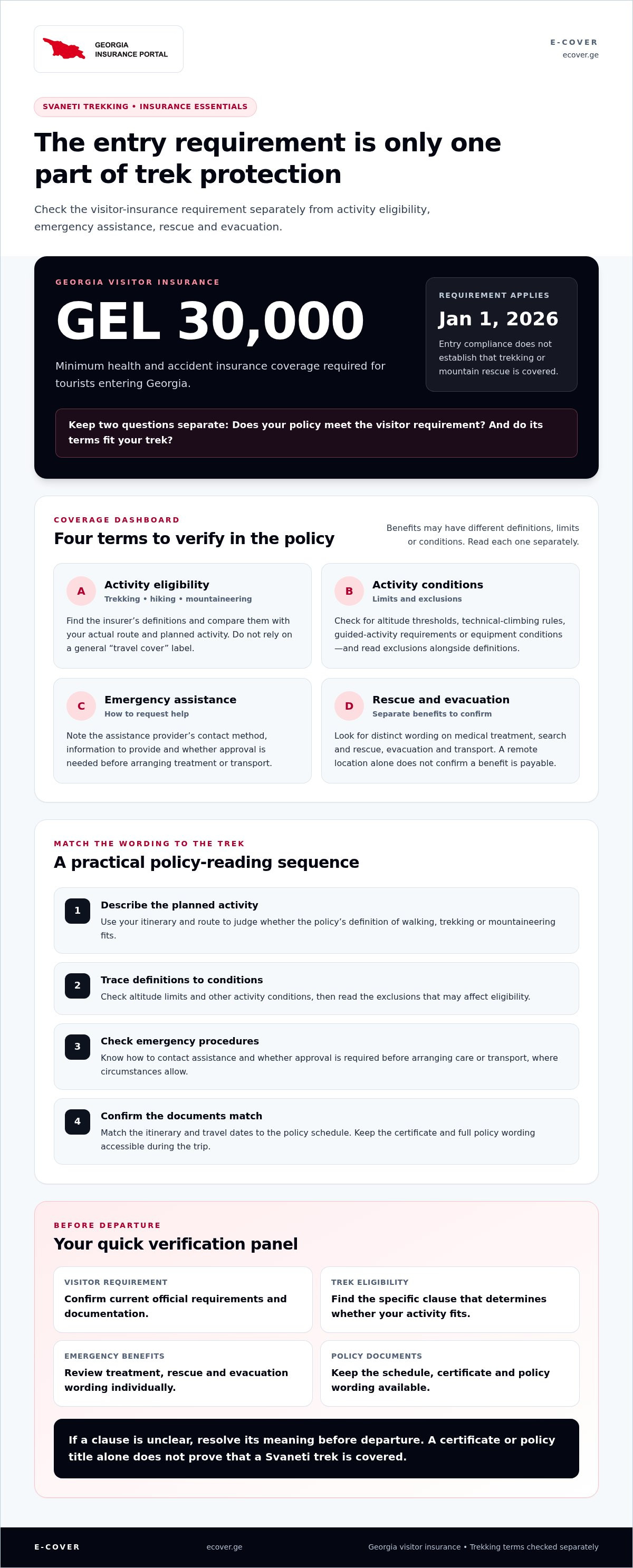
A pre-departure checklist for trekking insurance documents and emergency readiness
Before leaving for Svaneti, check that your itinerary, policy schedule, and policy wording are consistent. A certificate may be useful for visitor-insurance documentation, while the full wording explains applicable activities and benefits. Keep both accessible, along with the assistance instructions. These steps help you prepare travel insurance for Svaneti trekking without relying on a document you can’t retrieve when needed.
Five checks to complete before departure
- Write down your full itinerary. Include arrival and departure dates, trekking days, and any other planned activities. Use it as your reference when checking the policy.
- Match dates to the policy schedule. Confirm that the coverage period includes the entire trip, not just the days on the trail. If your plans change, compare the revised dates with the schedule.
- Compare activities with the wording. Check how the policy describes your planned trekking and other activities. Review applicable conditions and limits rather than assuming a general activity label is sufficient.
- Review the certificate and policy wording together. Check that traveller details and coverage dates are consistent, and that the certificate contains the information required for your purposes. Keep the full wording, not only a summary or certificate.
- Save the documents for offline use. Download the certificate, policy wording, and assistance instructions to your phone or another accessible device. Keep a separate backup, such as a printed copy, in case your device is unavailable.
What to prepare for an emergency on the trek
Make key details easy to find. Keep your policy identification and assistance contact instructions somewhere you can reach quickly, and tell a trusted contact how to access the relevant documents if needed. Before setting out, share an appropriate itinerary and agree on a check-in plan. That person should know what to do if you miss an expected check-in.
Insurance is one part of preparation, not a substitute for it. Follow local guidance and emergency instructions, and make decisions with current conditions in mind. If the policy requires you to contact its assistance provider or obtain approval before arranging services, learn that process in advance and follow it where circumstances allow.
Visitor-entry documentation and cover for trekking-related events are separate checks. Review current rules and document requirements in Georgia’s mandatory insurance law requirements, then assess your policy wording against your plans. To arrange Georgia visitor medical insurance online and receive a digital certificate, get your visitor insurance documentation.
Arrange Georgia visitor insurance with E-COVER before your Svaneti trek
Once you’ve compared policy wording with your itinerary, arrange visitor-insurance documentation as a separate part of trip preparation. E-COVER provides online travel medical insurance for international visitors to Georgia. Policies are issued instantly online with a digital certificate. These documents support the visitor-insurance step, but they don’t by themselves establish that a particular trek, rescue, or evacuation is covered.
For travel insurance for Svaneti trekking, keep two questions distinct: does your documentation meet current visitor-insurance requirements, and do the issued policy terms address your planned activities? The certificate shows policy details, while the full wording sets out applicable benefits, conditions, and exclusions. Review both before departure.
What to do when arranging your Georgia visitor policy
- Enter traveller and trip details accurately. Use the correct personal information and dates for each traveller. Check the dates against your complete itinerary, including travel days before and after the trek.
- Review the issued documents. When the policy is issued, compare the certificate details with the information you entered. Retain the full policy wording alongside it, since the certificate may not contain all activity conditions or benefit terms.
- Check current official requirements. Verify the visitor-insurance rules and document requirements that apply to your travel dates. Don’t assume a previous trip’s requirements or an older policy document is still sufficient.
- Compare the policy wording with your plans. Look for activity definitions, restrictions, and emergency terms relevant to your itinerary. If your trek or travel dates change, revisit the documents rather than assuming the original details still fit.
Take the next step with E-COVER
E-COVER offers an online way to arrange visitor medical insurance for Georgia, with instant policy issuance and a digital certificate. After receiving the documents, save the certificate and full wording for offline access, and review activity terms separately. This keeps entry-related documentation and trekking-specific policy fit clear and distinct.
Arranging visitor insurance is one practical step in preparing for your trip. It doesn’t replace checking what the issued policy says about your Svaneti plans or following appropriate mountain safety guidance. Confirm current official requirements, make sure your documents match your trip, and keep assistance instructions readily available.
Arrange your Georgia visitor travel insurance online and retain the issued certificate and policy wording with your pre-departure documents.
Set out with your next steps in place
Your Svaneti plans deserve preparation that reflects the trip you’re taking. Before departure, use your itinerary as the reference point for reviewing your insurance documents, and leave time to resolve unclear policy terms. This helps you start the journey with greater confidence.
E-COVER provides online travel medical insurance for visitors to Georgia, with instant policy issuance and a digital certificate. It’s operated by LLC Insurance Broker WeInsure, licensed by Georgia’s Insurance State Supervision Service under License N012063. As you arrange travel insurance for Svaneti trekking, remember that visitor documentation and activity-specific protection are separate considerations. Review the issued policy wording against your plans rather than assuming trekking, rescue, or evacuation is covered.
When you’re ready to arrange your Georgia visitor insurance, get your policy online and keep its documents accessible as part of your trip preparation. A clear plan now can make it easier to focus on the experience ahead. Enjoy your time in Svaneti, and trek thoughtfully.
Frequently Asked Questions
Is travel insurance for Svaneti trekking different from standard travel insurance?
It can be, depending on how the policy defines trekking and other outdoor activities. For travel insurance for Svaneti trekking, compare those definitions with your route and activity level, including any planned guided or technical sections. Check for altitude conditions or exclusions, and review emergency assistance and evacuation terms. A general “travel insurance” label doesn’t settle eligibility. Use the issued policy’s benefits and conditions.
Does Georgia’s 2026 insurance requirement automatically cover trekking in Svaneti?
No. Meeting an entry-related insurance requirement and having cover for a trek are separate questions. A policy may satisfy visitor requirements while applying conditions or exclusions to trekking. Georgia requires mandatory visitor health insurance from January 2026. Before travelling, verify the current official rules, then check the policy wording for your planned activities. Keep evidence of entry-related insurance, but don’t treat it as confirmation of rescue or evacuation benefits.
Can travel insurance cover emergency evacuation during a Svaneti trek?
It may, but evacuation depends on the individual policy’s benefits, definitions, exclusions, and conditions. Look for terms covering emergency transport or evacuation, including any prior-approval requirement and instructions for contacting the assistance provider. Check who must authorize transport and what to do if immediate action is necessary. A remote location doesn’t make evacuation automatically payable, so save contact instructions offline before setting out.
How do I check whether trekking is covered by my travel insurance?
Search the full policy wording for “trekking,” “hiking,” “mountaineering,” “altitude,” and “adventure activities.” Compare the definitions with your actual route and plans, including guided or technical sections. Then check related exclusions, safety requirements, and assistance conditions. If a phrase such as “non-technical walking” appears, make sure it describes your activity accurately. Don’t infer cover from a product name or summary. Use the final issued documents.
When should my travel insurance start for a Svaneti trekking trip?
Set the policy period to match your full itinerary, including travel days before and after the trek. For example, if you arrive before your first walking day, make sure that arrival date falls within the insured period. Compare the certificate dates with your transport and accommodation plans, and check that no planned activity falls outside the policy dates. If your itinerary changes, review the policy terms to see whether an update is needed.
What documents should I carry while trekking in Svaneti?
Keep your insurance certificate, full policy wording, and assistance contact instructions available during the trek. Download them for offline access and consider carrying a paper copy separately from your phone. Keep identification and a trusted contact’s details accessible too. Share your planned route and expected check-in arrangements with someone you trust. Insurance documents help you follow the policy process, but they don’t replace local safety guidance or practical emergency preparation.
Does travel insurance for Georgia cover pre-existing medical conditions during a trek?
Coverage depends on the policy’s definitions, exclusions, and requirements for declaring health conditions. Read the relevant wording before purchase and answer application questions accurately. Check whether a condition must be declared and whether the policy describes restrictions related to treatment or activities. Don’t assume general medical benefits include a pre-existing condition. Review the issued documents to understand the terms that apply to your circumstances and planned trek.


