

For travelers asking what insurance is accepted in Georgia, the key starting point is the entry requirement: starting January 2026, the Georgian government requires all international travelers to have mandatory health insurance. This establishes the need for coverage, while the policy’s benefits and your share of medical costs depend on its terms.
It’s reasonable to want a clear answer before departure, especially when insurance terms can affect what you pay for care. This guide explains how travel insurance accepted in Georgia relates to deductibles, copays, coinsurance, and out-of-pocket maximums, so you can understand how each term may affect your budget.
The sections ahead explain travel insurance in this context, why a plan’s deductible and cost-sharing terms matter, and what an out-of-pocket maximum means when a plan includes one. These basics help you read coverage details more confidently and distinguish Georgia’s entry requirement from the amount you may owe for care.
Key Takeaways
- Learn how travel insurance coverage differs from the amount you may pay when you receive medical care.
- Understand how deductibles, copays, and coinsurance affect your share of covered costs.
- Use the details of your benefit plan to identify what to clarify about a Georgia provider’s network and coverage.
- See how E-COVER travel, student, long-term travel, and digital nomad insurance policies can support different travel needs.
Travel insurance
Travel insurance is a policy designed to address risks linked to a trip, including specified medical expenses. For international visitors, it is important to distinguish travel coverage from a domestic health insurance plan. Starting January 2026, the Georgian government requires all international travelers to have mandatory health insurance. That requirement concerns visitors entering Georgia, not which American insurance company a Georgia-based medical provider accepts.
Medical coverage describes the care services a policy may pay for, subject to its terms. Review benefits for treatment, exclusions, and the dates and territory covered. A policy’s name alone does not explain whether it covers a particular service or how much you may owe. For example, emergency medical treatment and routine primary care may be handled differently, so check each benefit category separately.
A deductible is the amount a policyholder pays toward eligible expenses before the plan begins paying under the relevant benefit. A copay is a set amount paid for a covered service, while coinsurance is a share of its eligible cost. These terms affect your portion of a claim. A plan may apply a deductible to one service and coinsurance to another. The policy wording determines which rule applies.
An out-of-pocket maximum is a plan limit on certain costs the insured pays for covered care. Its scope depends on the plan, so don’t assume every charge counts toward it. Check whether the policy defines a maximum, which services qualify, and how the limit applies during the trip. This helps distinguish the coverage provided by insurance from your potential share.
For American health plans, one federal rule concerns insurer spending, not travel-policy acceptance. According to the Centers for Medicare & Medicaid Services, the Affordable Care Act requires health insurers in the individual and small group markets to spend at least 80 percent of premiums on health care services and activities to improve health care quality. According to the Centers for Medicare & Medicaid Services, an insurer that does not spend at least 80 percent of premiums on health care services and quality-improvement activities must rebate the difference. These rules do not establish that a particular plan covers care in Georgia.
Names such as Anthem and UnitedHealthcare identify insurance companies or health plans, but the name alone doesn’t establish travel coverage in Georgia. A domestic plan’s network and benefits may differ from a travel policy’s terms. Being eligible for a health plan also does not show which services it covers during a trip. The country, treatment type, network arrangement, and policy conditions all matter.
Use these steps to assess the medical section of a travel policy:
- Identify the territory and travel dates stated in the policy.
- Review covered medical services, exclusions, and any claim conditions.
- Find the deductible, copay, coinsurance, and any out-of-pocket maximum.
- Separate entry-related health insurance requirements from questions about a provider’s network.
For a visitor to Georgia, start with a policy that meets the government’s mandatory health insurance requirement. Then review its medical benefits and cost-sharing terms. This clarifies what the policy is intended to cover and what you may owe for eligible care.
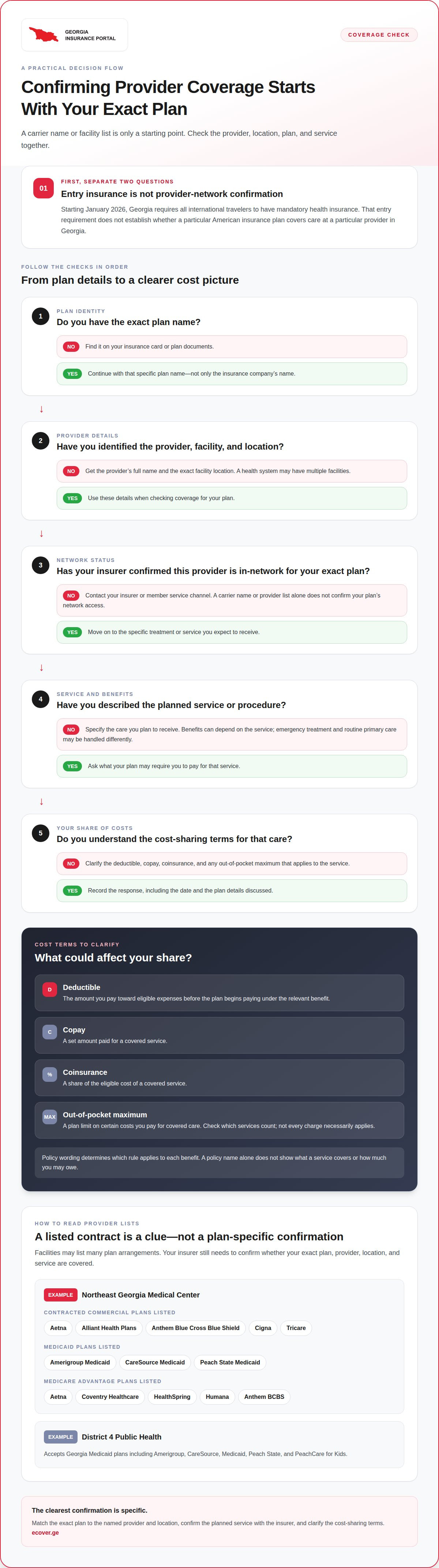
How can I check whether a Georgia provider accepts my insurance?
In-network access means your specific benefit plan recognizes a provider for coverage purposes. Check with your insurance company, because access depends on the benefits attached to your plan. A carrier’s name alone does not establish that a particular clinic, hospital, or service is covered.
A contracted plan is an insurance plan a provider lists among its arrangements. Georgia facilities may contract with different commercial, Medicaid, and Medicare plans. For example, Northeast Georgia Medical Center lists Aetna, Alliant Health Plans, Anthem Blue Cross Blue Shield, Cigna, and Tricare among contracted commercial plans. That list may help identify possibilities, but it does not confirm whether your exact plan applies.
Plan-specific coverage means the benefits and network rules attached to your individual insurance plan. Before receiving medical services, use your insurer’s member service channel to ask whether the named provider is in-network for your plan. Emory Healthcare advises patients to contact their insurance company to clarify coverage before services. Have the provider’s full name and location available, since a health system may have multiple facilities.
Use a focused sequence to get a useful answer:
- Find the exact plan name on your insurance card or plan documents.
- Identify the provider, facility, and location where care is planned.
- Ask the insurance company whether that provider is in-network for your specific plan.
- Describe the service or procedure, since benefits can depend on the care provided.
- Ask what your plan may require you to pay for that service.
- Record the response, including the date and the plan details discussed.
Medicaid acceptance refers to whether a provider lists a particular Medicaid plan. Northeast Georgia Medical Center lists Amerigroup Medicaid, CareSource Medicaid, and Peach State Medicaid among accepted Medicaid plans. District 4 Public Health accepts Georgia Medicaid plans including Amerigroup, CareSource, Medicaid, Peach State, and PeachCare for Kids. These examples show why checking the specific facility and plan matters.
Medicare Advantage acceptance means a provider lists a particular Medicare Advantage plan, not simply that it accepts Medicare-related coverage generally. Northeast Georgia Medical Center lists Aetna, Coventry Healthcare, HealthSpring, Humana, and Anthem BCBS Medicare Advantage plans. For a planned appointment, ask the insurer about the exact facility and service, then compare the answer with the provider’s plan listing.
Out-of-network status means a provider is outside the network recognized by a particular insurance plan. Northeast Georgia Health System is out of network with United Healthcare. Emory Healthcare lists United Healthcare commercial plans as accepted, but excludes Cigna LocalPlus and Cigna Connect from its general accepted commercial-plan listing. These examples show why a carrier-wide answer can mislead: acceptance differs by provider and plan.
For a practical final check, confirm the provider and plan together, then ask about the specific service. A hospital’s general listing may not resolve coverage for every procedure or benefit. The insurer can clarify how the benefit plan applies, while the provider’s listing helps identify the plans it contracts with. Keep these details together before scheduling care.
Make clear that you need an answer for your specific benefit plan, not a general statement about the insurer’s network. Give the provider’s full name and the location where you expect to receive care, then describe the service. Ask the insurance company to confirm whether that provider and service are treated as in-network under your plan. If the answer is unclear, explain what needs clarification and ask the representative to check the plan details before you rely on the response.
Ask the representative to explain any conditions attached to the coverage answer, including whether it applies to the particular location and service you described. Keep a record of the response and the details you gave, so you can refer to the same information when speaking with the provider. If the provider’s office gives a different answer, contact the insurance company again and ask it to review the exact plan and care you have in mind. Coverage depends on the specific benefit plan. A broad statement that a provider accepts an insurer does not, by itself, confirm in-network access for your plan. Check before care whenever possible, and seek clarification rather than treating an uncertain answer as confirmation.
E-COVER
E-COVER provides travel insurance policies for foreign visitors to Georgia. The policies are designed to meet the country’s mandatory health insurance requirements for international travelers. This is a practical next step when a domestic health plan’s provider network does not answer whether your trip coverage meets the entry requirement.
Choose coverage suited to your travel circumstances. E-COVER also offers student insurance, long-term travel insurance policies, and digital nomad insurance. Review the policy terms to understand the covered medical services and your share of eligible costs, including any deductible or coinsurance that applies.
If you’re preparing for travel to Georgia and need coverage, contact E-COVER to discuss your insurance needs.
Make your next coverage decision with confidence
Understanding what insurance is accepted in Georgia is only one part of preparing for a trip. The next step is choosing coverage that fits your reason for traveling and the time you’ll spend away. Read the policy terms with your plans in mind, so the benefits suit your circumstances.
E-COVER offers Travel Insurance Policies, Student Insurance, and Long term travel insurance policies. These options suit different travel situations, so consider which category best reflects your plans before reviewing the relevant coverage details. A clear choice can make it easier to prepare the documents and information you’ll need for your journey.
For help considering your travel insurance needs, contact E-COVER. Take the next step when you’re ready, and prepare for your trip with greater clarity.
Frequently Asked Questions
What types of insurance are accepted in Georgia?
Visitors should distinguish entry coverage from provider acceptance. If asking what insurance is accepted in Georgia, compliant travel medical insurance is required for foreign visitors from January 1, 2026. For a specific appointment, what insurance is accepted in Georgia depends on the plan’s network and benefits. Entry coverage must be purchased before or at entry, meet the 30,000 GEL minimum aggregate and four-day minimum, and be issued in Georgian and English. Occupied territories are excluded.


