

Could a travel insurance policy that covers medical emergencies still fall short at the Georgian border? Since January 1, 2026, foreign tourists entering Georgia need health and accident insurance with at least 30,000 GEL in coverage, valid for their entire stay. To determine whether your policy is acceptable insurance for Georgian border checks, look beyond its general coverage and review what the policy document actually states.
It’s reasonable to wonder whether an existing or foreign-issued policy will meet the requirement, especially if its certificate is brief or uses unfamiliar wording. Policies from Georgian and foreign insurers can be accepted, but the document needs to clearly show key details, including the insured person, coverage dates, risks and limits. It must also be in English or Georgian.
This guide explains how to compare general travel insurance with Georgia’s 2026 entry requirements, which policy and certificate details to review, and how to prepare clear proof before departure. If you need a Georgia-specific option, E-COVER provides online travel medical insurance with a digital certificate, so you can arrange and review your documents before your trip.
Key Takeaways
- Check whether your policy meets Georgia’s current entry requirements. Familiar travel insurance branding alone doesn’t establish that it qualifies as acceptable insurance for Georgian border checks.
- Review the certificate for clear details about who is insured, when cover applies, what it covers, and the stated limits.
- Compare existing, annual, or employer-provided insurance against the same criteria. Don’t assume it’s suitable just because it covers international travel.
- Verify the latest requirements, review your policy, and prepare clear proof before departure. Check everything again before you travel.
- A Georgia-specific online policy can offer a straightforward way to arrange travel medical insurance and receive a digital certificate.
What Makes Insurance Acceptable at the Georgian Border in 2026?
Acceptable insurance for the Georgian border is a policy that meets Georgia’s current visitor insurance rules and provides clear evidence of the required cover. A policy may offer useful medical protection but still needs to be checked against the entry requirement. The practical test isn’t whether a document simply says “travel insurance”. It’s whether the cover and supporting policy details align with the rules in force when you travel.
From January 1, 2026, foreign tourists entering Georgia are required to have health and accident insurance. The stated minimum coverage is 30,000 GEL. This entry-related obligation is separate from the broader question of how much medical or travel protection you may want for your trip. Since rules can change, confirm the current requirements before relying on an existing policy.
Georgia is a country at the intersection of Europe and Asia. The Georgia (country) page provides background that can help distinguish the destination from places with similar names. For insurance, the relevant question is whether your policy meets Georgia’s entry rules, not where the insurer is based or how familiar its brand is.
How is mandatory visitor insurance different from general travel insurance?
General travel insurance is designed to protect a traveller against covered costs and disruptions according to the policy’s terms. Mandatory visitor insurance serves an additional purpose: it must satisfy the insurance condition set for entry. These purposes can overlap, but one doesn’t automatically prove the other. A policy title, sales description, or broad promise of “worldwide cover” isn’t enough on its own to establish compliance.
That doesn’t mean every international policy is unsuitable or that every policy labelled for travel qualifies. The terms matter. Treat an existing policy as a candidate, then compare its actual coverage and documents with the current Georgian requirements. The next sections show how to assess those details without relying on assumptions.
Who should check the Georgian requirement before travelling?
Foreign tourists planning to enter Georgia should check whether the requirement applies to their trip, regardless of visa status. The rules include certain exemptions, so travellers should verify their circumstances against current official guidance. This article focuses on insurance for visitors, not visa-processing or residency advice.
Start with two questions: “Am I entering Georgia as a tourist?” and “Does the current rule require insurance for my circumstances?” If the answer may be yes, review your policy before departure rather than waiting until travel day. A Georgia-specific travel medical policy is one way to address the requirement, but read the policy and its proof carefully.
Keep the distinction clear: having insurance and being able to demonstrate that it meets an entry requirement are related, but not identical. The following sections turn that principle into practical checks, starting with what the policy and certificate need to show.
Which Policy and Certificate Details Should You Check?
Review the policy itself, not just a wallet card or short summary. A certificate can show that insurance has been arranged, but the policy terms define the actual cover. A policy certificate is evidence of the insurance contract and its stated cover, subject to the policy’s terms and conditions. For acceptable insurance for Georgian border checks, both the cover and the information presented need to be clear.
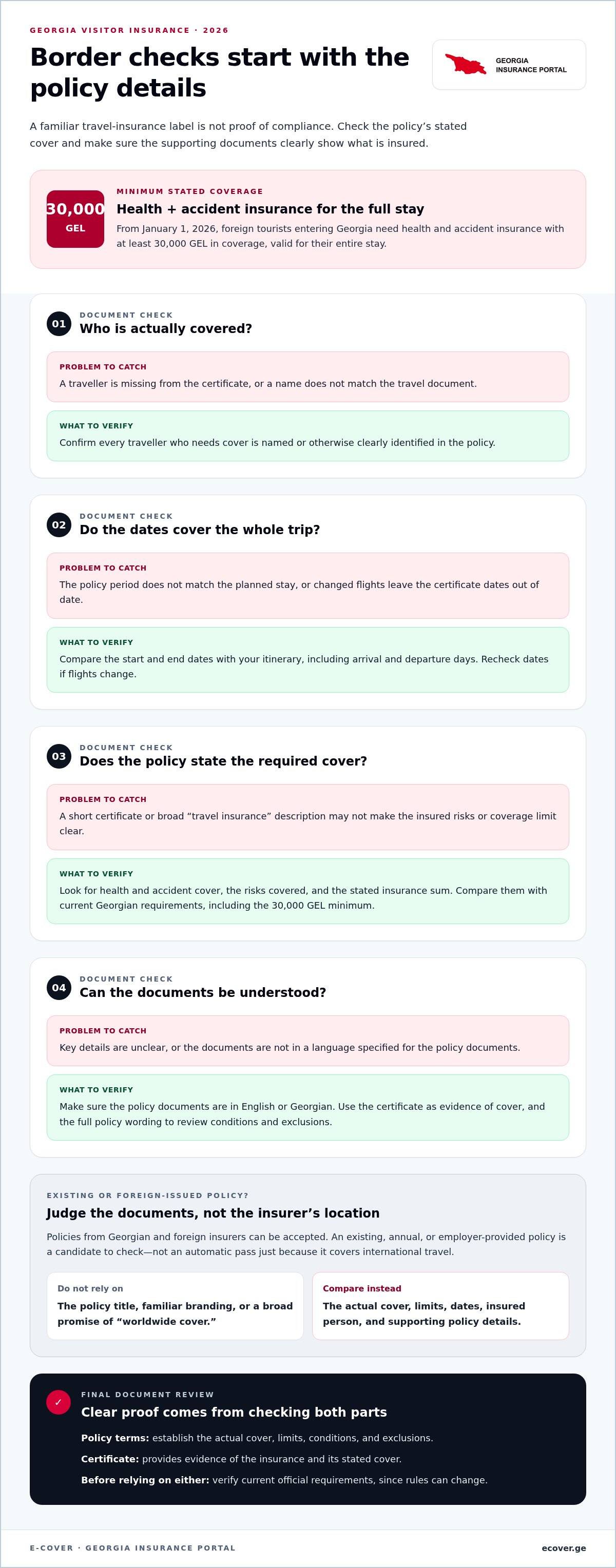
Separate the legal test from practical document checks. The current requirement, as described by the U.S. Embassy in Georgia, includes health and accident insurance with at least 30,000 GEL in coverage for the full stay. Verify current official guidance before relying on a threshold or specific document rule, since requirements can change. Document clarity helps you spot mistakes, but it doesn’t replace the legal criteria.
- Insured person: Confirm every traveller who needs cover is named or otherwise clearly identified in the policy.
- Coverage dates: Compare the start and end dates with your itinerary, including arrival and departure days.
- Scope of cover: Check that the policy describes health and accident insurance and states the risks covered.
- Limits and terms: Locate the insurance sum and read the full wording for conditions or exclusions that may affect the stated benefits.
Does the certificate identify the traveller and cover period clearly?
Compare each insured person’s name with the travel document they’ll use. A spelling difference, missing name, or certificate issued for only one member of a travelling group can raise questions about who is covered. Then check that the dates match the planned stay. If flights change, revisit the dates rather than assuming the original period still fits.
How can you check the coverage wording and limits?
Find the stated benefits, insured risks, coverage territory, and insurance sum in the policy documents. Compare them with current official Georgian requirements, including the minimum limit and required types of cover. A short certificate may not include every condition, so use it alongside the full policy wording. Don’t infer that a benefit is included just because it appears in a general sales description.
For a practical review, keep the certificate and full policy together, then check that the names, dates, and stated limits are consistent. A mismatch doesn’t determine what border officials will decide, but resolving it before travel can make your proof easier to understand. If you need a Georgia-specific option, online travel medical insurance for Georgia comes with a digital certificate.
Can an Existing or Foreign-Issued Policy Be Acceptable?
An existing policy may be worth reviewing, but its brand name or “worldwide” label doesn’t establish that it meets Georgia’s visitor insurance requirement. A policy issued outside Georgia isn’t automatically unsuitable either. Assess the actual contract against current official requirements, including the required types of cover, coverage limit, territory, and dates. For acceptable insurance for Georgian border checks, the policy details matter more than where you bought it.
Use the same review for every type of cover. The table below shows what to verify, not whether a particular policy will be accepted.
| Policy type | What to verify |
|---|---|
| Existing single-trip policy | Named travellers, Georgia in the covered territory, journey dates, and relevant benefits and limits. |
| Annual or multi-destination policy | Whether the current trip falls within its dates and territory, and whether its cover matches current requirements. |
| Employer-provided policy | Which family members or employees are insured, the applicable dates and territory, and the actual policy wording. |
| Newly purchased policy | Whether its full terms and proof clearly address the current Georgian requirements. |
Can an annual or multi-destination policy meet the requirement?
Possibly, but the annual label alone doesn’t settle the question. Check that the policy covers Georgia, applies to every traveller who needs insurance, and remains valid throughout the planned stay. Then compare the relevant benefits and limits with current official criteria. Annual cover can include conditions that affect a particular trip, so read the policy wording rather than relying only on a summary or card.
What if a policy certificate uses unfamiliar wording?
Insurance terms vary. One document may use different benefit labels from another, so compare what the contract actually covers with the verified requirement language. Read the full wording, including relevant definitions and exclusions. Don’t infer compliance from a certificate title or marketing description alone. If a benefit or limit remains unclear, rely on the complete policy wording when assessing whether the cover matches the requirement.
For each policy, check the same core points side by side:
- Who is insured, and whether the names match the travellers.
- Whether Georgia is within the covered territory.
- Whether coverage dates match the full planned stay.
- Whether the stated benefits and limits align with current official rules, including the 30,000 GEL minimum reported for the 2026 requirement.
Check that threshold and any other legal detail against current official guidance before relying on them. An unclear phrase or mismatch doesn’t predict a border decision, but resolving it in advance can make your documents easier to understand. If your existing cover doesn’t clearly address the requirement, compare it with a Georgia-specific travel medical policy using the same criteria.
How to Verify Your Insurance Before Travelling to Georgia
A reliable check has three stages: confirm the current rule, compare it with the policy, then prepare the proof you’ll carry. Complete the first review before buying insurance and repeat it before departure. Requirements and travel plans can change, so an earlier check shouldn’t be your only one.
For the 2026 requirement, the reported criteria are health and accident insurance with at least 30,000 GEL in coverage for the full stay, including arrival and departure dates. The policy must state key contract and coverage details. Check current official guidance for exact rules on language and presentation format. The U.S. Embassy in Georgia’s notice provides context, but verify the latest applicable instructions before travelling.
- Check the rule. Review current official Georgian guidance for who must be insured, required coverage, policy dates, and any rules about the document itself. Do this before purchase so you know what your policy needs to show.
- Review the policy. Compare its stated benefits and limits with the verified requirements. Confirm Georgia is within the covered territory, each relevant traveller is insured, and the coverage period matches the itinerary. Read the full terms if a summary leaves a benefit or condition unclear.
- Prepare the proof. Check that the certificate and policy wording are consistent, legible, and easy to access. Follow current official instructions for acceptable formats rather than assuming that a particular language or paper or digital version will meet the rules.
What should you do after checking the current requirement?
Match the policy wording and limits to the rule you’ve verified, then compare the insured names and dates against each traveller’s documents and itinerary. A small difference, such as a misspelled name or a coverage end date before the planned departure, may make the paperwork harder to interpret. Resolve discrepancies before travel rather than assuming they’ll be treated as immaterial.
Repeat this review shortly before departure, especially if your itinerary or policy has changed. A final comparison can catch a date mismatch or replacement document that wasn’t available when you first checked. Keep the official rule you relied on easy to find, so you can confirm the requirements again if guidance is updated.
How should you prepare your insurance proof for travel?
Save the issued certificate and full policy somewhere you can access during the journey. Check the latest official instructions for the required presentation format and follow them. Don’t rely on assumptions about printouts, electronic copies, or language. For a broader overview of Georgia’s mandatory visitor insurance rules, consult the article’s mandatory-insurance guide alongside official sources.
If you need a Georgia-specific policy, get travel medical insurance online with E-COVER and receive your certificate digitally. Review the issued documents against current requirements before your trip.
Get Georgia-Compliant Travel Medical Insurance Online with E-COVER
If your current policy doesn’t clearly match Georgia’s visitor insurance requirements, a Georgia-specific travel medical policy is a direct alternative to consider. E-COVER provides online travel medical insurance for foreign visitors to Georgia. Its policies meet the state-mandated coverage requirements taking effect in January 2026. As with any policy, review the issued documents against current rules and your travel dates. No policy or certificate can guarantee a border decision or entry.
E-COVER is operated by LLC Insurance Broker WeInsure, which is licensed by Georgia’s LEPL Insurance State Supervision Service under License N012063. This identifies the broker’s stated licence. It doesn’t mean the regulator endorses a particular policy or guarantees an outcome at the border. The practical next step is to check the official requirement, then make sure your policy details and certificate are clear and consistent.
What can travellers expect from E-COVER’s online policy process?
The platform issues travel medical insurance policies online for visitors to Georgia, with instant online issuance and a certificate delivered digitally. After obtaining a policy, review the certificate and its supporting details. Confirm that the insured traveller and coverage dates match your plans, then compare the stated cover with the requirements in force for your trip.
For broader context on travel cover for visitors, use the article’s travel insurance for Georgia guide alongside current official information. The guide can help you understand the visitor insurance topic, while the policy documents show the specific cover issued to you. Keep those purposes distinct: general guidance explains the rules, while your own documents are what you need to review for names, dates, and terms.
What should you do next if you still need cover?
Before obtaining a policy, confirm the current requirement and check the dates and details of your planned stay. If you need cover, use E-COVER’s online service to obtain travel medical insurance for visitors to Georgia. Once the certificate is issued, compare it with the official criteria and resolve any discrepancies before departure.
These steps help you prepare clear proof rather than relying on a familiar policy label or assuming what a certificate contains. For acceptable insurance for Georgian border requirements, what matters is the fit between the current rules, your actual policy terms, and the documents you carry. Get Georgia travel medical insurance online and review your certificate before travelling.
Set a Final Insurance Check Before You Travel
Make your insurance review a checkpoint, not a task you complete once and forget. After your itinerary is settled, compare your policy with the current requirements and keep the proof with your travel documents. If dates or travel arrangements change, revisit the policy details before departure. This helps you catch a mismatch while there’s still time to address it.
The goal isn’t to judge a policy by its brand or title. Make sure the cover and documentation align with the rules that apply to your trip. That’s the practical standard for acceptable insurance for Georgian border requirements, although no policy can guarantee a border decision or entry.
If you still need cover, explore E-COVER’s Georgia visitor travel medical insurance and review the issued documents before travelling. Get travel medical insurance for your trip to Georgia. A little preparation now can help you set off with greater confidence.
Frequently Asked Questions
Can travel insurance from my home country meet Georgia’s entry requirement?
Yes, an overseas-issued policy may meet the requirement if its terms align with current Georgian rules. Where you bought it doesn’t determine its suitability. For example, check whether the policy covers treatment in Georgia and whether any territorial restriction affects your trip. If the wording uses unfamiliar benefit names, read the full contract and compare it with official guidance. That’s more reliable than relying on the insurer’s brand or a sales summary.
Does a visa or visa-free entry remove the need for travel medical insurance?
No. Immigration permission and insurance are separate requirements. A visa or visa-free travel arrangement doesn’t by itself prove that you have the insurance required under current Georgian rules. Before departure, check the latest official guidance for your circumstances, especially if your travel purpose or status differs from a standard tourist visit. Keep your insurance certificate with your other travel documents so you can refer to it if requested.
Do children travelling with an adult need their own insurance proof?
Check that each child is covered and identifiable in the policy, even if an adult purchased the plan. For example, a family certificate might name everyone together, while another policy may issue separate records. Don’t assume an adult’s certificate automatically shows a child’s cover. Review the policy schedule or list of insured people, and verify the current Georgian rules for each traveller before setting off.
Does buying compliant insurance guarantee entry into Georgia?
No. Insurance can address the applicable insurance requirement, but it doesn’t guarantee entry or determine other border decisions. Entry conditions may depend on matters separate from your policy. Before travelling, check the official rules relevant to your trip and make sure your insurance documents accurately reflect the cover you purchased. Treat statements in a sales description as product information, not as a promise about what an authority will decide.
Is a screenshot of an insurance certificate enough as proof?
Don’t assume a screenshot is sufficient unless current official instructions say it is. A screenshot might crop out policy dates or other details, so keep the complete issued certificate accessible in its original form as well. Check the current rules for accepted presentation formats before departure. Whatever format you use, confirm that the document is readable and shows the information needed to identify your cover.
What should I do if my travel dates change after I buy insurance?
Compare the new itinerary with the dates on your policy as soon as plans change. If your return moves beyond the listed end date, the document may no longer reflect your actual trip. Review the policy’s amendment process and arrange any needed update through the issuing platform before departure. Then save the updated certificate and check that it reflects the revised dates rather than an earlier version.
Does travel insurance for Georgia replace a visa or residence permit?
No. Travel medical insurance isn’t a visa, residence permit, or immigration approval. It concerns insurance cover, while permission to enter or remain is governed separately. Check official immigration information that applies to your nationality, purpose of travel, and planned stay. Keep insurance documents distinct from immigration paperwork, and don’t treat one as a substitute for the other. A Georgia-specific policy can address the insurance side, but it doesn’t resolve immigration status.


