

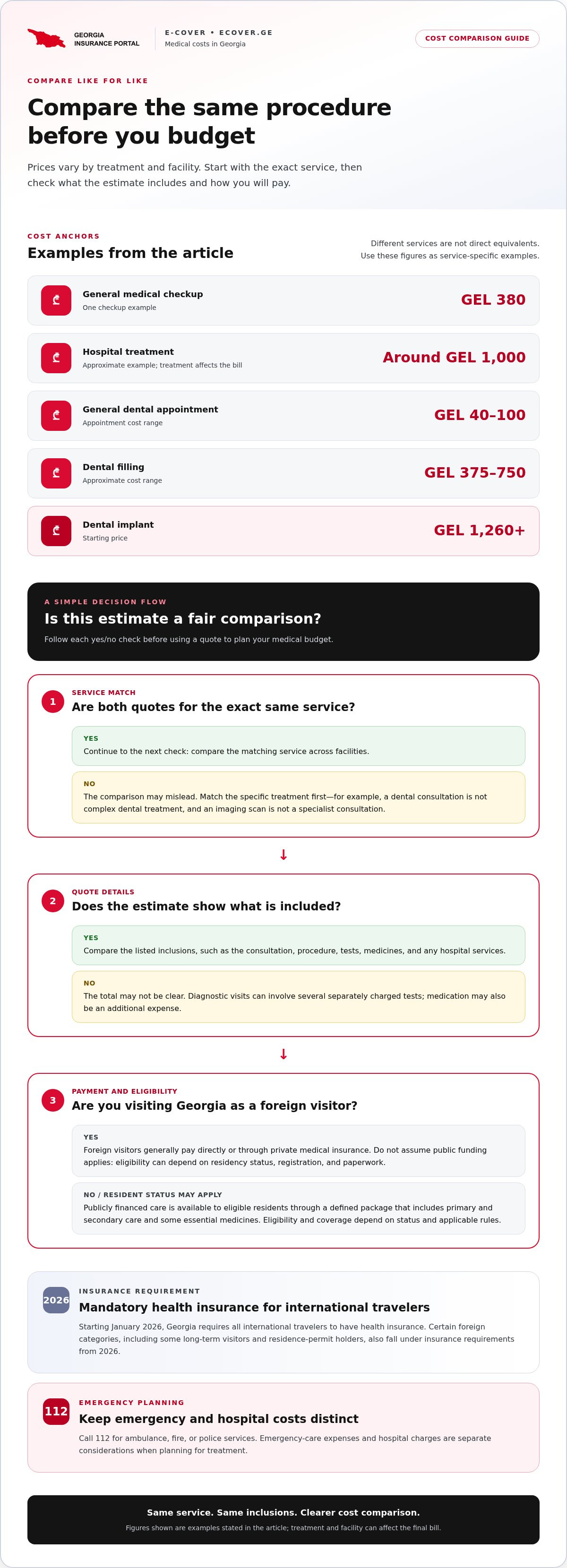
Dental care in Georgia can be manageable for foreign visitors: a general appointment costs GEL 40-100, while a filling costs around GEL 375-750 and dental implants start at GEL 1,260. The cost of medical care in Georgia for foreigners depends on the treatment, so a routine visit and a more involved procedure can mean very different expenses.
It’s sensible to plan your budget before seeking care, especially since costs can vary by facility and service. This guide explains what affects medical bills in Georgia, how to compare estimates, and how to prepare for possible treatment expenses as a foreign visitor.
You’ll also see how to compare expected costs across major cities and facilities, what emergency and hospital care may cost, and how payment arrangements can affect foreign visitors. With these details, you can plan for routine treatment and better understand the financial considerations if you need care during your stay.
Key Takeaways
- Compare the same procedure across facilities, and look at what the quoted price includes before estimating your total.
- Understand how public healthcare eligibility differs for foreign visitors and why many pay directly or use private insurance.
- Compare access to care in major cities by considering the type of treatment and facility, not just the city name.
- Budget separately for emergency care and hospital stays, since severity, room type, and treatment affect costs.
- Prepare for your trip by understanding the health insurance requirement for international travelers starting January 2026.
Comparing median medical procedure costs across Georgia facilities
Procedure prices vary by treatment and facility, so compare the same service before budgeting. For example, hospital treatment is around GEL 1,000, while a general medical checkup is around GEL 380.
Routine and Maternity Care Costs
Routine and maternity care covers preventive services and treatment, including physiotherapy, vaccinations, prenatal consultations, and childbirth. These examples involve different stages of care, so compare the specific service you need rather than treating every appointment as the same expense.
Dental Care and Medication Costs
Dental care covers appointments and procedures, while prescription medication is an additional treatment expense. A general dental appointment costs GEL 40-100, fillings are around GEL 375-750, and dental implants start at GEL 1,260.
Imaging and Laboratory Test Costs
Imaging and laboratory costs depend on the specific test a clinician orders. A diagnostic visit may involve several separately charged tests, so ask for an itemized estimate rather than assuming everything is included in one fee.
Costs for Foreign Citizens
Foreign visitors generally pay for medical services themselves or through private medical insurance. The facility, procedure, and treatment required all affect the bill. When comparing estimates, check that they cover the same service and inclusions.
Starting January 2026, Georgia requires all international travelers to have mandatory health insurance. From 2026, insurance is also mandatory for certain foreign categories, including some long-term visitors and residence permit holders.
In Georgia, call 112 for ambulance, fire, or police services; distinguish emergency-care expenses from hospital charges when planning.
Is healthcare expensive in Georgia?
Georgia has both publicly financed services and private providers, but costs depend partly on eligibility and the care setting. For foreign visitors, access to public subsidies can depend on residency status, registration, and paperwork, so don’t assume that public funding will apply.
Public Healthcare and State-Funded Services
Georgia’s Universal Health Coverage Program, established in 2013, makes a defined package of publicly financed care available to eligible residents. The package includes primary and secondary care, plus some essential medicines, and reforms extended access to almost 90% of residents.
Eligibility is not the same for every foreign resident. Legal status, registration, and completed paperwork affect whether an expat qualifies for the full subsidy. State funding covers up to 30% of costs for other citizens and specific treatments. Under the program, select services receive 100% coverage for certain vulnerable groups, including elderly people, children under five, and people with disabilities. These rules matter because a visitor should not assume public funding will reduce their bill.
Out-of-Pocket Healthcare Spending
Out-of-pocket spending is the portion patients pay themselves instead of receiving public funding or insurance payment. Approximately 40% of total health spending in Georgia came from out-of-pocket payments in the latest WHO/World Bank data referenced in the research.
Foreign visitors generally pay directly or use private medical insurance. Compare the treatment type and whether hospitalisation is included to understand why estimates may differ.
Private care is a substantial part of the system: 86% of hospitals in Georgia are privately owned. Patients can encounter separate charges for consultations, tests, medicines, and hospital services, so the treatment plan affects the total expense. Georgia’s public and private systems therefore serve different budget situations, rather than offering one uniform price for every patient.
Private health insurance premiums depend on the selected benefits, coverage period, and applicant’s circumstances; insurers provide a price after a quote request. Medical insurance can cover treatment expenses, emergency medical care, and hospitalisation. Local policies are generally limited to care within Georgia, while international coverage is designed for a wider travel context.
Starting January 2026, Georgia requires all international travelers to have mandatory health insurance. Certain foreign residents, including some long-term visitors and residence-permit holders, also fall under insurance requirements from 2026. Review the applicable rule for your status and travel plans, then consider insurance planning for travel in Georgia as part of preparing for medical expenses.
Access to care in major cities
Access planning in Georgia means matching the needed service with the city where you’ll stay. Tbilisi, Batumi, and Kutaisi are useful comparison points, but a city name alone doesn’t establish a procedure’s price or availability.
For a fair comparison, identify the exact service first: a dental consultation, an MRI, or prenatal care. Then compare clinics in Tbilisi, Batumi, or Kutaisi offering that same service. A general dental appointment is not equivalent to complex dental treatment, just as an imaging scan and a specialist consultation are different medical services. Matching the service prevents a misleading comparison.
Prices can differ between facilities, even for the same service. The type of clinic, treatment provided, and inclusions in the estimate can all affect the final expense. Check whether a dental quote covers only an examination or includes a procedure. For imaging, distinguish the scan fee from any separate consultation or follow-up care.
Location also affects practical access. In Tbilisi, consider how far a clinic is from your accommodation and whether reaching it fits your schedule. Apply the same check in Batumi or Kutaisi. If you’re staying outside a city centre, travel time to the chosen facility can matter as much as the listed service price, especially when treatment requires repeat visits.
For planned care, compare the treatment itself rather than relying on a facility’s reputation. If you need prenatal care, compare the same type of consultation at each clinic. For dental care, compare equivalent appointments and procedures. This helps separate differences between facilities from differences between services.
International visitors should also consider how they’ll communicate and arrange payment. Before attending a clinic in Tbilisi, Batumi, or Kutaisi, prepare the relevant medical records and describe the service you need clearly. If you have insurance, review how its terms apply to the planned treatment. These practical details help you understand the expected process without assuming every clinic handles international patients identically.
Use a simple comparison record for each city: note the facility, the specific service, what the quoted price includes, and the clinic’s location. For example, record a dental consultation separately from a filling, or an MRI separately from a follow-up appointment. Comparing those details across Tbilisi, Batumi, and Kutaisi gives you a more useful picture than comparing broad labels such as “hospital care.”
Facility and statewide cost comparisons
Compare facilities using estimates for the same service. Inpatient hospital treatment and an outpatient clinic appointment are different, even when they address the same condition. Separate the procedure, care setting, and inclusions before reviewing prices. These differences help explain the cost of medical care in Georgia for foreigners.
Start by matching the treatment category: compare one outpatient consultation with another, not with a hospital admission. Then check whether the estimate includes diagnostic tests, medicines, or follow-up care. One facility’s combined estimate may be higher than another’s itemized quote because it covers more services.
Coverage changes what a patient pays directly. Public funding depends on eligibility, while private insurance follows the policy’s terms. A facility’s listed charge may not be the same as an insured patient’s final expense. Separate the treatment price from any amount covered by insurance, and check whether the service is eligible under your plan.
For a useful comparison across Georgia, build a simple record for each facility:
- Care setting: note whether treatment is outpatient or requires hospital admission.
- Service: record the exact procedure, consultation, or test.
- Included items: list diagnostics, medication, and follow-up care services included in the estimate.
- Payment basis: note whether the amount is a direct patient charge or relates to insurance coverage.
This approach shows why prices vary without treating a statewide figure as a guaranteed charge at every clinic. Two estimates for the same outpatient procedure are more comparable than a clinic estimate and a hospital bill. Differences may reflect diagnostic services or the treatment setting, rather than a simple difference in location.
Statewide comparisons are reference points, not substitutes for facility-level details. A national or regional average may conceal differences in what an estimate includes. When comparing facilities, keep the procedure and care setting consistent. Like-for-like comparisons make the cost of medical care in Georgia for foreigners easier to assess.
Finally, keep the estimate and insurance information together. Record the facility, service, included care, and payment arrangement in one place. This gives you a clearer basis for comparing providers, understanding potential out-of-pocket expenses, and deciding whether a facility’s proposed care matches your needs. For instance, keep an outpatient consultation estimate separate from an estimate for hospital treatment, even if both relate to the same concern.
How much do emergency room visits and hospital stays cost in Georgia?
These figures describe different parts of care. Don’t treat an emergency visit estimate as the full cost of a hospital stay.
The final bill depends on what care is provided. For example, emergency assessment without an overnight stay differs from treatment followed by hospital admission. A stay’s room category also matters, as the standard-room and private-room estimates have different daily ranges. The number of days spent in hospital affects accommodation expenses, while treatment needs determine the medical services involved.
In Georgia, 112 is the emergency number for ambulance, fire, and police services. People with hearing problems can access 112 by SMS and video call. In an urgent situation, use the emergency number rather than delaying care to compare prices.
Keep these cost categories separate when planning or reviewing a bill:
- Initial emergency room evaluation and stabilization services
- Diagnostic tests, laboratory work, and imaging procedures
- Daily hospital room and board based on standard or private accommodation
- Medications, surgical procedures, and specialized medical supplies during the stay
These estimates distinguish emergency services from daily hospital accommodation. A patient who receives emergency treatment and then stays overnight faces separate cost categories. The figures don’t give a combined total, since the treatment, room type, and length of stay determine the actual bill.
Foreign visitors generally pay for medical services themselves or through private medical insurance. Coverage for treatment, emergency care, and hospitalisation depends on the policy terms. Before travelling, review how your policy handles emergency and hospital care, including claims and payment. Keep the policy details accessible in case you need treatment or admission.
Starting January 2026, Georgia requires all international travelers to have mandatory health insurance. If you’re preparing for a visit, arrange suitable travel medical insurance for Georgia before departure and keep its documents accessible during your stay.
E-COVER: Travel Insurance Policies
E-COVER provides travel medical insurance for foreign visitors planning a stay in Georgia. Starting January 2026, international travelers are required to have health insurance, so arrange suitable coverage before your trip. Medical insurance can help cover treatment expenses, emergency medical care, and hospitalisation, subject to the policy terms.
Choose coverage suited to your stay: Travel Insurance Policies for visitors, Student Insurance for study-related stays, or long term travel insurance policies and Digital Nomad Insurance for extended stays. Check the policy terms against your travel dates and planned activities before departure.
Visit ecover.ge to explore insurance options for your stay in Georgia.
Plan your healthcare arrangements before you travel
Planning for the cost of medical care in Georgia for foreigners means more than setting aside money for treatment. Consider how you’ll handle unexpected care, keep medical information accessible, and understand how your insurance applies during your stay. These preparations can help you respond promptly if your plans change.
Choose coverage that fits your reason for being in Georgia. E-COVER offers Travel Insurance Policies, Student Insurance, and Long term travel insurance policies. Review the policy terms against your travel plans so you can make an informed choice about your next step.
If you’re arranging healthcare protection for a stay in Georgia, contact E-COVER about expat healthcare. A little preparation before departure can help you travel with greater confidence and focus on your time in Georgia.
Frequently Asked Questions
Are dental services in Georgia affordable for expats?
Routine dental care can be relatively affordable for expats, though complex treatment costs more. A general appointment is GEL 40-100, fillings are around GEL 375-750, and implants start at GEL 1,260. Someone needing only an examination should budget differently from someone planning restorative treatment. Compare the exact procedure and whether the estimate includes imaging or follow-up, since these details can affect the total.
How Expats Access Healthcare?
Expats access care through clinics and hospitals, paying directly or using private medical insurance. First decide whether you need routine outpatient care or urgent treatment, then bring identification and relevant medical records, and describe your symptoms clearly. Eligibility for public subsidies can depend on legal residency, registration, and paperwork. Distinguish state-funded care eligibility from a visitor’s private-payment arrangements.
Where can Foreigners Find Treatment in Georgia?
Foreigners can seek treatment at clinics and hospitals, depending on whether care is outpatient, diagnostic, or hospital-based. A clinic may provide a consultation or test, while hospital care may be needed for admission or emergency treatment. In an emergency, call 112 for ambulance, fire, or police assistance. Keep identification, a medication list, and insurance details available to support registration and explain existing treatment.
What is the average cost of a doctor visit in Georgia for foreigners?
These estimates cover consultations, not a full course of care. Blood work and imaging ordered by the doctor may add separate expenses. Tell the clinic whether you need a general or specialist consultation, and budget separately for any prescribed treatment or diagnostic services.
What are typical prices for diagnostic tests, scans, and specialist consultations in Georgia?
Match the estimate to the exact test ordered, since “scan” can refer to different procedures. If several tests are requested, account for each separately.
How much do common prescription medicines cost in Georgia?
The cost depends on the prescribed medicine and treatment, so this range won’t apply to every drug or prescription. For budgeting, note the medicine’s exact name and prescribed formulation, and separate its pharmacy cost from consultation, diagnostic, and hospital expenses. Medication may be only one part of the overall care plan.
Can foreigners use public healthcare in Georgia, and what services are subsidized?
Foreigners may access public healthcare when they meet eligibility rules; legal residency, registration, and paperwork affect subsidy access. Established in 2013, Georgia’s Universal Health Coverage Program includes primary and secondary care and some essential medicines, with its defined package reaching almost 90% of residents. It covers 100% of select services for certain vulnerable groups, including elderly people, children under five, and people with disabilities; other citizens and specific treatments receive up to 30% state funding.
How do medical costs in Tbilisi compare with Batumi and other Georgian cities?
Costs vary by facility and service, so a city name alone can’t predict the bill. Compare the same procedure, such as one dental examination with another, and distinguish outpatient care from hospital treatment. Check what each estimate includes, including diagnostic services and follow-up. Like-for-like comparisons give you a clearer picture than comparing unrelated treatments or broad facility categories.


