

Starting January 1, 2026, your passport is no longer the only document required to clear customs in Georgia. If you arrive at the border without a government-compliant insurance policy, you will be denied entry. It's frustrating to face new legal hurdles when you're simply trying to plan a trip, especially when regulations shift so quickly. Understanding the Georgia border insurance requirements 2026 is now the most critical step in your pre-travel checklist. You've likely heard conflicting reports about what coverage is necessary or whether your current international plan is sufficient under the new law.
This guide eliminates that uncertainty and ensures your journey remains stress-free. You'll learn the exact mandatory health insurance limits required by the Georgian state and how border guards verify your documentation. We'll also walk you through the process of obtaining a valid certificate that meets every legal criterion. By the end of this article, you'll have a clear roadmap to compliance so you can focus on your travels instead of administrative delays at the frontier.
Key Takeaways
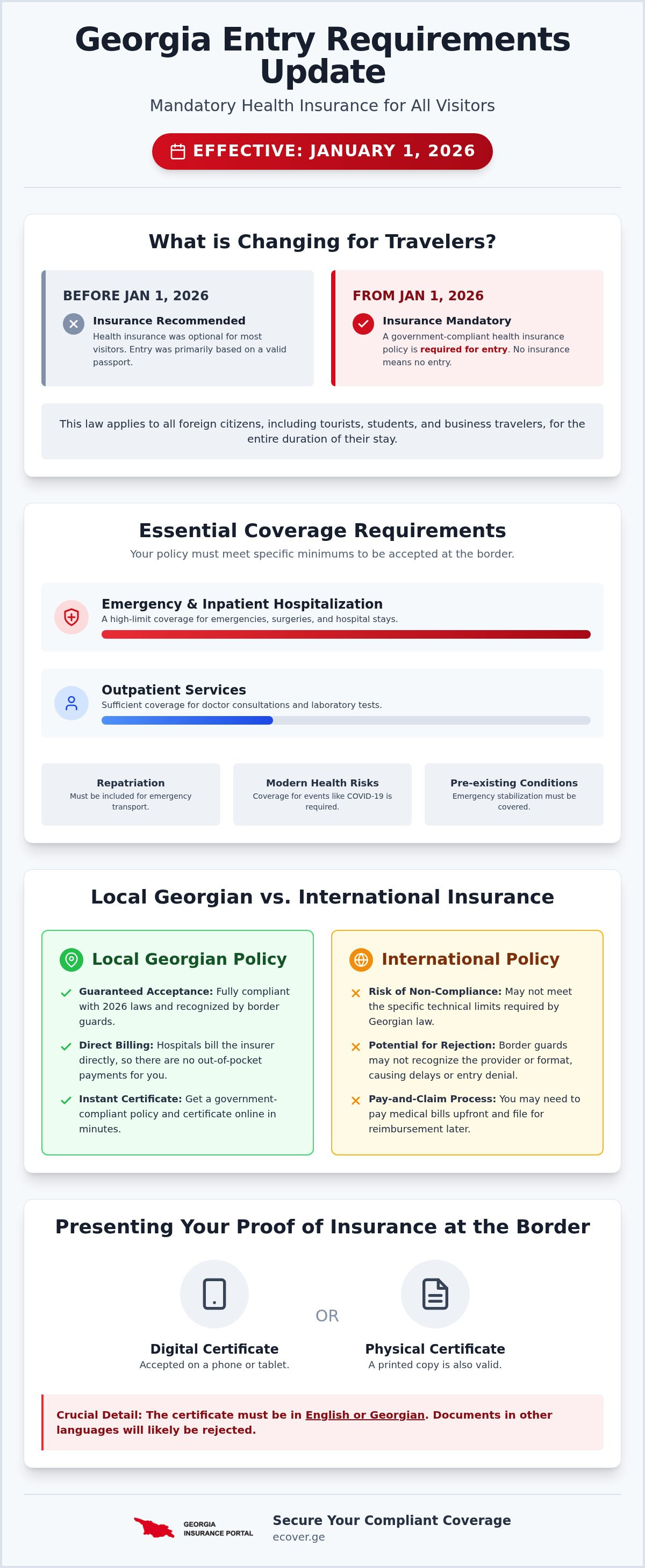
- Effective January 1, 2026, all foreign visitors must present a valid health insurance policy to clear Georgian customs.
- Ensure your policy meets the strict Georgia border insurance requirements 2026, including mandatory minimums for outpatient services and emergency hospitalization.
- Recognize the specific advantages of local insurance over international plans, such as guaranteed recognition by border guards and direct hospital billing.
- Prepare for the border verification process by learning which digital and physical certificate formats are accepted by passport control officers.
- Secure a government-compliant policy in under two minutes through a licensed provider to guarantee a seamless entry into the country.
Understanding the 2026 Georgia Mandatory Health Insurance Mandate
As of January 1, 2026, the legal framework for entering Georgia has shifted. What was once a recommendation for travelers has become a strict administrative mandate. This change requires every foreign visitor to possess valid health insurance before they reach passport control. The Georgia border insurance requirements 2026 are designed to ensure that every visitor has immediate access to medical care without facing financial ruin or placing an undue burden on the local public health infrastructure. If you arrive at any land, sea, or air crossing without a certificate that meets specific state-approved criteria, you risk immediate entry refusal or significant administrative fines. Border guards are now equipped with verification systems to check the validity of your policy in real time, making compliance a non-negotiable part of your travel preparation.
The Scope of the 2026 Insurance Law
The law applies broadly to nearly all foreign citizens. Whether you're visiting for a week of tourism, starting a degree as an international student, or working remotely as a digital nomad, the mandate remains the same. Your policy must remain active for your entire duration of stay, from the moment you cross the border until your departure. Business travelers attending conferences or meetings are also subject to these regulations. Understanding the Georgia border insurance requirements 2026 is the first step in avoiding logistical hurdles at the port of entry. There are very few exceptions to this rule, typically reserved for specific diplomatic personnel or those in short-term transit who do not leave the airport's secure zone. For everyone else, having a compliant policy is as essential as having a valid passport. If your stay is extended, you must ensure your coverage is updated to reflect the new departure date to avoid legal complications.
Why Georgia Implemented Mandatory Coverage
This legislative shift aligns Georgia with international travel safety benchmarks seen in many other developed nations. By standardizing medical coverage, the state ensures that international visitors receive a high quality of care in any emergency. It acts as a safety net for the traveler. Without this mandate, an unexpected surgery or sudden illness could result in tens of thousands of dollars in out-of-pocket expenses. By requiring insurance, the government protects both the visitor's financial well-being and the efficiency of the national medical system. This proactive approach ensures that medical resources are available to those who need them most while maintaining a transparent, regulated environment for all guests. It creates a more secure environment where travelers can explore the country with the confidence that their health needs are fully managed by a recognized legal structure.
Essential Coverage Limits and Legal Requirements for Entry
Meeting the Georgia border insurance requirements 2026 involves more than just purchasing a generic plan. The Georgian government has established specific technical thresholds that every policy must satisfy to be considered valid for entry. These regulations distinguish between outpatient care and inpatient hospitalization, ensuring that even minor medical needs are covered without exhausting the funds needed for major emergencies. Your insurance certificate must clearly state these limits in either English or Georgian. If your documentation is only available in another language, border guards will likely reject it, leading to delays or refusal of entry at the frontier.
Technical Standards for Medical Coverage
The 2026 law dictates that a policy must provide a minimum amount of coverage for emergency medical expenses, typically denominated in USD or EUR. This includes specific allocations for outpatient services, such as consultations and laboratory tests, alongside a much larger sum dedicated to inpatient care and emergency surgeries. While some older international plans exclude pandemic-related treatments, the new Georgian standards require coverage for modern health risks, including treatments related to COVID-19. It's also important to verify how your plan handles pre-existing conditions. Under the mandatory mandate, emergency stabilization of a pre-existing condition is a required baseline for compliance. You can easily check if your coverage meets these specific limits before you arrive at the border to ensure a smooth transition through passport control.
Repatriation and Emergency Transport Rules
Medical repatriation is a non-negotiable component of the 2026 legal requirements. This ensures that if a traveler requires specialized care in their home country or if a tragic event occurs, the costs of emergency transport or the return of remains are fully covered. The Georgian state requires that the insurance provider maintains a 24/7 assistance hotline. This allows local medical facilities and border officers to verify coverage instantly. Without this round-the-clock verification capability, a policy may be deemed insufficient by the LEPL Insurance State Supervision Service. These rules prevent the logistical and financial complications that arise when a visitor requires medical evacuation, providing a clear path for transport that is pre-arranged and fully funded by the insurer. Ensuring your policy includes these transport provisions is essential for legal compliance and personal safety.
Comparing Local Georgian Policies vs. International Travel Insurance
Choosing between a global policy and a local one is a critical decision for your trip. While global plans offer broad geographic reach, they often struggle to meet the specific Georgia border insurance requirements 2026. The primary issue isn't just the coverage amount, but the recognition of the policy by local authorities. Global premiums are typically higher because they cover risks across multiple continents. In contrast, a local mandatory plan is purpose-built for Georgian law. This makes local policies significantly more cost-effective for visitors who only need to satisfy the legal entry mandate without paying for unnecessary global overhead.
Recognition at the Georgian Border
Border guards prioritize speed and accuracy at passport control. They use a centralized state database to verify policy numbers in real time. Local policies are uploaded to this system the moment they're issued. If you present a global policy, the officer must manually review the terms, coverage limits, and language to ensure they match the 2026 mandate. This manual check often leads to secondary inspections or significant delays. Providers like E-COVER offer a guarantee of acceptance because their certificates are pre-approved by the LEPL Insurance State Supervision Service. This direct link to the state database ensures you clear the border in seconds rather than minutes.
Direct Billing and Local Support
The most significant practical advantage of a local policy is the elimination of the "pay-and-claim" model. Most international insurers require you to pay medical bills upfront and seek reimbursement weeks or months later. This can be a financial disaster during a medical emergency. Local insurance networks have established direct billing agreements with Georgian healthcare facilities. If you need treatment, the hospital coordinates directly with the insurer for payment. You won't have to navigate foreign time zones or language barriers to get a guarantee of payment. Local support teams operate 24/7 in the same time zone as the hospitals, ensuring that admission and treatment proceed without administrative friction. This integration provides a level of security that global policies simply cannot match in a local context.
Border Procedures: How to Present Your Insurance Proof at Entry
When you reach the Georgian frontier in 2026, the insurance check happens simultaneously with your passport verification. It's a streamlined process designed for efficiency, but it requires you to have your documentation ready before you reach the booth. The Georgia border insurance requirements 2026 mandate that every traveler presents a verifiable policy to the border police officer. If you don't have this proof, you'll likely be directed to a secondary holding area to purchase a policy, which causes significant delays and potential fines. To avoid this, ensure your policy is active the moment you land or arrive at a land crossing.
Arrival at Airports and Land Borders
Airports and land borders use high-speed scanners to process visitors. You should have your digital certificate or QR code pulled up on your smartphone as you approach the officer. While the border police accept physical printouts, digital copies are preferred for faster scanning against the state database. If your plans change and you decide to stay longer than originally intended, you must extend your coverage locally. If your insurance expires while you're still in the country, you're technically in violation of the law. This can lead to complications during your departure or if you require medical assistance. You can secure a government-compliant policy in under two minutes to ensure your coverage dates perfectly match your travel itinerary.
Documentation Checklist for 2026
A valid insurance certificate must contain specific data points to be accepted at the border. Officers look for three primary indicators of a compliant policy. First, your full name and passport number must match your travel documents exactly. Even a minor typo can lead to a manual review and entry delays. Second, the certificate must clearly state the coverage amounts for outpatient and inpatient care in either English or Georgian. Finally, the document must include a unique policy number or QR code that proves validity through a licensed broker. Avoid these common mistakes to ensure a seamless entry:
- Expired Dates: Ensure the policy covers your arrival and departure dates accurately.
- Insufficient Limits: Verify that the medical maximums meet the 2026 legal thresholds before travel.
- Language Barriers: Don't present policies written only in your native language if it's not English or Georgian.
- Missing Proof of Payment: Keep your digital receipt or broker confirmation accessible on your device.
By following this protocol, you'll move through passport control without friction. The border guards are trained to recognize compliant certificates quickly, allowing you to begin your journey with the security of full medical protection.
Securing Compliant Coverage with E-COVER for 2026 Travel
E-COVER serves as the primary facilitator for travelers seeking to meet the Georgia border insurance requirements 2026. Operating under LLC Insurance Broker WeInsure, we provide a streamlined digital platform that removes the complexity from administrative compliance. You don't need to navigate local offices or submit physical paperwork to secure your entry. Our automated system allows you to complete the entire application process in under two minutes. Once your details are submitted, the platform generates a government-compliant certificate that is sent directly to your email address, ensuring you have the necessary proof for passport control before you even board your flight.
Customized Plans for Every Visitor
Every traveler has unique needs, and the 2026 mandate accounts for various categories of residency and visitation. If you're arriving for academic purposes, our Student Insurance is specifically designed to satisfy both university enrollment criteria and the legal mandates of the LEPL Insurance State Supervision Service. For remote workers, our Digital Nomad Insurance and long term travel insurance policies provide continuous, year-long protection that remains valid even if you exit and re-enter the country. Short-term tourists can also access affordable, high-coverage options that prioritize the emergency medical limits required by border police, ensuring full compliance for shorter stays.
The E-COVER Advantage
We act as an authoritative intermediary, maintaining direct partnerships with top-tier Georgian insurance providers to ensure your policy is backed by institutional reliability. These deep local connections allow us to offer transparent pricing with no hidden administrative fees for the 2026 season. When you buy travel medical insurance Georgia through our portal, you're receiving a product that is already integrated into the state's centralized verification database. This technical alignment means your policy number is recognized the moment a border guard scans your travel documents.
Our status as a licensed broker (License N012063) with ID Code 205250967 provides the security and credibility required for a stress-free journey. By choosing a local expert, you bypass the common "pay-and-claim" delays associated with international providers. You gain the benefit of a support network that operates in your time zone and understands the specific protocols of the Georgian healthcare system. This proactive approach to travel safety allows you to focus on your experience in the country while we manage the technicalities of legal entry and medical security.
Ensure a Seamless Entry Into Georgia
Entering the country in 2026 requires more than just a plane ticket. You must hold a policy that satisfies the specific Georgia border insurance requirements 2026 to clear customs without delay. This mandate ensures that every visitor has access to high quality medical care without the risk of massive out of pocket expenses or legal complications. By choosing a local provider, you guarantee that your policy is recognized instantly at any border crossing, whether you're arriving by air or land. It's the most efficient way to bridge the gap between international travel and local regulatory compliance.
Don't let administrative hurdles or unexpected border checks disrupt your travel plans. E-COVER provides government compliant policies with instant email delivery to your inbox. We are licensed by the LEPL Insurance State Supervision Service of Georgia, so your certificate is accepted at all air and land borders. You can Get Your Mandatory 2026 Georgia Travel Insurance Instantly and receive your border ready documentation in under two minutes. We look forward to welcoming you to a safe and secure journey where your health and legal status are fully protected.
Frequently Asked Questions
Is travel insurance mandatory for Georgia in 2026?
Yes, as of January 1, 2026, it's a legal requirement. All foreign visitors entering the country must possess valid medical coverage. This mandate applies to all ports of entry, including air and land borders. Without a policy that meets the state's criteria, you'll be unable to clear customs. It's best to secure your policy before departure to ensure a smooth transition through passport control and avoid any unnecessary administrative hurdles.
Can I use my credit card insurance to enter Georgia?
Most credit card insurance policies aren't recognized because they don't meet the specific Georgia border insurance requirements 2026. Border guards require a certificate that clearly states minimum coverage limits for both outpatient and inpatient care in English or Georgian. If your credit card provider can't issue a compliant document that links directly to the state's verification system, it's highly likely that the policy will be rejected at the border booth.
What is the minimum coverage required by the Georgian government?
The Georgian government requires specific minimum limits for emergency medical services, outpatient care, and inpatient hospitalization. While the exact USD or EUR amounts are finalized by the state, the policy must also include mandatory coverage for medical repatriation. Your certificate must explicitly list these amounts so that border officers can verify your financial protection. Generic travel insurance often fails to detail these specific technical thresholds required by the 2026 law.
How do I prove I have insurance at the Georgian border?
You prove your coverage by presenting a digital or physical insurance certificate at the passport control booth. The document should feature a unique policy number or QR code that border police can scan against their database. This verification happens in real time. If you use a licensed local broker like E-COVER, your policy is pre-approved and uploaded to the system immediately, allowing for instant recognition by the authorities without the need for manual review.
Does the mandatory insurance cover COVID-19 treatments?
Yes, the 2026 mandate requires that all policies include coverage for pandemic-related treatments, including COVID-19. The law is designed to protect the public health infrastructure, so any policy that excludes respiratory pandemics is considered non-compliant. When you purchase a government-approved policy, these protections are automatically included in your coverage limits. This ensures you receive necessary medical attention without placing a financial burden on the local healthcare system or your own personal travel budget.
What happens if I enter Georgia without insurance in 2026?
If you arrive without insurance, you'll be denied entry or forced to purchase a policy at the border before clearing customs. This often results in significant delays and potential administrative fines. Since the Georgia border insurance requirements 2026 are strictly enforced, border guards are authorized to turn away any visitor who can't provide proof of compliant coverage. It's much more efficient to secure your documentation online before you arrive at the frontier.
Can I buy Georgian travel insurance online after I arrive?
While it's technically possible to buy a policy online after arrival, you risk being stopped at the border before you even reach your destination. You must have an active policy the moment you step foot on Georgian soil. If you realize your coverage has expired during your stay, you should renew it immediately through a licensed local broker to remain compliant with the law and avoid legal complications during your eventual departure from the country.
Is there a specific insurance requirement for international students in Georgia?
Yes, international students must have specialized health insurance that meets both the 2026 border mandate and university enrollment requirements. This coverage is often more comprehensive than a standard tourist policy, as it must cover the entire academic year. Student policies must be issued by a broker licensed by the LEPL Insurance State Supervision Service of Georgia (License N012063). This ensures the student remains legally compliant for the duration of their residency while pursuing their degree.


