

What if a single missing clause in your insurance policy could cause the Public Service Hall to reject your entire residency application? Many expats discover too late that standard travel insurance doesn't satisfy the strict Georgia residence permit insurance requirements mandated for 2026. If you're feeling overwhelmed by the shift from simple entry rules to complex residency mandates, you aren't alone. It's frustrating to navigate the gap between basic medical coverage and the specific legal standards required for a long term stay.
This guide simplifies the process by detailing exactly what the Georgian government demands for a successful application or renewal. You'll learn about the mandatory 30,000 GEL minimum coverage limit, how to overcome language barriers with official policy documentation, and the exact steps to secure a compliant certificate without unnecessary delays. We've broken down the 2026 criteria to ensure your transition stays on track, remains cost-effective, and meets every administrative hurdle with confidence. By following these requirements, you can protect your legal status and avoid the logistical complications of a rejected filing.
Key Takeaways
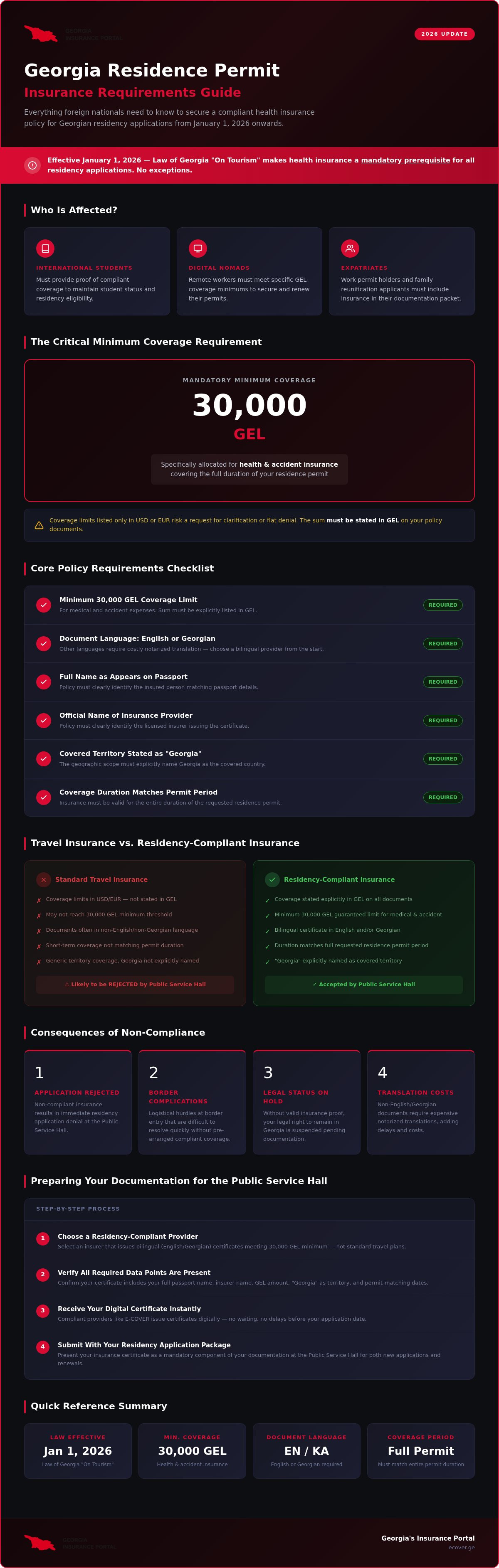
- Understand the legal shift starting January 1, 2026, when health insurance becomes a mandatory prerequisite for all Georgian residency applications.
- Ensure your policy meets the specific Georgia residence permit insurance requirements by maintaining a minimum coverage limit of 30,000 GEL for medical and accident expenses.
- Learn how to prepare your insurance certificate in English or Georgian to prevent administrative delays at the Public Service Hall.
- Identify why standard travel insurance often fails residency checks and how to secure a policy that satisfies the new 2026 contract standards.
- Discover how to obtain an instantly issued, digitally delivered certificate that local authorities accept for both new applications and permit renewals.
The 2026 Mandatory Insurance Law and Residency Applications
Effective January 1, 2026, the Law of Georgia 'On Tourism' introduces a significant shift in how the country manages foreign arrivals. While previous years often treated health coverage as a strong recommendation, it's now a non-negotiable prerequisite for a legal stay. This change isn't just for tourists at the airport; it's deeply integrated into the Georgia residence permit insurance requirements. If you're planning to stay long-term, you'll need to satisfy these new standards before you even step foot in the Public Service Hall.
The Georgian government is aligning its border entry mandates with residency criteria to ensure all foreign nationals have the financial means to cover medical emergencies. This synchronization means that the insurance you show at the border must often be the same type of high-standard coverage required for your residency application. It's a move toward a more structured administrative environment where security and preparedness are prioritized. By making this mandatory, the authorities aim to reduce the burden on the local healthcare system while protecting visitors from unexpected costs.
Who is Affected by the 2026 Mandate?
The 2026 mandate casts a wide net, affecting nearly every foreign national seeking a long-term legal status. It doesn't matter if you're arriving for a few weeks or planning to make Georgia your home; the requirement applies across the board. Specifically, the following groups must ensure their policies are compliant:
- International students: Those pursuing long-term degrees must provide proof of coverage to maintain their student status and satisfy Georgia residence permit insurance requirements.
- Digital nomads: Remote workers under the residency framework are now required to meet the specific GEL coverage minimums to secure their permits.
- Expatriates: Whether you're applying for work permits or family reunification, the insurance mandate is a critical piece of your documentation packet.
Legal Consequences of Non-Compliance
Failing to meet these standards carries immediate risks. If your policy doesn't align with the 30,000 GEL minimum or lacks the necessary linguistic translations, you face potential rejection of your residency application. This isn't just a minor delay; it can lead to logistical hurdles at the border and the Public Service Hall that are difficult to resolve quickly. Under the 2026 regulations, you must provide valid insurance proof that covers the entire duration of the requested residence permit. Without this documentation, your legal right to remain in the country is essentially on hold. Proactively securing a compliant policy is the only way to ensure your application moves through the system without friction.
Core Insurance Requirements for a Georgian Residence Permit
Securing a residency permit in Georgia requires more than just filling out forms; it demands specific financial safeguards that meet strict 2026 standards. The Public Service Hall doesn't accept generic certificates. To avoid rejection, your policy must satisfy the primary Georgia residence permit insurance requirements, starting with a minimum coverage limit of 30,000 GEL. This amount is specifically allocated for health and accident insurance to ensure you're protected throughout your stay.
Linguistic clarity is another hurdle that often catches applicants off guard. All policy documentation must be presented in either English or Georgian. If your provider issues documents in another language, you'll likely face the additional expense and delay of obtaining a notarized translation. Choosing a provider that issues bilingual certificates from the start is the most efficient way to keep your application moving. If you're looking for a hassle-free start, you can view residency-compliant insurance plans that meet these linguistic and financial criteria instantly.
Mandatory Policy Information for 2026
Administrative clerks look for specific data points when they review your insurance. Your policy isn't just a receipt; it's a legal contract that must identify all parties involved. This includes your full name as it appears on your passport and the official name of the insurance provider. Additionally, the document must explicitly state the covered territory as "Georgia" and list the insurance sum in GEL. If the limits are only listed in USD or EUR, you risk a request for clarification or a flat denial based on the new 2026 guidelines.
Coverage Duration for Residency Applicants
Your insurance timeline must mirror your residency goals. A common mistake is providing a six-month policy when applying for a one-year permit. The "full period of stay" rule dictates that your coverage must include your exact arrival and departure dates, or more accurately, the start and end dates of the permit you're requesting. If you apply for a residency extension, you must provide a new or renewed policy that covers the entire future period. This alignment ensures there are no gaps in your legal protection. Failing to match these dates precisely is one of the most frequent reasons for administrative delays at the Public Service Hall.
Comparing Entry Insurance vs. Long-Term Residency Coverage
Many travelers assume the insurance they use to cross the border will automatically suffice for their residency application. This is a risky assumption that often leads to administrative delays. While entry insurance covers basic emergencies for short-term visitors, it often lacks the structural depth required by the Public Service Hall. Meeting the Georgia residence permit insurance requirements involves a specific set of criteria that standard "global" travel policies often overlook. Understanding the distinction between these two types of coverage is essential for a successful legal stay.
The primary difference lies in how the policy is documented and recognized. A policy that satisfies a border guard might not satisfy a residency clerk who is looking for long-term security and specific legal clauses. International plans often prioritize broad global coverage, whereas residency-compliant plans are tailored to the local 2026 mandate. This local alignment ensures that the policy isn't just a piece of paper, but a recognized financial guarantee within the Georgian administrative system.
Why International Plans May Be Rejected
International insurers usually issue policies in USD or EUR. Under the 2026 mandate, officials require an explicit statement of the 30,000 GEL limit. If your document doesn't show this figure in the local currency, it may be dismissed. Additionally, many global plans operate on a reimbursement basis, which means you pay out of pocket and claim later. Local Georgian medical facilities often don't recognize these foreign providers for direct billing. Getting the required English or Georgian certificate from a large international firm can also be a slow, bureaucratic process that doesn't align with tight residency deadlines.
The Advantage of Resident-Specific Policies
Policies designed specifically for the Georgian market provide a "path of least resistance" through the administrative system. These plans are built to satisfy the 30,000 GEL mandate from day one, ensuring that your documentation is accepted without question. This specialized focus eliminates the need for notarized translations or currency conversion letters. For those with specialized needs, such as academic pursuits, a Student Health Insurance in Georgia plan offers targeted coverage that aligns perfectly with 2026 university and immigration standards. Choosing a resident-specific policy ensures that you're prepared for both the Public Service Hall and the local healthcare environment.
While some international expat plans offer high coverage limits, they often come with a premium price tag that exceeds what's necessary for legal compliance. Local resident-specific policies are generally more cost-effective because they focus precisely on the risks mandated by Georgian law. You get the security of a recognized local broker and the benefit of instant digital delivery. This approach balances legal necessity with financial practicality, ensuring you don't overpay for coverage that isn't required for your permit.
How to Document Your Insurance for the Public Service Hall
Presenting your insurance documentation is the final hurdle in the application process. Even a policy that meets all Georgia residence permit insurance requirements can be rejected if it isn't documented correctly. The Public Service Hall operates with high administrative precision, so your certificate must be clear, legible, and comprehensive to ensure a smooth approval.
Most applicants receive their policies digitally. While you can often upload documents for certain online services, you should always bring a high-quality printed copy to your appointment at the Public Service Hall. Ensure that the printout includes all pages of the certificate, especially the sections detailing the coverage limits and the insurance company's official stamp or digital signature. A blurry or incomplete printout is a common reason for unnecessary delays.
Under the 2026 guidelines, the "Parties to the Contract" rule is non-negotiable. The document must clearly list both the insurer and the insured person. Adhering to the specific Georgia residence permit insurance requirements means ensuring your name matches your passport exactly, character for character. If your passport includes a middle name, your insurance certificate must include it too. Any discrepancy here can lead to the officer requesting a corrected document, which could stall your residency by weeks.
The clerk also needs to see that the policy is fully funded. Your certificate should explicitly state the premium amount and confirm that payment has been settled. If the document looks like a preliminary quote or doesn't mention the payment status, it won't be accepted as proof of coverage. Clear visibility of these financial terms is essential for the officer to verify the contract's validity.
The Official Verification Process
The officer's primary task is to verify that your policy satisfies the Georgia Mandatory Insurance Law. They specifically look for the 30,000 GEL minimum limit and the "territory of coverage" clause. If these details are buried in fine print or missing, the application will likely be flagged. They also check that the policy was issued by a recognized entity, which is why using a licensed local broker is highly advantageous for verification purposes.
Checklist for a Successful Submission
- Provide the policy in English or Georgian, or include a certified translation if issued in another language.
- Ensure the 30,000 GEL limit is explicitly stated in the document text.
- Check that the policy dates cover the entire duration of your requested residency term without any gaps.
- Include a clear proof of payment or a "Paid" status directly on the insurance certificate.
If you're ready to submit your application and need a document that is guaranteed to pass inspection, you can get your residency-compliant insurance certificate here. This ensures your paperwork meets every 2026 standard before you arrive at the Public Service Hall.
Obtaining Compliant Insurance with E-COVER
If you're facing a tight deadline for your permit application, the speed of your insurance provider is just as important as the policy's content. E-COVER is specifically engineered to address the Georgia residence permit insurance requirements without the typical administrative friction. Because these policies are issued through WeInsure, a licensed broker under Georgian law, you gain the security of a product that's already vetted for local compliance by the State Supervision Service.
The primary advantage of this digital-first approach is the instant issuance of your certificate. You don't have to wait for manual approvals or physical mail. Once you complete the online form, a compliant certificate is generated immediately. This is a critical feature for those who need to satisfy the Public Service Hall requirements on short notice or during a last-minute renewal process.
The E-COVER Application Process
The process is designed to be intuitive and transparent for international users. You start by selecting your coverage dates, ensuring they align perfectly with your intended residency term or arrival dates. Once the payment is settled, you receive an English-language certificate that explicitly states all the mandatory 2026 criteria. For remote workers, selecting a specialized Digital Nomad Insurance for Georgia plan ensures your specific lifestyle needs are met while maintaining full legal compliance.
Why Choose a Local Licensed Broker?
Local licensing isn't just a badge; it's a guarantee of recognition within the Georgian administrative system. WeInsure operates under License N012063, issued by the LEPL Insurance State Supervision Service of Georgia. This means your policy satisfies the Georgia residence permit insurance requirements and is a document that Georgian border points and government offices are legally required to recognize. E-COVER provides the necessary 30,000 GEL coverage required for 2026 residency. By choosing a local broker, you eliminate the risk of a clerk questioning the validity of your insurer or the currency of your coverage limits.
The transition from visitor to resident should be a celebration of your new journey, not a battle with paperwork. E-COVER acts as a bridge, translating complex 2026 mandates into a simple, actionable digital solution. Whether you're an international student or a digital nomad, having a policy that's built for the local regulatory environment ensures your residency application is supported by professional, licensed protection. This methodical approach to insurance means you can focus on your life in Georgia while we handle the technical details of your compliance.
Secure Your Legal Status for 2026
Navigating the updated administrative landscape doesn't have to be a source of stress. The transition to the 2026 mandate means that meeting the 30,000 GEL coverage limit and providing bilingual documentation are now essential steps for every applicant. By ensuring your policy aligns with the official Georgia residence permit insurance requirements, you protect yourself from application rejections and unnecessary delays at the Public Service Hall. Proper preparation is the key to a successful long-term stay.
Choosing a local partner makes this process seamless. You can Get Your 2026 Residency-Compliant Insurance Policy Now to receive an instant online certificate that meets the 30,000 GEL legal requirement. Our policies are issued through a broker licensed by the Georgian State Supervision Service, ensuring your coverage is recognized by all local authorities. Don't leave your residency to chance when you can secure a compliant plan in minutes. We're here to help you build a stable future in Georgia with confidence and legal security.
Frequently Asked Questions
Is health insurance mandatory for a Georgia residence permit in 2026?
Yes, health insurance is a mandatory requirement for anyone applying for or renewing a Georgian residence permit starting January 1, 2026. This law applies to all foreign nationals regardless of their visa category or country of origin. Without a valid insurance certificate, the Public Service Hall won't process your residency paperwork. It's essential to secure your coverage before your appointment to avoid an immediate rejection of your application.
What is the minimum coverage amount required for Georgian residency insurance?
The Georgian government requires a minimum coverage limit of 30,000 GEL for medical and accident insurance. Your policy document must explicitly state this amount in Georgian Lari to be accepted by officials. If your international policy only lists limits in USD or EUR, you may be required to provide additional proof that it meets the threshold. Choosing a local provider ensures this specific requirement is clearly visible on your certificate.
Can I use my foreign health insurance for a residence permit application?
You can use foreign insurance only if it explicitly satisfies every part of the 2026 mandate. Most international plans are rejected because they don't mention the 30,000 GEL limit or lack direct billing recognition within the country. To meet the Georgia residence permit insurance requirements, your policy must be issued in English or Georgian and identify all parties to the contract. Many expats find it more efficient to purchase a locally recognized policy.
In what language must my insurance policy be presented for residency?
Your insurance policy must be presented in either English or Georgian to be accepted by administrative officials. If your original policy is in another language, you'll need to pay for a certified and notarized translation. This adds both cost and time to your residency process. To streamline your application, it's best to obtain an instantly issued bilingual certificate from a provider that specializes in the Georgian regulatory environment from the start.
What happens if my insurance expires before my residence permit does?
If your insurance expires before your residency term ends, you're technically in breach of the 2026 mandate. Officials require that your coverage dates match the entire duration of the residency permit you're requesting. If there's any gap in your coverage, your application will be flagged for non-compliance. You should always renew your insurance policy ahead of time and submit the updated certificate to maintain your legal status without any administrative interruption.
Does the 2026 insurance law apply to international students in Georgia?
Yes, international students are required to meet the same insurance standards as other residency applicants. To satisfy the Georgia residence permit insurance requirements, students must provide a policy with at least 30,000 GEL in coverage for the full duration of their academic year. Universities and immigration officials will verify this documentation during the permit issuance process. Students should ensure their insurance plan is specifically designed to meet these new 2026 legal standards.
How do I prove my insurance is valid for the 2026 mandate?
You prove validity by presenting an official insurance certificate that contains your full passport name, the 30,000 GEL coverage limit, and the specific dates of your stay. The document must also show that the premium is fully paid. Authorities look for policies issued by recognized brokers, such as those licensed by the LEPL Insurance State Supervision Service of Georgia. A digital certificate with a verifiable QR code or official stamp is typically accepted.
Where can I buy residency-compliant health insurance for Georgia online?
You can purchase residency-compliant insurance online through the E-COVER platform. These policies are issued by WeInsure, which holds License N012063 from the LEPL Insurance State Supervision Service of Georgia. The process is entirely digital, allowing you to generate a valid certificate in minutes. This is the fastest way to ensure your documentation meets the 2026 mandate for border entry and Public Service Hall applications across the entire country.


