

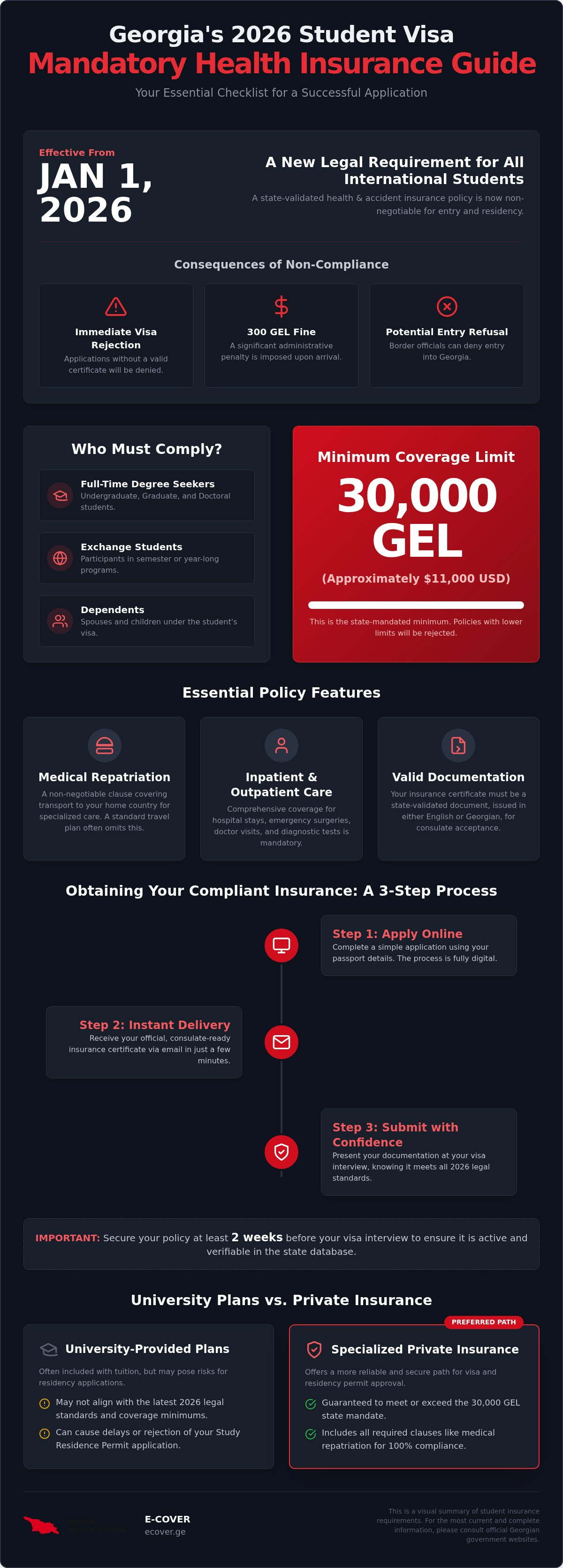
Starting January 1, 2026, your university acceptance letter is no longer the only document standing between you and your studies; without a state-validated insurance certificate, your visa application faces immediate rejection. It's common to feel overwhelmed by the new regulations, especially when you're trying to distinguish between U.S. state requirements and the country of Georgia's strict legal mandates. You want to focus on your education, not spend weeks decoding administrative jargon or worrying about a 300 GEL fine for non-compliance. Obtaining the right health insurance for Georgia student visa applications shouldn't be the hardest part of your journey.
This guide ensures you master the 2026 mandatory health insurance requirements for Georgian student visas so you can secure a compliant policy in minutes. We'll walk through the essential 30,000 GEL coverage limits and the specific documentation needed for a stress-free consulate appointment. You'll learn exactly how to obtain an affordable, 100% accepted certificate with instant digital delivery, allowing you to move forward with total confidence in your legal standing.
Key Takeaways
- As of January 1, 2026, all international students must carry a valid health and accident policy to enter the country and avoid significant administrative fines.
- Every compliant policy must meet the state-mandated 30,000 GEL minimum coverage limit and include specific provisions for medical repatriation.
- Securing the correct health insurance for Georgia student visa approval requires a state-validated certificate that is instantly recognized by Georgian consulates.
- You can complete the entire application process online with your passport details to receive your official documentation via digital delivery in minutes.
- Private insurance offers a more reliable path for residency permits compared to university plans, ensuring your coverage aligns with the latest 2026 legal standards.
Understanding the 2026 Mandatory Health Insurance Law for Students
Effective January 1, 2026, the Georgian government implemented a strict mandate requiring all foreign nationals to hold valid medical coverage. While this applies to all visitors, international students are classified as a high priority group because their residency status depends on long term legal compliance. You must understand that standard travel insurance often fails to meet these specific legal minimums. Unlike a casual tourist, a student requires a policy that aligns with the Georgian Healthcare System standards for non-residents. If you arrive at the border or a consulate without a state-validated certificate, you face an immediate 300 GEL fine and potential entry refusal. Securing the right health insurance for Georgia student visa requirements is the only way to avoid these administrative hurdles.
The Legal Framework for International Students
The LEPL Insurance State Supervision Service of Georgia regulates all policies to ensure they provide adequate protection for foreign residents. This agency sets the standards that every insurance provider must follow to be recognized by the Ministry of Foreign Affairs. For those applying for a D3 category student visa, having a compliant policy is a non-negotiable prerequisite. You should secure your policy at least two weeks before your visa interview. This timeline ensures your certificate is active and verifiable in the state database when the consulate reviews your application. If your insurance doesn't meet the 30,000 GEL minimum coverage limit, your residency permit will be denied.
Who Must Comply with the New Regulations?
The 2026 law leaves no room for ambiguity regarding who needs coverage. Compliance is mandatory for every foreign national enrolled in an educational program within Georgia. This includes:
- Full-time degree-seekers: Students enrolled in undergraduate, graduate, or doctoral programs.
- Exchange students: Individuals participating in short-term semester or year-long study abroad initiatives.
- Dependents: Spouses or children residing in Georgia under the student's residency status.
It's your responsibility to maintain continuous coverage throughout your entire academic tenure. If your policy expires during your studies, you risk losing your legal right to remain in the country. Using a specialized provider ensures your health insurance for Georgia student visa documentation remains valid and accessible whenever a government official requests proof of your status.
Essential Coverage Requirements for Georgian Student Residency
To satisfy the 2026 mandate, your policy must meet several technical benchmarks. The most critical requirement is the minimum coverage limit, which the Georgian government has set at 30,000 GEL (approximately $11,000 USD). This amount provides a financial safety net for medical expenses and accidents throughout your academic year. If your policy falls even slightly below this threshold, the Ministry of Foreign Affairs will reject your application. You'll need this documentation not just for the initial entry, but also when you submit your Study Residence Permit Application at the Public Service Hall. Consulates require the document to be in either English or Georgian. Policies issued in other languages aren't accepted without a certified translation.
Medical Repatriation: A Non-Negotiable Clause
Repatriation coverage is a mandatory component of any health insurance for Georgia student visa. This clause ensures that if a student suffers a severe injury or illness requiring specialized care in their home country, the insurance provider covers the transport costs. The government enforces this rule to prevent the local healthcare system from bearing the financial burden of international medical transfers. You should check your policy's "Table of Benefits" for a specific line item labeled "Repatriation of Remains" or "Medical Evacuation." Standard travel plans often omit this or set limits too low. For Georgian residency, the repatriation benefit must be clearly stated and active for the entire duration of your visa.
Emergency and Urgent Care Standards
Your policy must provide comprehensive coverage for both inpatient and outpatient services. Inpatient care covers hospital stays, emergency surgeries, and intensive care, while outpatient care handles doctor visits and diagnostic tests for acute conditions. It's vital to recognize that these plans focus on sudden illnesses rather than long-term management of pre-existing chronic conditions. The 2026 law also requires a specific provision for emergency pharmaceutical costs, ensuring you can access prescribed medication after an urgent consultation. Once you purchase your policy, you receive a certificate with a unique QR code or verification number. Border officials use this code to confirm your coverage is active in real-time. If you want to ensure your documentation meets every legal standard, you can view compliant student insurance plans that provide instant digital delivery and guaranteed consulate acceptance.
Comparing University Plans vs. Private Mandatory Insurance
Choosing between university-sponsored healthcare schemes and independent private providers is a critical decision for your budget and legal status. Most Georgian universities offer internal insurance plans, often automatically enrolling students during the registration process. While convenient, these campus plans usually carry higher premiums than private alternatives. More importantly, university coverage typically doesn't activate until you've officially enrolled and paid your tuition. This creates a dangerous legal gap because the 2026 mandate requires you to have an active policy before you even reach the border. If you rely solely on a university plan that isn't yet active, you risk visa rejection or a 300 GEL fine upon arrival.
Private health insurance for Georgia student visa applications offers the flexibility needed to bridge this gap. Independent policies allow you to select your own start date, ensuring you're covered from the moment you land. Most institutions allow a "waiver" process, where you can opt-out of the expensive university scheme if you provide proof of a comparable private policy. To successfully waive the campus plan, your private insurance must meet the university's specific medical benefits, which often include coverage for repatriation and emergency evacuation. Using a private provider is frequently the most cost-effective way to satisfy both the government's 2026 law and your university's internal requirements.
When to Choose Private Student Insurance
You should prioritize private insurance if you plan to arrive in the country several weeks before your classes begin. Since university plans are tied to the academic calendar, they won't protect you during your early arrival or orientation period. Private policies are also the superior choice for students who maintain a digital nomad lifestyle, as they often provide more comprehensive coverage for travel outside of the immediate campus environment. Securing your own policy ensures you meet the 2026 border entry requirements without waiting for administrative processing from your school's international office.
Ensuring Your Policy is "Residency-Ready"
Not every policy labeled as "travel insurance" is sufficient for a long-term residency permit. To be residency-ready, your documentation must explicitly state the 30,000 GEL minimum coverage and include the mandatory repatriation clause required by the LEPL Insurance State Supervision Service. You can find a detailed breakdown of these specific benchmarks in our Student Health Insurance in Georgia: The Complete 2026 Requirements Guide. Avoiding "travel-only" mistakes is vital; if your policy is designed for short-term tourists, it won't be accepted at the Public Service Hall when you apply for your study permit. Always verify that your certificate is issued by a licensed broker recognized by Georgian authorities to ensure 100% acceptance.
How to Obtain and Verify Your Insurance for Visa Approval
Securing your health insurance for Georgia student visa documentation is a streamlined digital process designed for international efficiency. To begin, you must have your passport ready, as the policy details must exactly match your official identification to be valid. You'll also need to define your duration of stay. It's advisable to select a period that covers your entire first academic year to avoid the logistical burden of frequent renewals. Following these steps ensures your documentation is ready for both the consulate interview and the border checkpoint.
The Online Issuance Process
For students seeking comprehensive support with their international move, including visa consultations and residence permit applications, JBD Travel provides professional assistance to ensure all your travel documentation is in order.
When using an online platform, you must select the specific "Student" category during the application. This selection ensures the policy includes the 2026 mandated repatriation and emergency care clauses required for residency. Most platforms accept major international credit and debit cards, making the transaction accessible regardless of your home country. Once your payment is confirmed, the system generates your digital certificate instantly. You'll receive an email containing a PDF document that serves as your official proof of insurance. You must download this file and print a high-quality physical copy, as border officials often require a paper version during the initial entry process.
Border Entry and Consulate Verification
Presenting your insurance at Georgian border checkpoints is a mandatory part of the entry sequence. Immigration officers will scan the QR code on your certificate to verify its validity in the national database in real-time. If you want a broader perspective on the general entry rules for all foreign nationals, consult our Mandatory Georgia Travel Insurance: 2026 Entry Guide. If an official questions your coverage, simply point to the specific clause citing compliance with the 2026 law. Because the policy is issued by a licensed Georgian broker, it's pre-verified for the country's legal standards. You can get your government-compliant student insurance now to ensure your paperwork is flawless before you travel.
Before you depart for the airport, cross-reference your certificate with the 2026 Border Entry checklist. You must ensure your full name is spelled correctly, your passport number is accurate, and the policy start date aligns with your arrival. If you find any discrepancies, contact your provider immediately for a correction. A single typo can lead to administrative delays at the consulate or even entry refusal at the border. Being meticulous during this verification phase guarantees a stress-free transition to your new life as a student in Georgia.
Why E-COVER is the Preferred Choice for International Students
Selecting a provider for your health insurance for Georgia student visa requirements is a decision that impacts both your budget and your legal standing. E-COVER operates as a licensed insurance broker (N012063) under the strict oversight of the LEPL Insurance State Supervision Service of Georgia. This local licensing ensures that every policy we issue is pre-verified to meet the 2026 mandate. While international providers often sell generic "global" plans that might lack specific Georgian legal clauses, our policies are built specifically for the local regulatory environment. You won't have to worry about consulate officials rejecting your documentation due to missing repatriation terms or insufficient coverage limits.
Affordability remains a primary concern for students living on a budget. We provide competitive long-term rates that are specifically optimized for the duration of an academic year. By focusing exclusively on the Georgian market, we eliminate the high overhead costs associated with global insurance conglomerates. This allows us to offer the mandatory 30,000 GEL coverage at a price point that is accessible for international students. Beyond the cost savings, you benefit from our deep local expertise. If you need to navigate the Georgian healthcare system or require assistance with a claim, our team understands the local medical protocols and provider networks better than any foreign entity.
Tailored Policies for the D3 Student Visa
The D3 category visa has specific documentation triggers that our plans are designed to satisfy. Every student policy includes the mandatory medical repatriation clause, which is often the number one reason for visa denials when using standard travel insurance. We understand that moving to a new country is a significant transition. To support this journey, we provide 24/7 assistance in English. If you experience a medical emergency at midnight, you'll speak with a representative who can guide you to the nearest compliant facility. This specialized support ensures you're never left to navigate a foreign language barrier during a health crisis.
Simplified Digital Experience
We've removed the traditional barriers to obtaining insurance. You don't need to undergo medical exams or submit complex health histories to qualify for our student plans. The entire application process is handled through a secure online platform that prioritizes speed. Once you enter your passport details and complete the payment, your certificate is generated instantly. This is particularly vital for students who have a last-minute visa interview or are already at the airport. You can get your compliant student insurance for Georgia now and receive your official PDF certificate in your inbox within minutes. This streamlined approach allows you to focus on your studies while we handle the complexities of your legal compliance.
Secure Your Academic Future in Georgia Today
Mastering the 2026 health insurance requirements is the final hurdle before you begin your studies. You now understand that a compliant policy must include the 30,000 GEL minimum coverage and specific repatriation clauses to satisfy the LEPL Insurance State Supervision Service. By choosing a private policy, you avoid the legal gaps often found in university schemes and ensure you're protected from the moment you land. This proactive approach is the most reliable way to prevent border fines and residency rejections.
Don't let administrative paperwork delay your academic goals. Obtaining the right health insurance for Georgia student visa applications is simple when you work with a licensed local expert. We provide instant certificate delivery and a 100% visa acceptance guarantee to give you total peace of mind during your transition. Get Your 2026 Compliant Student Insurance Now and take the first step toward a successful residency application. We look forward to welcoming you to your new home and supporting your journey every step of the way.
Frequently Asked Questions
Is health insurance mandatory for international students in Georgia in 2026?
Yes, as of January 1, 2026, all foreign nationals, including students, must have valid health and accident insurance to enter and reside in the country. This law is strictly enforced at all border checkpoints and consulates. Failure to provide proof of insurance results in immediate administrative fines. It's a non-negotiable requirement for anyone applying for a D3 student visa or a study residence permit during their academic tenure.
Will my international travel insurance work for a Georgia student visa?
Your existing policy will only work if it explicitly meets the 2026 Georgian state minimums, including the 30,000 GEL coverage limit and mandatory medical repatriation. Most generic travel plans don't include these specific legal clauses required by the LEPL Insurance State Supervision Service. You must ensure your health insurance for Georgia student visa documentation is recognized by local authorities. Without a certificate matching the state-mandated checklist, your visa application will be rejected.
What is the minimum coverage required for a Georgian residency permit?
The law requires a minimum coverage of 30,000 GEL, which is approximately USD 11,000, for medical services and accidents. This policy must remain active for the entire duration of your stay in the country. Additionally, the document must be provided in either English or Georgian to be accepted by the Public Service Hall. If your coverage falls below this amount or lacks repatriation benefits, you won't be granted a residency permit or visa extension.
Can I buy my student insurance after I arrive in Georgia?
You shouldn't wait until arrival because you must present proof of insurance to clear immigration at the border. The 2026 law mandates that coverage be active upon entry to avoid a 300 GEL fine. You'll also need the insurance certificate for your initial visa interview at the consulate in your home country. It's best to secure your policy online before your departure to ensure seamless entry and compliance with all residency rules from day one.
Does the 2026 law require insurance for all visa categories?
Yes, the 2026 mandate applies to all foreign nationals entering Georgia, regardless of their visa category or purpose of visit. This includes students, tourists, digital nomads, and business travelers. While the general requirements are the same, students must ensure their policy covers the full length of their academic year. Maintaining continuous coverage is a legal obligation for anyone holding a D3 category visa or a long-term residency permit while living in the country.
How much does student health insurance in Georgia cost for 2026?
Costs vary depending on the level of coverage and the duration of your stay. While budget-friendly plans are available for basic compliance, more comprehensive plans with higher medical benefits will carry higher premiums. You should compare different providers to find a rate that fits your student budget while still meeting the 30,000 GEL state mandate. Always prioritize policies that offer instant digital delivery to avoid delays in your visa application process or university registration.
What documents do I need to provide for E-COVER student insurance?
To obtain a compliant policy, you only need to provide your valid passport details and your intended dates of stay. No medical examinations or complex health history forms are required for issuance. Once you enter your information and complete the secure online payment, your official certificate is generated instantly. This digital document contains a unique verification code that Georgian border officials and consulates use to confirm your health insurance for Georgia student visa status in real-time.
What happens if I enter Georgia without the mandatory health insurance?
Entering without compliant insurance results in an immediate fine of 300 GEL for the first offense. Beyond the financial penalty, you may be refused entry at the border or face significant delays in your university registration. If you're already in the country and your insurance expires, you risk losing your legal residency status. It's essential to maintain a valid policy to avoid these legal complications and ensure you have access to necessary medical care without out-of-pocket expenses.


