

Imagine standing at the check-in counter for your flight to Tbilisi, only to be told your boarding pass is on hold because your travel policy lacks one specific clause. Since January 1, 2026, the country of Georgia, located at the intersection of Europe and Asia, has strictly enforced Government Regulation No. 602. This law requires every foreign visitor to hold compliant medical repatriation insurance Georgia to pass through border control. Without a policy that meets the exact 30,000 GEL coverage limit, you risk being denied entry or stopped at the airline gate before your journey even begins.
It's natural to feel some uncertainty about these new administrative hurdles or the specific limits required by the Georgian border police. You want your trip to be about the culture and landscape, not a stressful debate over documentation. This article will help you confirm legal compliance for your 2026 entry, explaining the vital difference between emergency evacuation and repatriation. We'll provide a clear roadmap to satisfy the new mandates, ensuring you can obtain a valid insurance certificate and proceed through customs with total confidence.
Key Takeaways
- Confirm your compliance with the mandatory insurance law effective January 1, 2026, which requires all foreign visitors to the country of Georgia to hold valid medical coverage.
- Understand that medical repatriation insurance Georgia is a specific legal requirement that covers the complex logistics of returning a patient to their home country, a benefit often excluded from standard health plans.
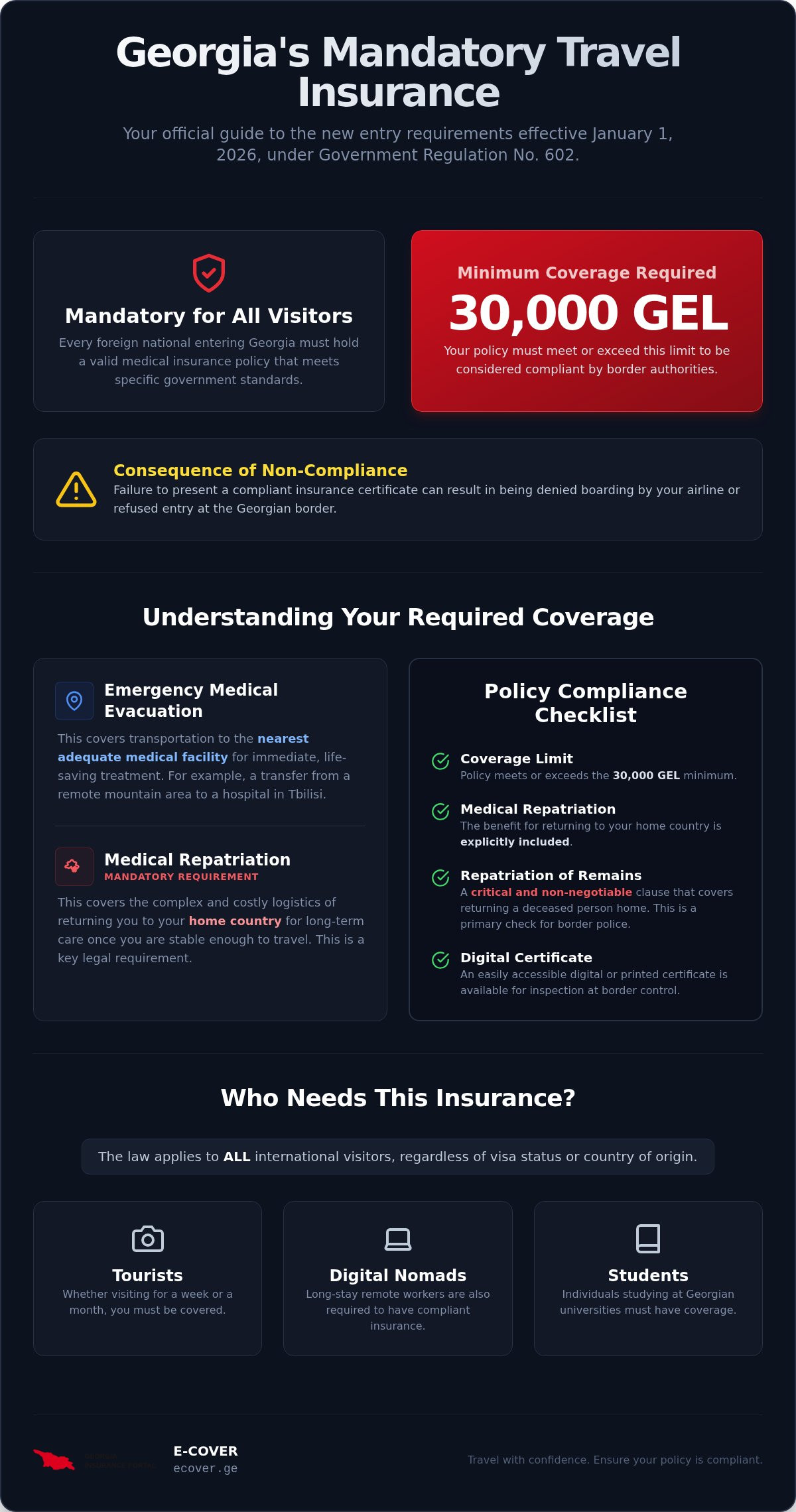
- Verify that your policy meets the mandatory minimum coverage limit of 30,000 GEL and explicitly includes "Repatriation of Remains" to satisfy Georgian border police.
- Learn how to distinguish between emergency outpatient care and medical evacuation to ensure your documentation isn't rejected at airline check-in or the border.
- Discover how to obtain a government-compliant digital insurance certificate instantly, allowing you to meet all administrative entry requirements with minimal friction.
Understanding Medical Repatriation Insurance for Georgia (Country)
Medical repatriation isn't just a standard hospital bill. It's the complex process of moving a patient from a hospital in the country of Georgia back to their home country. While local medical care focuses on immediate stabilization, Understanding Medical Repatriation Insurance involves specialized air transport and medical supervision. Medical repatriation is the logistics of returning a traveler to their country of residence for long-term care.
If you fall ill or suffer an accident, local facilities provide the immediate care you need. However, long-term recovery often requires you to be near your family and primary physicians. This is where medical repatriation insurance Georgia becomes essential. It covers the costs of medical escorts, specialized equipment, and international transit. This specific benefit is a cornerstone of the Mandatory Georgia Travel Insurance: 2026 Entry Guide, as the government now requires visitors to have a plan for returning home in case of a serious medical event.
Repatriation of Remains: A Critical Legal Component
One of the most vital, yet often overlooked, parts of the new law is the "Return of Mortal Remains" benefit. This ensures that, in the event of a tragedy, the deceased can be returned to their home country without placing a massive financial burden on their family or the Georgian state. Governments enforce this requirement to prevent administrative and financial complications at the national level. Without coverage, international repatriation can cost tens of thousands of dollars, making it a non-negotiable part of your entry documentation. Having this benefit clearly listed on your certificate is a primary check performed by border officials.
Emergency Medical Evacuation vs. Repatriation
It's easy to confuse these two terms, but they serve different purposes in your travel planning. Understanding the distinction is key to ensuring your policy isn't rejected at the border.
- Emergency Medical Evacuation: This involves moving you to the nearest adequate medical facility. If you are in a remote area, this might mean a helicopter transfer to a specialized hospital in Tbilisi.
- Medical Repatriation: This involves the final journey back to your home country once you are stable enough for travel but still require medical oversight.
Your health insurance for tourists in Georgia must include both to be fully compliant with 2026 regulations. If your policy only covers evacuation, you may find yourself stabilized in a local ward with no financial means to return home for extended recovery. Ensuring your medical repatriation insurance Georgia specifically lists these benefits is the only way to guarantee a smooth experience at the border. The Georgian authorities require this self-sufficiency to ensure that the public healthcare system isn't burdened by the logistical costs of international patient transfers.
The 2026 Mandatory Insurance Law: Why Repatriation is Required
Effective January 1, 2026, the Georgian government implemented a strict new mandate for all foreign visitors. This regulatory shift is anchored in the 2026 Mandatory Insurance Law, which seeks to protect both the traveler and the local healthcare infrastructure. By requiring visitors to be financially self-sufficient, the state ensures that emergency medical expenses, including complex international transfers, don't fall on the public budget. This legal framework reflects a global trend toward responsible tourism, where travelers must prove they can cover their own emergency logistics.
Whether you are visiting for a week as a tourist, studying at a local university, or staying for months as a digital nomad, you must carry compliant medical repatriation insurance Georgia to pass through immigration. The law applies to all international visitors regardless of their visa-free status or country of origin. If you arrive at the border without proof of coverage, the consequences are immediate. You risk being denied entry or, more likely, being stopped by your airline before you even depart for Georgia. Border officials have been instructed to verify these documents with zero exceptions to ensure total compliance with the new safety standards.
Border Entry Requirements and Document Verification
Georgian Border Police are now equipped to verify insurance certificates electronically at all points of entry. While digital proof on a smartphone is generally accepted, carrying a printed copy is a recommended safeguard against technical issues. Your policy document must be issued in either English or Georgian to be valid for inspection. Border officials specifically look for clearly defined clauses regarding repatriation and evacuation. If your certificate is in another language or uses vague terminology, it will likely be deemed insufficient. You can browse compliant policy plans that provide the exact documentation format required by Georgian authorities for a seamless arrival.
Minimum Coverage Limits for 2026 Compliance
The Georgia mandatory insurance law sets clear financial thresholds that every visitor must meet. Policies must provide a minimum coverage of 30,000 GEL, which currently equals approximately $11,000 USD. This total typically includes sub-limits, such as 5,000 GEL for emergency outpatient services and the full 30,000 GEL for inpatient care and repatriation. While some high-end global policies offer "unlimited" coverage, they often fail to explicitly mention "Repatriation of Remains" or specify the Republic of Georgia as a covered territory. Always check your insurance certificate for these specific keywords. If the benefit is not clearly defined in GEL or a major currency equivalent, border police may flag the policy as non-compliant, leading to significant delays at the gate.
Medical Repatriation vs. Standard Health Coverage
Many travelers believe a basic health plan is sufficient for international trips. However, standard health insurance usually stops at the hospital door. It covers the surgery or the bed rest within the country of Georgia, but it doesn't solve the logistical nightmare of how you get home if you cannot fly on a commercial plane. Medical repatriation is a separate, highly specialized operation. It involves air ambulances, medical escorts, and complex international coordination. As highlighted in the U.S. Embassy in Georgia travel requirements, the mandatory 30,000 GEL coverage must address these specific needs. A "cheap" policy might satisfy a quick glance at the border, but it often strips away these high-cost logistical benefits to lower the premium.
Consider the financial risk. A compliant medical repatriation insurance Georgia policy costs a small fraction of the potential out-of-pocket expenses. In contrast, an uninsured medical flight from Tbilisi to Western Europe or North America can easily exceed $50,000. If you don't have the right coverage, you or your family are responsible for that bill upfront. This is why the Georgian government mandates these benefits. They want to ensure no visitor is left stranded due to a lack of funds for international transport. Choosing a policy without these specific clauses is a gamble that could lead to financial ruin in a crisis.
What is Typically Excluded from Repatriation Benefits?
Even a robust policy has limits you should understand. Exclusions usually include non-emergency transport, where a traveler simply prefers to be treated at home for a minor condition. Repatriation for pre-existing conditions is also commonly excluded unless you've purchased a specific waiver or the condition was stabilized before travel. Additionally, search and rescue operations in the High Caucasus mountains are often considered a separate rider. You must ensure your medical repatriation insurance Georgia specifically includes "Repatriation of Remains" and "Emergency Medical Repatriation" to meet the strict 2026 entry standards.
The Role of Travel Assistance Services
A 24/7 emergency hotline is the bridge between a medical crisis and a successful journey home. These assistance teams coordinate directly with local Georgian hospitals and international carriers to secure flight clearances and medical priority. E-COVER facilitates this by acting as a local facilitator, ensuring instant communication between medical staff and transport providers. This coordination is vital. Repatriation approval often hinges on a "fit to fly" assessment that must be shared across borders in real-time. Without a dedicated assistance team, the logistics of returning home can become an insurmountable hurdle for a grieving or injured family.
How to Verify Your Policy Meets Georgian Border Entry Standards
To avoid delays at the border, you must perform a manual audit of your insurance certificate before departure. Ensuring your medical repatriation insurance Georgia documentation is flawless is the final step in your travel preparation. Border agents in 2026 are trained to look for specific markers that prove your policy is active and compliant with national laws. If your document lacks these identifiers, you may be required to purchase a new policy on the spot or face entry issues.
Your first priority is to confirm that the "Republic of Georgia" is explicitly listed as a covered territory. Many global policies use broad terms like "Europe" or "Worldwide," but local authorities prefer to see the country name clearly stated to avoid ambiguity. Additionally, you must verify that the "Repatriation of Remains" benefit is a line item on your certificate. As established by the January 2026 mandate, this is a non-negotiable requirement. Finally, check that your policy dates cover your entire stay. If your insurance expires even one day before your scheduled exit, it won't be accepted at the gate.
Common Pitfalls: Why Global Policies May Be Rejected
Even high-premium global plans can fail the Georgian border test if the wording is vague. A common issue is the confusion between "medical evacuation" and "repatriation" in policy fine print. If your document only mentions evacuation to the nearest facility, it doesn't meet the 2026 legal standard for returning you to your home country. Another hurdle is the deductible. If your policy has a high out-of-pocket deductible, Georgian officials may argue that you aren't truly self-sufficient for emergency costs. Modern border systems also prioritize speed, so a lack of a verifiable QR code or a clear, unique policy number can lead to manual inspections and significant wait times.
The Advantage of Local Georgian Insurance Providers
Choosing a local provider removes the guesswork from the verification process. Since these companies are licensed by the LEPL Insurance State Supervision Service of Georgia, their policies are built specifically to satisfy the 2026 mandates. This means the 30,000 GEL coverage limits and repatriation clauses are already formatted for immediate acceptance by border police. Verification is often faster because border databases are synced with local insurance registries, allowing for instant confirmation of your coverage. You can review the best travel insurance for Georgia to see how local plans compare to international options in terms of ease of entry. To ensure your documentation is 100% compliant before you fly, you can obtain a government-recognized certificate here in just a few minutes.
E-COVER: Instant Repatriation and Medical Coverage for Georgia
E-COVER operates as a dedicated facilitator, bridging the gap between international travelers and Georgian regulatory requirements. Our policies are engineered specifically to meet the January 1, 2026, mandate, ensuring every visitor arrives with the correct documentation. By partnering with LLC Insurance Broker WeInsure, a licensed Georgian entity, we provide institutional credibility that global providers often lack. This local expertise means your medical repatriation insurance Georgia isn't just a piece of paper; it's a government-recognized guarantee of coverage that border agents trust.
Every plan we offer includes comprehensive medical repatriation and evacuation benefits as standard. If a medical crisis occurs, our team manages the complex logistics of your return journey, coordinating directly with local hospitals and international carriers. This direct integration with the Georgian healthcare system ensures that approvals happen in minutes rather than days. Because we're licensed by the LEPL Insurance State Supervision Service of Georgia, border agents can verify your policy instantly through their internal databases. This eliminates the risk of being held at the gate due to unverified or unrecognized international documentation.
Transparent Pricing for 2026 Visitors
Compliance doesn't have to be expensive. We provide cheap travel insurance for Georgia that meets the full 30,000 GEL requirement without sacrificing essential benefits. Whether you're a student on a budget, a digital nomad staying for a year, or a tourist visiting for a week, our plans are tailored to your specific duration and risk profile. We maintain a policy of total transparency. There are no hidden administrative fees or surprise deductibles. The price you see during the application is exactly what you pay to secure your entry, ensuring you remain self-sufficient as the law requires.
Buying Your Policy Online: A Step-by-Step
We've streamlined the application process to ensure you can satisfy border requirements in under two minutes. You don't need to navigate complex legal jargon or wait for manual underwriting. The process is designed for efficiency and peace of mind.
- Enter your travel dates and personal details into our secure online form.
- Select the plan that matches your traveler profile (Tourist, Student, or Digital Nomad).
- Complete the payment using our encrypted international gateway.
- Receive your compliant PDF insurance certificate via email immediately.
Once you have your certificate, you're ready for boarding. It features the necessary policy numbers and language required by Georgian Border Police for instant verification. Don't leave your entry to chance at the check-in counter or the arrival gate. You can get your compliant Georgia travel insurance now and secure your 2026 journey today.
Preparing for Your 2026 Journey to Georgia
Entering the country of Georgia in 2026 requires more than just a valid passport. You must present a policy that meets the strict 30,000 GEL coverage limit and explicitly includes the return of mortal remains. As the new mandate takes effect on January 1, 2026, verifying your documentation before you reach the airport is the only way to ensure a seamless entry. Standard health plans often fall short of these logistical requirements, making it vital to choose a policy specifically designed for the local regulatory environment.
Obtaining compliant medical repatriation insurance Georgia doesn't have to be a complex administrative hurdle. By selecting a local, licensed facilitator, you guarantee that your certificate features the exact language and QR codes required by the Georgian Border Police. This level of preparedness allows you to focus on the hospitality and landscapes of this historic destination rather than worrying about border logistics.
Secure Your Mandatory 2026 Georgia Travel Insurance Instantly and receive your government-compliant certificate in minutes. Our policies are licensed by the LEPL Insurance State Supervision Service of Georgia, providing you with the security and professional support you need for a stress-free visit. We look forward to seeing you at the border.
Frequently Asked Questions
Is medical repatriation insurance mandatory for Georgia in 2026?
Yes, it is. Starting January 1, 2026, every international visitor must hold a policy that includes medical repatriation insurance Georgia. This requirement is based on the Law of Tourism and Government Regulation No. 602. You must ensure your coverage is active for your entire stay, including arrival and departure dates. Border officials and airline staff will verify these documents before you are allowed to enter the country.
What is the difference between medical evacuation and repatriation?
These are distinct logistical services. Medical evacuation involves moving you to the nearest capable medical facility within Georgia or a neighboring region. Repatriation is the process of returning you to your home country once you are stable enough for travel. The 2026 mandate specifically requires coverage for the return journey, ensuring that the financial burden of international patient transfers doesn't fall on the Georgian state or the visitor's family.
How much coverage is required for repatriation to enter Georgia?
The Georgian government requires a minimum total coverage of 30,000 GEL, which is approximately $11,000 USD. This amount must cover inpatient care and the logistics of returning a patient or remains to their home country. Some regulations suggest sub-limits, such as 5,000 GEL for emergency outpatient care. It's vital to check that your certificate explicitly mentions these amounts in a currency that border agents can easily verify during inspection.
Can I use my credit card travel insurance for the 2026 mandate?
You can use it only if it satisfies all 2026 legal standards. Most credit card plans provide generic global coverage but may lack the specific 30,000 GEL minimum or a clearly stated repatriation benefit for the Republic of Georgia. Your documentation must be in English or Georgian. If your card's policy is vague or has a very high deductible, border police might deem it non-compliant, leading to entry delays.
What happens if I arrive at the Georgian border without insurance?
You will likely be denied entry or stopped before boarding your flight. Airlines are the primary point of enforcement and often check for compliant insurance during the check-in process. If you reach the border without proof, you may be required to purchase a local policy immediately or face deportation. To avoid these logistical complications, it's safer to obtain a government-recognized certificate before you begin your journey to Georgia.
Does E-COVER insurance cover hiking and adventure activities in Georgia?
Standard policies cover general health emergencies, but high-risk activities like professional mountaineering or extreme sports often require a specific rider. You should review your policy certificate to ensure your planned activities are included. E-COVER provides policies that meet all mandatory entry requirements, but adventure travelers should confirm that their specific activities don't fall under common exclusions. This ensures you remain fully protected while exploring the Georgian landscapes and mountain ranges.
How do I show proof of insurance to the Georgian Border Police?
You can present your certificate in either a digital or printed format. Georgian Border Police accept electronic copies on smartphones, but having a physical printout is a reliable backup. The document must be in English or Georgian and include a unique policy number. Modern certificates often feature a QR code that allows officials to verify your coverage status instantly against the national insurance registry, significantly speeding up the immigration process.
Is the repatriation benefit valid for all nationalities?
The repatriation benefit is a universal requirement for all international visitors entering Georgia. This includes tourists, students, and digital nomads from every country. While certain diplomatic passport holders or those covered by specific international treaties might be exempt, the vast majority of travelers must comply. The law ensures that every visitor has the financial means to return home for long-term care, regardless of their nationality or the length of their stay.


