

Starting January 1, 2026, your passport is no longer the only document required to enter the country of Georgia. Under Government Resolution No. 602, what was once a recommendation has become a strict legal requirement for all international visitors. If you arrive at the border without a policy that meets the new Georgia mandatory insurance law, you risk being denied entry or facing administrative fines. This shift from optional coverage to a legal mandate ensures that every traveler is prepared for medical emergencies without placing a burden on the local health system.
It's natural to feel concerned about these new regulations, especially when online searches often confuse the country of Georgia with the U.S. state. You need to know exactly which coverage limits apply so your journey remains seamless. This guide will provide a clear breakdown of the 2026 requirements, including the 30,000 GEL minimum coverage limit for health and accident incidents. We'll also provide a checklist of required coverage amounts and explain how to verify that your insurance certificate will be accepted by border officials. By the end of this article, you'll have the precise information needed to secure a compliant policy and proceed through immigration with confidence.
Key Takeaways
- Understand the transition of travel insurance from a recommendation to a legal entry requirement for all foreign visitors starting January 1, 2026.
- Identify the specific coverage limits mandated by the Georgia mandatory insurance law to ensure your policy meets the 30,000 GEL minimum requirement.
- Access a practical checklist to verify that your insurance documentation is available in English or Georgian and covers your full duration of stay.
- Learn how to secure an instantly issued, compliant certificate online to prevent administrative fines or being turned away at the border.
The Shift in Georgia’s Entry Requirements: Understanding the 2026 Mandate
As of January 1, 2026, the legal landscape for entering the country of Georgia undergoes a significant change. Government Resolution No. 602 establishes a strict requirement for all foreign visitors to possess valid health and accident insurance. This Georgia mandatory insurance law isn't just a suggestion; it's a prerequisite for crossing the border. The mandate applies to a broad spectrum of visitors, including short-term tourists, international students, and those planning longer stays as digital nomads. By requiring visitors to carry their own coverage, the government aims to protect the national public health system from the financial burden of emergency medical treatments for non-residents. This ensures that medical resources remain available for local citizens while providing a safety net for travelers.
Mandatory vs. Optional Travel Insurance
In previous years, travel insurance was a recommended safety net for those exploring the Caucasus. That era ends in 2026. Now, the transition from "recommended" to "compulsory" means that border officials will actively check for compliant policies. If your insurance doesn't meet the specific legal thresholds defined by the state, you face immediate logistical hurdles. Under the Georgia mandatory insurance law, arriving at the border without a verified policy can result in a denial of entry or administrative fines. Standard policies that lack specific medical repatriation or accident coverage may no longer be sufficient to satisfy immigration officers. You must ensure your policy is explicitly designed to meet these new national standards to avoid being turned away upon arrival.
Distinguishing Georgia the Country from Georgia the US State
One of the biggest challenges for travelers is the digital confusion between the U.S. state of Georgia and the sovereign nation in the Caucasus. Many online searches for "Georgia insurance" return results for American auto policies or state-level health regulations that have no relevance to international travel. It's critical to understand that this mandate is a federal law of the country of Georgia. To ensure you're following the correct protocols, always look for references to Georgia's Entry Requirements and national legislation like the Law of Georgia "On Tourism." Verifying that your documentation aligns with the Caucasus nation's regulations is the first step toward a stress-free arrival. Official Georgian regulations will always specify coverage in Georgian Lari (GEL) and refer to national border control procedures rather than American DMV requirements.
The Legal Framework: Why Georgia is Implementing Mandatory Travel Insurance
The Georgia mandatory insurance law isn't just about paperwork; it's a strategic pillar of the country's 2026 health policy. This legislation is managed and enforced by the LEPL Insurance State Supervision Service of Georgia. This regulatory body ensures that every policy sold to an international visitor meets rigorous national standards for medical care and financial solvency. By centralizing oversight, the government can effectively monitor compliance among travel providers and guarantee that the protection promised to travelers is actually delivered. This proactive approach aligns the nation with international travel safety trends, following the lead of other countries that have successfully integrated health coverage into their border entry protocols.
Confirming The Shift in Georgia’s Entry Requirements, the U.S. Embassy notes that this change impacts all international arrivals. For the tourism sector, this mandate raises the baseline for visitor safety and professionalizes the travel experience. It ensures that travelers aren't just welcome, but are also protected against unforeseen medical emergencies. By standardizing these requirements, the state creates a predictable environment for both visitors and healthcare providers, significantly reducing the risk of unpaid medical bills that could otherwise strain the national treasury. It's a move designed to foster a sustainable and secure tourism environment for the long term.
Official Regulatory Oversight
Compliance with the Georgia mandatory insurance law isn't just a requirement for the traveler; it's a strict obligation for the insurance broker as well. The government requires entities like E-COVER to maintain specific licenses, such as License N012063, to issue these legal documents. When you purchase from a state-verified broker, you ensure your certificate will be recognized by border officials upon arrival. This strict licensing prevents the sale of inadequate policies that could lead to entry refusal at the border. You can check your eligibility for a compliant policy to ensure your documentation meets these official standards before you fly.
Protecting the Traveler and the State
The law serves a dual purpose by securing the traveler's financial health while preserving the state's medical resources. Medical debt is a significant risk for international visitors who lack coverage, often leading to complex legal and financial hurdles. By making insurance mandatory, the state guarantees that every visitor has access to high-quality medical care without the fear of crippling out-of-pocket expenses. A core component of this legal requirement is medical repatriation, which covers the costs of returning a patient to their home country if a serious condition arises. This inclusion is vital, as repatriation is often the most expensive part of a medical emergency, yet it's frequently overlooked in standard, non-compliant travel plans.
Minimum Coverage vs. Comprehensive Protection: What the Law Requires
Understanding the technical specifics of the Georgia mandatory insurance law is the difference between a smooth entry and a frustrating border delay. The legislation is precise about what constitutes a valid policy. It isn't enough to have generic travel coverage; your documentation must explicitly state that it meets the minimum thresholds set by the Georgian government. According to the Ministry of Foreign Affairs, you can find the full details of What the Law Requires regarding these entry protocols. The core of the mandate is the 30,000 GEL total limit, which covers both health and accident-related medical expenses.
The law breaks this coverage down into specific categories to ensure comprehensive care. Your policy must provide for outpatient medical services, including diagnostic tests and consultations. It also requires substantial coverage for inpatient hospital stays, which includes surgeries and intensive care. Perhaps most importantly, the mandate includes a strict requirement for emergency medical repatriation. This ensures that if a visitor requires specialized care or transport back to their home country, the costs are covered by the insurer rather than becoming a debt for the traveler or the state.
Decoding the Mandatory Coverage Limits
The 30,000 GEL minimum coverage is approximately equivalent to $11,000 USD or €9,500 EUR. However, border officials look for the GEL amount or its clear equivalent on your certificate. Beyond general medical care, the 2026 law requires coverage for emergency dental services and acute medical conditions that arise during your stay. You can't use policies that exclude these acute needs, as they're considered essential for visitor safety. If a "cheap" plan omits these specific categories to lower its price, it will likely be rejected during the verification process at the border.
Why Basic Global Plans May Fail Compliance
Many travelers assume their existing global health plan or credit card insurance will suffice. This is often a mistake. High deductibles are a major red flag for border control; if you must pay the first $5,000 out of pocket, the policy doesn't meet the spirit of the Georgia mandatory insurance law. Similarly, a standard policy might lack the specific Georgian repatriation language required by Government Resolution No. 602. For those planning an extended stay, reviewing a Digital Nomad Insurance for Georgia: 2026 Buying Guide is essential to ensure your specialized plan aligns with national entry standards. Relying on a non-compliant plan is a risk that could lead to entry refusal or administrative fines.
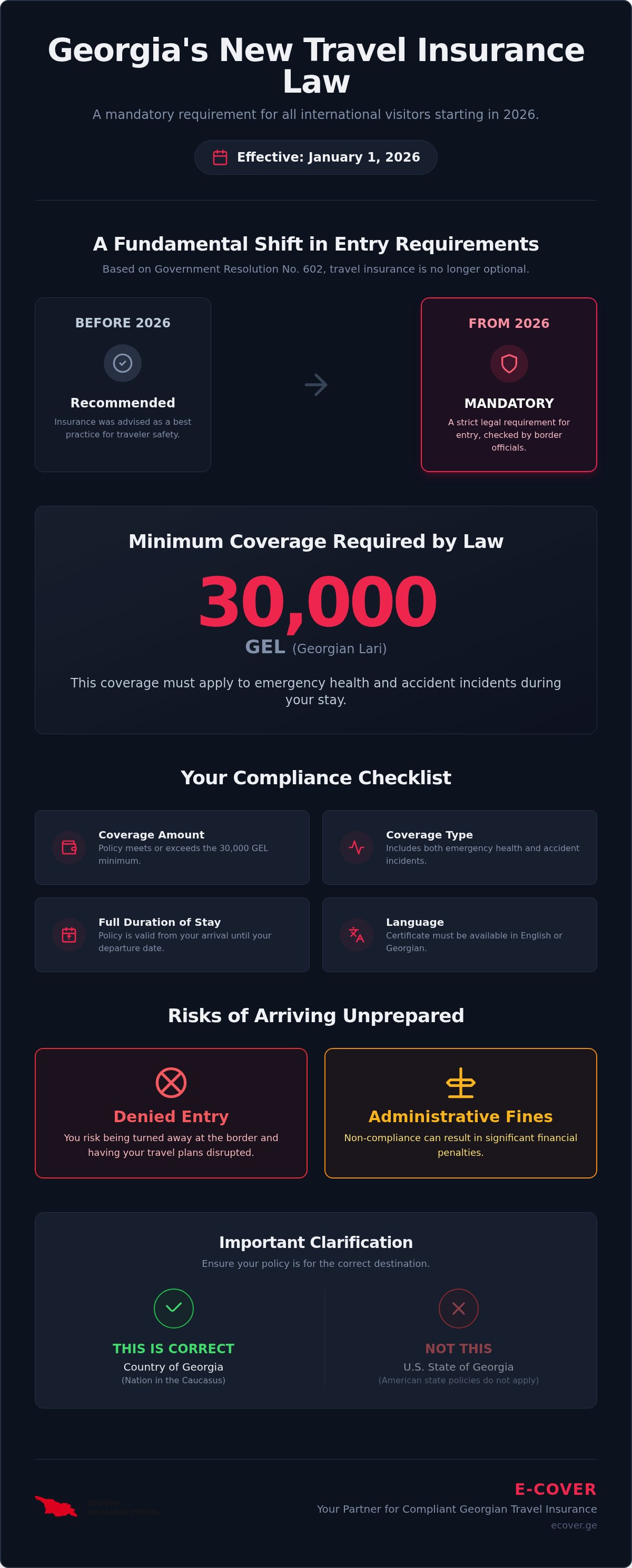
Compliance Checklist: How to Ensure Your Insurance Meets Border Entry Standards
Meeting the requirements of the Georgia mandatory insurance law involves more than just a quick purchase. You must verify that your documentation is legally sound to avoid complications during the immigration process. If you arrive with an incomplete policy, border officials have the authority to deny entry. Use this five step checklist to ensure your coverage is fully compliant with Government Resolution No. 602 before you depart.
- Step 1: Duration Verification. Your policy must be valid for the entire length of your stay. This includes the day you land and the day you depart. If you extend your trip, you'll need to update your coverage immediately.
- Step 2: Language Accessibility. The certificate must be presented in either English or Georgian. If your policy is in another language, border police won't be able to verify the coverage limits.
- Step 3: Repatriation Clause. Confirm that the policy explicitly includes emergency medical repatriation. This is a non-negotiable legal requirement for all international arrivals in 2026.
- Step 4: Licensing Check. Ensure your provider is a state-verified entity. Policies from uncertified brokers may not appear in the official verification systems used at the border.
- Step 5: Documentation Accessibility. Keep a high-resolution digital copy on your phone and a physical printout in your carry-on luggage. Technical failures shouldn't prevent you from proving compliance.
Following these steps ensures you're prepared for the administrative checks that define modern entry into the Caucasus. You can secure your compliant certificate now to guarantee your documentation meets every legal standard mentioned above.
The Border Verification Process
In 2026, border police utilize a streamlined verification system to check insurance status. When you present your passport, officials may request your insurance certificate to confirm it aligns with the Georgia mandatory insurance law. If your insurance expires while you're still in the country, you're technically in violation of national law. This can lead to administrative fines or difficulties when trying to exit the country. For a deeper look at the arrival experience, read our Mandatory Georgia Travel Insurance: 2026 Entry Guide to understand exactly what happens at the checkpoint.
Special Requirements for Students and Expats
While tourists need basic compliant coverage, students and long term residents face additional mandates. If you're on a student visa path, your insurance must often cover longer periods and meet specific university enrollment criteria. Our Student Health Insurance in Georgia: The Complete 2026 Requirements Guide outlines these nuances in detail. Residency seekers need a different level of compliant coverage because their stay transitions from a temporary visit to a long term legal status. Ensuring your policy is designed for your specific visa type is the only way to maintain legal standing throughout your stay.
E-COVER: Your Partner for Compliant Georgian Travel Insurance
E-COVER acts as a bridge between the visitor and the complex regulatory environment created by the Georgia mandatory insurance law. Instead of spending hours deciphering legal jargon, you can rely on our platform to provide a policy that's already vetted for compliance. We've designed our service specifically to meet the January 2026 requirements, ensuring that every certificate issued contains the necessary 30,000 GEL coverage and mandatory repatriation clauses. Our goal is to provide a seamless administrative experience so you can focus on your journey rather than border logistics.
Why Choose a Licensed Local Broker?
Choosing a local broker means your coverage is built on direct alignment with the LEPL Insurance State Supervision Service. As a licensed entity (License N012063), E-COVER possesses the expertise in Georgian medical billing and border requirements that global insurers often lack. This local standing gives you the peace of mind that your policy is guaranteed to be accepted by border police. We act as a reliable facilitator, translating official protocols into simple, actionable steps. If you need medical assistance, our deep understanding of the domestic healthcare system ensures that your claims are handled according to local standards, preventing any unexpected out-of-pocket costs.
The E-COVER Digital Experience
The E-COVER digital experience is built for the modern traveler who values both speed and legal certainty. Our simple 3-step purchase process allows tourists, students, and nomads to secure their documentation in minutes. We've optimized our platform to offer affordable pricing that doesn't sacrifice compliance, ensuring that every policy includes the specific medical repatriation and acute care limits required by the state. You don't have to worry about missing a technical detail; our system handles the legal complexity for you.
Once you complete your purchase, you can download your compliant certificate instantly. This digital document is formatted specifically for border presentation, allowing you to show it on your smartphone or provide a printed copy to immigration officials. We also provide support to assist travelers as they navigate the new 2026 landscape. By choosing a partner that understands the nuances of the law, you eliminate the fear of being turned away at the border and ensure your journey through the Caucasus is stress-free and fully protected.
Secure Your Entry Before You Fly
The transition to mandatory health coverage marks a new era for Georgian tourism. By now, it's clear that your travel plans must include a policy that meets the 30,000 GEL threshold and includes specific medical repatriation clauses. Border officials will strictly enforce these standards starting January 1, 2026. If you arrive without a verified certificate, you risk being denied entry at the checkpoint. Aligning your documentation with the Georgia mandatory insurance law is no longer optional; it's the foundation of a successful trip.
E-COVER simplifies this administrative hurdle by acting as your trusted local expert. We're licensed by the LEPL Insurance State Supervision Service, which means our policies are 100% border-entry compliance guaranteed. You don't have to wait for days for a manual review. You can Get Your Compliant 2026 Georgia Travel Insurance Instantly and receive an official PDF certificate via email in just minutes. We're dedicated to ensuring your arrival is seamless and your stay is fully protected. Safe travels, and we look forward to welcoming you soon.
Frequently Asked Questions
Is travel insurance really mandatory for Georgia in 2026?
Yes, travel insurance is legally required for all international visitors entering the country starting January 1, 2026. This mandate, established by Government Resolution No. 602, applies to all foreign citizens regardless of their visa status or nationality. You must present proof of a valid policy to border officials upon arrival. Failure to do so will result in administrative consequences, potential fines, or an immediate denial of entry into the national territory.
What happens if I arrive at the Georgian border without insurance?
Arriving at the border without compliant insurance can lead to immediate denial of entry by border police. Under the 2026 regulations, officials are authorized to verify your policy before granting passage through the checkpoint. If you cannot provide a valid certificate, you may also face administrative fines. To avoid these logistical complications, it's essential to secure your policy and have your digital or physical certificate ready for inspection before you land.
Does my credit card travel insurance meet the 2026 Georgian law requirements?
Most credit card travel insurance plans fail to meet the specific standards of the Georgia mandatory insurance law because they lack the required 30,000 GEL coverage limit. These plans often carry high deductibles or omit essential services like medical repatriation, which are strictly required by the state. You should carefully review your credit card policy's certificate. If it doesn't explicitly state coverage for Georgian territory and meet all 2026 mandates, you must purchase a dedicated policy.
What is the minimum medical coverage limit required by Georgian law?
The minimum medical coverage limit required by the new law is 30,000 Georgian Lari (GEL). This amount is approximately equivalent to $11,000 USD or €9,500 EUR. Your policy must cover both emergency medical treatments and accident related expenses up to this total. Border officials specifically look for this GEL threshold on your insurance documentation. Ensure your provider clearly states this amount on your certificate to avoid any confusion during the verification process at the border.
Can I buy the mandatory insurance after I arrive in Georgia?
You cannot wait until after you clear immigration to purchase your insurance. Border officials check for a valid policy at the point of entry before you are legally admitted into the country. If you arrive without coverage, you won't be allowed to proceed past the checkpoint. However, you can use our digital platform to purchase a policy instantly while at the airport, provided you do so and download the certificate before reaching the passport control desk.
Is medical repatriation included in the mandatory insurance plans?
Yes, medical repatriation is a core legal requirement for all insurance policies under the 2026 mandate. This coverage ensures that the costs of transporting a patient back to their home country for specialized care are fully covered. Standard global plans often exclude this feature or treat it as an optional add-on. Under Georgian law, any insurance policy that lacks specific repatriation coverage will be considered non-compliant and may be rejected by border authorities upon your arrival.
How do I prove my insurance is compliant with the 2026 mandate?
You prove compliance by presenting an insurance certificate issued by a licensed broker in either English or Georgian. This document must clearly state your name, the policy's validity dates, and the 30,000 GEL coverage limit. Border police accept both physical printouts and digital PDF copies on mobile devices. It's best to carry both formats to ensure you can provide proof even if you experience technical issues with your smartphone or internet connection during inspection.
Do international students need a specific type of mandatory insurance?
International students must hold a policy that meets the Georgia mandatory insurance law while also covering their entire period of enrollment. While the 30,000 GEL minimum applies, student policies often require additional features to satisfy university and long term residency regulations. It is critical to purchase a dedicated student insurance plan rather than a short term tourist policy. This ensures you remain in legal standing with both the immigration authorities and your educational institution.


