

A mountain itinerary into Georgia comes with a clear insurance requirement: from January 1, 2026, tourists must have health and accident insurance with minimum coverage of 30,000 GEL. Travel insurance for the Caucasus Mountains should therefore meet Georgia’s entry rule while matching the needs of your planned trip.
It’s sensible to look beyond the paperwork, too. Trekking in the Caucasus can involve varied routes and levels of exertion, so understanding what a policy covers helps you make an informed choice before departure. This guide explains Georgia’s insurance requirement, what the required cover includes, and how to assess protection for a mountain trip. You’ll also learn how a policy for visitors to Georgia fits into your plans, so you can prepare the right documents and understand your cover.
Key Takeaways
- Learn which treatment expenses matter when assessing the minimum coverage for a mountain trip.
- Understand when Georgia’s insurance requirement applies and how long your policy must remain valid.
- Know what to do in a medical emergency and which number to call for an ambulance in Georgia.
- See how trip length and travel purpose can help you identify a suitable type of insurance policy.
Minimum insurance coverage and covered expenses
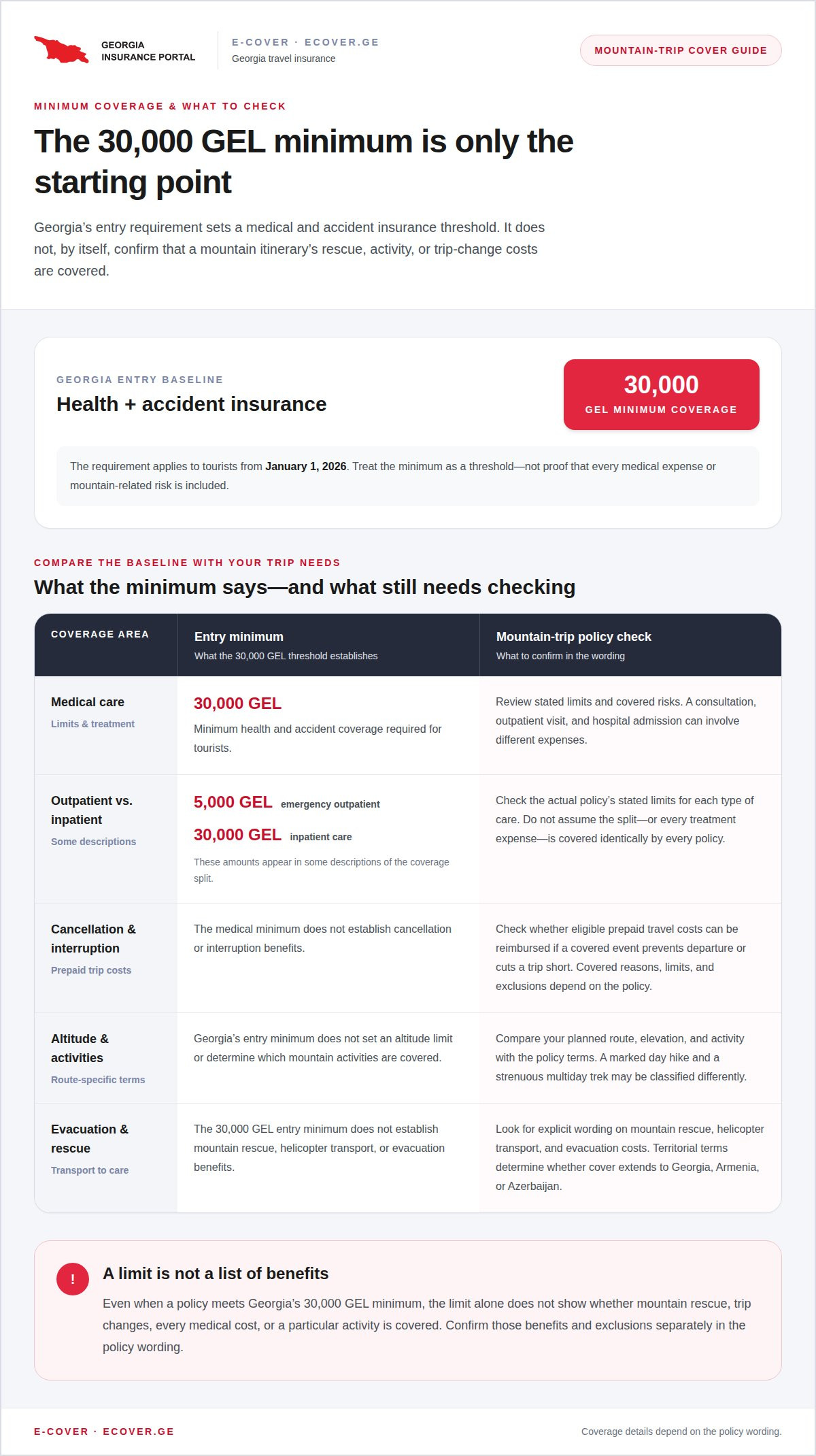
For Georgia, tourists need health and accident insurance with minimum coverage of 30,000 GEL. This entry requirement is a starting point, not a complete measure of protection for a mountain itinerary.
Some descriptions divide Georgia’s coverage into 5,000 GEL for emergency outpatient care and 30,000 GEL for inpatient care. The distinction matters: an outpatient visit and a hospital admission involve different expenses. Review the policy’s stated limits and covered risks, then consider whether they suit your route. A 30,000 GEL minimum alone doesn’t explain whether mountain rescue, trip changes, or every medical cost is covered.
Trip Cancellation and Interruption
Trip cancellation and interruption coverage can reimburse eligible prepaid travel costs when a covered event prevents departure or cuts a trip short. It matters if a trekking itinerary includes non-refundable transport or accommodation. For example, cancelling before departure differs from returning home early after reaching Georgia. Covered reasons, reimbursement limits, and exclusions depend on the policy wording, so assess these terms separately from the 30,000 GEL medical minimum.
Altitude Limits and Activity Exclusions
Altitude limits and activity exclusions define which elevations and mountain activities a policy covers. No single altitude limit applies to every travel policy, and the Georgian entry minimum doesn’t set one. A marked day hike and a strenuous multiday trek may be classified differently. Compare your planned route, elevation, and activity with the policy terms; an exclusion can affect a claim even when the policy meets Georgia’s 30,000 GEL minimum.
Emergency Evacuation and Helicopter Rescue
Emergency evacuation and helicopter rescue benefits address transport from an incident site to suitable medical care. They are not established by Georgia’s 30,000 GEL entry minimum, and cover in Georgia, Armenia, or Azerbaijan depends on the policy’s territorial terms and stated benefits. Look for explicit wording on mountain rescue, helicopter transport, and evacuation costs. If those terms are absent, the medical coverage limit alone doesn’t show that rescue expenses are covered.
Do I need travel medical insurance for Georgia?
Yes. Travelers should check whether health and accident insurance is required for their visit to Georgia. Travelers planning a trek in the Caucasus should check whether any insurance requirements apply to their trip. The minimum coverage amount is explained above; meeting that threshold addresses only one part of preparing valid proof.
It is sensible to check that your policy covers your full time in Georgia. It may be issued by a Georgian or foreign insurance company. Carry proof in paper or electronic format, and make sure it is written in Georgian or English. A policy in another language does not meet the stated format requirement.
The policy must identify each insured person and the territory covered. It must also state the subject of insurance, coverage dates, insured risks, coverage limits, premium, and the place and deadline for payment. These details help confirm that the document applies to you, your destination, dates, and covered risks. Save the proof somewhere accessible offline, rather than relying on an email account you may not be able to open.
Some groups are exempt from Georgia’s mandatory insurance requirement. These include holders of diplomatic and special visas, accredited diplomatic or consular staff and eligible family members, and people entering under Georgia’s international treaties and agreements. Drivers engaged in international road freight or passenger transportation are also exempt. The exemptions are specific, so ordinary visitors should not assume they qualify.
For a mountain itinerary, match the policy dates to the full period spent in Georgia, not just the days scheduled for hiking. A trip that includes arrival before a trek or travel after it still falls within the required stay period. You can review insurance for visitors to Georgia as part of preparing the required documentation.
Emergency medical treatment
In Georgia, call 112 for an ambulance during a medical emergency. Give the operator your location as clearly as possible, including a nearby road, village, or trail landmark. On a Caucasus route, a useful location description is more actionable than naming only the mountain range. If another person is with you, ask them to share the details while you stay with the injured traveler.
Once help is arranged, keep the traveler’s identification and insurance details accessible. Tell medical staff what happened, when symptoms began, and whether the person has relevant medical conditions or takes medication. For example, after a fall, describe the impact and any changes in pain or movement. Clear information can help the treating team assess the situation and relate care to the incident.
Medical care can involve different settings and expenses. A consultation at a good private clinic in Tbilisi or Batumi typically costs under 100 GEL. That figure relates to a consultation, not every possible treatment expense. The total depends on the care needed, the facility, and whether treatment continues beyond an initial visit. Keep itemized bills and medical records together so the services and dates are documented.
For a claim, records help show what care was provided and why. Retain prescriptions, discharge papers, diagnostic reports, and proof of payment when available. If a companion pays for treatment, keep that payment record with the patient’s documents. A clinic visit in Batumi, for instance, may produce several separate records, so store them together rather than relying on memory later.
In a remote area, communication and access can shape the response. Share the route, last known position, and nature of the emergency with 112, then follow the operator’s instructions. Avoid moving someone with a suspected serious injury unless remaining there presents immediate danger. After reaching care, record the facility name and treatment date; those details help connect medical documents to the event and any later claim.
Travel insurance options and local providers
Travel insurance for the Caucasus Mountains may come from Georgian or foreign insurers, but the provider’s location alone doesn’t show whether mountain activities are covered. For an itinerary that crosses borders, distinguish Georgia from Armenia and Azerbaijan. The policy’s covered territory must match every country on your route, not just your point of arrival. Start by matching the policy territory to your full itinerary.
Which policies cover mountaineering, climbing, and high-altitude trekking? A policy covers these activities only when its terms include the activity and your planned conditions. A policy name alone cannot confirm coverage. For example, a policy describing ordinary hiking may treat technical climbing differently. Compare the activity wording with your route, altitude, and whether the trek lasts multiple days.
Assess options by purpose and duration as well as destination. A short visit and a long stay in Georgia present different policy periods, while study or remote work can affect which policy category fits. Check that the insured dates span the full stay, and that the territory includes each country visited. A Georgian-issued policy and a foreign-issued policy can both meet the format rule, provided the document states the required details.
Local providers may be familiar with Georgia’s entry documentation, while international insurers may issue policies covering broader itineraries. Those labels don’t replace reading the contract. Check its stated insured risks, limits, exclusions, and claim process. A policy that meets the entry-document requirement may still treat rescue, climbing, or trip interruption under separate terms. Keep the policy certificate and emergency instructions available offline during remote hikes.
Use a simple comparison: list each planned activity, country, and travel date, then match them against the policy wording. Resolve mismatches before relying on the policy for your itinerary. For example, if your route combines trekking in Georgia with climbing in Armenia, the contract needs to address both the activity and the territory. This helps you judge whether travel insurance for the Caucasus Mountains fits the trip you plan to take.
E-COVER: Travel Insurance Policies
E-COVER provides travel insurance policies for foreign visitors travelling to Georgia, designed to meet the state’s health insurance requirements. If your Caucasus itinerary includes a longer stay, study, or remote work, Student Insurance, long term travel insurance policies, and Digital Nomad Insurance are relevant options to consider.
For a mountain trip, distinguish the required Georgia cover from protection for planned activities. Review the policy’s insured risks, limits, territory, and dates alongside your route. If your itinerary includes climbing or high-altitude trekking, check the activity wording carefully, since it determines what the cover applies to.
Contact E-COVER to discuss insurance for your trip to Georgia.
Prepare for the journey ahead
Bring your route and insurance choice together as your next planning step. Before departure, consider the kind of experience you want in the Caucasus, from a relaxed stay to a demanding mountain itinerary. Choose cover that fits the trip you intend to take. That alignment makes decisions about activities, timing, and preparation more straightforward.
For travel insurance for the Caucasus Mountains, E-COVER offers Travel Insurance Policies, Student Insurance, and long term travel insurance policies. These options serve different travel situations, so your purpose and length of stay can guide the next conversation. A clear outline of your plans helps keep that discussion focused on the cover relevant to your visit.
Take the next step when you’re ready. Contact E-COVER about travel insurance to discuss a policy for your trip to Georgia. With the insurance decision in hand, you can give more attention to the places and experiences that brought you to the mountains.
Frequently Asked Questions
Does travel insurance cover hiking and trekking in the Caucasus Mountains?
It can, if the policy covers the specific activity and conditions planned. A marked day hike may be treated differently from technical climbing or a remote multiday trek. Check whether the policy’s activity wording includes guided trekking, independent hikes, and the route’s altitude. Also review the exclusions for rescue and evacuation, since medical treatment cover alone doesn’t mean those costs are covered.
What medical coverage limits are recommended for trekking in the Caucasus Mountains?
For Georgia, the required health and accident insurance minimum is 30,000 GEL. That is a legal threshold, not a universal recommendation for every expense or every Caucasus country. Consider the care your route could require, including hospital treatment and transport from a remote trail. A policy limit doesn’t automatically include every service, so distinguish the overall limit from the benefits and exclusions listed in its terms.
Does travel insurance cover trip cancellations or interruptions due to weather, trail closures, or political unrest in the Caucasus?
Coverage depends on the policy’s covered reasons, exclusions, and terms. Weather, a closed trail, or political unrest isn’t automatically covered. For instance, a trail closure may affect a trek without making your transport or accommodation refundable. Read the cancellation and interruption clauses for each event, and note whether they apply before departure, during the trip, or both. Keep evidence of the event and related expenses.
Are there country-specific insurance requirements for U.S. visitors to Georgia, Armenia, or Azerbaijan?
Georgia requires tourists to hold health and accident insurance, and the rule applies to visitors rather than only U.S. citizens. Georgia’s requirement does not establish the rules for Armenia or Azerbaijan; treat each country separately when planning a cross-border itinerary. For Georgia, E-COVER policies are issued in Georgian and English. A policy covering Georgia should not be assumed to satisfy requirements in neighboring countries.
How do travel insurance providers compare for Caucasus trekking and adventure sports coverage?
Compare policies by their terms, not simply by whether they’re called “adventure” cover. Check whether the wording includes your actual activities, such as high-altitude trekking or technical climbing, and every country on your route. Then review the limits, covered services, and relevant exclusions. A general description cannot replace the benefits and conditions written in the policy.
What should travelers check in a policy before buying insurance for a Caucasus Mountains trip?
Match the policy against your itinerary before purchase: confirm the insured dates, destination countries, planned activities, medical limits, and exclusions. For Georgia, the policy must cover the full stay and be available in Georgian or English. Also check how emergency assistance and claims work, and keep the policy document accessible offline. If your route changes to include Armenia or Azerbaijan, review the territorial coverage again.


