

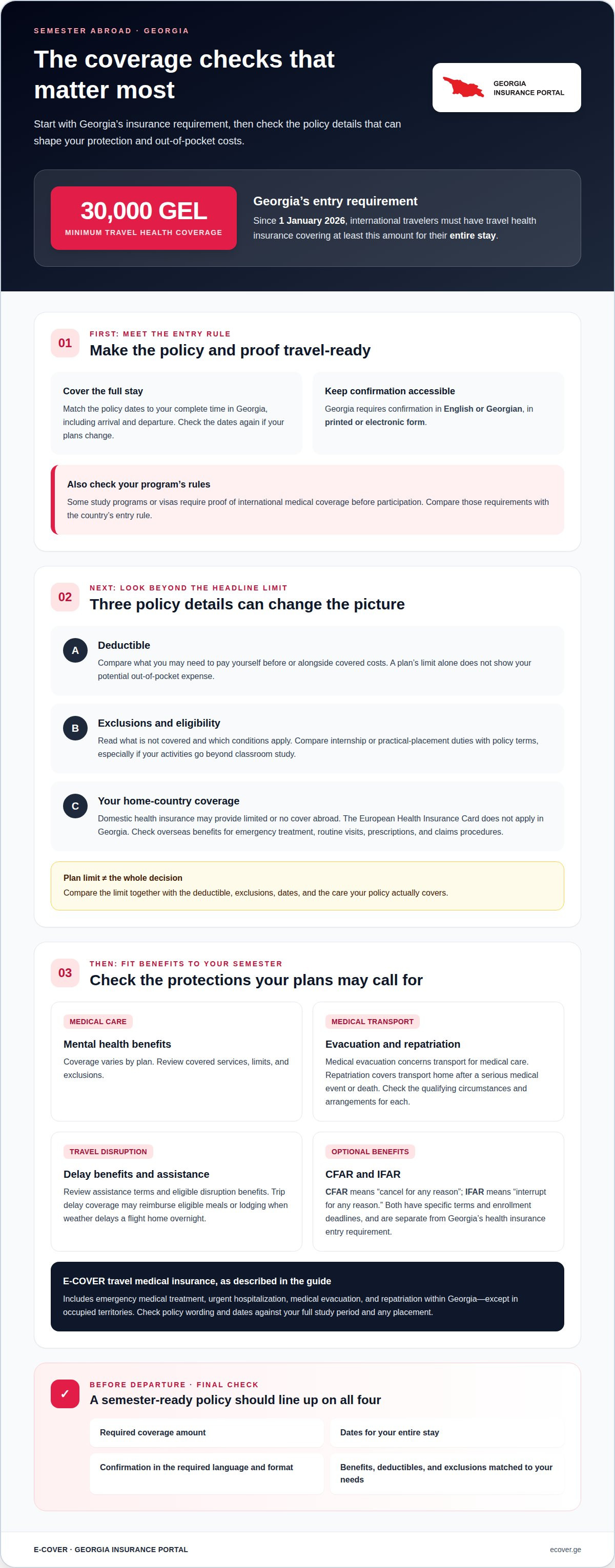
For semester abroad insurance in Georgia, the key requirement is at least 30,000 GEL in travel health coverage for your entire stay. Since 1 January 2026, Georgia requires all international travelers to have health insurance, with confirmation in English or Georgian in printed or electronic form. A plan’s headline limit is only part of the decision: the deductible and exclusions also affect what you may pay yourself.
It’s sensible to compare coverage carefully before departure, especially if your home-country policy offers limited protection abroad or your study program has its own insurance rules. This guide explains how to assess those requirements, weigh deductibles against plan limits, and understand how eligible travel-disruption benefits may fit into your protection. You’ll also learn what can shape the cost of a policy, so you can choose coverage that suits your stay without relying on assumptions about what your existing insurance will cover.
Key Takeaways
- Match your policy documents to your study program’s requirements so you’re prepared before departure.
- Review where your home-country health plan applies and identify gaps in overseas medical coverage.
- Consider how medical care and travel delays could affect your plans, and which benefits may help.
- Compare deductibles, exclusions, and plan limits, then explore E-COVER Student Insurance or Travel Insurance Policies for your stay.
International medical coverage requirements for study programs and visas
For a semester in Georgia, separate the country’s entry rule from your university’s study abroad requirements. Since 1 January 2026, visitors must have travel health insurance covering at least 30,000 GEL for their entire stay.
Georgia requires insurance confirmation in English or Georgian, in printed or electronic form. Some study programs or visas also require proof of international medical coverage before participation. Match the policy dates to your full stay, then prepare an accessible copy of the confirmation for travel and program administration.
Mental Health and Emergency Evacuation
Mental health coverage varies by plan, so read the benefit description for covered services, limits, and any exclusions. Emergency evacuation is a separate protection to assess: review what circumstances qualify, how transport is arranged, and whether the benefit applies during your study abroad program. For example, a policy focused on routine medical treatment may not address evacuation needs. Compare these protections alongside the required medical coverage.
Internships and practical placements can involve activities beyond classroom study. Compare your placement duties with the policy terms and any exclusions, and make sure your policy dates cover your full stay, including arrival and departure. If your plans change during the semester, review the coverage against your updated dates and activities.
Optional CFAR, or “cancel for any reason,” and IFAR, or “interrupt for any reason,” benefits address cancellation or interruption beyond standard covered reasons. They have specific terms and enrollment deadlines. Read the eligibility conditions and deadline before purchasing, then consider whether the timing fits your program’s payment dates and travel arrangements. These optional benefits are distinct from Georgia’s health insurance entry requirement.
Repatriation Coverage
Repatriation covers transport home after a serious medical event or death, while medical evacuation concerns transport for medical care. Check the policy wording to understand the conditions for each benefit. E-COVER’s travel medical insurance includes medical evacuation and repatriation within Georgia, except in occupied territories; it also covers emergency medical treatment and urgent hospitalization. Check that your policy covers your entire study period, including any placement.
Limitations of domestic health insurance outside the home country
Your domestic health insurance may offer limited or no cover outside the country where it applies. Compare its overseas benefits with the care you may need while studying in Georgia. The European Health Insurance Card does not apply in Georgia, so it cannot fill a local coverage gap. Check policy terms for emergency treatment, routine visits, prescriptions and claims procedures before departure.
Students can buy health insurance by choosing a policy that meets Georgia’s entry standard and covers their full stay. Keep the insurance confirmation in English or Georgian, in printed or electronic form, as required for travel. For semester abroad insurance in Georgia, also match the policy dates to your arrival and departure.
Since 1 January 2026, Georgia requires international travelers to hold travel health insurance with at least 30,000 GEL in coverage for their entire stay. Compare your home policy against this requirement, including its dates and coverage limit. A policy that applies only at home may leave you without the documentation or protection needed for your stay.
Prepare for health needs before departure. The Centers for Disease Control provides travel health recommendations, immunization guidance and information about re-entry into the United States. It also identifies vaccinations recommended for different regions; students should obtain necessary vaccinations at least six weeks before traveling. Georgia State University students studying abroad must submit a Health Clearance Form completed by a U.S.-based licensed physician. They also attend a pre-departure meeting with Study Abroad Programs and/or their Program Director.
Share specific health requirements with your campus study abroad office early. This gives the office time to consider program suitability and necessary accommodations. For example, explain ongoing care needs before confirming a placement, then compare those needs with your insurance benefits. When choosing semester abroad insurance in Georgia, explore student insurance options alongside your home-country coverage.
Medical care and travel disruptions during gap-year travel
A study abroad policy can help with local medical care and certain travel disruptions. Compare medical benefits with travel protection and assistance before departure.
Travel Protection and Assistance
After an injury in Georgia, student travel insurance can help students find and pay for local medical care. For longer trips, travel insurance may combine medical coverage, travel protection, and 24/7 assistance. Review the policy’s assistance terms and covered disruption benefits. For example, trip delay benefits can reimburse eligible meals or lodging when weather delays a flight home overnight.
Check destination safety guidance before planning travel outside your university city. As of 24 October 2026, the Federal Foreign Office strongly advises against travel to Abkhazia, South Ossetia, and the immediate vicinity of Georgia’s conflict regions. Share your itinerary with your university’s study abroad department and know how its emergency procedures apply if plans change.
Medical Expense Claims
If you pay medical expenses out of pocket while abroad, file an insurance claim after returning to the United States. Keep bills, receipts, and medical records together, and follow the policy’s claims instructions. For example, retain the clinic invoice and proof of payment so your claim documents show both the treatment and expense. Organizing records during the trip can make the later submission more straightforward.
Hospitals, Clinics, and Medical Payments
Students should know that care may require paying locally before seeking reimbursement. These estimates show why medical limits and claim procedures matter.
In an emergency, seek local medical assistance first. Keep your insurance details accessible and follow the policy’s instructions for contacting the insurer or assistance service. If treatment requires an upfront payment, save the itemized bill and proof of payment. Your university’s emergency contact can also help you understand program procedures while you arrange care.
Comparing student insurance plan limits and deductibles
For U.S. students on University System of Georgia study abroad programs, study abroad insurance is required. Students may use a system-wide policy and contact their campus study abroad office for details or to ask whether coverage comes with their program. Georgia Tech also requires supplemental study abroad insurance for its programs, and students should retain domestic coverage while abroad.
These program arrangements differ from a private insurance plan. Compare the policy maximum, deductible, and covered benefits rather than choosing by the headline limit alone. The maximum is the most the plan pays under its terms; the deductible is the amount you pay before eligible benefits begin. A lower deductible can reduce your initial share, while a higher maximum may provide more protection against large eligible claims.
A suggested private insurance waiver checklist calls for a policy maximum of at least $100,000 and a deductible below $500. Treat those figures as comparison benchmarks, not as Georgia’s entry requirement. Check whether the maximum applies per incident or across the policy period, and whether separate limits apply to evacuation or repatriation. These distinctions can change how much protection remains after a claim.
Read the exclusions and benefit wording alongside the figures. A policy may have a high maximum but limit a particular service or exclude an activity. Compare which treatments and circumstances are covered, the deductible and any separate benefit caps. Then check that the dates match your university program and planned activities. Keep the insurance certificate and policy wording together for your records.
Before selecting a plan, write down your maximum, deductible, and any evacuation or repatriation limit. Compare those details against your program’s insurance rules and your existing domestic coverage. If you need an individual policy for your study period, explore student insurance options and compare the terms that matter for your stay.
E-COVER: Travel Insurance Policies
E-COVER offers Travel Insurance Policies for foreign visitors traveling to Georgia, including students preparing for a semester abroad. Its online policies are designed to meet Georgia’s health insurance entry requirements, helping travelers arrange coverage for their stay. Turn to E-COVER when you need travel medical insurance for Georgia or Student Insurance suited to your study plans.
Before choosing a policy, compare its dates with your study period and check its terms, deductible and benefits. E-COVER offers Annual Mandatory Travel Insurance for long-term visitors, as well as Foreign Students Insurance. Choose a policy that covers your full stay, including the day you enter Georgia and the day you depart.
Visit ecover.ge to explore coverage for your time in Georgia.
Make Your Coverage Decision Before You Travel
Use your next step to turn policy comparisons into a clear plan for your time abroad. Set your study dates, program requirements, and expected activities beside the insurance terms you’ve reviewed. This makes it easier to identify which benefits matter most and keep the relevant documents ready for university administration and travel. If juggling travel logistics alongside academic coursework deadlines becomes overwhelming, students seeking support with their studies can turn to academic assistance platforms like Pisanie Prac Zaliczeniowych i Dyplomowych for guidance on papers and diploma projects.
Choosing semester abroad insurance in Georgia is not only about meeting an entry requirement. It’s also a chance to prepare for how you’ll handle an unexpected medical need or a change in travel plans. Keep your policy details accessible, understand the steps for getting assistance, and save the information you may need if you pay medical expenses yourself.
E-COVER can be a next step if you’re ready to arrange coverage for your stay. Contact E-COVER about your coverage and take the next step toward a well-prepared semester in Georgia.
Frequently Asked Questions
What health insurance is required for study abroad in Georgia (the country)?
Students need travel health insurance that meets Georgia’s entry requirement, plus any separate coverage required by their study program. For a policy to meet E-COVER’s stated requirements, its aggregate limit must be at least 30,000 GEL, and it must be issued in Georgian and English. Set the start date to include entry and the end date to include departure.
Does Georgia require international students to have health insurance?
Yes. Since 1 January 2026, Georgia requires international travelers, including students, to have travel health insurance. This country-level requirement is separate from a university’s program rules, which may require additional study abroad coverage. Students should therefore keep their entry insurance documents and any university insurance records together, so they can provide the relevant document for each requirement.
What does student travel insurance for Georgia typically cost per semester?
There isn’t one standard semester total. The amount depends on the policy selected and the dates it covers, including the full stay from entry through departure. A semester policy and a longer-term policy may use different pricing structures. Compare the total period insured and the benefits included, rather than estimating from a shorter trip or assuming every plan uses the same rate.
What coverage limits are recommended for a semester in Georgia?
Georgia’s entry requirement is at least 30,000 GEL in aggregate coverage. Separately, a suggested private insurance waiver checklist uses a policy maximum of at least $100,000 and a deductible below $500 as comparison benchmarks. These figures serve different purposes: compare the GEL requirement for entry, then assess whether the plan maximum, deductible, and any separate benefit limits suit your program.
Does student insurance in Georgia cover emergency evacuation and repatriation?
Some study abroad policies include emergency evacuation and repatriation, but benefits and conditions depend on the policy. E-COVER’s stated travel medical coverage includes medical evacuation and repatriation within Georgia, excluding occupied territories. Before relying on a plan, distinguish evacuation from local treatment and review how its repatriation benefit applies. Keep the assistance and claims instructions accessible during your studies.
Are pre-existing conditions, mental health care, and prescription drugs covered by study-abroad insurance in Georgia?
Coverage depends on the policy wording for each benefit. Check how it defines pre-existing conditions, which mental health services it lists and whether prescription drugs are covered during treatment or for ongoing use. For example, a plan may distinguish a new prescription during emergency treatment from routine refills. Compare those terms with your needs, and confirm that the policy meets Georgia’s entry requirements before choosing it.


