

Could a missing digital document stop your entry into the Country of Georgia before you even leave the airport? Starting January 1, 2026, the Georgian government officially mandates that every visitor must carry a specific health and accident insurance policy to cross the border. Obtaining compliant emergency medical cover Georgia authorities recognize is now a non-negotiable step for international travelers. We understand that new border regulations often bring a sense of uncertainty, especially when you're trying to distinguish between state-level requirements and general travel advice. You want to ensure your arrival is seamless and your documentation is beyond reproach.
This guide provides a clear roadmap to meeting these 2026 mandates so you don't face the risk of being turned away. We'll show you how to secure the mandatory insurance that the government requires, including the necessary 30,000 GEL minimum coverage and English-language certification. By the end of this article, you'll have a practical understanding of the new laws, the specific repatriation requirements, and exactly how to obtain a compliant policy that guarantees peace of mind for your entire stay in the Country of Georgia.
Key Takeaways
- Understand the new January 1, 2026, legal mandate that makes health insurance a prerequisite for entering the Country of Georgia.
- Identify the specific coverage limits and inclusions, such as emergency medical cover Georgia, required to pass border inspections.
- Learn the differences between public and private healthcare systems to ensure you receive the most efficient medical care possible.
- Discover the exact documentation formats you'll need to present at the border to avoid entry delays or complications.
- Find out how to obtain a compliant, state-supervised policy with instant digital issuance for your upcoming trip.
What is Emergency Medical Cover for Georgia in 2026?
Emergency medical cover Georgia refers to a specific category of health insurance that meets the legal standards established by the Georgian government for all foreign arrivals. Starting January 1, 2026, this is no longer a suggested addition to your packing list; it's a mandatory entry requirement. This cover is designed to provide immediate financial protection for sudden illnesses or accidents, ensuring that visitors can access high-quality medical care without facing personal financial ruin or placing a burden on the local economy.
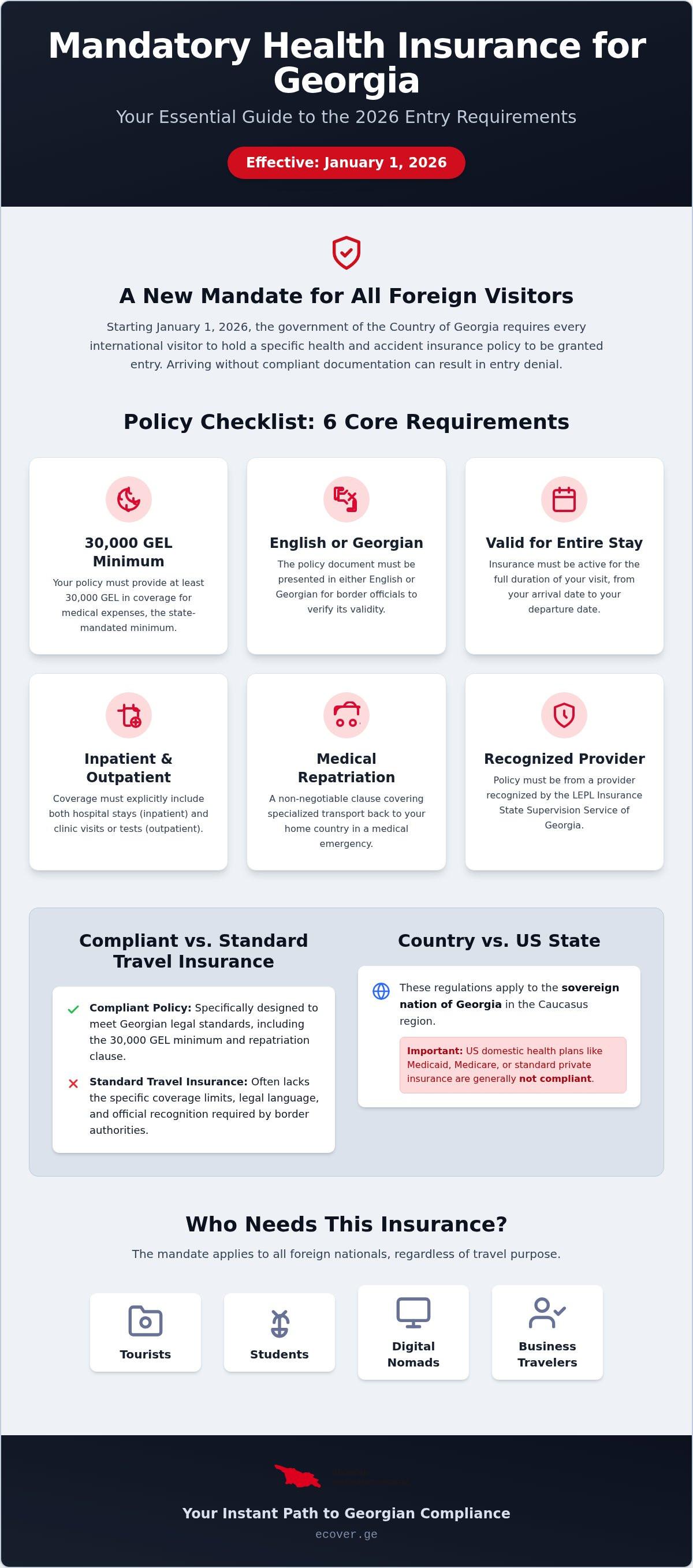
A critical distinction exists between standard travel insurance and state-compliant medical cover. While many general policies offer broad travel protection, they often lack the specific legal language and coverage minimums required by Georgian border authorities. To be considered valid for entry, your policy must meet the state-supervised criteria, including specific limits for both inpatient and outpatient care. This mandate applies to all foreign visitors, regardless of their reason for travel. This includes tourists exploring the mountains, students enrolled in local universities, digital nomads working remotely, and business professionals attending conferences.
The 2026 Mandate: Why Georgia Changed Its Entry Laws
The transition to mandatory insurance reflects a strategic move to modernize the nation's border protocols. By requiring all visitors to hold private insurance, the government ensures that international travelers are funneled into private medical centers rather than utilizing state-funded resources intended for citizens. This maintains the overall balance of Healthcare in Georgia, which relies on a mix of public and private infrastructure. Whether you're traveling under a visa-free regime or you've obtained a formal visa, the requirement remains the same. If you arrive at the border without a verifiable insurance certificate, you face a high probability of being denied entry or facing significant administrative delays.
Country of Georgia vs. US State: Clearing the Confusion
Search results can be misleading, so it's vital to clarify that these 2026 regulations apply to the sovereign nation of Georgia in the Caucasus region, not the US state. If you're a traveler from the United States, you should be aware that domestic health plans like Medicaid, Medicare, or private Anthem policies typically do not meet the 2026 mandate. These plans rarely offer the international repatriation or local emergency medical cover Georgia requires. The official regulatory body overseeing these rules is the LEPL Insurance State Supervision Service of Georgia. To ensure compliance, your policy must be issued by a broker or provider recognized by this service, featuring a minimum coverage limit of 30,000 GEL as specified in the 2026 regulations.
Core Requirements of a Compliant Georgian Medical Policy
To pass through border control in the Country of Georgia starting in 2026, your insurance policy must satisfy four primary criteria. First, the policy must provide a minimum coverage limit of 30,000 GEL. This amount is the state-mandated threshold designed to cover significant medical events. Second, the document must be presented in either Georgian or English. If your policy is in another language, border officials may not accept it as valid proof of coverage. Third, the policy must be active for your entire stay. If you plan to remain in the country for 90 days, your insurance must reflect those exact dates. Finally, the provider must be recognized by the LEPL Insurance State Supervision Service of Georgia to ensure the certificate is authentic.
The 2026 law specifically requires that your emergency medical cover Georgia includes both inpatient and outpatient services. Inpatient care covers costs associated with hospital stays, surgeries, and intensive care. Outpatient care focuses on diagnostic tests, specialist consultations, and urgent clinic visits that don't require an overnight stay. Failing to include both categories makes the policy non-compliant. The U.S. Embassy in Georgia has confirmed that mandatory health and accident insurance is now a prerequisite for all tourists, emphasizing the shift toward strict border enforcement.
The Medical Repatriation Clause
Medical repatriation is a critical and non-negotiable component of the 2026 mandate. This clause ensures that if a visitor becomes critically ill or injured and cannot travel by standard commercial means, the insurance covers the cost of specialized transport back to their home country. Without this specific inclusion, the financial burden of an air ambulance or medical escort would fall entirely on the traveler. Georgian law requires this to prevent visitors from becoming stranded without the means to return home for long-term recovery. If you're looking for a policy that automatically includes these legal headers, you can buy a compliant policy online in just a few minutes.
Emergency Dental and Urgent Care Inclusions
Your policy must distinguish between routine maintenance and acute medical needs. Routine dental cleanings or pre-planned checkups are not covered under the 2026 mandate. However, emergency dental care for acute pain, infections, or accidents is a required inclusion. Similarly, urgent care for sudden illnesses, such as severe food poisoning or high fevers, must be clearly outlined in your benefits schedule. When reviewing your emergency medical cover Georgia, check the "Table of Benefits" for these specific sub-limits. A compliant policy will clearly list the maximum payout for dental emergencies, typically as a portion of the overall 30,000 GEL limit.
Emergency Care in Georgia: Public vs. Private Systems
The Country of Georgia maintains a dual healthcare system. While state-run hospitals provide essential services to citizens, private medical facilities are the primary choice for international visitors. These private centers offer significantly faster response times and higher standards of medical technology. Without emergency medical cover Georgia, a visitor might find themselves waiting in state facilities that lack the specialized equipment or administrative speed found in the private sector. The infrastructure in the private sector has seen rapid modernization, making it the most reliable option for travelers who require urgent diagnostics or surgical intervention.
Language accessibility is a significant factor in why travelers prefer private care. Most private hospitals employ staff who are proficient in English, which is vital during a medical crisis. In contrast, state facilities often operate primarily in Georgian, which can lead to dangerous communication gaps. International guidance, such as the appropriate health and accident insurance recommendations from GOV.UK, highlights the necessity of being prepared for these logistical hurdles. Choosing a facility that understands your language and your insurance documentation is essential for a stress-free recovery.
Accessing Emergency Services as a Foreigner
If you encounter a medical emergency, you should immediately dial 112. This is the centralized dispatch number for police, fire, and ambulance services. When the ambulance arrives, or upon arrival at a clinic, you must present your digital or printed insurance certificate. Your insurance broker plays a key role here; they act as a liaison between you and the hospital's billing department to confirm that your policy meets the 2026 mandate. This verification process ensures that the hospital can proceed with treatment without worrying about payment authorization.
Financial Protection Against High Medical Bills
Medical costs for uninsured foreigners can escalate rapidly. While a simple consultation might be affordable, emergency surgeries, long-term hospitalizations, or intensive care stays can cost several thousand GEL. For those without emergency medical cover Georgia, hospitals often require a substantial upfront deposit before treatment begins. A state-compliant policy removes this barrier by providing a direct guarantee of payment to the facility. This ensures you receive immediate care without the stress of liquidating personal funds or managing complex currency transfers during a medical crisis. Having a policy recognized by the LEPL Insurance State Supervision Service provides the ultimate peace of mind that your financial risks are fully mitigated. It transforms a potentially devastating financial event into a manageable administrative process.
How to Secure and Verify Valid Insurance for the Border
Securing valid insurance for your trip requires a methodical approach. You shouldn't wait until you arrive at the border to verify your coverage. To ensure you meet the 2026 mandate, purchase your policy through a platform that provides instant digital issuance. This is especially vital for last-minute travelers who need a certificate immediately to present to airline staff or border officials. Obtaining the right emergency medical cover Georgia authorities expect means checking the provider's credentials before you pay. A legitimate policy must be issued by a broker licensed by the LEPL Insurance State Supervision Service of Georgia. This ensures the document is recognized by the state and will be accepted during entry inspections.
Digital preparation is just as important as the policy itself. Keep a copy of your insurance certificate on your smartphone, but also carry a physical printout. Border systems can occasionally face technical issues, and having a hard copy prevents unnecessary delays. Always double check that the digital file is a PDF and not a simple screenshot, as officials may need to verify the document's security features or QR codes.
Verification Checklist for Travelers
Before you finalize your travel plans, use this checklist to confirm your policy is border-ready. If your document lacks any of these details, you may face entry issues:
- Territorial Validity: The policy must explicitly mention "Georgia" or "Country of Georgia" as a covered territory.
- Repatriation Clause: Ensure the mandatory medical repatriation clause is clearly stated in the benefits table.
- Identity Matching: The names on the insurance certificate must match your passport exactly; even minor typos can cause friction.
- Date Alignment: Your coverage must start the day you enter and remain active until the day you exit.
What to Do if Your Current Policy is Not Compliant
Many travelers assume their existing coverage is sufficient. However, "credit card insurance" or general global plans often fail to meet the specific legal wording required by the 2026 mandate. These plans frequently lack the necessary 30,000 GEL minimum or the specific repatriation headers required by Georgian law. If your current plan is insufficient, you don't necessarily need to cancel it. Instead, you can supplement it with a local, compliant policy that satisfies border requirements. For a deeper dive into these technicalities, read our guide on the Georgia mandatory insurance law.
If you find your current coverage is lacking, the most efficient solution is to obtain a dedicated certificate that is pre-approved for border entry. You can secure your compliant emergency medical cover Georgia in less than five minutes to ensure a stress-free arrival.
E-COVER: Your Instant Path to Georgian Compliance
E-COVER acts as the essential bridge between international visitors and the regulatory environment in the Country of Georgia. Finding a policy that meets every specific legal nuance can be difficult, but our platform simplifies this by offering pre-vetted options. Every policy issued through E-COVER is guaranteed to provide the emergency medical cover Georgia requires for 2026, including the necessary repatriation and hospitalization sub-limits. Whether you're a digital nomad planning a six-month stay, a student arriving for the semester, or a tourist on a short holiday, our system tailors the coverage to your specific duration and traveler profile. We ensure that your documentation is 100% compliant with state laws before you even reach the airport.
Streamlined Online Application Process
The application process is designed for speed and transparency, acknowledging the practical urgency of travel planning. We've removed the need for medical exams or dense paperwork, focusing instead on the data points border officials actually check. The 2-minute application process delivers a PDF certificate via email immediately after payment is confirmed. This instant digital access ensures you have your proof of insurance ready for your boarding gate or the immigration desk. Because the system is fully automated, you can secure your policy at any time of day, making it the ideal solution for last-minute trips or forgotten documentation.
Expert Support and Licensed Reliability
Our reliability is built on institutional credibility and a deep understanding of local protocols. E-COVER is backed by the expertise of LLC Insurance Broker WeInsure, ensuring that every certificate carries the weight of a licensed intermediary. Our policies align directly with the standards set by the LEPL Insurance State Supervision Service of Georgia, which is the only way to guarantee your entry isn't delayed by non-compliant documentation. If you choose an unverified provider, you risk the financial consequences of denied entry or out-of-pocket medical costs.
24/7 digital access to your policy means you don't have to worry about losing physical papers during your journey. If a hospital needs to verify your emergency medical cover Georgia, you can pull up the official certificate on your phone in seconds. For more detailed insights into planning your trip and staying compliant with new laws, you can consult our Georgia Travel Medical Policy guide. This resource provides the full 2026 visitor context you need to travel with total confidence and security.
Secure Your Entry to the Country of Georgia for 2026
Entering the Country of Georgia in 2026 requires more than just a valid passport; it necessitates a specific legal commitment to your own health and safety. You now know that a compliant policy must feature at least 30,000 GEL in coverage and include a non-negotiable medical repatriation clause. By prioritizing private healthcare facilities, you ensure faster service and access to English-speaking staff. This makes your recovery much smoother if an unexpected accident occurs. Obtaining the correct emergency medical cover Georgia authorities require doesn't have to be a complex administrative hurdle that delays your trip.
E-COVER provides a streamlined path to full compliance. Don't leave your entry to chance. Our policies are 100% compliant with 2026 border entry laws and are officially licensed by the LEPL Insurance State Supervision Service. With our instant digital issuance, you can receive your certificate in minutes. This allows you to focus on the excitement of your upcoming journey rather than paperwork. Get your mandatory Georgian travel insurance certificate in 2026 today to ensure a seamless arrival at the border. We look forward to welcoming you to a safe and stress-free experience.
Frequently Asked Questions
Is travel insurance mandatory for Georgia in 2026?
Yes, travel insurance is legally mandatory for all foreign visitors entering Georgia starting January 1, 2026. This law applies to tourists, students, and business travelers alike. You must present a valid insurance certificate at the border to avoid being denied entry. The Georgian government implemented this change to ensure all visitors can access private medical care without placing a financial burden on state resources.
What is the minimum coverage required for the Georgian visitor mandate?
The Georgian government requires a minimum coverage limit of 30,000 GEL for any compliant policy. This amount must cover emergency medical expenses, including both inpatient and outpatient services. Your policy must also include specific provisions for medical repatriation to your home country. Obtaining the correct emergency medical cover Georgia authorities recognize is essential for a smooth border crossing and legal stay within the country.
Does my global health insurance satisfy the 2026 Georgian law?
Most global health plans or credit card insurances don't automatically satisfy the 2026 mandate. To be compliant, a policy must meet specific state-supervised criteria and be issued by a recognized provider. It must also be available in English or Georgian. If your current plan lacks the mandatory repatriation clause or the 30,000 GEL minimum limit, you'll need to supplement it with a local, state-approved policy.
Can I buy the mandatory insurance at the Georgian border upon arrival?
You shouldn't rely on purchasing insurance at the border because officials expect you to present a valid certificate upon arrival at the immigration desk. Failing to have your documentation ready can lead to significant delays or entry denial. It's much safer to use a digital platform for instant issuance before you depart. This ensures your emergency medical cover Georgia is verified and ready for inspection.
What happens if I stay in Georgia longer than my insurance policy covers?
Remaining in Georgia without active insurance is a violation of the 2026 mandate. If your policy expires while you're still in the country, you're no longer legally compliant with entry requirements. This could lead to administrative fines or complications when you attempt to exit the country. You should always ensure your policy dates align with your travel plans or renew your coverage through a licensed broker before the term ends.
Does the mandatory emergency cover include COVID-19 or pandemics?
The mandatory insurance is designed to cover acute medical emergencies and sudden illnesses. While specific pandemic riders vary by provider, any condition that requires urgent hospitalization or emergency care is generally covered under the state-mandated limits. The primary focus of the 2026 law is ensuring that visitors have the financial means to access private healthcare for any immediate or urgent medical situation that arises during their stay.
Is medical repatriation included in the standard E-COVER policy?
Yes, medical repatriation is a standard and mandatory inclusion in every E-COVER policy. Georgian law specifically requires this clause to ensure that travelers can be safely transported back to their home country if they suffer a severe medical crisis. We ensure that every certificate we issue meets this legal requirement, providing you with the necessary documentation to satisfy border officials and the financial protection needed for specialized medical transport.
Do international students in Georgia need different medical cover?
International students must meet the same 2026 mandatory insurance requirements as tourists, but they often require longer-term coverage. E-COVER provides specialized Student Insurance that satisfies the state mandate for the entire duration of an academic year. Whether you're here for a single semester or a full degree program, your policy must remain active and meet the 30,000 GEL minimum limit to ensure your legal status remains valid.


