

What if the travel insurance you've relied on for years is the very reason you're denied entry at the border? Starting January 1, 2026, Georgia has moved from recommending coverage to enforcing a strict legal mandate for every foreign visitor. To pass through customs, you must now present a specific Georgia travel medical policy that aligns with new state regulations. If your documentation doesn't meet these precise standards, you could face significant logistical hurdles or be turned away entirely.
It's natural to feel concerned about managing these administrative changes, especially when you need to distinguish between a basic plan and a government-approved policy. You deserve the peace of mind that comes with being fully prepared. This guide clarifies the 2026 insurance laws, outlining the 30,000 GEL coverage limits and the mandatory risks your plan must cover. We'll explain why standard cards like the EHIC aren't enough and show you how to obtain instant, compliant digital proof that guarantees a seamless entry. This ensures you can begin your visit with total confidence.
Key Takeaways
- Understand the legal requirements of the 2026 mandate, which makes health insurance a compulsory entry document for every foreign visitor starting January 1.
- Learn the specific coverage limits required by state regulations, including the 30,000 GEL minimum for emergency medical and accident-related expenses.
- Identify the critical differences between standard international plans and a state-compliant Georgia travel medical policy to ensure your documentation is accepted at the border.
- Discover how to secure instant digital proof of insurance without the need for complex medical history checks or physical paperwork.
- Prepare for a seamless journey by verifying that your policy includes direct billing features at local health facilities throughout the country.
The 2026 Mandate: Why You Need a Georgia Travel Medical Policy
Starting January 1, 2026, your travel checklist requires one essential document that didn't used to be mandatory. The Georgian government has implemented a strict requirement for all foreign visitors to hold a valid Georgia travel medical policy before crossing the border. This isn't just a recommendation for your safety; it's a legal prerequisite for entry. Whether you're visiting for a short holiday, enrolling in a university, or staying long-term as a digital nomad, you must prove you have adequate health coverage to avoid being denied entry at the gate.
The Legal Framework of the 2026 Insurance Law
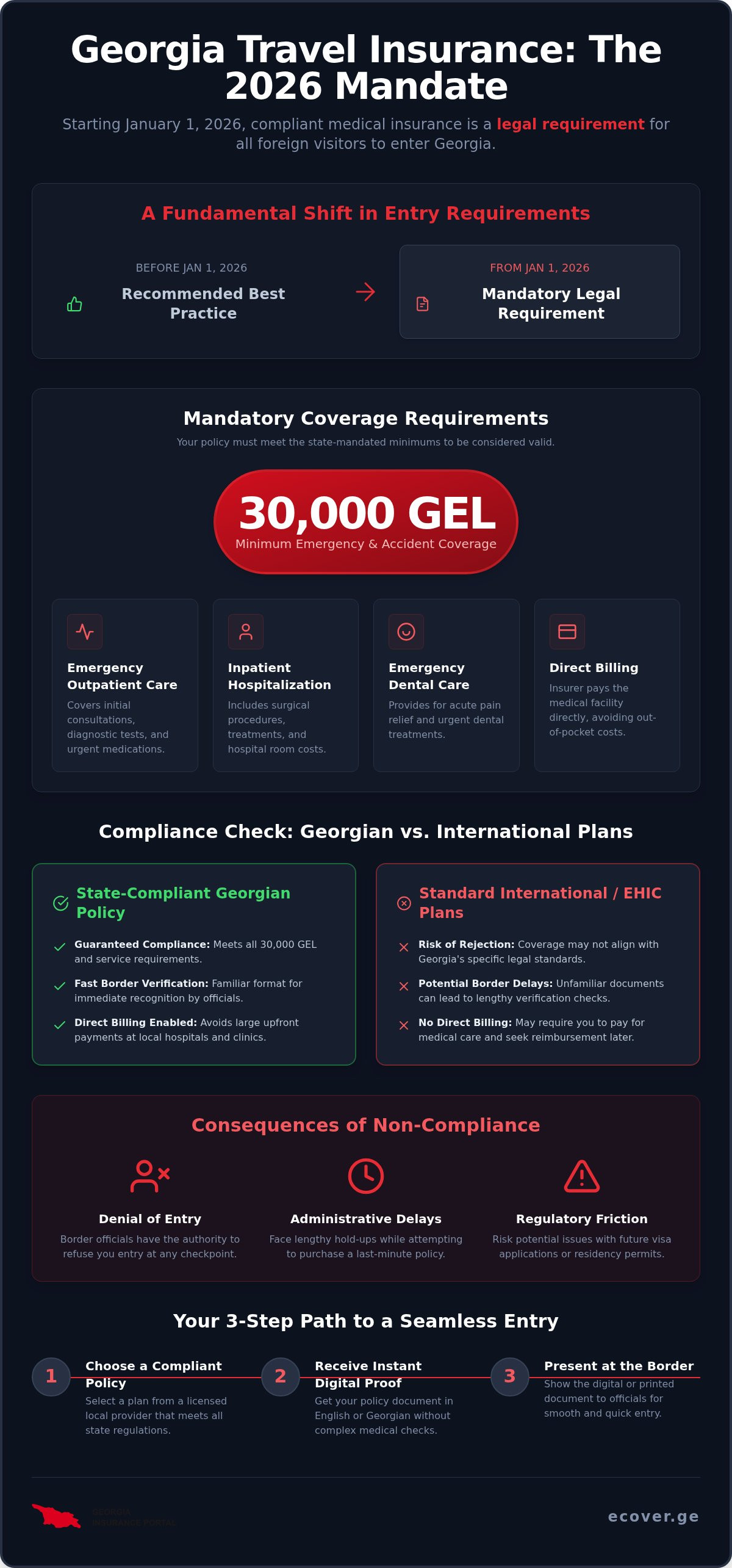
This new regulation stems from the Law of Georgia "On Tourism" and Government Regulation No. 602. The LEPL Insurance State Supervision Service of Georgia oversees these standards to ensure that every visitor can access medical care without placing a burden on the public healthcare system. Previously, having travel insurance was considered a best practice for individual security. Now, the state has shifted this to a mandatory status to guarantee that all medical and accident-related expenses are covered by a private policy. If you arrive without a plan that meets the minimum 30,000 GEL coverage limit, you're technically in violation of the current entry protocols. This shift ensures that the destination remains a safe and sustainable environment for international guests.
Border Entry Requirements and Document Verification
Border officials are now trained to verify insurance documents alongside passports and visas. You can present your Georgia travel medical policy in either a physical paper format or a digital version on your smartphone. However, the document must be in English or Georgian to be accepted. While some international plans are recognized, having a policy from a licensed local broker like E-COVER ensures that the document format is immediately familiar to border agents. This reduces the risk of long delays during the verification process. For more details on how these rules fit into the broader entry landscape, you can consult the Visa Policy of Georgia, which outlines the specific insurance obligations for different types of travelers.
Failing to secure a compliant policy before arrival can lead to several complications that disrupt your travel plans:
- Immediate denial of entry: You may be refused passage at the border checkpoint.
- Administrative delays: You'll face lengthy hold-ups while you attempt to purchase a policy on-site.
- Regulatory friction: Potential issues with future visa applications or residency permits.
It's far more efficient to secure your digital proof of insurance before you board your flight. This proactive step ensures your journey remains stress-free and fully compliant with the latest local laws.
Key Coverage Requirements: Understanding Mandatory Policy Limits
The legal framework established by the LEPL Insurance State Supervision Service defines exactly what a compliant Georgia travel medical policy must include. It's not enough to have a generic plan; your policy must meet the minimum coverage threshold of 30,000 GEL. This amount is specifically allocated to cover emergency medical services and accident-related costs throughout the duration of your stay. As highlighted in the U.S. Embassy in Georgia announcement, these regulations are strictly enforced at all points of entry to ensure visitors aren't left vulnerable during medical crises.
Mandatory Medical Service Categories
To be considered valid, your policy must cover several distinct tiers of care. First, it must provide for emergency outpatient services, which include initial consultations, diagnostic tests, and urgent medications. If your condition requires more intensive care, the policy must also cover inpatient hospitalization, including surgical procedures and room costs. Additionally, the mandate includes a provision for emergency dental care, though this is typically limited to acute pain relief rather than routine checkups.
One of the most critical features for travelers is "Direct Billing." When you use a policy from a licensed local broker, the insurance company pays the medical facility directly. This means you don't have to pay large sums out-of-pocket and wait months for reimbursement. If you want to ensure your plan includes these direct payment agreements with local clinics, you can view compliant travel insurance plans here to secure the right coverage.
Repatriation and Emergency Evacuation
A non-negotiable component of the 2026 law is the inclusion of repatriation benefits. This ensures that if a patient is too ill to continue their journey, the insurance provider covers the costs of specialized transport back to their home country. The policy must also include specific provisions for the repatriation of remains in the event of a fatality. Under the 2026 legal framework, repatriation coverage is defined as the mandatory financial provision for the medically supervised return of a visitor to their country of residence or the transport of remains.
Understanding these limits is vital for compliance. If your current international plan lacks these specific Georgian regulatory markers, border officials may deem it insufficient. Always verify that your policy explicitly mentions the 30,000 GEL minimum and the required service categories before you travel.
Compliance Check: Local Georgian Insurance vs. International Plans
Choosing between a global insurance provider and a Georgia travel medical policy issued by a local broker is a decision that directly affects your speed of entry. While international plans offer broad coverage, they often operate on a "pay and claim" basis. This means you must pay the full medical bill upfront and seek reimbursement later. Georgian border officials prioritize policies that offer "Direct Billing," where the insurer pays the clinic directly. If your plan doesn't explicitly state its alignment with local billing protocols, you risk being held up at immigration while officers verify your coverage.
The Problem with Foreign-Issued Policies
Foreign-issued policies frequently present language barriers that complicate the entry process. If your policy document is only in a language other than English or Georgian, border agents cannot verify the 30,000 GEL minimum requirement in real-time. As the U.S. Embassy in Georgia confirms 2026 insurance mandate, the responsibility for proving compliance rests entirely on the traveler. Digital nomads using popular services like SafetyWing or World Nomads should be particularly cautious. While these plans are excellent for general travel, they may lack the specific state-mandated registration numbers required for instant recognition by Georgian border police. This lack of local registration can lead to frustrating delays or even entry denials if the agent cannot confirm the policy's validity on their system.
Advantages of a State-Compliant Local Policy
Opting for a policy from a licensed local broker like E-COVER removes the guesswork from your arrival. These policies are designed to be instantly recognized by the national border police database, ensuring a smooth transition through customs. A local plan guarantees that you are in full compliance with the Georgia mandatory insurance law, meaning your documents already meet the 30,000 GEL threshold and include the necessary repatriation clauses. Beyond the border, a local policy provides you with direct coordination with the national medical network. If you need a doctor, the clinic will recognize your provider immediately, allowing you to focus on your recovery instead of navigating complex international claim forms. It's the most efficient way to bridge the gap between being a visitor and being a protected guest in the country's healthcare system.
How to Obtain and Verify Your Policy for Border Entry
Securing your Georgia travel medical policy should be one of the final steps in your pre-departure checklist. It's best to finalize your purchase once your flight dates are confirmed, but you should aim to do this at least 24 hours before you depart. This lead time allows the policy to be registered within the national database, ensuring that border officials can see your active status the moment you arrive. Proactive preparation prevents the stress of trying to navigate local websites while standing in the immigration queue.
The Online Application Process
The modern system for obtaining insurance is designed for efficiency. You don't need to provide a complex medical history or undergo a physical examination. Instead, the process relies entirely on your travel data. Follow these steps to ensure a valid issuance:
- Select your exact entry and exit dates to match your travel itinerary.
- Input your passport details exactly as they appear on the physical document.
- Verify your email address to receive your digital certificate immediately.
It's vital that the name on your insurance matches your passport character-for-character. Any discrepancy, such as a missing middle name or a typo in the passport number, can cause verification failures at the border. If you're a student or a digital nomad, you must ensure you select a duration that covers the full length of your intended stay to remain compliant with the 2026 mandate.
Verification and Validity Checks
Every compliant Georgia travel medical policy now includes a unique QR code. When you reach the immigration desk, having this code ready on your smartphone allows the officer to scan and verify your coverage in seconds. This digital link connects directly to the official portal of the LEPL Insurance State Supervision Service, confirming that your policy meets all legal requirements. If you want to avoid administrative delays, you can secure your state-compliant policy instantly through our streamlined portal.
If your travel dates change after you've already purchased your plan, you must contact your broker to update the policy before you arrive. A policy with dates that don't align with your arrival will be flagged as invalid by the border police system. Once you receive your policy ID via email, keep a copy in your cloud storage and another offline on your device. This ensures you can present proof even if you lack an immediate internet connection at the airport. Being prepared in this way transforms a potential administrative hurdle into a simple, five-second check.
Securing Compliant Coverage with E-COVER
E-COVER acts as the essential bridge between the international visitor and the 2026 regulatory environment. By providing a centralized platform for state-approved insurance, we simplify the process of meeting complex legal requirements. As a licensed local broker (ID 205250967), we ensure that every Georgia travel medical policy issued through our system aligns perfectly with the current legal mandates. We eliminate the ambiguity of international plans by offering documentation that is instantly recognizable to border officials. This focused approach allows you to secure your entry documents with minimal friction and maximum legal certainty.
Tailored Plans for Every Visitor Type
We provide a range of solutions designed for specific stay durations and travel purposes. Our Travel Medical Insurance plans for tourists offer the essential coverage required for short-term visits, ensuring you're protected from the moment you land. For those moving for academic purposes, we offer specialized student health insurance in Georgia that meets the specific requirements for university enrollment and residency permits. Digital nomads and long-term expats can also access extended policies that provide continuous protection without the need for frequent renewals or administrative gaps.
Why E-COVER is the Trusted Choice for 2026
Reliability is the cornerstone of our service in this new administrative landscape. Because we are licensed by the LEPL Insurance State Supervision Service of Georgia, our policies carry the institutional credibility required for a smooth arrival. You don't have to wait days for a response or navigate complex paperwork. Our automated system delivers your policy to your inbox within 2 minutes of purchase. This efficiency makes it the fastest way to become border-ready, even if you've secured your insurance shortly before your flight.
Beyond administrative speed, we provide a functional safety net through our direct contracts with local health facilities. Unlike many international providers that rely on "pay and claim" models, we facilitate direct billing for our clients. This means that in an emergency, the medical facility coordinates directly with our team, sparing you from significant out-of-pocket expenses and long reimbursement cycles. Our 24/7 local support team is always available to bridge the gap between you and medical providers, ensuring that your Georgia travel medical policy works exactly as intended when you need it most. We guarantee that every policy we issue is compliant with the 2026 mandate and will be accepted at the border, giving you the security to travel without hesitation.
Secure Your Entry and Start Your Journey
The 2026 mandate has transformed health coverage from a personal choice into a critical legal requirement for every visitor. To pass through immigration without delay, you must ensure your documentation aligns with the 30,000 GEL minimum coverage and includes the necessary repatriation clauses. Opting for a locally registered provider ensures that your policy is instantly recognized by border police systems, providing you with immediate security upon arrival.
Securing a Georgia travel medical policy doesn't have to be a source of stress. By choosing a licensed broker, you gain the benefit of direct billing and institutional credibility that international plans often lack. We provide the tools you need to meet these new legal obligations efficiently, allowing you to focus on the purpose of your visit rather than administrative hurdles.
Get Your State-Compliant Georgia Travel Medical Policy Instantly and benefit from our 100% border acceptance guarantee, licensed status by the LEPL Insurance State Supervision Service, and instant email delivery. We're here to facilitate your arrival and ensure your stay is as smooth as possible. Georgia is ready to welcome you, and with the right preparation, your journey will be a success.
Frequently Asked Questions
Is travel medical insurance mandatory for Georgia in 2026?
Yes, starting January 1, 2026, travel medical insurance is a legal requirement for every foreign citizen entering the country. This regulation applies to all visitors regardless of their nationality or visa-free status. You must present a valid policy at the border to avoid being denied entry. This mandate ensures that all visitors have access to necessary medical care without creating a financial burden on the state's public health resources.
Can I enter Georgia with my existing global health insurance?
You can use an existing global policy only if it explicitly meets the 30,000 GEL minimum coverage and includes mandatory repatriation clauses. However, many global plans lack the local registration numbers that border officials use for instant verification. If your current provider doesn't offer a document in English or Georgian that mentions these state-required limits, you might face significant delays or entry refusal at the border checkpoint.
What is the minimum coverage limit required for a Georgia travel medical policy?
The state-mandated minimum coverage for a Georgia travel medical policy is exactly 30,000 GEL. This specific amount is designated to cover emergency medical expenses, accident-related care, and repatriation costs for the duration of your stay. When you purchase a policy, you must ensure your certificate clearly states this limit. Policies that fall below this threshold or fail to specify the 30,000 GEL minimum are considered non-compliant with the 2026 entry laws.
How much does the mandatory health insurance for Georgia visitors cost?
The cost of your insurance policy varies depending on the length of your stay and your specific age group. While the state doesn't fix a specific price for these plans, they are designed to be an affordable addition to your travel budget. It's best to check current rates directly through a licensed local broker to get an accurate quote for your travel dates. The value of a compliant policy far outweighs the risk of border denial.
Do I need to print my insurance policy or is a digital copy enough?
A digital copy of your insurance certificate is legally sufficient for entry at any border checkpoint. Most travelers present their policy ID or a QR code directly from their smartphones to the immigration officer. However, it's a good practice to have the document saved for offline access in case you don't have an immediate internet connection upon arrival. If you prefer physical documents, a printed version in English or Georgian is also accepted.
Does the mandatory policy cover pre-existing conditions?
Standard mandatory policies are primarily designed to cover emergency medical situations and unexpected accidents during your trip. They typically don't cover the routine management or elective treatment of pre-existing conditions unless those conditions lead to a life-threatening emergency while you are in the country. If you require specific coverage for a known medical issue, you should review the policy terms carefully or consider a more comprehensive plan that extends beyond the basic requirements.
What happens if I stay in Georgia longer than my insurance policy covers?
If your stay exceeds the duration of your Georgia travel medical policy, you're technically in violation of the 2026 entry regulations. This could lead to complications if you need medical care or if your status is checked by authorities during your stay. You should always extend your policy online before the current one expires. Keeping your coverage active for the entire duration of your journey ensures you remain legally compliant and fully protected.
Is medical repatriation included in the mandatory Georgia insurance?
Yes, medical repatriation is a non-negotiable requirement under the 2026 insurance mandate. Every compliant policy must include financial provisions for transporting a patient back to their home country if they are medically unfit to continue their stay. It also covers the repatriation of remains in the event of a fatality. Without these specific clauses, your insurance document won't meet the verification standards set by the LEPL Insurance State Supervision Service.


