

What if your US health plan covers treatment but doesn’t provide the proof required at the border? If you’re asking, “can I use my US health insurance in Georgia,” first clarify whether you mean the country of Georgia or the US state. Coverage in the US state depends on your plan. A trip to the country raises two separate questions: whether your plan covers medical care abroad and whether you have the insurance documentation required for your visit.
Many US health plans offer limited or no coverage in the country of Georgia. Check your policy wording and claims process before departure. Since January 1, 2026, foreign visitors to the country must have health and accident insurance with at least 30,000 GEL in coverage for the full stay. Proof must be in English or Georgian.
This guide shows you what to check in your US plan, how medical coverage differs from entry compliance, and how to prepare if you need visitor insurance. E-COVER provides online travel medical insurance designed to meet Georgia’s visitor insurance requirements.
Key Takeaways
- The answer to “can I use my US health insurance in Georgia” depends on your exact policy and whether you mean the country or the US state.
- Check your plan’s international-care terms, exclusions, reimbursement rules, and prior-authorization requirements before you travel.
- A US health plan and Georgia visitor insurance serve different purposes. Review your plan documents and the visitor insurance rules separately.
- Use a pre-trip checklist to locate your policy, clarify its geographic limits, and save overseas assistance and claims instructions.
- If your US plan doesn’t meet your needs, consider a separate Georgia visitor policy. E-COVER provides online travel medical insurance and certificates.
Can I use my US health insurance in Georgia? First, identify which Georgia
Your US health plan’s overseas coverage depends on its exact terms, and coverage alone doesn’t automatically prove compliance with Georgia’s visitor insurance rules. This guide is about the country of Georgia, not the US state. If you’re asking, “can I use my US health insurance in Georgia,” separate two questions: will your plan pay for eligible care abroad, and do you have the insurance documents required for your visit?
These terms describe different kinds of coverage. Domestic health insurance is a plan primarily designed to cover care within its stated US service area or provider network. International medical coverage means a policy or plan provision that may cover eligible treatment outside the United States, subject to its terms. Travel medical insurance is coverage arranged for a trip abroad; its benefits and limits depend on the policy. Don’t assume one type includes the others.
The distinction matters in practice. A US insurer might reimburse an eligible overseas expense under specific conditions, but reimbursement isn’t the same as having a local provider network or meeting a visitor insurance requirement. For background on the country’s healthcare system and its mix of public and private care, see Healthcare in Georgia (country). Use that overview for context, not as a substitute for your policy wording or current entry rules.
Why search results for Georgia can point to the wrong destination
Search engines may show state-based health plan pages because “Georgia” is also a US state. For example, Georgia Access serves the health coverage market in the US state of Georgia. Its enrollment information, like pages about other state-based US plans, doesn’t explain whether a policy covers treatment during travel to the country. Check the page’s location and subject before relying on it. The rest of this guide concerns international travel to the country of Georgia.
The short answer for US travelers visiting the country
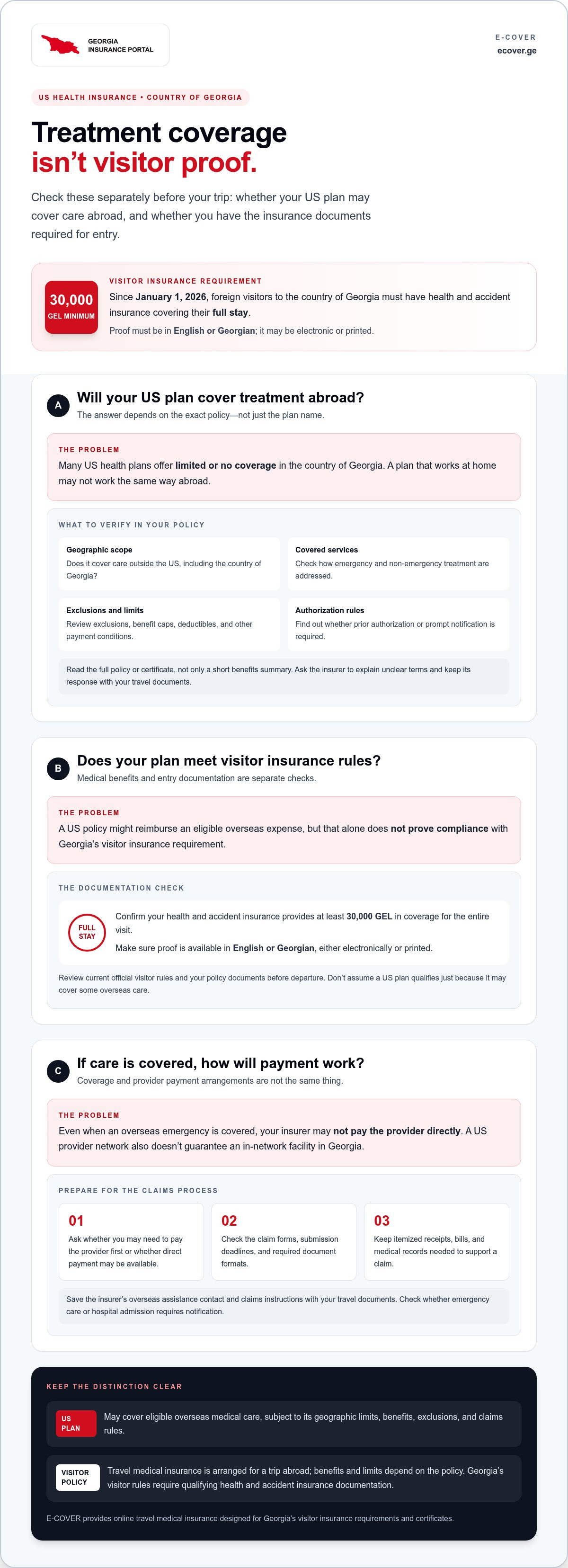
Your policy determines whether it covers eligible overseas medical expenses. Geographic limits, covered services, emergency-care terms, and claims procedures vary, so a plan that works at home may not work the same way abroad. Having a domestic provider network also doesn’t guarantee access to an in-network facility in the country. Review your current policy, not just the insurer’s general plan description.
Medical coverage and entry documentation are separate checks. As of January 1, 2026, foreign visitors to the country of Georgia are required to have health and accident insurance with at least 30,000 GEL in coverage for their full stay. The policy must be in English or Georgian, and proof may be electronic or printed. Don’t assume a US policy satisfies this requirement simply because it may cover some overseas care. Review current official visitor rules and your policy documents before departure.
How US health insurance may work during a trip to Georgia
A US health plan may cover some treatment abroad, but the result depends on the policy wording. Don’t rely on a general benefits summary, your usual provider network, or an assumption that emergency care is automatically covered. To answer “can I use my US health insurance in Georgia,” look for explicit terms about international care and check how they apply to the country of Georgia.
Even when a policy covers an overseas emergency, it may not arrange payment directly with a medical provider. You might need to pay first, keep itemized receipts and medical records, and then submit a claim under the insurer’s process. Coverage and payment arrangements are separate issues. Check the current policy documents for plan-specific exclusions, limits, and claims rules.
Which policy terms should you check before departure?
Start with the policy’s geographic scope. Look for language explaining whether treatment outside the United States is covered and whether the country of Georgia is included. Then review the benefits and conditions that determine what a claim may qualify for:
- Covered services: Check whether emergency and non-emergency treatment are addressed, and whether the policy names specific services or care settings.
- Exclusions and limits: Review exclusions, benefit caps, deductibles, and other conditions that could affect payment for treatment abroad.
- Authorization rules: Find out whether prior authorization or prompt notification is required, especially for emergency treatment or hospital admission.
- Claims evidence: Note the required forms, submission deadlines, receipts, itemized bills, and medical records. Check whether documents must be translated or supplied in a particular format.
Read the full policy or certificate, not just a short plan description. If a term is unclear, ask the insurer to explain it and keep the response with your travel documents.
What to ask your insurer about overseas treatment
Use the contact details in your policy materials to get specific answers before departure. Ask whether the country of Georgia is within your plan’s geographic coverage, which types of treatment may qualify, and what exclusions or limits apply. Then clarify the payment process: will you need to pay the provider yourself and seek reimbursement, or is a direct payment arrangement available for eligible care?
Record the insurer’s overseas assistance contact, the steps to take before or after receiving treatment, and the exact documents needed for a claim. Save copies of your policy and the insurer’s instructions offline as well as on your phone. These details help you act quickly if you need care, but they don’t establish whether your plan meets Georgia’s visitor insurance rules. For the separate entry requirement, consult the Ministry of Foreign Affairs of Georgia’s tourist insurance guidance and check the current official rules before traveling.
If your US plan leaves gaps in coverage or documentation, consider a separate visitor policy. E-COVER’s online travel medical insurance for Georgia provides visitors with a policy and certificate designed for Georgia’s insurance requirements.
US health insurance vs. Georgia visitor insurance: what each is for
A US health plan and a Georgia visitor policy can serve different purposes. Your US plan is governed by its own terms: it may cover eligible medical care abroad, but that alone doesn’t establish that it meets Georgia’s visitor insurance requirements or provides the required proof. Since January 1, 2026, Georgia requires health insurance for international travelers. Check the current official rules and your policy documents before relying on either policy for your trip.
If you’re asking, “can I use my US health insurance in Georgia,” assess medical coverage and entry documentation separately. This Georgia's 2026 visitor insurance entry guide offers a broader overview of the visitor requirement. Use the comparison below to identify which documents to review.
| Comparison point | US health plan | Georgia visitor insurance |
|---|---|---|
| Intended traveler | People enrolled in a particular US health plan, as defined by its terms. | International visitors traveling to Georgia. |
| Geographic scope | Set by the plan; overseas treatment may be limited or subject to conditions. | Read the policy wording to understand where its coverage applies. |
| Purpose | Provides the medical benefits described in the US plan documents. | Provides travel medical insurance for a visitor and may support required documentation, depending on current rules and policy terms. |
| Documents to review | Policy or certificate, benefit details, exclusions, and claims instructions. | Policy wording and certificate, plus current official requirements for acceptable proof. |
Can one policy meet both medical and entry-document needs?
Possibly, but don’t assume a US insurance card, benefits summary, or promise of overseas emergency coverage is sufficient proof. Whether one policy can serve both purposes depends on current Georgian rules and the exact policy documents, including what they say about coverage and proof. Compare the policy with official guidance before departure, and clarify any unclear requirement through the relevant official source.
How to compare the two kinds of coverage
Compare the policy terms side by side. Check geographic scope, covered medical expenses, exclusions, limits, and claims procedures. A US plan may use its own reimbursement process, while a visitor policy has its own benefits and documentation. Assess the wording, not just the policy name. For a focused explanation of the legal framework, review Georgia's mandatory insurance law requirements, then verify the current official rules that apply to your travel dates.
Keep the distinction clear: medical benefits describe what a policy may pay for; compliance evidence shows whether it meets the visitor rules. A policy that appears to cover treatment abroad may not automatically satisfy documentation requirements. If your US plan doesn’t address both needs, a separate Georgia visitor policy is an option to consider.
How to check your US policy before traveling to Georgia
Your insurance card won’t tell you everything you need to know. Use this five-step checklist to understand what your US plan says about overseas care, then check Georgia’s visitor insurance requirements separately. If you’re still asking, “can I use my US health insurance in Georgia,” start with the policy wording and the insurer’s answers.
A pre-trip policy review in five steps
- Find the full policy wording. Download the current policy or certificate from your insurer’s member portal. A card or brief benefits summary may not explain international coverage, exclusions, or claims procedures.
- Confirm geographic scope. Search for terms such as “outside the United States,” “international,” or “foreign travel.” Check whether the country of Georgia is within the stated coverage area and whether emergency and non-emergency treatment are handled differently.
- Inspect exclusions and conditions. Review the sections on covered services, exclusions, benefit limits, deductibles, emergency care, and prior authorization. Note any requirement to notify the insurer before or soon after receiving treatment.
- Contact the insurer about unclear terms. Ask specifically whether eligible care in the country of Georgia is covered, what payment arrangements may apply, and how to submit a claim from abroad. Record the date of the conversation and the guidance you receive.
- Save the practical details. Write down the overseas assistance contact, claims contact, notification steps, and required documents. Keep them with your policy so you can access the instructions without searching for them in an urgent situation.
Make the review specific. For example, “emergency treatment is covered” may not tell you whether you must pay the provider first, obtain authorization, or submit itemized bills. Ask about the actual process, then compare the response with the written policy. If the insurer’s explanation and policy wording appear inconsistent, request clarification in writing and keep it with your records.
Keep the right documents accessible while traveling
Save your US plan documents and insurer instructions on your phone, and keep an offline copy in case you can’t access your account. A printed copy is a useful backup. Store the documents where a travel companion can find them if needed. These steps make your US plan information easier to retrieve, but they don’t establish that the plan meets Georgia’s visitor insurance rules.
Check the current official requirements for the country of Georgia separately, including what proof is accepted. The rules effective from January 1, 2026 require health insurance for international travelers. Use the Georgia visitor insurance entry guide as a starting point, then verify details against current official guidance. Keep any required visitor insurance certificate with your travel documents, and check the current rules for acceptable language and format.
If your US policy doesn’t meet your coverage or documentation needs, prepare your Georgia visitor insurance online with E-COVER’s travel medical policy and certificate.
If your US plan is not enough, prepare Georgia visitor insurance
If your US plan has no clear coverage for care in the country of Georgia, or its documents don’t address the visitor insurance requirements, consider a separate Georgia visitor policy. This doesn’t mean every US plan excludes overseas treatment or every traveler needs duplicate benefits. Compare your actual coverage and documentation with the rules for your trip before deciding whether another policy is needed.
When a separate visitor policy may be the practical choice
A separate policy may help if your US plan limits care geographically, covers only certain overseas emergencies, or doesn’t provide documentation that meets visitor requirements. For example, your plan might describe possible reimbursement for treatment abroad without clearly showing whether its certificate satisfies the required proof. Check both the policy terms and current official guidance before relying on it.
Georgia requires health insurance for international travelers starting in January 2026. Requirements and accepted proof can be specific, so review the Georgia visitor insurance requirements guide as part of your trip preparation, then verify the latest official details. The key question isn’t simply “can I use my US health insurance in Georgia?” It’s whether your US plan covers the care you may need and whether your insurance documents meet the applicable visitor rules.
Get your Georgia travel medical policy online
E-COVER provides online travel medical policies for foreign visitors to Georgia, designed to meet the country’s visitor insurance requirements taking effect in January 2026. Policies and certificates are issued online. Compare the policy information with current requirements and your travel dates, then review the certificate and policy wording to understand the coverage and documentation. Keep the documents accessible with your other travel records.
If a separate visitor policy fits your needs, get travel medical insurance for Georgia online through E-COVER. It’s a practical way to prepare when your US plan doesn’t clearly address overseas care or the documentation you need. Review the policy alongside your existing coverage and current official requirements before making your arrangements.
Before departure, make two final checks: compare your US plan benefits with its current policy wording, and verify Georgia’s visitor insurance requirements through official sources. Rules and policy terms can change. Use this guide as general information, not as a substitute for your insurance documents or current official requirements.
Make your insurance decision before departure
Before you travel, compare your plan documents with the care you may need and the current requirements for your destination. Asking “can I use my US health insurance in Georgia” is a useful starting point, but your policy wording and official rules determine what applies to your trip.
If your review reveals gaps in overseas coverage or visitor documentation, a separate travel medical policy can be a practical next step. E-COVER provides online policies for foreign visitors to Georgia. Its parent company, LLC Insurance Broker WeInsure, is licensed by Georgia’s Insurance State Supervision Service under License N012063. Review the policy and certificate details alongside current official requirements before making your arrangements.
Get travel medical insurance for Georgia online through E-COVER and prepare your documents in advance. Review your policy details before departure so you know what your coverage and certificate state.
Frequently Asked Questions
Can I use my US health insurance in the country of Georgia?
Possibly, if your policy’s geographic scope and terms cover eligible care in the country of Georgia. If you’re asking, “can I use my US health insurance in Georgia,” remember that medical benefits and compliance with visitor insurance rules are separate checks. Georgia’s visitor insurance requirement took effect in January 2026. Review your policy wording, then verify current official requirements and acceptable documentation before relying on your US plan.
Does US health insurance cover medical emergencies in Georgia?
It depends on the insurer and the specific plan, so don’t assume emergency care abroad is covered. Check whether the policy includes treatment in the country of Georgia, and look for geographic restrictions, exclusions, and emergency-care conditions. Also confirm whether you must pay the provider first, notify the insurer, or submit particular records to make a claim. Verify each answer against your current policy documents.
Is Georgia Access health insurance valid when traveling to Georgia?
Georgia Access serves the health coverage marketplace for the US state of Georgia. Enrollment through that marketplace doesn’t, by itself, show whether your plan covers care in the country of Georgia. Check the specific plan’s policy wording for international benefits. Separately, consult current official guidance on the country’s visitor insurance requirements and accepted documentation before departure. Marketplace enrollment alone doesn’t establish that your travel insurance proof meets those rules.
Can my US insurance card serve as proof of health insurance for Georgia?
Don’t assume your US insurance card alone proves the coverage or documentation required under Georgia’s visitor rules. A card may identify your plan, while the relevant details may be in its policy certificate or full wording. Check current official guidance to learn what proof is accepted, then compare those requirements with your documents. Verify that the card or summary is relevant to your trip before relying on it.
Do I need separate travel medical insurance if I have US health insurance?
Not necessarily. It depends on what your US plan covers abroad and what Georgia currently requires from visitors. A plan may provide some overseas medical benefits, but that doesn’t automatically establish that its documents satisfy visitor rules. Compare its geographic scope, exclusions, and proof documents with official requirements. If your existing plan addresses both needs, duplicate coverage may not be necessary; if it doesn’t, consider a separate visitor policy.
What should I check in my US health policy before visiting Georgia?
Use the full policy wording to check geographic coverage, emergency and other overseas benefits, exclusions, payment arrangements, and claims procedures. Find the insurer’s assistance instructions and note which records or receipts a claim may require. If a term is unclear, ask the insurer to explain how it applies to care in the country of Georgia. These checks clarify your plan benefits, but don’t replace verification of current visitor insurance rules.
How can I get health insurance for a trip to Georgia if my US plan is limited?
You can consider a separate travel medical policy designed for visitors to the country of Georgia. E-COVER provides online policies designed to meet Georgia’s visitor insurance requirements, with certificates available online. Before traveling, read the policy documents and compare them with current official requirements. This helps you prepare your insurance documentation, while checking the rules remains an important part of your travel preparations.


