

In Georgia, access to medical care doesn’t automatically mean the state will cover the bill. The Georgian healthcare system for foreigners depends on your status and reason for staying, so a visitor, student, and residence-permit holder may face different coverage rules and payment routes.
It’s understandable to assume that public healthcare applies to everyone, or that insurance can be arranged only after a problem arises. In practice, the state-funded Universal Healthcare Program generally doesn’t cover foreign nationals unless they hold a Georgian residence permit and meet specific eligibility criteria. Since January 1, 2026, foreign nationals entering for tourism must also have health and accident insurance, subject to stated exemptions.
This guide explains how foreigners can access care, when you may need to pay directly, and what to prepare before seeking treatment. You’ll also learn what to ask about costs and claims, and how to consider insurance for a visit, study period, or longer stay. For tourists, online travel medical insurance is one way to prepare before arrival, while longer-term residents may need a different coverage route.
Key Takeaways
- Understand how the Georgian healthcare system for foreigners combines public financing with private providers, and why eligibility depends on individual status.
- Compare public coverage, direct payment, and private insurance based on your eligibility and length of stay.
- Use a practical preparation checklist to keep identification, medical information, and insurance documents ready before seeking care.
- Understand how visitor medical insurance can help you prepare financially and administratively without replacing medical treatment.
- Know which policy details and payment questions to clarify before arranging care.
How the Georgian Healthcare System Works for Foreigners
Georgia combines public financing with healthcare delivered by public and private providers. Government programs may pay for defined services for people who meet the eligibility rules. Patients can also receive care from private facilities and may have to pay some or all of the bill themselves. The system’s structure alone doesn’t tell you whether you qualify for public coverage.
What public and private healthcare mean in Georgia
Public financing means the government funds healthcare services through specific programs with defined eligibility rules. It doesn’t mean every service is free or that everyone in the country is covered on the same terms. You may still be responsible for costs that fall outside a program’s covered services or eligibility conditions.
Private provision means privately operated facilities deliver care. A private provider may bill you directly, work with an insurer, or have other arrangements that affect payment. Private ownership alone doesn’t guarantee faster access, better care, or a particular payment method. Before a planned visit, confirm how payment works for the service you need.
For a concise overview, Healthcare in Georgia (country) describes a system where public healthcare financing and private-sector provision coexist. For foreign readers, the key point is that financing, provider ownership, and personal eligibility are separate questions.
Why a foreigner’s stay type matters
A short-term visitor, international student, foreign worker, and longer-term resident shouldn’t assume they have the same access to publicly financed care. Eligibility can depend on legal status and the current rules of a particular program. General descriptions of how residents use services don’t establish that a foreign national qualifies.
If you’re visiting temporarily, plan how you’ll use insurance and pay for care. If you’re studying or working in Georgia, your status and any applicable institutional or employment arrangements may affect your options, but they don’t automatically determine public-program eligibility. Review the requirements that apply to your circumstances rather than relying on general descriptions of the national system.
Students should consider both their healthcare access and any insurance conditions attached to their studies or stay. The Georgia student health insurance requirements guide covers the student-specific requirements to review.
For longer-term residents, residence in Georgia alone shouldn’t be treated as proof of coverage. Check the current official criteria for the relevant public program, including whether your legal status and personal circumstances meet them. Until you establish your eligibility, keep a practical payment plan in place, such as suitable private insurance or the ability to pay directly.
In short: the Georgian healthcare system for foreigners combines public financing with care from public and private providers, but your access and costs depend on your status, applicable program rules, and payment arrangements.
Can Foreigners Use Georgia’s Public Healthcare Coverage?
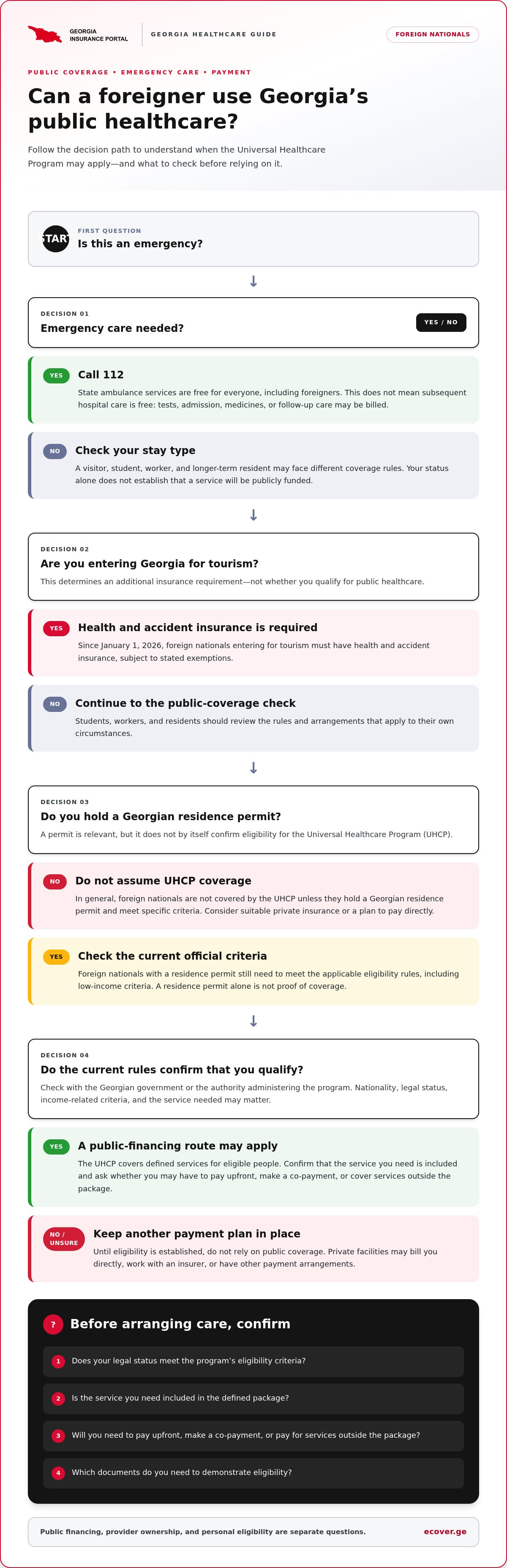
Sometimes, but foreign nationality alone doesn’t establish eligibility. Georgia’s Universal Healthcare Program (UHCP) is a state-funded program with defined services and eligibility rules. The Georgian government’s current criteria, applied to your individual status and circumstances, determine whether you qualify. A headline figure about the share of residents covered can’t answer that personal question.
For foreign visitors, students, workers, and residents, the practical answer may differ. In general, foreign nationals aren’t covered by the UHCP unless they hold a Georgian residence permit and meet specific criteria, including low-income criteria. A residence permit by itself doesn’t confirm coverage. Check your eligibility against the current official rules.
What Universal Health Coverage does, and does not, tell a foreigner
The UHCP describes a public financing route for eligible people and covered services. It doesn’t mean that every resident, every foreign national, or every type of treatment is automatically covered. Broad population coverage figures describe the program’s reach in a particular context, not an individual eligibility decision. Historical percentages shouldn’t be treated as current without a dated, reliable source.
Emergency response is separate from entitlement to publicly financed treatment. In an emergency, call 112. State ambulance services are free for everyone, including foreigners, but subsequent hospital care may be billed. Emergency assistance doesn’t confirm that tests, admission, medicines, or follow-up care will be paid for by the state.
Questions to resolve before depending on public coverage
Before relying on the UHCP, review the latest eligibility guidance published by the Georgian government or the authority administering the program. Then establish how the rules apply to your circumstances. Nationality, residence status, income-related criteria, and the type of service may all matter. Don’t assume that meeting one condition settles every question.
- Does your current legal status meet the program’s eligibility criteria?
- Is the service you may need included in the program’s defined package?
- Would you need to pay upfront, make a co-payment, or cover services outside the package?
- What documents do you need to demonstrate eligibility when seeking care?
Get answers from current official guidance before making public coverage your only payment plan. If your eligibility or the service’s coverage is uncertain, budget for direct payment or consider private insurance instead of assuming reimbursement will follow.
Before relying on public coverage, establish from current Georgian government UHCP rules whether your individual status qualifies and whether the specific care you need is included. This helps you understand the Georgian healthcare system for foreigners without mistaking emergency access or national coverage descriptions for a personal guarantee.
If you’re visiting and want to prepare a separate financial route for medical care, consider online travel medical insurance as part of your arrival planning.
Private Care, Direct Payment, and Insurance: How to Compare Your Options
There isn’t one payment route that suits every foreigner. Your options may include paying a provider directly, using public coverage if you’re eligible, or relying on private insurance according to its terms. In the Georgian healthcare system for foreigners, these routes aren’t interchangeable. Each has different eligibility conditions, payment steps, and relevance to the length of your stay.
Use this comparison as a starting point, not a guarantee of coverage. Confirm current public-program rules and read your policy documents before arranging non-emergency care.
| Route | Eligibility | Payment route | Intended stay | Questions to resolve |
|---|---|---|---|---|
| Direct payment | Doesn’t depend on insurance eligibility, but provider arrangements vary. | You pay the provider under its payment process. | Any stay, if you’re prepared to cover the bill. | What payment methods are accepted? What documents or receipts will you receive? |
| Public coverage | Only if you meet the current program criteria for your individual circumstances. | The program may cover eligible services. Other charges may remain your responsibility. | Potentially relevant to eligible students, workers, or residents. | Do you qualify, and is the specific service included? |
| Private insurance | Depends on the policy’s terms and your eligibility for that policy. | The policy may involve direct settlement or a claim for reimbursement. Don’t assume either applies. | Visitors, students, remote workers, or longer-term residents, depending on the policy. | What care is covered, what exclusions or limits apply, and what steps must you follow? |
Direct payment versus insurance for a medical visit
Paying directly can be straightforward if you’re comfortable covering the costs yourself, but the process isn’t standardized. Fees, accepted payment methods, and the documents a provider issues can vary. If you may claim through insurance later, keep invoices, medical reports, prescriptions, and proof of payment. Where practical, check the policy’s claim requirements before treatment.
Insurance doesn’t automatically mean a provider will bill the insurer directly. Review whether you must pay first, seek approval, use particular facilities, or submit documents afterward. Coverage depends on the policy terms, and reimbursement isn’t automatic unless the relevant conditions are met.
Match the insurance route to your stay
Visitor travel medical insurance is designed for a trip, not as a substitute for comprehensive long-term health insurance. Students should consider study-related requirements and the planned duration of their stay. Remote workers and digital nomads should compare their needs with the policy period and coverage structure; the Georgia digital nomad insurance buying guide addresses that situation. For longer-term residence, assess ongoing coverage separately rather than assuming a short-visit policy will fit.
Match your status and expected stay to the coverage route, then verify the payment process and documentation. For a temporary visit, online travel medical insurance can be one part of preparing for medical costs in Georgia.
How to Prepare for Medical Care in Georgia: A Practical Checklist
Preparation can make it easier to explain your needs, understand payment steps, and keep the right records. In the Georgian healthcare system for foreigners, having insurance doesn’t automatically mean a provider will bill the insurer directly. Save your policy instructions and be ready to ask how payment works.
Use this checklist before you need care. Keep identification, relevant medical information, and insurance documents somewhere you can access them quickly, both online and offline.
- Review your policy and save its documents. Check the dates it applies, the situations and services it covers, exclusions, and how to request assistance or make a claim. Download the policy and insurer instructions to your device, and keep an offline copy in case you can’t access the internet.
- Prepare a brief medical summary. List current medicines, allergies, relevant diagnoses, and important medical history. Include generic medicine names if you know them, and note the doses you take. Keep the summary concise so you can show it or share it during an appointment.
- Contact the provider before a non-emergency visit. Ask how to book, what records or identification to bring, whether staff can communicate in a language you understand, and whether you’ll need to pay upfront. Language support and appointment procedures can vary, so confirm practical details rather than making assumptions.
- Prepare for payment and documentation. Check which payment methods the provider accepts and whether it can issue an itemized invoice or medical report. If you plan to claim through insurance, review the required documents and submission steps. Keep receipts, prescriptions, test results, and visit summaries together, and photograph or scan them as a backup.
For visitors, entry requirements and medical-care arrangements are related but separate preparation tasks. The mandatory Georgia travel insurance entry guide explains the visitor insurance rules to review before travel. Keep your policy documents accessible throughout your stay.
If the situation is urgent, don’t delay emergency help while trying to resolve insurance paperwork. Call 112 in Georgia. After emergency assistance, keep records of care and clarify any subsequent payment or insurance steps as soon as circumstances allow.
Put your documents in one accessible place before you travel. If you’re visiting Georgia, you can arrange travel medical insurance online as part of your medical-care preparation.
How Visitor Medical Insurance Fits Into Georgia’s Healthcare System
Visitor medical insurance helps you prepare for potential medical expenses and understand the steps for seeking help. It doesn’t provide treatment or guarantee that a provider will bill an insurer directly, and it isn’t the same as public healthcare coverage or comprehensive insurance for living in Georgia. For visitors, it’s one part of planning how to access and pay for care.
As of January 1, 2026, foreign nationals entering Georgia for tourism purposes must have health and accident insurance for their stay, including travelers eligible for visa-free entry. The current rule sets minimum coverage of 30,000 GEL, requires medical treatment and accidents to be covered for the full stay, and allows the policy document in English or Georgian, digitally or in print. Exemptions apply to valid Georgian residence-permit holders and accredited employees of diplomatic missions and international organizations. Check current requirements and how they apply to your travel circumstances before departure.
What visitors should verify in a policy
Read the policy wording rather than relying on a short description. Check that its dates cover your full stay and that the insured events and scope meet the current entry requirement. Review exclusions, claim instructions, and any steps required before arranging treatment. Keep the policy document accessible, and make sure you understand how to provide it if asked. The Georgia mandatory insurance law requirements guide offers further detail on the visitor rule.
Meeting an entry requirement and having useful cover are related, but not identical. The policy terms determine what it covers and how claims are handled. Don’t assume that every medical service is included or that expenses will be reimbursed automatically. If you need care, follow the policy’s instructions and retain relevant records and receipts.
Choose cover that fits your stay
A visitor policy is intended for a trip. Students should review insurance requirements relevant to their studies and stay. Digital nomads should consider whether the policy period and terms fit their plans. People relocating or residing in Georgia should assess longer-term coverage separately. A short-visit policy isn’t comprehensive ongoing health insurance, and it doesn’t establish eligibility for Georgia’s public programs.
E-COVER provides online travel medical insurance policies for foreign visitors to Georgia that meet Georgian government requirements effective from January 2026. Read the policy and check current rules, including the policy dates, wording, and required documents, before relying on it for your trip. Coverage and claims remain subject to the policy terms.
Prepare before you travel: Get travel medical insurance for your Georgia trip.
Make Your Healthcare Plan Before You Travel
Turn what you’ve learned into a plan that fits your reason for staying in Georgia. If you’re visiting, arrange travel medical insurance before departure and keep the policy details accessible. If you’ll study, work remotely, or live in Georgia longer term, assess coverage for that specific stay instead of relying on a visitor policy or assuming public coverage applies.
Planning ahead helps you approach the Georgian healthcare system for foreigners with clearer expectations about eligibility, payment, and what to do if you need care. E-COVER is operated by LLC Insurance Broker WeInsure, licensed by Georgia’s Insurance State Supervision Service under License N012063.
Get travel medical insurance for your Georgia trip and take a practical step toward a more prepared visit. With your coverage arranged and your documents ready, you can focus more confidently on your time in Georgia.
Frequently Asked Questions
Can foreigners use Georgia’s Universal Health Coverage program?
Some foreigners may qualify, but the Universal Healthcare Program (UHCP) isn’t automatically available to every non-citizen. A Georgian residence permit alone doesn’t establish eligibility; current rules may also consider circumstances such as income and the service needed. Before choosing a facility, check the program administrator’s current criteria and how eligibility is determined for your care. Keep relevant proof of status and any official eligibility decision with your records.
Is healthcare free for foreigners in Georgia?
No, foreigners shouldn’t assume healthcare will be free. Publicly financed services depend on program eligibility and the specific service, while private care may involve direct charges. State ambulance services are free, but that doesn’t mean subsequent hospital treatment is free. Before a planned visit, ask for an estimate of charges and clarify what payment is due at the time of care.
How do foreign visitors pay for medical care in Georgia?
Visitors may pay a provider directly or use insurance according to the policy’s payment and claim procedures. For example, a clinic may require payment before issuing documents needed for a later claim, but arrangements vary. Before a non-emergency appointment, ask about accepted payment methods, likely charges, and the receipts or medical records you’ll receive. Keep invoices and proof of payment, since your insurer may require them to assess a claim.
Do I need health insurance to travel to Georgia in 2026?
Yes. The rule effective January 1, 2026 requires foreign nationals entering Georgia for tourism to have health and accident insurance for their stay, including visa-free travelers. Exemptions apply to valid Georgian residence-permit holders and accredited employees of diplomatic missions and international organizations. Check current official guidance before travelling, especially if your purpose of entry or status may affect whether the requirement applies.
What is the difference between travel insurance and health insurance for living in Georgia?
Travel insurance is generally arranged for a defined trip, so its dates and terms are tied to that visit. Health insurance for living in Georgia needs to suit an ongoing stay and your longer-term healthcare needs. They aren’t interchangeable, and neither automatically gives you eligibility for public coverage. Before relocating, compare the policy period and wording with your plans instead of assuming a visitor policy will continue to fit.
Can a foreigner visit a private hospital or clinic in Georgia?
Yes, a foreigner can seek care at a private hospital or clinic. For a planned appointment, contact the facility to learn how to book, what identification or medical records to bring, whether staff can communicate in a language you understand, and how payment works. Private ownership doesn’t determine your insurance coverage, so review your policy separately. In an emergency, prioritize getting help over arranging routine appointment details.
What documents should I bring when seeking medical care in Georgia?
Bring identification, your insurance policy or certificate, and concise information about current medicines, allergies, and relevant medical history. If you have useful prior test results or prescriptions, keep copies accessible. For a claim, save itemized invoices, receipts, prescriptions, and medical reports. A secure digital copy can help if paper documents are misplaced, but keep essential information accessible offline too in case you can’t connect to the internet.
Does travel insurance guarantee that a medical provider will bill the insurer directly?
No. A policy doesn’t guarantee that a provider will bill your insurer directly. Depending on the provider’s arrangements and your policy terms, you may need to pay first and submit a claim afterward. Before planned care, check whether approval is needed and what documents to request. If you must pay, retain proof of payment and clinical records. Don’t delay urgent care to resolve routine billing questions.


