

A valid passport is only the starting point for crossing into Georgia in 2026. The documents needed for Georgia border crossing 2026 depend partly on your nationality and trip, so conflicting advice can make it difficult to know what to prepare. Check more than visa rules: since January 1, 2026, tourists generally need health and accident insurance that covers their full stay, including arrival and departure dates.
This checklist separates core documents from supporting records that apply only in certain situations. You’ll learn what to prepare for identity and visa checks, why supporting documents vary by traveler, and how to keep your insurance proof ready. The insurance policy must meet Georgia’s requirements, including minimum coverage of 30,000 GEL, and be available in English or Georgian. Proof may be shown in physical or electronic form, and some travelers are exempt. Use official sources to check rules that depend on your nationality, rather than assuming every traveler needs the same paperwork.
Key Takeaways
- Use the documents needed for Georgia border crossing 2026 checklist to separate core travel papers from documents that depend on your plans.
- Check visa eligibility by nationality, not by the country you’re departing from, and identify the entry route that applies to you.
- Compare the steps for visa-free entry, an e-Visa, and other visa routes before you travel.
- Review your insurance certificate and supporting records in advance, then keep the documents easy to present.
- Recheck official Georgian guidance close to departure in case entry rules or procedures have changed.
Documents Needed for Georgia Border Crossing in 2026: Start with This Checklist
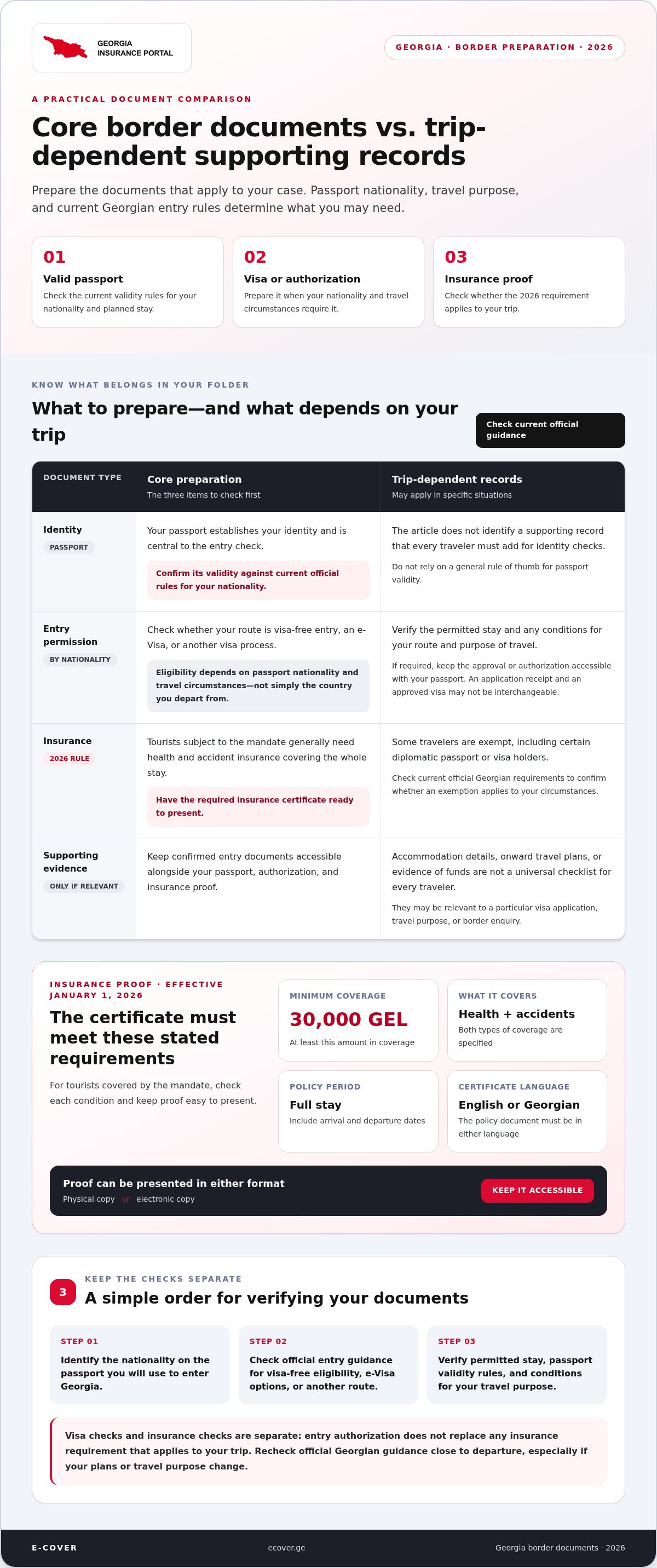
Start with three items: a valid passport, any visa or entry authorization required for your nationality, and travel medical insurance proof if the requirement applies to you. This checklist helps you prioritize the documents needed for Georgia border crossing 2026 without treating every possible supporting record as compulsory for every visitor.
- Passport: Check that it meets the current entry rules for your nationality and remains valid for your planned stay.
- Visa or entry authorization: Prepare this if your nationality and travel circumstances require it.
- Insurance proof: Check the 2026 rules and have the required certificate ready to present.
Which documents belong in every traveler’s preparation folder?
Your passport establishes your identity and is central to the entry check. Confirm its validity against current official guidance for your nationality instead of relying on a general rule of thumb. Georgia’s visa requirements also vary by nationality. Use the official Georgian consular information portal to identify the route that applies, then consult the Visa policy of Georgia for an overview of visa-free entry and e-Visa options.
A visa or other authorization belongs in your folder when required for your case. Don’t assume the country you’re flying from determines your eligibility. Your nationality and purpose of travel matter. If a visa applies, keep the authorization with your passport and make sure its details match your travel documents.
Insurance is a key 2026 preparation item for tourists who are subject to the mandate. Under the rules effective January 1, 2026, the policy must cover health and accidents, provide at least 30,000 GEL in coverage, and remain valid for the whole stay, including arrival and departure dates. The policy document must be in English or Georgian. Proof may be presented in physical or electronic form, and some travelers, including certain diplomatic passport or visa holders, are exempt. Check current official Georgian requirements for your circumstances before departure. E-COVER provides online travel medical insurance for visitors to Georgia, with an insurance certificate issued online.
Which supporting documents may depend on your trip?
Accommodation details, onward travel plans, or evidence of funds aren’t a universal checklist for every traveler based on the information here. They may be relevant to a particular visa application, travel purpose, or border enquiry, so distinguish possible supporting evidence from confirmed entry requirements for all visitors.
Before leaving, check official guidance for your nationality and reason for travel. If it specifies supporting records, prepare the relevant documents and keep them accessible alongside your passport, authorization, and insurance proof. Reviewing current information close to departure is a practical final check, especially because requirements and procedures can change.
Georgia Visa and Passport Rules by Nationality
Your visa route depends on your passport nationality and Georgia’s current entry rules, not simply on the country you’re traveling from. Two people on the same flight may need different documents. Check whether you qualify for visa-free entry, need an e-Visa, or must follow another visa process. Then confirm the permitted stay and any conditions attached to that route. These checks make the documents needed for Georgia border crossing 2026 specific to your circumstances rather than based on a general country list.
How to check whether you need a Georgian visa
Use the official Georgian consular information portal to check your passport nationality against current entry guidance. Confirm both visa eligibility and how long you may stay. Visa-free access doesn’t mean the same permitted stay applies to every nationality, so verify the duration and conditions separately. Don’t rely on old country lists or advice based only on your departure country.
What to prepare if you need an e-Visa or visa
If the official guidance directs you to an e-Visa, use Georgia’s official e-Visa portal and follow its current application instructions and document list. If another visa route applies, follow that route’s requirements. Keep any required visa approval or authorization accessible with your passport while traveling. An application receipt and an approved visa aren’t necessarily interchangeable, so check what evidence your route requires before departure.
Use this sequence to keep the checks separate:
- Identify the nationality shown on the passport you’ll use to enter Georgia.
- Check the official entry guidance for visa-free eligibility, e-Visa options, or another visa route.
- Verify the permitted stay, passport validity rules, and any conditions that apply to your travel purpose.
For general background, the Visa policy of Georgia summarizes visa-exempt entry and e-Visa options, but confirm current eligibility using official Georgian information. Check again close to departure, especially if your plans or travel purpose change. Your passport must meet the validity rules that apply to your nationality and stay. Don’t assume a rule you read for another passport applies to yours.
Visa checks and insurance checks are separate. Your visa route determines the entry authorization you may need; it doesn’t replace any applicable insurance requirement. For the legal context on visitor coverage, read the Georgia mandatory insurance law guide. Once you’ve confirmed which insurance proof applies to your trip, prepare it alongside your travel authorization. E-COVER provides travel medical insurance for Georgia with an online-issued certificate.
Do Border Documents Differ by Traveler or Route?
There isn’t one document set that fits every visitor. The entry authorization you need depends mainly on the nationality of the passport you’ll present and Georgia’s current rules. Your arrival route matters for planning, but arriving by air rather than land doesn’t replace the nationality-specific visa check. The table below is a planning guide, not a guarantee of admission.
What changes between visa-free, e-Visa, and visa-required travel?
Start with the passport each traveler will use, then confirm the entry route and permitted stay through official Georgian sources. The examples below describe common categories, not a complete eligibility list.
| Traveler scenario | Entry authorization to check | Preparation focus |
|---|---|---|
| Visa-free traveler | Whether their nationality qualifies and the permitted stay | Passport and any conditions tied to visa-free entry |
| e-Visa traveler | Eligibility and current e-Visa application requirements | Required application documents and approved visa evidence |
| Traveler on another visa route | The visa type and procedure specified for their circumstances | Required supporting records and proof of authorization |
Rule snapshot: October 2026. Entry rules can change, so confirm your case using Georgia’s consular information portal or the official e-Visa portal close to departure. Visa-free eligibility and the permitted stay are separate details. Check both, and don’t infer your eligibility from a travel companion’s passport, even if you share the same itinerary. Documents needed for Georgia border crossing 2026 may differ among people traveling together.
What should families and land-border travelers check?
For a family, verify the applicable entry and travel-document rules for each person, including minors, through official sources. Don’t assume a child’s requirements are identical to an accompanying adult’s, or treat extra documents as universal requirements. If official guidance or your circumstances call for supporting records, organize them for the traveler they relate to.
Air and land arrivals involve different planning. A land journey may require checking the operational status and arrangements for the specific crossing, while an air journey has its own carrier and airport procedures. Neither route determines whether a visa is required. Confirm the nationality-based entry rules first, then check route-specific logistics separately.
Keep each traveler’s passport, any required visa or authorization, and applicable insurance proof together or clearly labeled. For a group, matching each record to the right person makes documents easier to retrieve if requested. A prepared folder helps, but border officials make decisions under the rules and circumstances of each case. Visitors preparing their insurance paperwork can review travel medical insurance for Georgia and keep the certificate with their travel records.
How to Prepare Your Georgia Border Documents Before Departure
An ordered review can help you catch mismatched details before travel day. Start with official requirements, then organize the documents that apply to each traveler and itinerary. Don’t treat a screenshot, an old checklist, or another traveler’s experience as proof that a particular document format or requirement applies to you.
A four-step document check before you travel
- Confirm your passport and entry route. Check current Georgian government guidance for the nationality on your passport, including passport validity, visa requirements, and permitted stay. If you need an e-Visa or other authorization, follow the current instructions for that route and retain the required approval evidence.
- Review the insurance requirement. Check current official information on whether the 2026 visitor insurance mandate applies to you. Compare your certificate with the required details, including the insured traveler and dates, and resolve any discrepancy before departure. E-COVER issues online certificates for its travel medical insurance policies for visitors to Georgia.
- Gather relevant supporting records. Review your trip and circumstances for documents specifically required by your visa route or official guidance. Keep these separate from optional records, such as itinerary details, that you’re carrying for convenience rather than because they are universal entry requirements.
- Organize and verify presentation formats. Group each person’s passport, authorization, insurance proof, and applicable supporting records together. Keep paper copies in an accessible folder and digital copies on a device or in secure storage, but verify official presentation rules for each document instead of assuming either format will always be accepted.
A complete preparation check means matching every document to the current official rules that apply to your nationality, travel purpose, and itinerary.
How to avoid outdated or conflicting border advice
Start with government information for visa eligibility, entry conditions, and document requirements. Georgia’s consular information portal and official e-Visa portal can help you check the route for your passport. For insurance, use current official Georgian guidance to confirm the mandate’s scope and the proof required for your circumstances.
Third-party travel guides can help explain a process, but check their publication or update date before relying on them. A page without a review date may describe a rule that has since changed. Separate confirmed requirements from practical suggestions, and treat individual traveler reports as personal experiences, not binding guidance. If sources appear to disagree, prioritize current official information and verify the specific rule that affects your case.
Make one final review close to departure, especially if your dates, route, passport, or travel purpose have changed. Then put the documents needed for Georgia border crossing 2026 where you can retrieve them without searching through messages or luggage. If you still need an insurance certificate, you can get travel medical insurance for Georgia and add the issued certificate to your document set.
Georgia’s 2026 Insurance Proof: Prepare the Required Travel Medical Document
Travel insurance needs a document check separate from your passport and visa review. The 2026 rules describe health and accident insurance as mandatory for tourists entering Georgia from January 1, but confirm the requirement’s scope and any exemptions through current official Georgian information before you travel. Don’t assume that having a policy alone proves compliance: the certificate should clearly relate to the traveler and the dates of the visit.
For broader legal context, see this Georgia mandatory travel insurance entry guide, then verify current requirements against official guidance. Rules can define specific coverage details and acceptable document formats, so don’t rely on a general summary if your circumstances are unusual or an exemption may apply.
What should travelers check on an insurance certificate?
Review the certificate line by line before departure. Confirm that the insured person’s details match the passport they’ll use, and check that the policy dates cover the planned stay. If you’re traveling as a family or group, make sure you can identify which certificate belongs to each person. These mismatches are easier to resolve before travel than at a checkpoint.
- Traveler identity: Check the insured name and details against the traveler’s passport.
- Policy dates: Compare the start and end dates with the full itinerary.
- Required coverage: Confirm that the policy is intended to meet Georgia’s current visitor insurance requirements.
- Presentation details: Check official rules for the certificate’s language and whether paper, electronic, or both formats are accepted.
Don’t guess at coverage details or rely on a certificate that appears to cover only part of the trip. If your arrival or departure date changes, review the policy dates and current requirements again. Keep the certificate accessible with your other travel papers, and confirm official presentation rules rather than assuming a phone copy or printout will always be accepted.
How E-COVER helps travelers prepare insurance proof
E-COVER provides online travel medical insurance policies for foreign visitors to Georgia. Its policies are designed to meet the state-mandated visitor insurance requirements, and the insurance certificate is issued online. Check the traveler details and dates against your plans, then organize the certificate with the rest of the documents needed for Georgia border crossing 2026. This is a practical preparation step, not a guarantee of entry.
Use the checklist before departure and review it again if your itinerary changes. For insurance designed for Georgia’s visitor requirements, get travel medical insurance for your Georgia trip.
Make Your Final Document Check Part of Departure Planning
Before leaving, review your travel documents alongside your final itinerary. A changed arrival date, passport, or travel purpose can affect which documents needed for Georgia border crossing 2026 apply to you. Check current official guidance once more, then keep the documents relevant to your trip organized and easy to retrieve.
For the insurance part of your preparation, E-COVER’s online travel medical policies are designed for Georgia’s state-mandated visitor requirements, and an insurance certificate is issued online. Its parent company is licensed by Georgia’s Insurance State Supervision Service under License N012063. A certificate is useful proof to prepare, but it doesn’t guarantee admission at the border.
Get travel medical insurance for your Georgia trip and take one more practical step toward a well-prepared departure. With current information and your paperwork in order, you can focus on the journey ahead.
Frequently Asked Questions
Do I need travel health insurance to enter Georgia in 2026?
Most tourists entering Georgia need health and accident insurance under the requirement effective January 1, 2026, though certain travelers, including some diplomatic passport or visa holders, may be exempt. Check current official rules to see whether your circumstances qualify for an exemption. If the requirement applies, make sure your policy covers your trip and that you can access its certificate while traveling.
Can I enter Georgia with only my national ID card?
Don’t assume a national ID card can replace a passport. Georgia generally requires a passport for entry, but specific rules may allow certain nationalities to use another accepted travel document. Check Georgian government guidance for the nationality and document you plan to present before departure. If official rules don’t clearly confirm that your ID card is accepted, travel with a valid passport rather than relying on an assumption.
Is a digital copy of my insurance certificate enough at the Georgian border?
Georgia’s 2026 guidance allows insurance proof in electronic or physical form. Keep the certificate accessible on your device, and consider a paper copy as a practical backup in case your phone battery runs low or you can’t access a file. Check current official instructions before traveling, especially if your route or circumstances raise questions about how the document should be presented.
What happens if I arrive in Georgia without the required insurance?
Arriving without insurance when the requirement applies may create problems at check-in or at the border, so don’t assume you’ll be able to resolve the issue immediately. The exact outcome can depend on the circumstances and current procedures. Confirm the rule before departure, arrange compliant coverage if needed, and keep proof accessible. Insurance documentation supports preparation but doesn’t guarantee admission to Georgia.
Do visa-free travelers still need to prepare border documents?
Yes. Visa-free entry removes the need for a visa only when your nationality qualifies and you meet the relevant conditions. You still need the appropriate travel document, and other requirements may apply to your trip. For example, a visa-free visitor may still need insurance proof if the mandate applies. Check the permitted stay as well as eligibility, since visa-free access doesn’t mean every traveler can remain for the same period.
Do children need separate travel documents to enter Georgia?
Check entry-document requirements for each child using their own nationality and circumstances. A child may need an individual passport or another travel document accepted under Georgian rules; don’t assume they can travel using a parent’s document. If a child is traveling with one parent or another adult, check official guidance for any additional consent or supporting documents that may apply. Requirements can depend on the child’s nationality and travel arrangements.
Should I keep accommodation or return-travel documents with me at the border?
Keep relevant itinerary details accessible, but don’t treat accommodation bookings or return tickets as universal requirements unless official guidance for your visa route or circumstances says they are. A booking confirmation may help you answer questions about your plans, while a visa application may have its own supporting-document rules. Verify what applies to your case, and distinguish required documents from practical records you carry for reference.


