

You wake up feeling unwell in Georgia and need to decide what kind of care to seek. Finding a doctor in Georgia as a tourist can feel complicated when you’re unsure whether to contact a general practitioner, seek a specialist, or get emergency help. Start by assessing how urgent the symptoms are, then choose the appropriate next step.
You may also have practical questions: How do you book an appointment? What should you bring? How will you explain your symptoms, and how might payment or insurance work? A little preparation can make these decisions easier when you’re away from your usual healthcare providers.
This guide explains how to choose an appropriate level of care, contact a clinic, and prepare the information and documents you may need. It also covers the role of travel medical insurance in planning for possible medical expenses. Since January 1, 2026, foreign tourists entering Georgia are required to have valid health and accident insurance. E-COVER provides online policies designed for Georgia’s visitor insurance requirements.
Key Takeaways
- When finding a doctor in Georgia as a tourist, let the urgency of your symptoms guide whether you seek emergency or routine care.
- Use a clear sequence to choose the type of care you need, contact a suitable facility, and confirm appointment details.
- Before your appointment, prepare a brief symptom timeline, medication and allergy details, relevant medical history, and useful travel documents.
- Plan for insurance separately from finding a clinician, and review your policy to understand how it may relate to potential medical expenses.
Finding a Doctor in Georgia as a Tourist: Start by Assessing Urgency
Becoming unwell away from home can be stressful, especially when you’re unsure how quickly you need help or where to begin. When finding a doctor in Georgia as a tourist, start by assessing the severity of the symptoms, then choose emergency help or routine care. Don’t let convenience, distance, or the hope that symptoms will pass outweigh signs of a serious or rapidly worsening problem.
Georgia’s healthcare system includes public and private provision, but tourists shouldn’t assume that arrangements for residents apply to them. The overview of Healthcare in Georgia (country) offers background; your immediate decision should be based on the person’s condition. If you’re unsure how urgent the situation is, contact a qualified medical professional or emergency services for guidance instead of trying to diagnose it yourself.
When is emergency care more appropriate than a routine appointment?
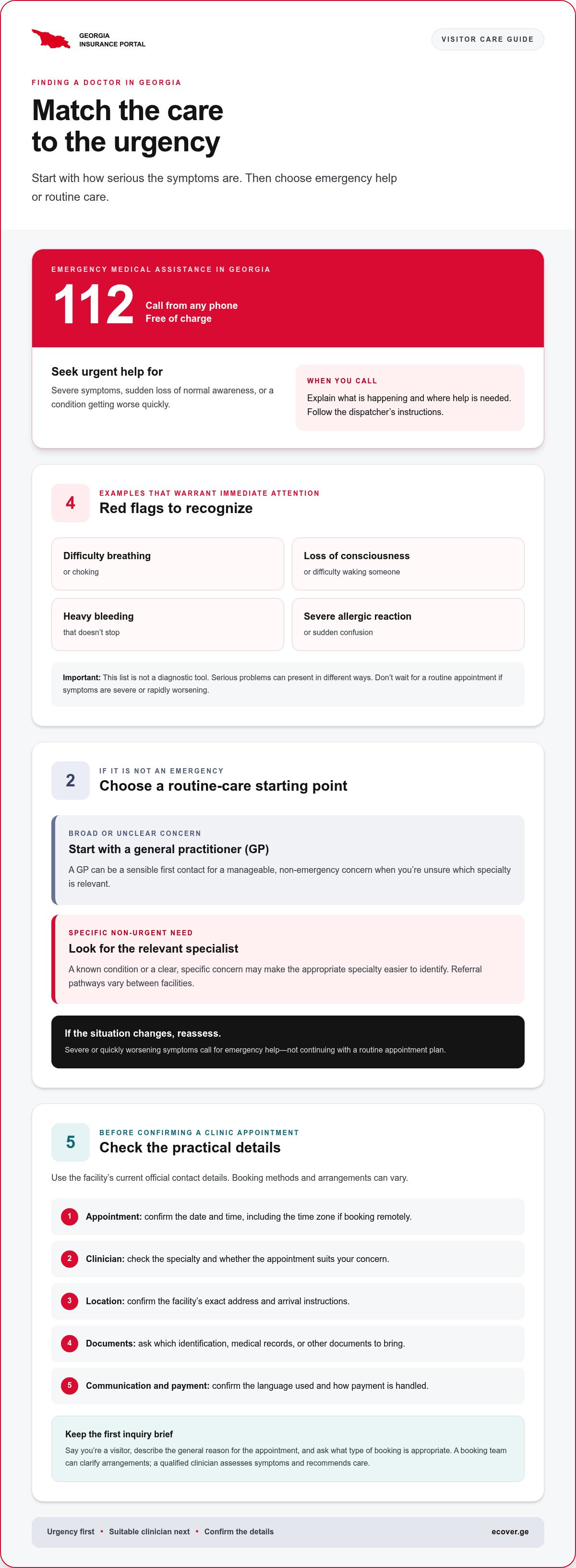
Seek urgent help for severe symptoms, a sudden loss of normal awareness, or a condition that is getting worse quickly. Examples that warrant immediate attention include:
- Difficulty breathing or choking
- Loss of consciousness or difficulty waking someone
- Heavy bleeding that doesn’t stop
- A severe allergic reaction or sudden confusion
This list isn’t a diagnostic tool, and serious problems can present in different ways. Don’t wait for a routine appointment if symptoms are severe or rapidly worsening. In Georgia, call 112 for emergency medical assistance. The number can be called from any phone, free of charge. Explain what’s happening and where help is needed, then follow the dispatcher’s instructions. If someone else is with you, they can call while you stay with the person who is unwell.
When should a tourist look for a general practitioner or specialist?
A general practitioner (GP) can be a sensible starting point for a non-emergency concern when you’re unsure which specialty is relevant. For example, if you have a new but manageable concern that doesn’t clearly point to a particular specialist, a GP can assess the situation and advise on next steps. If the condition becomes severe, seek emergency care instead.
If your non-urgent need is clear, you can look for a relevant specialist. A follow-up for a known condition or a specific concern may make the appropriate specialty easier to identify. When contacting a facility, describe the main issue plainly and ask what type of appointment to book. A clinic’s booking team can clarify appointment arrangements, but only a qualified clinician can assess symptoms, determine appropriate care, and recommend treatment.
Keep the decision rule straightforward: severe or quickly worsening symptoms call for emergency help; stable, non-urgent concerns can usually begin with a GP or relevant specialist. If the situation changes while you’re arranging an appointment, reassess the urgency rather than continuing with your original plan.
How Healthcare Access in Georgia Works for Visiting Tourists
For routine care, the basic pathway is practical: identify the kind of help you need, contact a suitable facility, and clarify how and when an appointment can take place. Georgia’s healthcare system includes public and private services, but tourists shouldn’t assume that arrangements for residents apply to visitors. Public healthcare coverage is primarily associated with citizens, while visitors may need to pay for care themselves or use applicable insurance. The process depends on the facility and the service required.
There isn’t one booking route for every clinic. Some facilities may take appointment requests through a website or by phone, while others use different contact methods. Language support and payment arrangements can also vary. Use a facility’s current official contact details and confirm the practical arrangements directly, rather than relying only on an online directory or an old recommendation.
In short, tourists can start seeking routine care by identifying the type of clinician they need, contacting a suitable facility through its current official channel, and confirming the appointment arrangements.
What is the difference between a general practitioner and a specialist?
A general practitioner (GP) provides broad medical care and can be an initial point of contact for non-emergency concerns, particularly when you’re unsure which specialty fits your situation. A specialist focuses on a particular area of medicine and may be appropriate when your non-urgent need is already clear. Referral pathways vary between facilities, so ask about the booking process when you contact the clinic.
What should tourists know about contacting a clinic?
Use the facility’s current official website, phone number, or booking channel rather than relying only on a third-party listing. Keep your first message brief: say that you’re a visitor, describe the general reason for the appointment, and ask what type of booking is appropriate. You don’t need to provide a full medical history in an initial inquiry.
Before finalizing the appointment, confirm the details that could otherwise cause confusion:
- The appointment date and time, including the time zone if booking remotely
- The clinician’s specialty and whether the appointment suits your concern
- The facility’s exact location and any arrival instructions
- Which identification, medical records, or other documents to bring
- What language will be used for communication and how payment is handled
Don’t assume that English-language support is available at every facility. Confirm how you’ll communicate before attending, and prepare a short written description of your concern if it will help you explain it clearly. If time has passed since booking, reconfirm important details.
Keep insurance planning separate from clinic access: a policy doesn’t book an appointment or guarantee treatment. From January 1, 2026, international travelers entering Georgia are required to have health and accident insurance. For official entry information, consult Georgia’s Ministry of Foreign Affairs. E-COVER provides online policies designed for Georgia’s visitor insurance requirements to help you prepare for possible medical expenses.
How to Choose and Book the Right Doctor in Georgia
Once you’ve decided that a routine appointment is appropriate, match the care to your need and confirm the practical details. A clear booking request helps the facility understand what kind of appointment you’re seeking. Wait for the facility to confirm the appointment before making plans around it.
- Describe the concern. Note the main symptom or reason for care, when it began, and whether it has changed or worsened. Keep the description factual and brief.
- Choose a care type. If you know which specialty fits a non-urgent concern, identify it. If you’re unsure, ask about starting with general care.
- Find current facility information. Use the facility’s official website or contact channel. Directory entries and older travel recommendations can be out of date, so confirm that the contact details and booking route are current.
- Contact the facility and confirm arrangements. Explain that you’re a visitor, share the essential details, and ask what to do next. Record the response so you can refer to the confirmed appointment information later.
Which details help match a doctor to your medical need?
Give the clinic enough context to route your request: the main concern, how long it has been present, and whether it is worsening. Mention relevant medical history or an existing diagnosis if it affects the reason for the visit. If you know the appropriate specialty, name it, but don’t expect the facility’s booking team to determine a diagnosis. For a child, state the child’s age and concern so the facility can direct you toward age-appropriate care.
For example, “I’m visiting and would like an appointment about a symptom that began two days ago and is getting worse” is more useful for an initial inquiry than a long, unstructured account. If symptoms become severe or rapidly worsen while you’re arranging routine care, stop the booking process and seek urgent help instead.
What should you confirm when making an appointment?
Before you consider the booking complete, make sure you understand the essential logistics. Ask concise questions and note the answers, especially if you’re arranging care for someone else or coordinating travel to the facility.
- The clinician’s specialty and whether the appointment is intended for your stated concern
- The confirmed date and time, plus the facility’s full address and arrival instructions
- Any preparation instructions, including whether to bring previous test results or records
- What identification or other documents the facility requests
- How payment is handled and what communication language arrangements are available
Don’t assume that a particular language, payment method, or booking procedure is available at every clinic. Ask directly and make sure you understand the response. Resolve any remaining questions before travelling to the appointment. Confirming these details makes finding a doctor in Georgia as a tourist more organized and helps you avoid relying on assumptions about how every facility operates.
Prepare for a Doctor’s Appointment in Georgia: Documents and Communication
A little preparation can help you explain your concern clearly and make better use of your appointment. When finding a doctor in Georgia as a tourist, focus on two things: information that helps the clinician understand your health, and any practical requirements the facility gives you. You don’t need to assemble a special medical file for every visit, but useful records can save time and help prevent important details from being missed.
What information and documents should a tourist bring?
Bring identification and, if available, relevant medical records or recent test results. Before the visit, write a short timeline: when the concern began, how it has changed, and any steps you’ve already taken. Include allergies, current medicines, and important existing conditions. If you have a medication list, use the names and doses shown on the packaging or prescription.
- Generally useful: identification, relevant health records, test results, and a concise list of medicines, allergies, and existing conditions.
- Facility-specific: any additional forms, records, or other documents the clinic requests when arranging the appointment.
Follow the facility’s instructions about what to bring. Don’t assume you need a particular certificate or form for an ordinary appointment. Special medical certificates and forms are purpose-specific, so prepare them only when they’re relevant to the service or process you need.
How can you reduce language misunderstandings during care?
Prepare a brief written summary in simple language before the appointment. Include the main concern, its timeline, known allergies, and medicines you take. Write down important details rather than relying on memory under stress. You can respectfully ask whether communication or interpretation support is available, but don’t assume a particular language or service will be provided.
During the consultation, use short, direct sentences and ask the clinician to repeat or explain anything you don’t understand. Before leaving, make sure you know how you’ll receive prescriptions, follow-up instructions, and test results. If instructions are unclear, ask for them to be written down or clarified. Confirming these details helps you understand what to do next, especially if you’ll be travelling or changing accommodation.
Keep digital copies of useful records somewhere you can access them, and bring original documents if the facility asks for them. Share health information relevant to your care, including any important detail that may affect the clinician’s assessment. Your notes support the conversation; they don’t replace a clinician’s evaluation.
Travel medical insurance is separate from the documents a clinician needs and doesn’t guarantee a particular appointment or treatment. To prepare for potential healthcare costs during your visit, explore E-COVER travel medical insurance for Georgia.
How Travel Medical Insurance Fits Into Finding a Doctor in Georgia
Insurance and medical care serve different purposes. Finding a clinician means identifying an appropriate facility and arranging care; a travel medical insurance policy may help with eligible medical expenses, subject to its terms. It doesn’t diagnose an illness, refer you to a doctor, book an appointment, or guarantee treatment or payment. Keep these roles separate so you know what to do if you become unwell and what to review when considering potential costs.
From January 1, 2026, international travelers entering Georgia are required to have health and accident insurance. Requirements can be updated, so review official guidance for your travel dates and circumstances. The Georgia travel insurance entry guide explains the requirement in more detail; official instructions remain the reference for current entry rules.
What can travel medical insurance do, and what does it not do?
A policy provides financial protection only as defined by its individual terms and conditions. Coverage, limits, exclusions, claim requirements, and assistance procedures depend on the policy you hold. Don’t assume a clinic visit, test, prescription, or other service is covered simply because you have insurance. Read the policy documents before travel so you understand what steps apply if you need care.
Insurance doesn’t determine which doctor you should see. If you need medical attention, contact an appropriate facility based on your health concern, then consult your policy documents for relevant instructions about claims or assistance. For more context on planning cover as a visitor, see this tourist health insurance guide.
What should you prepare before travelling to Georgia?
Keep your policy certificate and insurer contact details accessible during the trip. Save a digital copy somewhere you can retrieve it, and consider carrying a paper copy as a backup. Before departure, review the policy dates and applicable terms, and make sure you know where to find instructions for seeking assistance or submitting a claim. This helps you consult the right information without mistaking the policy for a guarantee of access to care.
Use this short preparation checklist:
- Save or print your policy certificate and insurer contact details.
- Review the policy’s coverage terms, limits, exclusions, and applicable procedures.
- Check current official Georgian visitor insurance requirements before travelling.
- Keep your insurance information separate from the clinic’s appointment and medical-document requirements.
Travel medical insurance is one part of preparation, alongside knowing how to contact a facility and having relevant health information ready. E-COVER provides online policy issuance for foreign visitors to Georgia, with policies designed for the state’s visitor insurance requirements. To arrange cover as part of your travel planning, explore E-COVER’s Georgia travel insurance.
Make Your Georgia Travel Preparation Count
Before departure, make your healthcare information easy to access. Keep key details somewhere you can reach if your plans change, and review them before you travel. This can help you act more confidently if you need care away from home.
Finding a doctor in Georgia as a tourist is easier when you know your next step and have practical arrangements in order. Medical care and insurance serve different purposes, so plan for both rather than expecting one to replace the other.
E-COVER provides online travel medical insurance policies for foreign visitors to Georgia. It’s operated by LLC Insurance Broker WeInsure, licensed by Georgia’s Insurance State Supervision Service under License N012063. If you’re arranging travel cover, get your Georgia travel medical insurance online with E-COVER.
Frequently Asked Questions
Can tourists see a doctor in Georgia without speaking Georgian?
Yes, tourists can seek care without speaking Georgian, but language support varies by facility and shouldn’t be assumed. Confirm communication arrangements when booking, and prepare a short written symptom summary with key details and dates. If appropriate, bring someone who can help you communicate. For severe or rapidly worsening symptoms, contact emergency services rather than delaying care to resolve a language issue.
How do I know whether to see a general practitioner or a specialist in Georgia?
A general practitioner can be a starting point if you’re unsure which specialty fits your concern; a specialist may suit a known, non-urgent need. When finding a doctor in Georgia as a tourist, describe the concern to the facility and confirm which appointment type to request, since booking pathways vary. If symptoms are severe or rapidly worsening, seek urgent help instead of arranging a routine visit.
Do I need an appointment to see a doctor in Georgia?
Appointment arrangements vary by facility and type of care, so don’t assume walk-ins are accepted. For a routine concern, contact the facility first to ask about booking steps, availability, and what information to provide. Wait for confirmation rather than treating a request as a guaranteed appointment. If symptoms are severe or rapidly worsening, seek emergency help instead of waiting for a routine booking.
What documents should a tourist bring to a doctor’s appointment in Georgia?
Bring identification, relevant medical records or test results, and a list of current medicines and allergies. Keep your insurance policy information accessible too, in case it’s relevant to payment or a later claim. The facility may request additional information, so follow its instructions. A particular certificate or form isn’t automatically needed for every medical appointment; its relevance depends on the purpose of the visit.
Is emergency number 112 used in Georgia?
Yes. Call 112 in Georgia for emergency assistance, including medical emergencies. Use emergency services for severe or life-threatening situations rather than waiting for a routine appointment. State the location and describe the immediate situation as clearly as you can, then follow the dispatcher’s instructions.
Does travel medical insurance find a doctor or guarantee that an appointment will be covered?
No. Insurance doesn’t itself locate a doctor or guarantee an appointment, treatment, or payment. Whether a particular medical expense is covered depends on the policy’s terms, exclusions, and claim or assistance procedures. Read your policy documents before seeking care when circumstances allow, and follow the insurer’s stated process. Don’t assume a service is covered simply because you hold travel medical insurance.


