

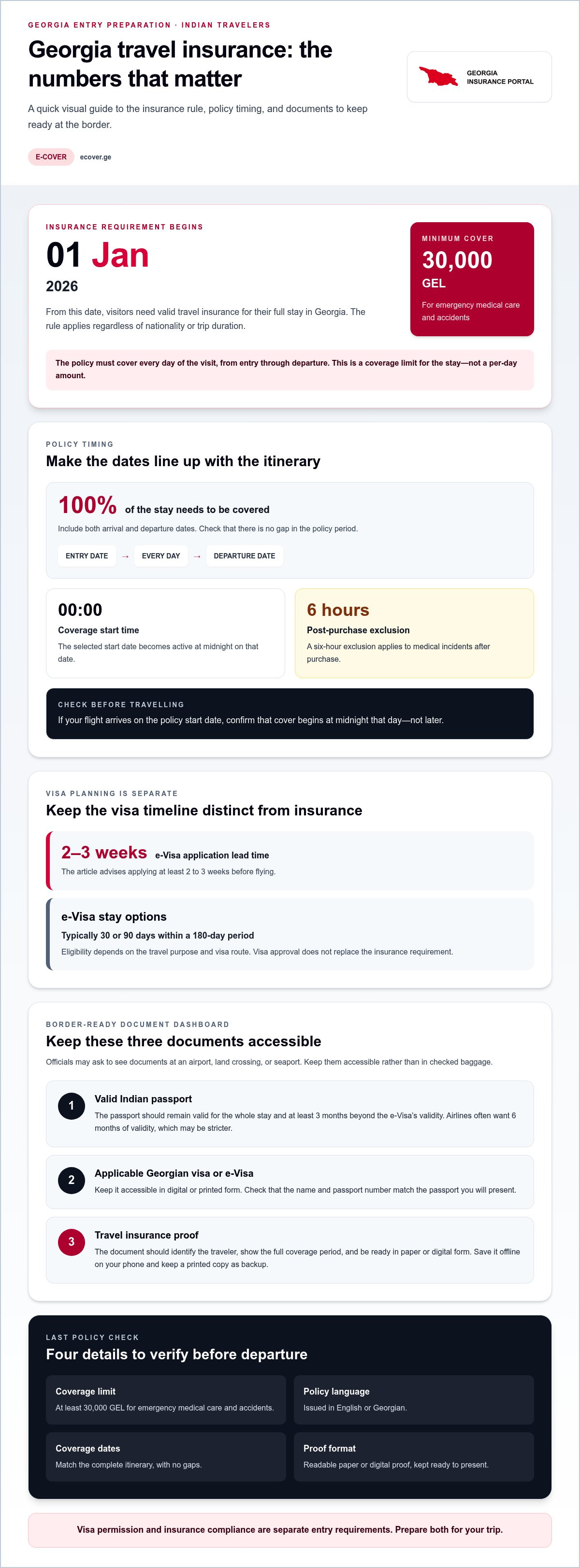
Indian citizens should treat travel insurance as a required part of Georgia’s entry preparation: from 1 January 2026, visitors need cover of at least 30,000 GEL for emergency medical care and accidents, for every day of their stay. Georgia entry requirements for Indian citizens include being ready to present proof of insurance at the border, in paper or digital form. Visa eligibility is a separate question, so prepare the visa documents that apply to your trip as well.
It’s easy to focus on the visa and leave insurance until the last minute. But a policy that doesn’t cover your full stay or meet Georgia’s requirements can cause problems at the border. This guide explains the visa question, the insurance rules, and the documents officials may ask to see.
You’ll also learn what the policy must show, how its dates should match your itinerary, and how to prepare clear proof of cover before travelling. Use these details as a practical checklist to avoid last-minute uncertainty.
Key Takeaways
- Confirm the visa route that applies to your Indian passport and travel purpose before booking; visa eligibility and insurance compliance are separate entry requirements.
- From 1 January 2026, visitors need travel insurance with at least 30,000 GEL in emergency medical and accident coverage for their full stay.
- Keep your passport, applicable visa, and insurance proof ready to present at the Georgian border in paper or digital form.
- Check that the policy is in English or Georgian and that its coverage dates match your entire itinerary without gaps.
- Review the policy details before departure so you can show that it meets Georgia’s requirements if officials ask.
Do Indians Need a Visa to Visit Georgia?
Indian citizens should arrange the visa that matches their travel purpose. For tourism, Georgia’s B-2 visa is one option, while an e-Visa can cover short tourism or business stays, typically 30 or 90 days within a 180-day period. Apply for an e-Visa at least 2 to 3 weeks before flying. Visa approval and travel insurance are separate requirements, so having one does not replace the other.
Insurance rules changed on 1 January 2026. Georgia requires visitors to hold insurance for the full stay, with at least 30,000 GEL in emergency medical and accident coverage. Treat these as separate coverage benchmarks when reviewing a policy, rather than assuming one currency figure automatically satisfies both.
For additional protection, consider the recommended coverage levels for medical care and evacuation. These are recommendations, not replacements for Georgia’s stated minimum.
Georgia accepts insurance from providers in India if the policy meets its criteria. The policy must be issued in English or Georgian, so arrange a compliant version before departure if your documents use another language. The named exemptions are diplomats and accredited staff of international organisations; the requirement otherwise applies to visitors of every nationality and trips of any duration. Children and long-stay visitors should have cover, and passengers entering Georgia during transit should be prepared to show proof.
Purchase the policy early enough to review its dates and coverage details. It must cover every day from entry through departure, without a gap. A selected start date becomes active at 00:00 on that date, and a six-hour exclusion applies to medical incidents after purchase. For example, if your flight arrives on the policy’s start date, confirm that coverage begins at midnight that day, not later.
- Match the coverage period to your full itinerary, including arrival and departure dates.
- Keep proof ready in paper or digital form for presentation at the border.
- Review the policy’s medical and accident limits, language, and start date before travelling.
This full-stay rule is especially relevant to visitors from visa-exempt countries. A 6-hour exclusion applies to medical incidents after a policy is purchased.
Documents checked at the Georgian border
Prepare your documents so you can present them promptly when you arrive in Georgia. For Indian travelers, the key documents are a valid Indian passport, the Georgian visa or e-Visa applicable to the trip, and proof of travel insurance. Border officials may ask to see insurance evidence at an airport, land crossing, or seaport. Keep the documents accessible, not in checked baggage.
Check the passport’s validity before departure. It should remain valid for the whole stay and at least 3 months beyond the e-Visa’s validity. Airlines often want a passport valid for 6 months, so an airline’s boarding check may be stricter than the period used for the e-Visa. Compare your passport expiry date with both your travel dates and visa validity. If the passport details differ from the visa application, resolve the mismatch before travelling.
Your visa document should match the purpose and length of your visit. An Indian tourist may use the relevant Georgian visa route, including an e-Visa where eligible. Keep an electronic copy and a readable paper copy available. Before leaving, compare the name and passport number on the visa with the passport you’ll present. A visa issued for an old passport may not match your current travel document.
Insurance proof should identify the traveler and show the policy’s coverage period. Georgia requires visitors to hold insurance for their stay, and travelers must be ready to present proof in paper or digital form. Save the policy offline on your phone and carry a printed copy as backup. Check that the policy dates include your arrival and departure dates. For a family, make each insured person’s details easy to find.
- Passport: Carry the valid Indian passport used for the visa application.
- Visa: Keep the applicable Georgian visa or e-Visa accessible, in digital or printed form.
- Insurance: Have readable proof showing the insured traveler and the full coverage period.
A typical Georgian immigration check for Indian travelers takes 60 to 90 seconds, according to the research summarized for this guide. That short interaction is easier when documents are organized and names, passport details, and travel dates align. Store your passport and visa together, with insurance proof close at hand. If you still need a policy document, you can review Georgia travel insurance options before departure.
Whether Indian citizens need travel insurance to enter Georgia
Yes. Indian citizens need valid travel insurance to enter Georgia. The requirement applies from 1 January 2026, regardless of nationality or trip duration. Georgia’s Decree 602 was adopted on 26 December 2025 and took effect on 1 January 2026. A short visit, a long stay, and visa-exempt entry all fall under the same insurance rule. Visa permission and insurance compliance are separate checks. For travelers planning the Georgia entry requirements for Indian citizens insurance, that distinction is central: an approved visa does not replace required cover.
Travelers must be ready to present proof at an airport, land border, or seaport. Border officials may request the policy, so keep it accessible throughout your journey. You can show a digital copy or carry a paper version. Save the document on your phone before departure and keep a printed copy as backup. Georgia entry requirements for Indian citizens insurance also mean reviewing the policy itself, not relying only on a general confirmation that insurance was purchased.
The requirement is for a policy that meets Georgia’s rules, not simply a document labelled “travel insurance.” Georgia accepts policies from Georgian companies and international providers when they meet government criteria. An Indian-issued policy can qualify on the same basis. Before travelling, check that it identifies the insured traveler, includes Georgia in its covered territory, and covers the entire visit. These details show that the policy applies to the person, destination, and travel dates.
Coverage must span your entire stay, with no gap between entry and departure. Compare the policy’s start and end dates with your itinerary, including any flight changes. For example, if your return flight is delayed to a later date, an earlier policy end date leaves part of the trip uncovered. Choose dates that cover the whole visit and keep the updated proof accessible. The requirement applies even to a brief stop in Georgia.
- Before leaving India: Confirm the policy covers the full Georgia itinerary.
- Before boarding: Save readable proof offline and pack a paper copy.
- At the border: Be prepared to present the policy at an airport, land crossing, or seaport.
Insurance is an entry requirement, not merely an optional precaution for medical expenses. Without proof that meets Georgia’s rules, a traveler may have difficulty demonstrating compliance during a border check. Keep the policy with your passport and visa documents, but treat each as a separate requirement. This helps you prepare for the different checks involved in entering Georgia.
Insurance requirements for Georgia e-Visas
Applying for a Georgian e-Visa and meeting the insurance requirement are separate tasks. The e-Visa portal does not require an insurance policy upload with the application. That portal step does not remove the obligation to hold compliant cover while visiting Georgia. Decree 602 was adopted on 26 December 2025 and took effect on 1 January 2026, establishing the travel insurance requirement. Understanding Georgia entry requirements for Indian citizens insurance starts with keeping these two application and travel obligations distinct.
The insurance rule applies to visitors of every nationality and trips of any duration, including Indian travelers using an e-Visa. Georgia accepts policies issued by Georgian companies or international providers when they meet government criteria. A policy purchased in India can qualify on the same basis. It must be issued in English or Georgian, so travelers whose documents use another language need an eligible-language policy document. This language requirement is part of the Georgia entry requirements for Indian citizens insurance, not an e-Visa upload instruction.
Check the policy wording, not just the certificate title. Georgia’s required policy details include the parties to the insurance contract, the covered territory, and the subject matter of the insurance. It must also state the premium amount and the place and terms of payment. The policy should show its start and end dates and list the insured risks. These details clarify what is covered, where, and for what period, making the document easier to assess if requested.
Exemptions are limited to diplomats and accredited staff of international organisations. An Indian traveler does not qualify for an exemption simply by holding an e-Visa or taking a short trip. Children and long-stay visitors are also subject to the general rule, which covers trips of any duration. For a longer visit, the policy dates must span the entire stay. Visa duration and insurance duration answer different questions, so align both with your itinerary.
- For the e-Visa application: Insurance upload is not required in the portal.
- For the trip: Hold a policy meeting Georgia’s requirements and keep its proof accessible.
- For the policy document: Use English or Georgian and review the required contract details.
Without required insurance or other entry documents, a traveler may be unable to demonstrate compliance when officials request proof. Missing documents can complicate border processing, so keep your visa, passport, and policy evidence accessible together. An e-Visa approval confirms the visa decision; it does not replace the separate insurance requirement. Before departure, compare the traveler’s name and itinerary with the policy, particularly if travel dates change after the e-Visa application.
What minimum coverage, policy duration, and insurance terms does Georgia require from tourists?
From 1 January 2026, Georgia requires tourists to hold valid travel insurance for their entire stay. The minimum is 30,000 GEL in emergency medical and accident coverage. This is the entry requirement, not an optional recommendation. Check the policy’s stated limit and covered risks rather than relying only on a document labelled “travel insurance.” The policy must provide evidence that the required coverage applies to your visit.
Duration matters as much as the coverage limit. The policy must begin no later than your arrival and remain valid through your departure, with no uncovered days. Compare its start and end dates with your itinerary. For example, a return-flight change can leave your final day outside the policy period if you don’t update the end date. Georgia’s requirement applies to trips of any duration, so even a short visit needs cover for the full period.
The policy should also make its scope clear. It must identify the parties to the insurance contract, state the subject matter, and list the insured risks. Its geographic territory must include Georgia. A policy that names only another destination, or covers only part of a multi-country trip, may not demonstrate the required protection for your time in Georgia. Review the wording and schedule together to ensure the territory, dates, and insured person match your trip.
Georgia’s required policy terms include several specific details:
- The identities of the contracting parties.
- The territory covered, including Georgia.
- The subject matter of the insurance and the insured risks.
- The commencement and expiration dates of coverage.
- The premium amount and the place and terms of payment.
Check these details on the policy document before travelling. A certificate that shows a coverage limit but omits the insured dates or geographic zone may not establish that your entire visit is covered. Confirm that each traveler is identified, especially when family members have separate certificates. Keep the document in Georgian and English, and retain an accessible copy that clearly displays the policy terms.
Use the 30,000 GEL minimum as your first compliance check, then review duration, territory, risks, and contract details. These requirements work together: adequate coverage with incorrect dates can still leave a trip unprotected. To arrange cover around Georgia’s stated requirements, review travel insurance policy options and compare the policy details with your itinerary before departure.
Before travelling, confirm that the policy states its start and end dates and clearly shows the coverage duration and geographic zone. Review the policy wording to confirm that it identifies the contracting parties and clearly states the territory covered.
Policies that cover only part of a trip or omit arrival and departure dates may not meet the requirement. Check the wording before relying on the policy, and make sure its dates span your entire visit. This distinguishes a policy that simply exists from one whose stated duration and geographic scope match your trip.
E-COVER: Travel Insurance Policies
E-COVER provides travel insurance policies for foreign visitors who need to meet Georgia’s insurance entry requirements. If you’re travelling from India, compare the policy’s coverage period and terms with your itinerary before departure. E-COVER policies are designed to meet Georgia’s state-mandated coverage requirements and are available online.
For a study visit, consider Student Insurance. Longer trips may suit long term travel insurance policies, while Digital Nomad Insurance is available for eligible travel needs. Whichever type fits your trip, review the policy documents and keep proof accessible with your passport and visa paperwork.
Contact E-COVER to explore travel insurance for your stay in Georgia.
Prepare your insurance before you finalize your plans
Your next step is to match your insurance choice to the kind of stay you’re planning. A short visit, a study period, and an extended stay can call for different policy arrangements, so consider your travel purpose and itinerary together. E-COVER offers Travel Insurance Policies, Student Insurance, and long term travel insurance policies for different travel needs.
For Indian citizens, Georgia entry requirements include arranging suitable insurance alongside your visa and travel documents. Treat insurance as part of trip planning, not a task to leave until departure day. Reviewing the Georgia entry requirements for Indian citizens, including insurance, can help keep your preparations organized.
If you’re ready to arrange cover for your trip, contact E-COVER for insurance help. With your documents organized and your plans in place, you can focus on enjoying your time in Georgia.
Frequently Asked Questions
What Documentation Do Indian Travelers Need?
Prepare a valid Indian passport, the Georgian visa or e-Visa applicable to your trip, and proof of travel insurance. Your visa route depends on your travel purpose and eligibility. For example, Georgia e-Visas cover short tourism or business visits, typically 30 or 90 days within a 180-day period. Keep your documents together and make sure names and passport details match across the records.
What documents must Indian citizens show at the Georgian border?
Be ready to show your Indian passport, applicable Georgian visa or e-Visa, and proof of insurance. You may present insurance proof digitally or on paper. Save a readable copy to your phone before departure so you can access it without an internet connection. Keep a printed backup with your travel documents, and check that the policy identifies the traveler presenting it.
Is travel health insurance mandatory for visitors to Georgia, and when does the requirement take effect?
Yes. Georgia’s mandatory travel insurance requirement took effect on 1 January 2026, and applies to international visitors of every nationality and trips of any duration. The e-Visa application portal doesn’t require an insurance upload, but visitors still need to hold compliant cover for their stay. Keep proof available for the journey, even if your e-Visa application was submitted without attaching the policy.
What are the current Georgia entry rules for Indian citizens, including passport validity and proof of accommodation or funds?
Indian travelers need a valid passport and the Georgian visa or e-Visa that applies to their trip, plus proof of required insurance. The passport should remain valid throughout the stay and at least 3 months beyond the e-Visa’s validity; airlines often want 6 months. Keep accommodation bookings and evidence of funds accessible as supporting travel records. They don’t replace the core entry documents.


