

A smooth crossing into Georgia starts with knowing what must be declared. If you’re preparing for Georgia border control questions, cash, cheques, or securities totaling more than GEL 30,000 or its equivalent in another currency must be declared when entering or leaving the country. Travelers also need a valid passport.
It’s natural to focus on documents and luggage, but entry decisions, screening, and permitted stay can also affect your plans. From January 2026, international travelers must have health insurance to meet Georgia’s entry requirements.
This guide covers the cash declaration threshold, what may happen if you are refused entry, how passport checks and luggage inspections work, and the consequences of overstaying. It also offers practical preparation tips: organize your travel documents, know what you are carrying across the border, and track how long you are permitted to stay. Understanding these basics before departure can help you respond calmly and avoid preventable complications.
Key Takeaways
- Count cash, cheques, and securities together when deciding whether a border declaration is required, and treat goods for economic activity as a separate customs concern.
- Prepare for airport entry screening by keeping travel documents and the purpose of your visit clear and consistent.
- Expect customs officers to be able to ask questions and inspect luggage, hand luggage, vehicles, or passengers during screening.
- Track the end date of your lawful stay carefully: overstaying can lead to a fine and a temporary ban on re-entering Georgia.
Currency declaration thresholds on entry and exit
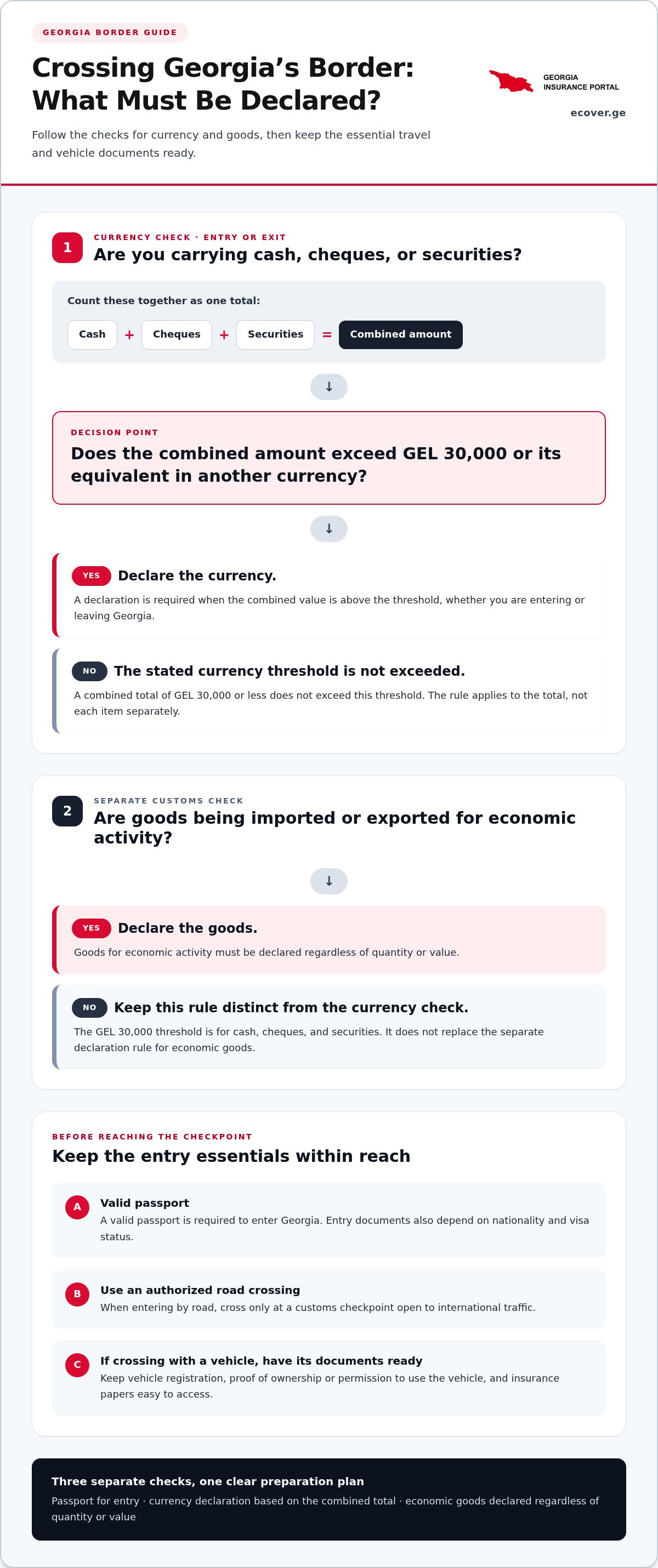
A currency declaration is a customs notice for cash, cheques, or securities crossing a border. When entering or leaving Georgia, declare them if their total exceeds GEL 30 000 or its equivalent in another currency. Add the amounts together, rather than assessing each item separately. For example, count cash and cheques together when checking whether the threshold is crossed.
Entry documents depend on nationality and visa status; travelers need a valid passport to enter Georgia. U.S. citizens may enter and stay without a visa for up to 365 days. Check your travel documents against your nationality and intended stay before departure.
Georgia’s cash declaration threshold applies to cash, cheques, and securities, not alcohol or tobacco. Goods imported into or exported from Georgia for economic activity must be declared, regardless of quantity or value. Keep commercial goods separate from personal belongings when preparing your customs information. The cash threshold is a separate rule and does not replace goods declarations.
If entering by road, you may cross Georgia’s state border only at a customs checkpoint open to international traffic. Keep your passport, vehicle registration, proof of ownership or permission to use the vehicle, and insurance papers within easy reach. These documents help clarify who is travelling and which vehicle is crossing the border.
Do not confuse Georgia’s border procedures with U.S. checkpoints. U.S. Border Patrol operates checkpoints within 100 miles of any U.S. border or coastline, according to U.S. Customs and Border Protection. That distance describes U.S. checkpoint operations, not Georgia’s currency declaration threshold or customs rules.
Before reaching a Georgian checkpoint, group cash, cheques, and securities so you can calculate their combined value. If the total exceeds GEL 30 000 or its equivalent, declare it on entry or exit. Keep commercial goods and personal items easy to distinguish, especially when a shipment supports economic activity.
These steps address different border questions: your passport supports entry, the checkpoint governs where you cross, and customs declarations cover currency and economic goods. A traveler carrying GEL 30 000 or less in total cash, cheques, and securities does not exceed the stated currency threshold; exceeding it triggers declaration.
Declare cash, cheques, and securities when their combined value exceeds GEL 30,000 or its equivalent in another currency. Goods imported into or exported from Georgia for economic activities must be declared regardless of quantity or value.
Entry denials at Tbilisi airport
An entry denial means officials refuse a traveler permission to enter Georgia. At Tbilisi airport, prepare to explain your visit and present consistent travel documents.
Reasons for Entry Denial
An entry denial is a border decision not to admit a traveler. Reports describe individual cases, not a rule that applies automatically to every visitor. On November 18, 2025, a forum participant reported a Russian traveler was deported after his Iranian girlfriend was denied entry at Tbilisi airport. Another contributor described an Australian traveler who was refused entry, possibly after attending several protests.
These reports do not show that nationality, personal relationships, or past activity automatically lead to refusal. If asked about your visit, answer directly and make sure your explanation matches your documents. Avoid guessing or adding details that conflict with your itinerary. For Georgia border control questions about a possible refusal, keep the decision and your travel documents together.
A refusal at an airport may involve detention and deportation. At a land border, a traveler may have to turn back. These outcomes can affect onward travel in different ways, so keep essential documents and contact details accessible. Avoid making plans that depend on immediate entry before screening is complete.
Evidence of Travel Plans and Funds
Evidence of travel plans means records that explain your accommodation, onward travel, and how you will support your visit. Keep relevant booking details and travel records organized and easy to access.
The reports do not establish a standard document format for explaining a trip. Carry records that reflect your actual plans, such as accommodation details or onward travel information, if available. A clear itinerary can help you answer questions about your visit. Keep digital copies accessible and store essential records separately from your passport.
A valid passport is required for entry, while your nationality and visa status determine the applicable entry conditions. Answer consistently about your destination, accommodation, and return plans. If your plans change, update the details you give about your itinerary. If you are preparing for Georgia border control questions about your plans, organize these records before departure. Reservations and tickets can help explain your itinerary, but they do not guarantee admission.
Passport stamps and border screening
Border screening is the inspection of travelers and belongings at an official crossing. Georgian customs officers may ask questions and inspect luggage, hand luggage, vehicles, or passengers in person.
Border Checks by Crossing Type
Border checks are customs and passport procedures carried out at an authorized entry point. You may cross Georgia’s state border only through customs checkpoints open to international traffic. At airports, land crossings, and seaports, officers may interview passengers and inspect belongings or vehicles. The inspection may vary depending on what you are carrying and the circumstances of your crossing.
For land crossings, a 2024 report described Iranian travelers being denied entry at two Georgia-Armenia borders while traveling in their own car. That report does not establish a different rule for every land checkpoint. Regardless of crossing type, keep travel documents accessible and answer officers’ questions directly. Restrictions also apply to specific items: prescription medications depend on their drug composition and quantity. Historical items require care when leaving Georgia.
Passport Stamps and Officer Questions
A passport stamp records a border crossing in a travel document. A new passport does not necessarily prevent questions about your travel history. One traveler was questioned years later about visits to Abkhazia and Russia using a route from Georgia, despite presenting a new passport, and was ultimately allowed to enter.
Questions from officers are part of screening, but the available reports do not establish a fixed script. Be ready to explain your destination, travel purpose, itinerary, and belongings clearly, and answer consistently with your documents. If you are carrying prescription medication, explain that it is for personal use and keep a doctor’s statement with it. Only personal medications accompanied by a doctor’s statement can be imported without government permission. Medication rules depend on composition and quantity; travelers without required permits are often detained and face heavy fines.
Restricted items require separate attention. Exporting items of historical value from Georgia requires a license from the Ministry of Culture. Before travelling, identify any medicines and historical objects you are carrying, then prepare the relevant supporting documents. These involve different considerations: a medicine’s composition can affect import permission, while an object’s historical value can trigger an export licensing requirement.
Overstaying and potential fines
Overstaying means remaining in Georgia after your lawful period of stay expires. The consequences depend on how long you remain after that date.
U.S. citizens may enter and stay in Georgia without a visa for up to 365 days. Travelers need a valid passport, and from January 2026, international travelers must have health insurance to meet Georgia’s legal entry requirements.
For an alien whose lawful stay has expired by up to three months, the Legislative Herald of Georgia states that the violation “shall carry a fine in the amount of GEL 1 000 and a ban on an alien entering Georgia for a period of six months.” This penalty combines a monetary fine with a temporary re-entry ban, so departure plans should account for both consequences.
A separate threshold applies after a longer overstay. Foreign citizens and stateless persons who remain in Georgia for more than three months after their legal stay expires are subject to a GEL 360 penalty. These periods mark distinct legal situations. Don’t assume that the shorter-overstay penalty replaces the consequence for remaining longer.
Keep track of your authorized stay using your entry date and applicable visa or visa-free conditions. If your plans change, arrange to leave before your lawful stay expires. For a U.S. citizen, the visa-free allowance is up to 365 days, not an automatic extension beyond that period. Overstaying that permitted stay can result in a fine.
Follow this practical sequence to reduce the risk of an accidental overstay:
- Record your entry date and the last day of your permitted stay.
- Keep passport and travel records together for departure planning.
- Set a reminder before your lawful stay ends, then plan your exit in time.
A fine or re-entry ban can disrupt future travel to Georgia. Treat your permitted stay’s expiry date as a firm deadline and act before it passes.
E-COVER: Travel Insurance Policies
E-COVER offers Travel Insurance Policies to help travelers prepare for medical needs during a stay in Georgia. Starting January 2026, international travelers must have health insurance to meet Georgia’s legal entry requirements. Comprehensive coverage for foreign visitors is intended to meet those requirements.
Travel insurance addresses health coverage, not passport screening, visa eligibility, customs declarations, or permission to enter. Keep your travel documents and border declarations ready separately. If you’re studying, staying long term, or working as a digital nomad, E-COVER also offers Student Insurance, Long term travel insurance policies, and Digital Nomad Insurance.
Review your insurance arrangements as part of your travel preparation, alongside your entry documents and itinerary. To discuss insurance for your trip, contact E-COVER.
Make Your Next Travel Step Count
Good preparation turns border rules into practical decisions before you leave. Use the details that apply to your own itinerary, and keep your documents, travel plans, and insurance arrangements organized together. Answers to Georgia border control questions can help you plan, but your next step is making sure your trip preparation also addresses your health coverage needs.
E-COVER offers Travel Insurance Policies, Student Insurance, and Long term travel insurance policies. These options can support travelers preparing for different kinds of stays, while insurance remains separate from immigration permission and border decisions. Choose the coverage type that fits your travel purpose and make it part of your planning before departure.
For help with travel insurance, contact E-COVER for travel support. A little preparation now can help you begin your Georgia trip with greater confidence.
Frequently Asked Questions
What happens if a traveler is denied entry to Georgia, and how can the decision be appealed?
A traveler refused entry at an airport may face detention and deportation; at a land border, they may have to turn back. To seek a review, ask the officials handling the refusal for the written decision and instructions for submitting an appeal. Keep copies of the decision, passport details, and travel documents, and follow the procedure and deadline set by the responsible authority.
What documents are required to enter Georgia by nationality and visa status?
Travelers need a valid passport, and entry documents depend on their nationality and visa status. U.S. citizens may enter and stay without a visa for up to 365 days.


