

Arriving in Georgia without insurance and buying it afterward won’t meet the entry requirement: from January 1, 2026, international travelers must hold health insurance when they enter. The legal requirements for Georgia tourist insurance include cover for the full stay, so a policy bought after arrival can protect you going forward but won’t cover the period before it began.
It’s sensible to wonder whether you can arrange cover once you’re in the country, especially if travel plans change. The safest step is to have a valid policy and proof ready before you reach the border. This guide explains what the policy must cover, what proof to carry, who should check current entry rules, and what may happen if you arrive without the required insurance.
Key Takeaways
- Match your policy dates to your full stay, and plan how to maintain cover if your trip lasts longer than the policy.
- Keep accessible proof of insurance with you, and make sure it meets the language and format rules for presenting it.
- Review current entry requirements against your own travel circumstances, including whether an exemption applies.
- Arriving without the required cover can have consequences, so prepare your policy before travelling rather than relying on sorting it out later.
Can You Buy Travel Insurance After Arriving in Georgia?
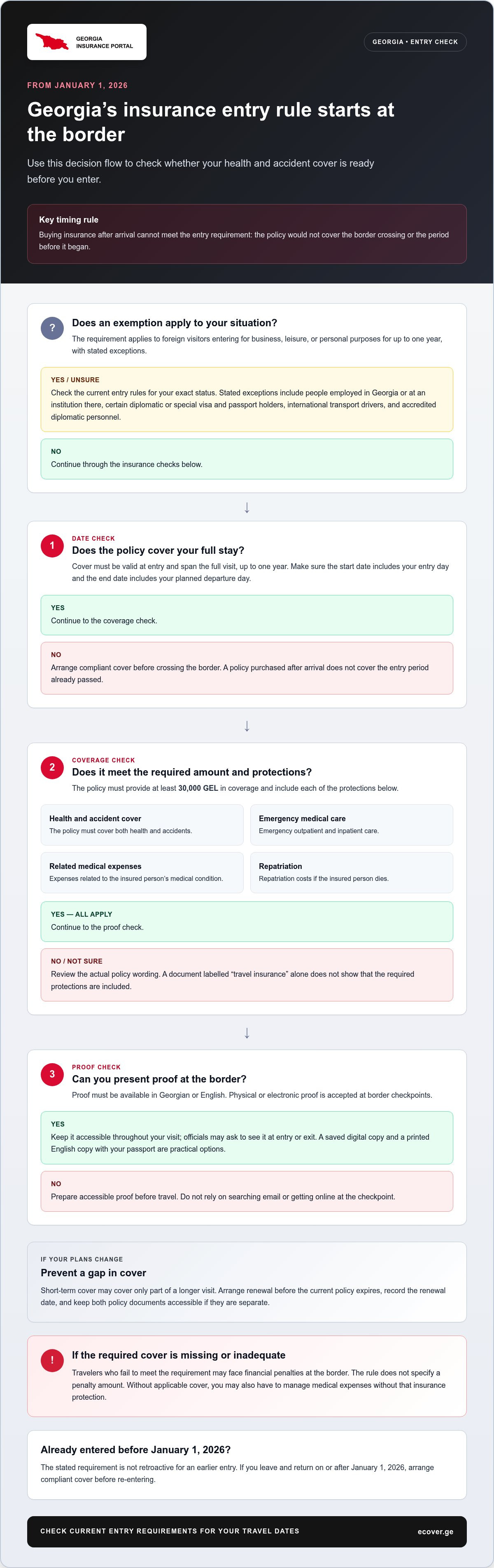
Georgia’s 2026 entry rule requires eligible foreign visitors to hold health and accident insurance when entering the country. The legal requirements for Georgia tourist insurance apply from January 1, 2026, and include having valid cover at the time of entry. Buying a policy after arrival cannot meet that entry requirement, because the policy would not cover the crossing itself.
The required insurance must cover the visitor’s full stay, up to one year, and provide at least 30,000 GEL in coverage. It must include accidents, emergency outpatient and inpatient medical care, expenses related to the insured person’s medical condition, and repatriation costs if the insured dies. Check the dates and coverage terms before travel, not only the policy’s name.
Travel medical insurance describes a type of cover, but the legal requirements for Georgia tourist insurance concern the protections and terms the policy provides. A document labelled “travel insurance” may not be sufficient if it lacks accident cover or does not span the full visit. Review the actual policy wording and confirm its start date includes your entry date.
The requirement applies to foreign visitors entering for business, leisure, or personal purposes for up to one year, except people employed in Georgia or at an institution there. Children and minors also need cover, with an individual policy for each child. Listed exemptions include certain diplomatic or special visa and passport holders, international transport drivers, and accredited diplomatic personnel.
For visitors who entered Georgia before January 1, 2026, the stated requirement does not make insurance retroactive for that earlier entry. If you leave and return on or after that date, arrange compliant cover before re-entering. A policy purchased after arrival will not cover the entry period already passed, so arrange the required insurance before crossing the border.
Traveler responsibility for checking current entry requirements
Current entry requirements are the rules that apply when you cross Georgia’s border. Before departure, review whether your policy meets the rules in force for your travel dates, and keep proof ready in Georgian or English. Requirements can change, so a policy that worked for an earlier trip may not meet the conditions for a later entry.
Proof of insurance is the document showing your active cover and its terms. Georgia accepts physical or electronic proof at border checkpoints, so save a digital copy where you can open it without searching through email. A printed English copy kept with your passport is also practical if your phone battery runs low or you cannot access a connection.
Keep your policy available throughout your visit, not just at the initial border crossing. Officials may ask to see proof at entry or exit, so check that the coverage dates include both your arrival and departure days. A saved PDF makes it easier to show that your insurance covers the full visit.
A short-term policy is insurance that covers only part of a longer visit. Visitors may enter Georgia with short-term cover, but they must renew it to protect the remaining stay. For example, if your policy ends before your planned departure, arrange renewal before the existing cover expires. Keep both policy documents accessible if the renewal creates separate records.
Use this preparation sequence before travelling:
- Confirm the policy dates match your entry and planned departure.
- Save an electronic copy and carry a printed English version with your passport.
- Record the renewal date if your stay extends beyond the current policy.
Review your documents before departure and keep them available at border checks. For a policy to arrange before travelling, explore Georgia travel insurance policies.
Consequences of arriving without insurance
A consequence is an outcome of failing to meet an entry rule. From January 1, 2026, tourists entering Georgia must hold mandatory health and accident insurance. Tourists who fail to meet the requirement may face financial penalties at the border. The available rule does not specify a penalty amount, so don’t assume the consequence is a fixed fee.
Officials may ask to see your insurance at entry or exit. Make sure the coverage starts on or before your entry day and ends on or after your departure day. A policy that starts after arrival or ends before departure does not cover the full visit.
Non-compliant cover means a policy that does not satisfy the entry conditions. For example, a document may show insurance but lack accident coverage, or its dates may not include the full stay. In either case, possessing a policy does not by itself demonstrate that you meet Georgia’s requirement. The relevant details are the actual cover and dates.
Missing or inadequate insurance also removes the protection the required policy is meant to provide. Georgia’s requirement concerns medical and accident cover, including emergency outpatient and inpatient care. Without applicable cover, a traveler may have to manage medical expenses without that insurance protection. No particular medical bill or penalty amount can be inferred from the rule.
Before travelling, use these steps to reduce compliance problems:
- Check that your policy is active on your Georgia entry date.
- Compare the coverage period with your planned departure date.
- Confirm the policy includes health and accident protection, not merely a document labelled “travel insurance.”
- Keep proof accessible so you can present it during a border check.
If your plans change after arrival, review your coverage dates promptly. Renewing before existing cover expires helps avoid a gap, while keeping the updated policy available supports checks during your stay or departure from Georgia.
Georgian government recommendation to carry proof of health insurance
Georgia’s government recommends that foreign visitors carry proof of health insurance valid in the country at all times. For medical care, choose cover that includes emergency outpatient and inpatient treatment; the listed requirements include repatriation costs if the insured dies, but do not identify emergency medical evacuation as a separate mandatory benefit.
Proof of Health Insurance
Proof of health insurance is a document showing that your policy provides active cover in Georgia. Keep it accessible throughout your visit, not just when crossing the border. The policy should identify its coverage dates and insured risks, so you can show what protection applies if asked. Check that the document is in Georgian or English, or has a certified translation.
Medical Care and Emergency Evacuation Coverage
Medical care coverage pays for eligible treatment under the terms of an insurance policy. Georgia’s required policy coverage includes emergency outpatient and inpatient medical care, accidents, and expenses related to the insured person’s medical condition. Repatriation costs in the event of death are also included. These details help distinguish medical treatment cover from evacuation cover.
Emergency evacuation means transport arranged for urgent medical reasons. The stated insurance conditions identify repatriation after death, not a separate emergency medical evacuation benefit. Read the policy wording for the specific protection it provides, and don’t assume that “medical cover” automatically includes transport from a remote location.
Before departure, check that your policy meets these requirements:
- Confirm the policy is valid in Georgia for your travel dates.
- Locate the sections covering outpatient care, inpatient care, accidents, and repatriation.
- Check how the policy describes emergency transport, if that protection matters for your plans.
For coverage designed for foreign visitors, explore Georgia travel insurance options and review the policy terms before travelling.
E-COVER: Travel Insurance Policies
E-COVER provides travel medical insurance for foreign visitors to Georgia, with policies designed to meet the state’s entry requirements. Consider arranging cover before departure so you can review the policy dates and terms before reaching the border.
Choose a policy suited to your travel circumstances. E-COVER offers travel insurance policies, alongside student insurance, long-term travel insurance, and digital nomad insurance. Before travelling, check that your selected policy matches your stay and provides the required health and accident cover.
If you need insurance for a Georgia trip, visit ecover.ge to explore E-COVER’s options.
Make insurance part of your travel preparations
Build insurance into your Georgia trip planning alongside transport and accommodation. The legal requirements for Georgia tourist insurance are one part of that preparation; your policy also needs to suit the journey you intend to take. Keep the documents easy to find, and review them again if your plans change before departure.
Choose your next step based on what you need: time to review policy terms, help arranging cover, or a policy that fits a longer stay. E-COVER offers travel insurance policies, student insurance, and long-term travel insurance policies. For insurance help with your Georgia plans, contact E-COVER.
A little preparation now can help you set out with greater confidence. Take the next step when you’re ready, and enjoy planning your time in Georgia.
Frequently Asked Questions
Is travel insurance legally required for tourists visiting Georgia (the country)?
Yes. Starting January 2026, the Georgian government requires all international travelers to have mandatory health insurance. The rule covers visits for business, leisure, or personal purposes lasting up to one year, with an exception for people employed in Georgia or at an institution there. Children and minors need individual policies. Check whether a specific exemption applies to your circumstances before travelling.
Do US citizens need travel medical insurance to enter Georgia?
US citizens are subject to the insurance requirement as foreign visitors entering Georgia, unless a listed exemption applies. The requirement is based on visitor status and entry, not a special rule for US passports. Before departure, review your policy’s cover and dates. If travelling with children, arrange a separate policy for each child rather than relying on an adult’s policy.
Does Georgia require tourists to have minimum medical or accident insurance coverage?
Yes. The minimum required coverage is 30,000 GEL. The policy must cover accidents and emergency outpatient and inpatient medical care, along with expenses related to the insured person’s medical condition. It must also cover repatriation costs if the insured dies. Check the actual policy terms and limits, rather than relying only on a product label or a general statement that medical cover is included.
Are there insurance requirements for tourists entering Georgia by land, air, or sea?
The requirement applies to foreign visitors entering Georgia, and compliant policies are accepted at all Georgian entry points, including airports, land borders, and seaports. Your route does not remove the need for qualifying cover. Buy the policy before or at the moment of entry, and keep the proof accessible during your crossing.
Does travel insurance need to be shown at the Georgian border or included with a visa application?
Travelers must be able to present proof of insurance at Georgian border checkpoints, in physical or electronic form. The policy should be in Georgian or English, or have a certified translation. Keep a downloadable copy on your phone and consider carrying a printed English version. The entry requirement concerns having valid insurance for border presentation; prepare the policy document for that purpose.
What are the penalties or consequences for entering Georgia without required tourist insurance?
Travelers who fail to meet Georgia’s insurance requirement may face financial penalties at the border. Insurance can also be checked at entry and exit, with stay dates compared against policy coverage. If your documents show a gap, you may not demonstrate cover for the full visit. Before travelling, confirm the policy dates match your entry and departure plans, and keep proof available during the trip.


