

Starting January 1, 2026, tourists entering Georgia must have valid health and accident insurance with coverage of at least 30 000 GEL. The policy must cover the full stay, including arrival and departure dates. The insurance requirement applies to tourist entry, so holding an e-visa doesn’t remove the need for qualifying cover.
It’s easy to focus on the visa application and overlook the separate insurance conditions. Understanding the requirements for Georgia e-visa insurance means knowing what the policy must cover, what details it must show, and which travelers are exempt. This guide explains the coverage threshold, eligible policies and how to present proof at the border, so you can prepare the right document for your trip.
Key Takeaways
- Make sure the policy clearly identifies who is insured, where and when cover applies, the risks covered, the limits, and premium payment details.
- Match the insurance dates to your entire visit, including the day you arrive and the day you leave.
- Prepare proof in an accepted language and format, and understand which traveler categories are exempt from the entry requirement.
- Separate the insurance rules for entering Georgia from any proof of cover that may apply to a visa or residence-permit application.
Insurance plan coverage and eligibility
For a Georgia-bound tourist, eligibility depends on the policy matching the traveler and trip. Starting January 1, 2026, the document must show specific contract and coverage details.
Coverage and Eligibility Basics
Coverage and eligibility basics mean checking that the policy identifies the insured traveler and the terms of protection. These details matter because an insurance document must show what applies, rather than simply confirm that a policy exists. Starting January 1, 2026, a tourist’s policy must state the contract parties, covered territory, subject matter, coverage dates, insured risks, insurance limits, and premium payment details.
Review those fields together before travel. For example, the covered territory should include Georgia, and the coverage dates should match the visit. The insured risks and limits clarify the protection provided, while the premium details identify the payment terms. A policy that lists these items gives the traveler a clearer document to present if asked.
Medical and Evacuation Coverage
Medical coverage addresses health-related costs, while evacuation coverage concerns transportation when urgent care requires it. Both matter because treatment and access can differ between a city and a remote area. Emergency evacuation from rural areas or Georgia’s Caucasus Mountains can cost thousands of dollars, so read the policy’s insured risks and limits carefully.
Check how the policy describes emergency medical care and evacuation, rather than relying only on a general label such as “health cover.” The stated terms show which risks are insured and the applicable limits. For a trip involving remote parts of the Caucasus, evacuation wording deserves particular attention alongside medical coverage.
Acceptance of Foreign Insurance
Yes. Georgia permits tourist insurance issued by either a Georgian or foreign insurance company, starting January 1, 2026. A foreign policy can therefore meet the insurer-origin condition, provided its terms also satisfy the applicable coverage and document requirements.
For an e-visa traveler, the insurer’s country alone doesn’t establish that every policy detail aligns. Review the document for the named contract parties, Georgia as covered territory, the visit dates, insured risks, limits, and premium payment details. This makes it easier to distinguish a policy’s foreign origin from whether its recorded terms fit the trip.
Is Travel Insurance Required To Enter Georgia?
Starting January 1, 2026, tourists must hold valid health and accident insurance to enter Georgia. Visa and residence-permit applications can involve separate proof requirements.
Insurance for Visas and Residence Permits
Policy Limits and Coverage Amounts
Georgia’s minimum policy limit is the lowest cover an eligible tourist policy must provide. Starting January 1, 2026, tourist health and accident insurance must provide at least 30 000 GEL in coverage. Compare the policy limit with that threshold, rather than relying only on the policy’s general description. The requirement applies to the policy, not a different amount for each traveler category. A tourist arriving without valid insurance does not meet the stated entry condition; the available information does not establish a specific penalty.
Proof of Insurance for E-Visa Applications
The entry insurance requirement does not itself describe an upload step for a Georgia e-visa application. Some Georgia visa applications may require proof of valid health insurance, so application requirements and border-entry rules should be treated separately. For certain consular visa applications, the requested policy may need to cover medical expenses and emergency medical evacuation. Travelers planning their itinerary who need assistance coordinating flights and entry paperwork can also consult travel agencies like deiratravel.com for international visa and booking support.
Insurance Documents for Entry
Proof of insurance for entry is the policy document a tourist can present at the border. Starting January 1, 2026, travelers must be able to show it in physical or electronic form, and it must be available in Georgian or English. Keep the document accessible during arrival, rather than relying on an application record alone. Check that the policyholder and coverage dates match the traveler and trip, including arrival and departure dates.
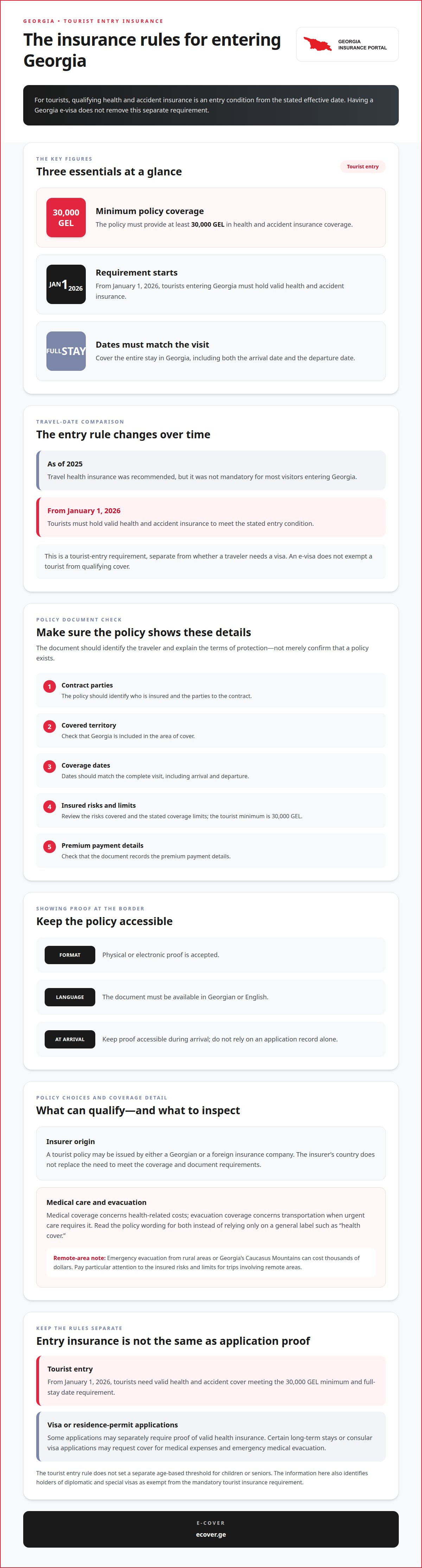
Whether travel insurance is required for entry to Georgia
For tourists, the answer depends on the travel date. Starting January 1, 2026, tourists entering Georgia must hold valid health and accident insurance. This is an entry condition, separate from whether a traveler needs a visa. The insurance rule applies to tourist entry, including visitors arriving with an e-visa.
The timing matters. As of 2025, travel health insurance was recommended but wasn’t mandatory for most visitors entering Georgia. From January 1, 2026, the requirement changes: tourists need valid health and accident cover. A traveler planning a visit across that change should distinguish the rule applicable to each travel date rather than assume the earlier recommendation remains sufficient.
The tourist policy must cover the full stay in Georgia, including arrival and departure dates. It may be issued by a Georgian or foreign insurance company. The country where the insurer operates doesn’t change the requirement to hold valid insurance for the entire visit. Keep the policy dates aligned with the itinerary, especially if travel dates change.
Several categories are exempt from the mandatory tourist insurance requirement:
- Holders of diplomatic and special visas.
- Drivers engaged in international road freight and passenger transportation.
- Accredited employees of diplomatic missions, consular representations, international-organization representation offices, and equivalent offices, plus their accredited family members.
- People whose entry is provided for by Georgia’s international treaties and agreements.
These exemptions are based on the traveler’s status or the basis for entry, not simply their nationality. For example, an accredited employee’s family member is covered by the stated exemption only when accredited. A tourist who doesn’t fall within an exemption must account for the insurance condition when planning entry from January 1, 2026. The rule establishes that insurance is required; it doesn’t specify a particular penalty for arriving without valid cover.
Are there minimum policy limits or coverage amounts required by Georgia?
Yes. Starting January 1, 2026, tourist health and accident insurance for entry to Georgia must provide at least 30 000 GEL in coverage. Treat this as a required minimum, not a suggested target. A policy with a lower stated limit falls short of the entry threshold, even if it describes its protection as comprehensive.
Read the policy schedule and wording together. Find the stated coverage limit, then check that it applies to the health and accident insurance required for tourist entry. A broad policy title alone doesn’t show the amount available. For example, if a document lists a limit below 30 000 GEL, it doesn’t meet this minimum.
Next, compare the limit with the insured risks and the rest of the policy details. The schedule should make clear which traveler and trip the limit applies to. Check that Georgia is within the covered territory and that the dates cover the visit. These details help distinguish a policy’s headline amount from the protection recorded for the specific trip.
Use this quick review before relying on the document:
- Locate the coverage amount and compare it with the 30 000 GEL minimum.
- Check that the policy is health and accident insurance for tourist entry.
- Match the insured person, Georgia coverage, and dates to the planned visit.
The threshold is a minimum, not a complete measure of how useful cover will be. A traveler should also read the insured risks and limits attached to the policy. For instance, two policies might display the same headline amount while setting out different covered risks. The stated amount answers the minimum-limit question; the wording explains how protection applies.
Reviewing the limit before departure helps identify a mismatch while there’s still time to arrange suitable cover. Explore Georgia travel insurance options for policies designed to meet the state’s entry coverage requirements.
E-COVER: Travel Insurance Policies
E-COVER offers Travel Insurance Policies for foreign visitors to Georgia, with instant online policies designed to meet state entry coverage requirements starting January 2026. This can help travelers arranging cover for a Georgia visit and seeking a policy aligned with the applicable rules. Review the policy terms, insured risks, coverage dates, and limits so they match your trip and travel needs.
E-COVER also offers Student Insurance, Long term travel insurance policies, and Digital Nomad Insurance. These options serve different travel circumstances, such as studying abroad or staying in Georgia for an extended period. Choose based on your travel purpose, then consider how the policy fits Georgia’s entry conditions. Contact E-COVER to explore travel insurance options for your Georgia visit.
Make Your Georgia Travel Plans with Confidence
Add insurance to your travel checklist before departure. Purchase the policy before or at the moment you enter Georgia, and set its dates to include both your entry and departure days. Save the PDF sent by email so it is accessible on your phone or tablet, and check that the policy is in Georgian and English.
The requirements for Georgia e-visa insurance are one part of preparing for a smooth arrival. Choosing cover that fits your travel purpose can also help you feel more organized before departure. E-COVER offers options for different travel needs, including students and longer stays.
If you’re ready to explore cover for your trip, contact E-COVER about your insurance. A little preparation now can help you set off for Georgia feeling ready for the journey ahead.
Frequently Asked Questions
Is travel health insurance mandatory for entering Georgia on an e-visa?
Yes. Starting January 1, 2026, foreign visitors entering Georgia need mandatory health insurance, including travelers with e-visas. An e-visa doesn’t replace insurance. The requirements for Georgia e-visa insurance also affect when cover begins: arrange the policy before entry or at the moment of entry, with its start date covering your border-crossing day. Set its end date to include your departure day.
What are Georgia's travel insurance requirements for foreign visitors?
Visitors need a policy that meets Georgia’s entry conditions and covers their travel dates. The requirements for Georgia e-visa insurance include a document issued in both Georgian and English and a minimum policy duration of 4 days. Coverage applies throughout Georgia except the occupied territories. Match the policy territory and dates to your itinerary, including any changes to your planned arrival or departure.
What minimum medical coverage must a policy provide for travel to Georgia?
The policy’s aggregate limit must be at least 30 000 GEL. An aggregate limit is the maximum payable across the policy term, while a per-claim limit applies to an individual claim. Read both figures in the policy wording to understand the overall cap and any claim-specific limit. The aggregate amount must meet Georgia’s minimum.
Must travel insurance cover emergency medical care, hospitalization, and evacuation in Georgia?
Georgia-bound travel medical insurance should address emergency care and evacuation in its stated benefits. E-COVER’s coverage includes ambulance services, emergency medical treatment, urgent hospitalization, medical evacuation, and repatriation. It also includes urgent dental treatment and COVID-19-related medical expenses. Review the listed benefits to understand how these services apply if an emergency requires transport from your location.
Where can travelers buy insurance that meets Georgia's entry requirements?
Travelers can buy E-COVER travel medical insurance online at ecover.ge. Set dates that include entry and departure, then complete the purchase before or at the moment of entry. Policy delivery is usually within 1-2 minutes, or up to 1 working day for non-instant providers. For purchase support, contact [email protected] or call or message +995 511 776 766.
What happens if a traveler arrives in Georgia without valid insurance?
They do not meet the stated entry condition for tourists. No specific penalty is established.


