

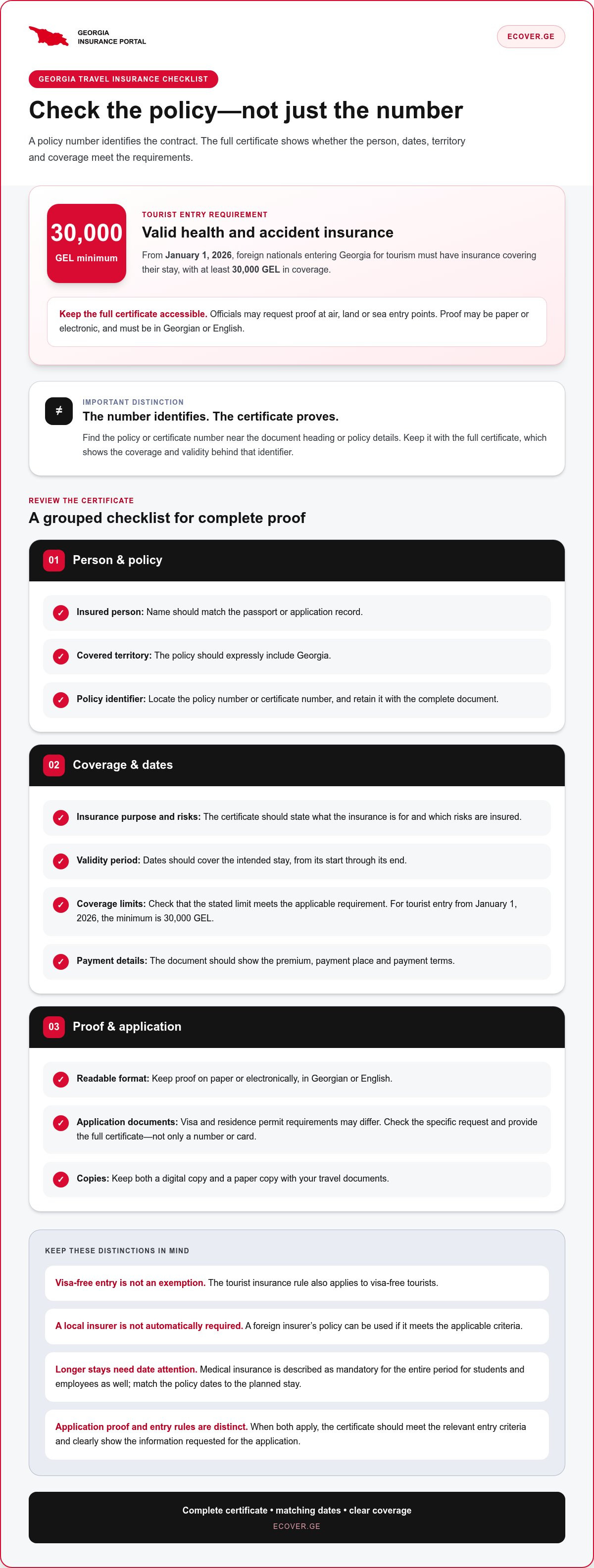
A Georgia health insurance policy number for a visa is the identifier shown on your insurance document, but the number alone is not proof of coverage. Since January 1, 2026, foreign nationals entering Georgia for tourism must have valid health and accident insurance with at least 30,000 GEL in coverage. Travelers must be able to show proof in paper or electronic form, in Georgian or English.
When preparing visa or residence permit documents, it’s easy to focus on finding the right number. What matters is having a policy document that identifies you and confirms coverage in Georgia for your travel dates.
This guide explains Georgia’s insurance requirement for foreign visitors, what visa or residence permit applications may ask you to provide, and how to find the policy number on your certificate. It also covers the policy details to check before you travel.
Key Takeaways
- From January 1, 2026, foreign nationals entering Georgia for tourism need valid health and accident insurance with at least 30,000 GEL in coverage.
- The policy number identifies your insurance contract, but the policy document is what shows the coverage and dates behind it.
- Prepare proof in paper or electronic form, written in Georgian or English, and make sure it covers your stay in Georgia.
- Visa and residence permit applications may have their own documentation requirements, so understand what proof applies to your application and travel status.
- Learn which policy details to look for and how travel, student, long-term travel, and digital nomad insurance can fit different stays.
Is Travel Insurance Required To Enter Georgia?
Yes. Starting January 1, 2026, foreign nationals entering Georgia for tourism must have valid health and accident insurance covering their stay. The minimum coverage is 30,000 GEL.
This entry rule also applies to visa-free tourists. Check the certificate’s coverage, dates, and policy number before traveling, so you can present complete proof if requested.
Entry Insurance Requirements
Entry insurance is valid health and accident coverage that meets Georgia’s requirements for foreign tourists. It matters because officials may request proof at air, land, or sea entry points. A foreign insurer’s policy can be used if it meets the legal criteria, so a local policy isn’t automatically required.
Visa-free status doesn’t remove the tourist insurance requirement. For example, a U.S. traveler entering visa-free still needs qualifying cover from January 1, 2026. Citizens of over 90 countries can enter Georgia visa-free for up to one year, but that permission doesn’t replace insurance.
A U.S. health insurance plan can work if it covers Georgia and meets the applicable criteria. Travelers don’t automatically need a Georgian insurer. The required minimum for tourist health and accident insurance is 30,000 GEL. Confirm that the certificate clearly states the coverage limit, especially if it expresses the amount in another currency.
The policy document should identify the contract parties, covered territory including Georgia, insurance purpose, validity dates, insured risks, coverage limits, premium, payment place, and payment terms. Match the insured person’s name and travel dates to their passport and itinerary. Proof must be available on paper or electronically, in Georgian or English.
Finding the Policy Number
The policy number is the contract identifier printed on your insurance certificate or policy document. Look near the heading or among the policy details, beside a label such as “Policy number” or “Certificate number.” The Georgia health insurance policy number for visa paperwork identifies the contract, but does not by itself confirm that the policy meets entry requirements.
The Georgia health insurance policy number for visa records should be kept with the full certificate, which shows the insured person, territory, dates, and limits. If the policy is invalid or below 30,000 GEL, it doesn’t demonstrate the required coverage. If officials request proof at entry, missing or insufficient documents can complicate your entry.
For a short-term tourist trip, the policy must cover the stay. Longer stays have a distinct consideration: medical insurance is described as mandatory for the entire period, including for students and employees. Match the policy dates to your planned stay, whether you’re visiting briefly or remaining in Georgia longer.
Insurance proof for visa applications and residence permits
Visa or residence permit applications may also require proof of valid medical insurance. Application requirements vary, so distinguish the documents requested for an application from the separate insurance rule for entering Georgia. A policy number identifies the contract, but does not show its coverage or validity period.
Prepare the full policy certificate, not just a card or number copied into a form. Check that the document connects the insured person to the contract and explains where, when, and for what risks coverage applies. If an application asks for evidence, a readable certificate makes those details easier to assess. Keep a digital copy and a paper copy with your travel documents.
Review these policy details before submitting an application or preparing to enter Georgia:
- Identity: The insured person’s name should match the passport or application record.
- Territory: The covered area should expressly include Georgia.
- Period: Validity dates should cover the intended stay, including its start and end.
- Purpose and risks: The document should state the insurance purpose and insured risks.
- Limits and payment: It should show coverage limits, premium, payment place, and payment terms.
- Language and format: Keep proof in Georgian or English, on paper or electronically.
For tourist entry from January 1, 2026, health and accident insurance must provide at least 30,000 GEL in coverage. That entry requirement is distinct from application-specific document requests. A visa or residence permit applicant should therefore ensure the certificate answers both needs when both apply: it should meet the relevant entry criteria and clearly show the information requested for the application.
Check that the coverage period matches your travel dates. For example, if your planned stay is longer than the period shown on the certificate, the documents may appear inconsistent. Review the insured risks and limits as well. A payment receipt does not replace the certificate’s coverage terms.
A medical provider network can help explain where an insured traveler may seek care, but it doesn’t replace proof of the policy’s territory, dates, or limits. Keep network information alongside the certificate if it helps you use the coverage during your stay. If you need travel insurance documentation for a Georgia trip, explore travel insurance policies and keep the issued policy documents with your application and travel records.
At Georgian border control, foreign visitors must have proof of travel insurance. Keep the policy certificate accessible with your travel documents, and make sure it can be reviewed if requested. Having the complete evidence ready is more useful than relying on a policy number alone.
Mandatory health and accident insurance for tourists entering Georgia
Starting January 2026, the Georgian government requires international travelers to have mandatory health insurance. The policy must provide at least 30,000 GEL in coverage. This applies to tourist entry regardless of whether the traveler needs a visa, so visa-free status alone doesn’t remove the insurance obligation.
The requirement is for valid insurance, not merely a policy number. The certificate needs to identify the insured person, validity dates, covered risks, and territory. Check that the policy covers Georgia for your full planned stay. Coverage applies throughout Georgia except in the occupied territories.
Review the policy’s stated limits and covered risks together. A policy number can help identify a contract, but it doesn’t show whether emergency medical expenses or accident-related treatment fall within its coverage. For example, a certificate could identify a traveler correctly yet still fail to demonstrate the required limit or valid dates. Keep the full document available in paper or electronic form, in Georgian or English.
- Coverage: Confirm the health and accident limit meets 30,000 GEL.
- Territory: Check that Georgia is included in the covered area.
- Dates: Match the insurance period to the planned stay.
- Risks: Read the listed medical and accident protections, not only the policy title.
- Proof: Keep a readable certificate ready to present at an entry point.
The rule has specific exemptions. Holders of diplomatic or special visas are exempt, as are accredited employees of diplomatic missions, consular representations, international-organization representation offices, equivalent offices, and their accredited family members. People entitled to enter under Georgia’s international treaties and agreements are also exempt. Drivers engaged in international road freight and passenger transportation are exempt from the tourist insurance requirement.
For travelers who aren’t exempt, consider the practical effect of a medical emergency. These amounts describe potential expenses, not insurance prices. Review policy updates if your trip dates or travel situation change, then make sure the certificate still reflects the correct period and coverage. Choosing a policy that meets the entry minimum helps satisfy the rule; the listed limit also makes the coverage terms clear when you need to use the document.
Keep your certificate accessible during arrival. Georgia may request proof of insurance at any entry point, including airports, land borders, and seaports.
Buying insurance and receiving policy documents
Buying travel insurance for Georgia involves selecting a policy, entering traveler details, arranging payment, and receiving the policy documents. Before paying, make sure the policy meets the entry requirements and fits your travel dates. The start date must include your day of entry, and the end date must include your day of departure. Coverage is valid throughout Georgia except in the occupied territories.
Use each traveler’s passport as the reference for their full name and spelling. Even a small difference can make it harder to match a certificate to its holder. If a policy covers several people, check that each is named as insured rather than assuming one policy number includes everyone. Review the territory, dates, and coverage limits before paying.
A practical purchase sequence helps catch document errors early:
- Set the trip details. Enter Georgia as the destination and choose dates covering the full intended period.
- Enter traveler information. Match each insured person’s name to their passport and include every member who needs coverage.
- Review the terms. Read the stated purpose, insured risks, coverage limits, premium, and payment terms.
- Complete payment. Keep the payment record with the policy documents, since it supports your purchase history.
- Save the issued documents. Locate the certificate and policy number, then store a digital copy and a printable version.
The policy number identifies the insurance contract; it does not replace the certificate. After the insurer issues the documents, look near the certificate heading or policy details. Labels vary, so find the value explicitly marked as the policy or certificate number. Save the complete document, which explains the coverage attached to that identifier.
Before travel, open the saved file and check that the insured name, covered territory, validity dates, risks, and limits are legible. A cropped screenshot showing only the policy number may omit important coverage details. Keep the certificate accessible offline, especially if you expect limited internet access during your trip.
If your itinerary changes, compare the new dates with the policy duration. A delayed departure or extended stay can leave a gap if the original end date no longer matches your plans. For multiple travelers, check each person’s details separately; one correct passport match does not verify the other members. Keep any policy updates with the current certificate, and use the latest document as your travel record.
What health insurance requirements apply to Georgia visa types and travelers?
Your visa category determines how you enter Georgia, while your travel purpose helps determine which insurance rules apply. From January 1, 2026, foreign nationals entering for tourism need valid health and accident insurance, subject to stated exemptions. A visa-free stay does not by itself remove this tourist entry requirement.
Visa-free travelers should plan around both permitted stay and insurance validity. Citizens of over 90 countries can enter Georgia visa-free for up to one year. Nationals of the European Union, United Kingdom, United States, Canada, Australia, and Japan may enter visa-free for up to twelve consecutive months. Their permitted entry period does not replace the need for qualifying tourist coverage.
For travelers who need an e-visa, Georgia e-visas typically allow stays of up to 30 or 90 days within a 180-day period. Match the policy dates to the intended visit, not simply the visa’s issue date. If travel plans change, the insurance period should still cover the actual stay. Keep the certificate available with your passport and visa records.
Some Georgia visa applications or residence permit applications may require proof of valid health insurance. That application evidence is separate from tourist insurance requirements at entry. Review the specific application checklist and ensure the policy document clearly identifies the insured person, coverage period, and territory. If you are applying for a longer stay, use the dates and status shown in your application when assessing the insurance period.
For longer stays, make sure the policy covers the entire trip. The entry requirement applies to foreign visitors, including students and employees. A policy that ends before your planned departure will leave part of your stay uncovered. Match the policy dates to your travel plans and keep the certificate with your documents.
Some travelers are exempt from the insurance requirement. The listed exemptions include holders of diplomatic or special visas, accredited diplomatic and consular staff, certain international-organization employees and their accredited family members, and people entitled to enter under Georgia’s international treaties and agreements. Drivers engaged in international road freight and passenger transportation are also exempt.
Use this distinction to assess your situation:
- Tourist entry: Confirm whether the tourist insurance rule applies to your entry and whether an exemption covers you.
- Visa-free travel or e-visa: Check the permitted stay, then align insurance dates with the trip.
- Study or employment: Match medical insurance to the entire long-term stay.
- Visa or residence application: Include the policy proof requested for that application.
Before departure, compare your passport, visa or entry status, and insurance certificate. This final review helps catch mismatched names, dates, or travel purposes before presenting documents at a Georgian entry point.
E-COVER: Travel Insurance Policies
E-COVER offers travel insurance policies for foreign visitors preparing to travel to Georgia. Its online policies are designed to meet the country’s health insurance entry requirements, helping travelers obtain policy documents for their trip. Review the certificate after purchase and make sure the insured details, Georgia coverage, and travel dates match your plans.
E-COVER also offers Foreign Students Insurance, Annual Mandatory Travel Insurance, and insurance for digital nomads and long-term visitors. Choose a policy that fits your travel purpose and dates, then keep the issued certificate accessible with your passport and visa records. The minimum policy duration is four days.
Visit ecover.ge to explore insurance options for your Georgia trip.
Make your travel file ready for the journey
Before you travel, keep your insurance paperwork with your passport and any relevant visa or residence documents. Treat the Georgia health insurance policy number for visa paperwork as an identifier, not a replacement for the full policy certificate. The complete document shows the coverage and dates you may need to demonstrate.
E-COVER provides travel insurance for foreign visitors, including students and people staying longer term. Choose the policy that fits your travel purpose, and check that its dates include your entry and departure days. The certificate supports your travel preparations but does not replace visa or residence permit application documents.
Contact E-COVER about your insurance to explore the available options for your trip. With your documents organized and your next step clear, you can focus on preparing for the journey ahead.
Frequently Asked Questions
Does Georgia require health insurance for visa applicants or entry?
For tourist entry, Georgia requires foreign nationals to hold health and accident insurance from January 1, 2026. Visa application requirements are separate: some visa applications and residence permits may require proof of valid health insurance. For example, a traveler can face an entry insurance requirement even when entering visa-free, while an application’s document list depends on its category. Check both obligations when planning your trip.
Does Georgia require a policy number on a visa application?
There is no blanket policy-number requirement stated for every Georgia visa application. Some applications require proof of valid insurance, and the policy number identifies the contract. If a form includes an insurance-number field, enter the number shown on the certificate, not a passport number or payment reference. Keep the full policy document available because it provides the associated coverage details.
Which insurance documents are accepted as proof of coverage for a Georgia visa?
Use the complete policy certificate or insurance document, in paper or electronic form, written in Georgian or English. A payment receipt alone doesn’t describe the insured risks or coverage limits. For an E-COVER policy, the document is issued in Georgian and English and delivered as a PDF. Save the PDF on your phone or tablet, and keep a printed copy if you prefer a physical backup.
How do I buy health insurance that meets Georgia visa requirements?
Buy a policy before or at the moment of entry, and set its dates to include both your border-crossing day and departure day. For E-COVER, enter traveler details, passport country, email, and travel dates online, then pay by international debit or credit card, Google Pay, or Apple Pay. The minimum duration is four days, and aggregate coverage must be at least 30,000 GEL. For support, contact [email protected] or +995 511 776 766, or visit ecover.ge.


