

Entering the country of Georgia without a verifiable insurance certificate in 2026 isn't just a travel risk; it's a legal barrier that can end your trip at the border. You've likely heard the news about the strict January 1 mandate and feel concerned about navigating a foreign medical system or facing rejection at the hospital. It's natural to worry about language barriers or if your policy truly meets the new legal standards for entry. This guide ensures you master the Georgia health insurance claim process for foreigners so that your mandatory coverage works exactly as intended.
We'll show you how to secure a border-ready certificate that satisfies every requirement of Decree №602, including the 30,000 GEL minimum coverage limit. You'll learn the precise steps to trigger direct billing and confirm that your medical expenses, including repatriation, are fully covered. By the end of this article, you'll have the administrative clarity needed for a stress-free journey, backed by a policy that's as compliant as it is protective.
Key Takeaways
- Understand why the January 2026 health insurance mandate is a strict legal requirement for all foreign visitors to ensure a smooth border entry.
- Identify the mandatory benefits your policy must include, such as the 30,000 GEL minimum coverage limit and essential medical repatriation.
- Master the Georgia health insurance claim process for foreigners by choosing local providers that offer direct billing to avoid large out-of-pocket costs.
- Learn the immediate steps to take during a medical emergency, from contacting 24/7 assistance to presenting your verifiable digital insurance ID.
- Discover how to secure a state-compliant policy that satisfies Decree №602 and provides instant administrative peace of mind.
The 2026 Georgia Health Insurance Mandate: Claim Essentials
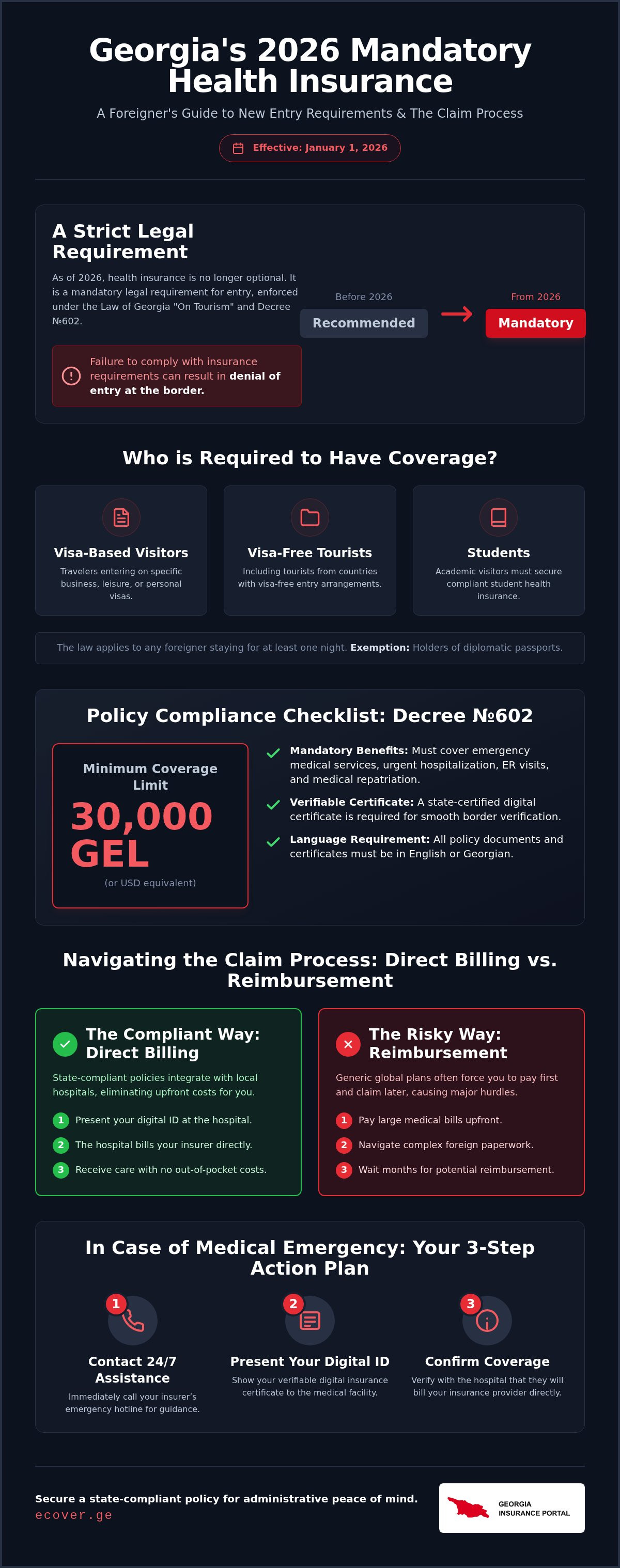
As of January 1, 2026, Georgia transitioned from recommending health insurance to making it a strict legal requirement for every foreign visitor. This shift, driven by the Law of Georgia "On Tourism" and Decree №602, means you can't treat medical coverage as an optional extra anymore. If your policy doesn't meet the state's minimum standards, you risk more than just high medical bills; you risk being denied entry at the border. Understanding the Georgia health insurance claim process for foreigners starts with recognizing that your policy must be verifiable by local authorities from the moment you arrive.
Previously, travelers often relied on generic global plans that required paying out-of-pocket and seeking reimbursement months later. The 2026 mandate changes this by prioritizing policies that integrate directly with the Georgian insurance infrastructure. If you carry a non-compliant plan, local facilities might refuse to process it as a direct claim. This forces you to handle complex paperwork in a foreign language while managing a medical emergency. The new state-mandated verification system is designed to prevent these administrative hurdles by ensuring your coverage is recognized instantly by the healthcare provider.
Who is Covered Under the 2026 Law?
The mandate applies to any individual entering Georgia for business, leisure, or personal reasons who stays for at least one night. This includes tourists from visa-free countries and those arriving on specific visas. If you're coming for academic reasons, you must secure student health insurance Georgia that aligns with these new regulations. While holders of diplomatic passports are exempt, all other visitors must prove they have at least 30,000 GEL in coverage for the entire duration of their stay. Failing to maintain this coverage throughout your visit can invalidate any future claims you attempt to file.
Border Verification and Policy Activation
Your claim journey actually begins before you even see a doctor. When you reach the border, agents will verify your travel insurance for Georgia to ensure it meets the 2026 legal standards. A state-certified digital certificate is the most efficient way to prove your compliance. If your policy isn't recognized by the state system at the point of entry, the Georgia health insurance claim process for foreigners becomes significantly more difficult. Familiarizing yourself with the broader landscape of Healthcare in Georgia helps you understand why these strict protocols exist. They ensure that every visitor has guaranteed access to emergency services without causing an administrative bottleneck for local hospitals or the traveler.
Coverage Limits and Mandatory Claimable Benefits
To successfully navigate the Georgia health insurance claim process for foreigners, you must first ensure your policy meets the strict financial thresholds set by the state. According to the 2026 Georgia Health Insurance Mandate, every foreign visitor must carry a policy with a minimum coverage limit of 30,000 GEL. This amount is specifically allocated to cover emergency medical services and urgent hospital care. If your insurance certificate lists a lower limit or fails to specify this amount in Georgian Lari or its USD equivalent, you'll likely face issues at border control or when attempting to file a claim at a local clinic.
Documentation requirements are equally precise. All claim-related paperwork, including your insurance certificate and medical reports, must be issued in either English or Georgian. Many standard global policies fail the 2026 compliance test because they provide documentation only in the home country's language or use vague terminology that doesn't align with local legal definitions. Without a clearly translated certificate, local providers can't verify your benefits, which often leads to a rejected claim. You can avoid these complications by securing state-compliant travel insurance that is pre-verified for the Georgian market.
Emergency Outpatient and Hospitalisation
The 2026 framework requires that your policy covers the full spectrum of emergency care. This includes initial emergency room visits, diagnostic tests like X-rays or blood work, and any pharmaceuticals administered during an urgent care scenario. Under the Georgia medical insurance for foreigners guidelines, inpatient stays are also covered up to the 30,000 GEL limit. It's vital to check that your policy doesn't have "hidden" sub-limits that cap hospital room costs at a level lower than the actual local rates, as this could leave you with an unexpected bill.
Medical Repatriation: A Non-Negotiable Requirement
One of the most overlooked aspects of the 2026 law is the mandatory inclusion of medical repatriation. Your insurance must cover the costs of transporting you back to your home country if a medical professional deems it necessary. This isn't just a recommendation; it's a legal requirement for entry. When you start the Georgia health insurance claim process for foreigners for a major incident, the insurer must coordinate directly with local authorities to manage the logistics of evacuation. Ensure your insurance certificate explicitly mentions "Repatriation" or "Medical Evacuation" to prevent your coverage from being flagged as non-compliant during a border check.
Local vs. Global Providers: Navigating the Claim Gap
Choosing between a local Georgian insurer and a global provider is a decision that directly impacts the speed of your medical care. While many international brands offer "worldwide" coverage, they often operate on a reimbursement basis. This means you must pay the full cost of your treatment upfront and wait weeks for a payout. In contrast, the Georgia health insurance claim process for foreigners is significantly smoother with local providers that utilize direct billing. By selecting a state-compliant policy, you ensure the insurer pays the hospital directly, which eliminates the financial burden of high out-of-pocket expenses during an emergency.
Verification speeds also differ greatly between these two options. A local digital certificate is integrated into the Georgian state database, allowing border agents and medical facilities to confirm your coverage instantly. International PDF policies often lack this integration, leading to delays at the point of entry or during hospital admission. Understanding the broader context of Universal Health Coverage in Georgia helps you see why local recognition is vital. The state has built a structured system that favors insurers who are licensed to operate within its specific legal and medical framework.
The Direct Billing Network in Georgia
Local insurers maintain established partnerships with the country's leading medical facilities. When you present a state-recognized insurance ID, the hospital staff can verify your benefits through a dedicated portal. This coordination is the reason why health insurance for Georgia student visa holders is almost exclusively sourced from local brokers. Students and long-term visitors can't afford to have thousands of GEL tied up in a reimbursement queue. A direct billing network ensures that your focus remains on recovery rather than managing financial logistics in a foreign country.
Language and Support Hurdles
Global providers frequently struggle with the linguistic nuances of the Georgian medical system. If you use an international insurer, you're often responsible for providing certified translations of your medical reports before they'll even consider your claim. This adds another layer of cost and delay to the process. Local providers offer 24/7 support in both English and Georgian, acting as a bridge between you and the hospital staff. They handle the administrative communication in real-time, regardless of the time zone. This local presence is essential for obtaining immediate emergency authorizations, which global call centers in different continents often fail to provide quickly enough.
Step-by-Step: Filing a Health Insurance Claim in Georgia
Executing a successful claim requires following a specific administrative sequence. If you deviate from these steps, you might face delays or even a partial rejection of your benefits. Much like how property owners in the United States might discover Public Adjusters Atlanta to handle the intricacies of property damage claims, travelers in Georgia need to be meticulous with their medical paperwork. The Georgia health insurance claim process for foreigners is designed to be efficient, but it relies on your ability to provide the correct data at the right time. By treating your insurance certificate as your primary medical ID, you ensure that the local healthcare infrastructure recognizes your coverage from the moment you enter a facility.
Your first action depends on the urgency of your medical situation. For non-life-threatening issues, you must call the 24/7 assistance number printed on your policy before you visit a doctor. The operator will verify your details and direct you to a partner clinic within their direct billing network. This step is vital because it allows the insurer to issue a 'Guarantee of Payment' to the hospital. If you're in a life-threatening emergency, go straight to the nearest medical center. Once you're stabilized, you or a companion should contact the insurer immediately to provide your passport number and policy details. This ensures the Georgia health insurance claim process for foreigners starts while you're still receiving care.
Phase 2: Documentation and Submission
Collecting the right paperwork before you leave the hospital is the only way to avoid future administrative headaches. You must request a formal medical report that includes your diagnosis, the tests performed, and the physician's signature. In Georgia, official documents are only valid if they bear the facility's official stamp. You'll also need detailed invoices that list every individual charge rather than just a total sum. If your policy doesn't support direct billing, these stamped invoices are the evidence you'll need for reimbursement.
Most state-compliant providers now use digital submission protocols to speed up settlements. Instead of mailing physical documents, you can upload high-resolution scans of your stamped reports and invoices to a secure portal. Ensure that all dates and amounts are clearly visible to prevent the insurer from requesting resubmissions. To simplify this entire experience and guarantee your policy is recognized by local hospitals, you should secure your state-compliant insurance here before your trip begins. This ensures you have a verifiable certificate that local providers are trained to process without friction.
Securing a Border-Compliant Policy with E-COVER
Choosing the right intermediary is the most critical step in satisfying the 2026 mandate. E-COVER acts as a specialized facilitator, bridging the gap between international visitors and the Georgian regulatory environment. As a licensed broker under LLC Insurance Broker WeInsure (License N012063), we provide policies that are pre-verified by the LEPL Insurance State Supervision Service of Georgia. This institutional credibility ensures that your Georgia health insurance claim process for foreigners isn't just a theoretical benefit, but a functional, state-recognized service that works when you need it most. By aligning your coverage with a locally licensed entity, you gain the administrative security required for a stress-free journey.
Designed for the 2026 Entry Requirements
The January 2026 law requires more than just a payment; it requires a verifiable digital certificate that border agents can authenticate in real-time. E-COVER provides instant issuance of these certificates, ensuring you have the necessary documentation before you even board your flight. Our system is built to satisfy every technical requirement of Decree №602, including the mandatory 30,000 GEL coverage limit and repatriation clauses. If you're applying for a long-term stay, we offer specialized health insurance for Georgia student visa applicants that aligns perfectly with academic residency requirements. Selecting a plan designed specifically for the 2026 mandate eliminates the risk of entry denial or policy invalidation.
24/7 Support for Your Journey
A policy is only as good as the support behind it during a medical crisis. E-COVER provides 24/7 assistance to help you manage the Georgia health insurance claim process for foreigners without linguistic or administrative delays. Whether you're a digital nomad on a solo trip or a family traveling in a group, our local expertise ensures you're never left to manage a foreign hospital system alone. We coordinate directly with local medical providers to facilitate direct billing, which significantly reduces your out-of-pocket exposure. This proactive support provides the security and preparedness necessary for a stress-free journey. You can get your 2026 compliant Georgia insurance certificate now and ensure your medical needs are fully protected under the new state laws.
Secure Your Journey with State-Compliant Coverage
The 2026 health insurance mandate is more than a simple entry requirement; it's a structured system designed to protect your health and finances during your stay. By ensuring your policy meets the 30,000 GEL minimum and includes mandatory repatriation, you avoid legal complications at the border. Mastering the Georgia health insurance claim process for foreigners requires a policy that local hospitals recognize and accept through direct billing. This approach eliminates the stress of managing large out-of-pocket payments or navigating language barriers during a medical emergency.
E-COVER provides the administrative bridge you need for a stress-free journey. Our policies are licensed by the Insurance State Supervision Service of Georgia and come with a 100% border compliance guarantee. You'll receive your verifiable digital certificate via email instantly, allowing you to focus on your travel plans instead of paperwork. Secure Your 2026 Compliant Georgia Insurance Certificate in 2 Minutes. Travel with the peace of mind that comes from being fully prepared; we look forward to welcoming you to Georgia with the security you deserve.
Frequently Asked Questions
Is health insurance really mandatory for all foreigners in Georgia in 2026?
Yes, health insurance is mandatory for all foreign citizens as of January 1, 2026. This legal requirement applies to tourists, business travelers, and visitors staying for at least one night. Only holders of diplomatic or special visas are exempt from this rule. To stay compliant, your policy must provide a minimum coverage of 30,000 GEL for the entire duration of your visit to ensure legal entry at the border.
What documents do I need to file a claim in Georgia?
You must provide a formal medical report, itemized invoices, and your insurance certificate. The Georgia health insurance claim process for foreigners requires that all medical documentation be issued in either English or Georgian. Ensure every invoice bears the official stamp of the medical facility. Without these specific administrative markers, your insurer may delay the settlement or request further verification from the hospital staff before approving your benefits.
Can I use my existing international travel insurance to enter Georgia?
You can use international insurance only if it explicitly meets the 2026 Georgian legal standards. The policy must provide at least 30,000 GEL in coverage and include medical repatriation. Additionally, the certificate must be in English or Georgian. Many global plans are rejected because they lack these specific details or don't offer direct billing within the local medical network, which often complicates the verification process at the border.
Does the mandatory insurance cover medical repatriation?
Yes, medical repatriation is a non-negotiable requirement under Decree №602. Your policy must cover the costs of returning you to your home country if a medical emergency makes it necessary. When reviewing your certificate, ensure this benefit is clearly listed in the text. If your insurance doesn't explicitly include repatriation, border authorities may deem your coverage non-compliant, leading to potential entry denial or significant financial issues during a medical emergency.
How do I prove my insurance is compliant at the Georgian border?
You prove compliance by presenting a state-certified digital or physical insurance certificate to the border agent. This document must clearly show the insured names, the 30,000 GEL coverage amount, and the validity dates for your entire stay. Border agents use these details to verify your policy against the national database. Carrying a verifiable certificate from a licensed broker ensures a seamless transition through passport control without the risk of administrative delays.
What happens if I arrive at the border without health insurance?
Arriving without compliant insurance can result in denied entry into the country. Since the January 2026 mandate, border authorities have strictly enforced these regulations to ensure all visitors are protected. If you don't have a valid policy, you'll be required to purchase one immediately at the border or face return to your point of origin. It's much safer to secure your digital certificate online before you travel to avoid these complications.
Is there a specific claim process for international students in Georgia?
International students follow the same core Georgia health insurance claim process for foreigners but must ensure their policy covers the full academic year. Your insurance must remain active for the duration of your residency to satisfy visa requirements. When filing a claim, students should use the direct billing network of their local provider to avoid large out-of-pocket expenses, which is especially important for those managing a fixed academic budget abroad.
Can I buy the mandatory insurance after I have already entered Georgia?
While you can technically purchase insurance after entry, you must have a valid policy from the moment you reach the border. If you enter and your initial policy expires, you must renew it immediately to remain legally compliant. However, failing to have insurance at the point of entry is a violation of the 2026 mandate. It's always best to have your full duration covered by a state-recognized policy before your arrival.


