

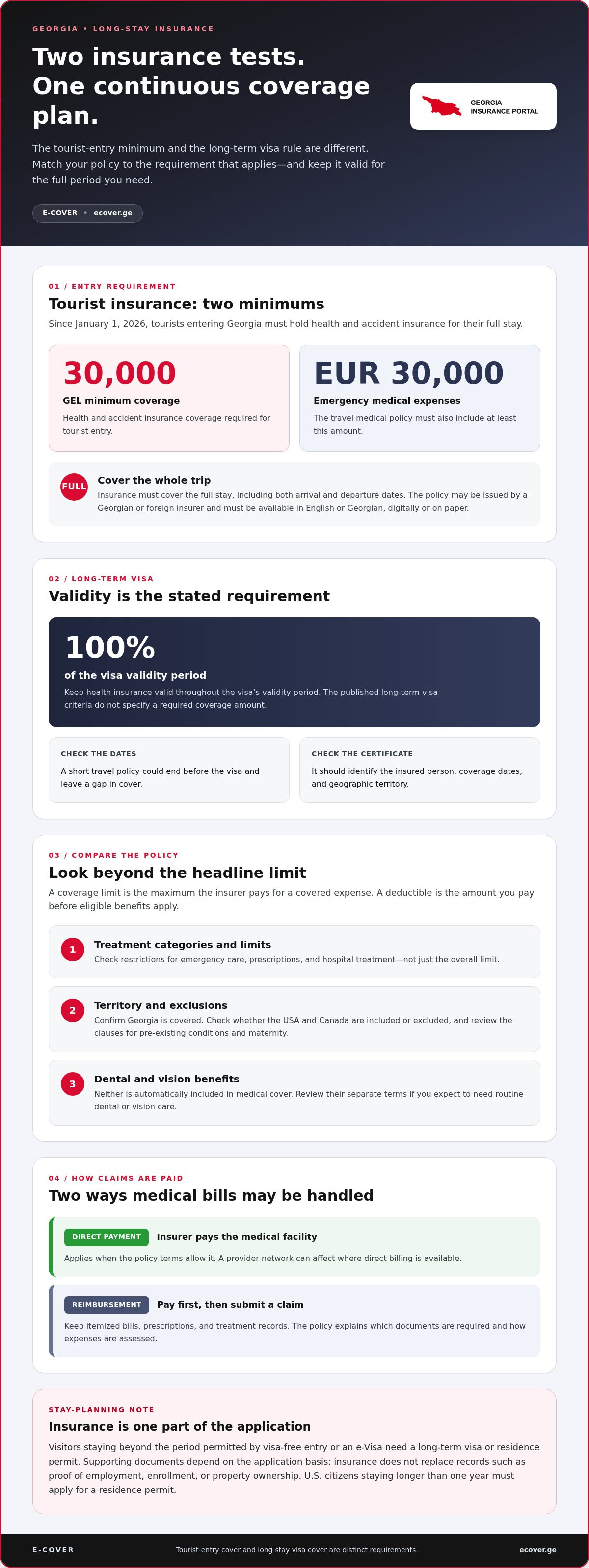
A long-stay visa and an entry-insurance rule answer different questions. Georgia medical insurance for a long-stay visa must remain valid for the visa’s validity period; since January 1, 2026, tourists entering Georgia must also have health and accident insurance with at least 30,000 GEL in coverage for their full stay. The published long-term visa criteria do not specify a required coverage amount.
When planning a longer stay, look beyond the minimum entry requirement. The right policy also depends on how long you’ll be in Georgia, which care you want covered, and whether you need routine dental or vision treatment, neither of which is automatically included in medical cover.
This guide explains how mandatory entry insurance differs from cover for a long-stay visa, what to compare in travel medical insurance, and how dental and vision benefits may fit your needs. It also clarifies how insurance relates to residence permit requirements, so you can plan cover around your stay.
Key Takeaways
- Since January 1, 2026, tourists entering Georgia need health and accident insurance with at least 30,000 GEL in coverage for their full stay, including arrival and departure dates.
- For a long-term visa, keep insurance valid throughout the visa’s validity period; the published criteria don’t state a required coverage amount.
- Dental and vision care aren’t automatically included in medical coverage, so compare the policy benefits with the care you expect to need.
- Stays beyond the period allowed by visa-free entry or an e-Visa require a long-term visa or residence permit, with supporting documents depending on the basis for the application.
- Explore travel, student, long-term travel, and digital nomad insurance options to match coverage to your stay and circumstances.
Insurance questions about mandatory cover, local policies, reimbursements, and medical bills
For Georgia medical insurance for a long-stay visa, distinguish the entry requirement from cover for the visa period. Then compare how the policy handles treatment, payment, and exclusions in Georgia.
Travel and Long-Term Health Cover
Travel insurance generally covers medical needs during a trip, while long-term health cover is designed for an extended stay abroad. This distinction matters because a policy for a short visit may not last as long as a long-stay visa. Georgia’s published long-term visa insurance criteria require cover for the visa’s validity period but do not specify a required coverage amount.
Since January 1, 2026, tourists entering Georgia must hold health and accident insurance for their full stay, including arrival and departure dates. The required cover is at least 30,000 GEL; Georgia travel medical insurance must also include at least EUR 30,000 in emergency medical expense coverage. A policy may be issued by a Georgian or foreign insurer, and must be available in English or Georgian, digitally or on paper.
Whether you choose a local or international policy, check how claims are paid. With direct payment, the insurer pays a medical facility when the policy terms allow it. With reimbursement, you pay first and submit supporting documents afterward. Keep itemized bills, prescriptions, and treatment records, as these can help document a claim. The policy’s claim rules specify which records are required and how expenses are assessed.
Medical costs vary by service. These examples show why it matters to compare emergency limits with everyday benefits.
Limits and Deductibles
A coverage limit is the maximum an insurer pays for a covered expense; a deductible is the amount you pay before eligible benefits apply. Compare both with the policy’s treatment categories, not just its headline limit. A high overall limit, for example, may still come with separate restrictions on emergency care, prescriptions, or hospital treatment.
Worldwide coverage depends on the policy’s stated territory. Check whether it includes Georgia and whether the USA and Canada are included or excluded, as the territory determines which care falls within the contract. Read the clauses on pre-existing conditions and maternity too: they explain eligibility, waiting periods, exclusions, and any separate limits. Dental and vision care may have distinct benefits, so review those terms separately from emergency medical cover.
Long-term international medical insurance for individuals and families
For a long-stay visa, duration is key: Georgia’s published criteria require health insurance to remain valid for the visa’s validity period. They do not set a required coverage amount, so compare the policy’s medical benefits and exclusions as well as its dates. A short travel policy could end before the visa, leaving a gap in cover.
What happens if a long-stay visa applicant in Georgia lacks valid health insurance? Their policy would not meet the stated insurance-duration requirement. Keep the cover valid for the entire visa period, rather than relying on a policy that ends earlier.
How do you submit proof of health insurance with a Georgia visa application? Include the insurer’s policy certificate with your application documents through the relevant application channel. The certificate should clearly identify the insured person, coverage dates, and geographic territory. Keep both a digital copy and a paper copy for your records.
For an individual, match the insured person’s certificate details to the passport used for the application. For a family, confirm that every person needing cover is listed as an insured member or dependent. A parent’s certificate alone, for example, may not show that a child is covered. Check each person’s dates separately if family members arrive or depart at different times.
International insurance may suit someone who wants cover beyond Georgia. Check the geographic limits carefully, including whether Georgia is covered, whether the USA or Canada is excluded, and how treatment outside the covered territory is handled. A provider network can affect where direct billing is available; for out-of-network care, you may need to pay first and seek reimbursement under the policy terms.
Language also affects practical use. Keep the policy certificate and emergency assistance details in a language you can understand, and make sure the document used as proof is clear to the application reviewer. Georgia’s tourist insurance rule requires the policy to be available in English or Georgian, digitally or on paper; this is a tourist-entry rule, distinct from the long-term visa validity criterion.
Keep insurance separate from other visa documents. Depending on the basis of the application, supporting documents may include proof of employment, enrollment at an educational institution, or evidence of property ownership. Insurance addresses medical expenses; it does not replace these records. Visitors staying beyond the period permitted by visa-free entry or an e-Visa need to apply for a long-term visa or residence permit. U.S. citizens staying longer than one year must apply for a residence permit.
Before submitting, compare the policy period with the visa period, verify every covered family member, and organize the certificate with the application papers. If you need cover designed for an extended stay, review long-term travel insurance options alongside the policy conditions.
Residence permit holders and insurance requirements
A U.S. health insurance policy can meet Georgia’s tourist-entry insurance requirement if it satisfies the rules for coverage, dates, language, and territory. For a long-term visa, the policy must remain valid throughout the visa’s validity period.
Since January 1, 2026, tourists entering Georgia must hold health and accident insurance for their full stay. The minimum coverage is 30,000 GEL, and the policy must be available in English or Georgian, digitally or on paper. A policy issued by a foreign insurer is allowed.
Does Georgia require health insurance for residence permit holders or visa-free U.S. visitors? Visa-free U.S. visitors are subject to the tourist-entry insurance rule unless an exemption applies. For residence permit holders, distinguish that entry rule from the long-term visa criterion, which requires coverage for the visa’s validity period.
U.S. citizens can enter Georgia without a visa for stays of up to one year. A U.S. citizen staying longer than one year must apply for a residence permit. Visa-free entry does not remove the tourist insurance requirement, so visitors should align their policy dates with their planned stay in Georgia.
Residence permit and visa applications apply to different situations. Visitors staying beyond the period permitted by visa-free entry or an e-Visa need to apply for a long-term visa or residence permit. Supporting documents depend on the application basis, such as employment, education, or property ownership. Insurance addresses medical expenses, while those documents support the reason for the stay.
Territorial validity means the countries or regions where a policy applies. A global plan may include Georgia, while another may cover only Europe or exclude certain destinations. Read the geographic terms carefully, including any exclusions for the USA or Canada. A policy’s “international” label alone does not establish that it covers treatment in Georgia.
Territory and benefit type are separate considerations. A policy might cover emergency treatment in Georgia while limiting routine dental care, maternity, or other planned services. Check that the benefit schedule includes the treatment you expect, not just emergency medical expenses. Both the geographic area and the services covered determine whether a claim falls within the policy.
For your application or travel records, keep the insurance certificate with your identity and immigration documents. Compare the insured person’s name and coverage dates with the passport and intended stay. If family members have different arrival dates, review each certificate separately. This simple check can reveal a date gap before travel.
Georgia’s tourist-entry rule exempts people whose entry is covered by specific international treaties or agreements. Exemptions also apply to holders of diplomatic or special visas and diplomatic or official passports, eligible accredited diplomatic staff and family members, and drivers in international road freight or passenger transportation. These exemptions concern the tourist-entry rule, not the long-term visa validity criterion.
Types of foreigners who may need health insurance in Georgia
Different visitors need cover for different reasons: entry rules, study, work, or an extended stay. Since January 1, 2026, tourists entering Georgia must hold health and accident insurance. The rule makes travel insurance relevant even for visitors staying briefly, while long-term residents should also match coverage to their planned time abroad.
The tourist-entry minimum is 30,000 GEL in coverage for the full stay. The policy can come from a Georgian or foreign insurer and must be available in English or Georgian, digitally or on paper. For example, a visitor arriving for a short holiday should check that the insurance dates include both arrival and departure.
Students have a different planning horizon from tourists. A student enrolled at a Georgian institution may need cover for the study period, rather than a policy that ends after the initial trip. Compare the policy dates with the enrollment period, and review cover for routine care and emergencies, along with any relevant exclusions. Student insurance is a distinct category to consider.
People relocating for work, family, or another extended stay may compare local health insurance with international cover. A local policy may be designed around treatment in Georgia, while an international policy may cover multiple countries, depending on its terms. If you divide your time between Georgia and Europe, for example, read the territorial limits rather than relying on a “global” or “international” label.
Expatriates should distinguish emergency travel benefits from ongoing health cover. A travel policy may focus on unexpected medical events during a trip; a longer-term policy may better fit continuing healthcare needs. Check benefit categories individually, including outpatient care, hospital treatment, prescriptions, dental services, and maternity. Premiums depend on factors such as age, duration, territory, benefits, and deductible, so compare the coverage structure rather than assuming the lowest premium will suit every need.
For a foreign visitor, the right comparison starts with their status and intended stay. Keep these distinctions in mind:
- Tourist: meet Georgia’s entry insurance rule and align dates with the full visit.
- Student: compare coverage dates with the study period and planned care.
- Expatriate or long-stay visitor: assess ongoing benefits, territory, and renewal terms.
People eligible for visa-free entry still need to account for the tourist insurance rule. Visa-free access and medical cover address separate requirements. If you plan a longer stay, first establish whether the permitted entry period fits your plans, then compare the insurance duration with that period. Stays beyond the time allowed by visa-free entry or an e-Visa require an application for a long-term visa or residence permit.
Before choosing cover, compare the policy wording. Confirm who is insured, where the benefits apply, how claims work, and whether routine treatment is included. Emergency medical benefits do not automatically cover dental or vision care. Matching the policy to the visitor’s status and actual stay helps separate entry compliance from broader healthcare planning.
Travel medical insurance plan options for Georgia
Start with the rule that applies to visitors entering Georgia. Since January 1, 2026, tourists need health and accident insurance for their full stay, with at least 30,000 GEL in coverage. Georgia travel medical insurance must include at least EUR 30,000 in emergency medical expense coverage. The policy can come from a Georgian or foreign insurer.
That minimum is an entry requirement, not a complete guide to choosing a plan. Compare the benefits with how you expect to use your cover while living in Georgia. For a short trip, you might prioritize emergency medical care and hospital expenses. For work or study, you may also consider routine appointments, prescriptions, and how claims are handled.
For a temporary visit, travel medical insurance can cover eligible emergencies during the policy dates. Make sure the dates include both your entry and departure days, and that the policy covers Georgia. A plan covering Europe, for example, may define its territory differently from a worldwide plan. Read the geographic terms rather than relying on a broad label.
A longer stay calls for closer attention to policy duration and renewal. Long-term travel insurance may suit someone staying beyond a typical holiday, while international health insurance may be relevant if you need cover across countries. Students should compare the policy period with their enrollment dates. Digital nomads should consider whether their travel pattern and time in Georgia fit the policy’s eligibility and territorial terms.
Compare the policy wording in these areas before selecting a plan:
- Emergency benefits: review medical treatment, hospital care, and transport provisions.
- Cost sharing: check the deductible and any limits that apply to specific services.
- Claims: understand whether the insurer pays a facility directly or reimburses you after payment.
- Documents: confirm the policy is available in English or Georgian, digitally or on paper.
Premiums depend on factors such as age, trip length, coverage territory, benefits, and deductible. A lower premium may come with narrower benefits or higher out-of-pocket costs. For a practical comparison, consider the same scenario, such as an emergency visit, then review each plan’s payment rules and exclusions. Don’t judge value by the headline limit alone.
For a Georgia stay, the practical takeaway is to match the policy type and dates to your travel purpose, then compare covered services and claim terms. Explore travel medical insurance options and compare the coverage structure with your planned stay.
E-COVER: Travel Insurance Policies
E-COVER provides travel insurance policies for foreign visitors to Georgia, including online policies designed to meet the state’s entry coverage requirements. For an extended stay, compare the policy dates with your visa period and review the benefits, territory, and exclusions before choosing cover.
Different travel plans may call for different insurance categories. E-COVER offers long-term travel insurance policies, Student Insurance, and Digital Nomad Insurance, alongside Travel Insurance Policies. These options help travelers focus on cover suited to their reason for staying, whether studying, working remotely, or spending an extended period in Georgia. Review the policy terms to see which benefits apply to your situation.
For a policy that fits your Georgia travel plans, visit ecover.ge.
Make your next insurance decision with confidence
Choosing Georgia medical insurance for a long-stay visa is an opportunity to plan for your life in Georgia, not just the documents you need to carry. Consider how your plans may change: studying, working remotely, or extending your visit can affect which type of policy suits you. A clear picture of your plans makes it easier to compare options.
E-COVER offers Travel Insurance Policies, Student Insurance, and long-term travel insurance policies for different travel needs. Review the policy details against your intended stay and the care you want covered, then take the next step when you’re ready.
Contact E-COVER about Georgia insurance to explore an option for your plans. With your priorities clear, you can move forward feeling prepared for your time in Georgia.
Frequently Asked Questions
Are dental and vision care included, or are they optional add-ons?
E-COVER’s stated benefits include urgent dental treatment, but not vision care. This distinction matters if you need routine dental work, glasses, or an eye examination during your stay. Emergency dental treatment and a planned cleaning, for example, are different types of care. Check the benefit schedule for the specific treatment covered, and don’t assume routine dental or vision services are included just because emergency medical care is covered.
Are these plans suitable for individuals living or working abroad?
E-COVER’s travel medical policies are designed for foreign visitors to Georgia, including business travelers, students, and digital nomads. They may suit people staying in Georgia for work or study, subject to the policy dates and terms. These policies are not general worldwide health insurance: their stated territory is Georgia, excluding the occupied territories. If you travel between countries, distinguish Georgia cover from broader international health insurance.
Do the plans offer coverage for emergency medical services and evacuation?
Yes. E-COVER’s stated benefits include ambulance services, emergency medical treatment, urgent outpatient and inpatient care, medical evacuation, and repatriation. The aggregate limit is not less than 30,000 GEL, and coverage applies within Georgia except its occupied territories. For example, an urgent hospital admission and an evacuation are separate benefit types, so read the policy terms to understand how each covered event is assessed.
How does the claims process work, and is there 24/7 support?
E-COVER provides 24/7 multilingual support for policy and claims questions. The policy defines the deductible and the maximum payable limit, so keep treatment records and receipts related to an insured event. For support, use [email protected] or call or message +995 511 776 766 through WhatsApp, Viber, or Telegram. You can also visit ecover.ge. The policy terms govern claim assessment and payment.
What customizable coverage options are available under these plans?
When buying online, you select your travel dates and a Georgian insurance provider. E-COVER offers Travel Insurance Policies, Student Insurance, long-term travel insurance policies, and Digital Nomad Insurance. These categories help match a policy to your purpose, such as study or remote work. Listed benefits include emergency care and urgent dental treatment; the policy terms define limits, deductibles, and covered services.
Does Georgia require health insurance for long-stay visa applicants?
Yes. Georgia’s long-term visa insurance criterion requires the policy to remain valid throughout the visa’s validity period. Applicants arranging Georgia medical insurance for long-stay visa coverage should align the policy dates with that full period. The separate entry rule requires health and accident insurance for international travelers from January 1, 2026, so short-term entry cover may not meet a longer visa’s duration requirement.
What types of Georgian long-stay visas require proof of medical insurance?
For a long-term visa, insurance must remain valid throughout the visa’s validity period. Georgia medical insurance for long-stay visa applicants should be documented with a certificate identifying the insured person and coverage dates. Include it with the supporting documents for your application. Employment-based and study-based applications, for example, require different records to support the reason for the stay, while the certificate shows the insurance period.
What are Georgia's minimum health insurance coverage requirements for visa applicants?
For tourist entry, health and accident insurance must provide at least 30,000 GEL in coverage for the full stay. Georgia travel medical insurance must also include at least EUR 30,000 in emergency medical expense coverage. For a long-term visa, the policy must cover the visa’s validity period; that criterion does not specify a minimum coverage amount. Keep the entry and long-term visa requirements distinct when preparing documentation.


