

Could a simple administrative oversight regarding mandatory medical insurance for Georgia travel actually end your trip before it even begins? Imagine arriving at the Tbilisi airport with your itinerary ready, only to be turned away because your paperwork is missing one specific coverage limit. As of January 1, 2026, this isn't just a hypothetical worry; it's the legal reality for every foreign visitor. Border officials now strictly enforce Government Decree No. 602, making your insurance policy a critical requirement for entry.
We understand that keeping up with shifting regulations feels overwhelming, especially when your holiday depends on it. You should be focusing on the mountains of Svaneti or the wine of Kakheti, not decoding complex government mandates. This guide provides the clear, authoritative answers you need to meet the 30,000 GEL coverage requirement and secure a verifiable certificate. We'll break down the exact policy details required by officials, clarify the confusion between GEL and USD limits, and show you how to obtain affordable, compliant coverage for a seamless border crossing.
Key Takeaways
- Starting January 1, 2026, all international visitors must present proof of mandatory medical insurance for Georgia travel to avoid being denied entry at the border.
- Confirm your policy meets the minimum 30,000 GEL coverage limit and explicitly includes Georgia within its territorial scope.
- Understand which specific traveler categories, such as diplomatic visa holders, are exempt from these new health insurance requirements.
- Ensure your documentation is issued in English or Georgian and covers the entire duration of your stay, including arrival and departure dates.
- Learn how to secure a government-compliant certificate instantly via email to ensure a stress-free experience at any Georgian checkpoint.
The 2026 Georgia Travel Insurance Mandate: An Overview
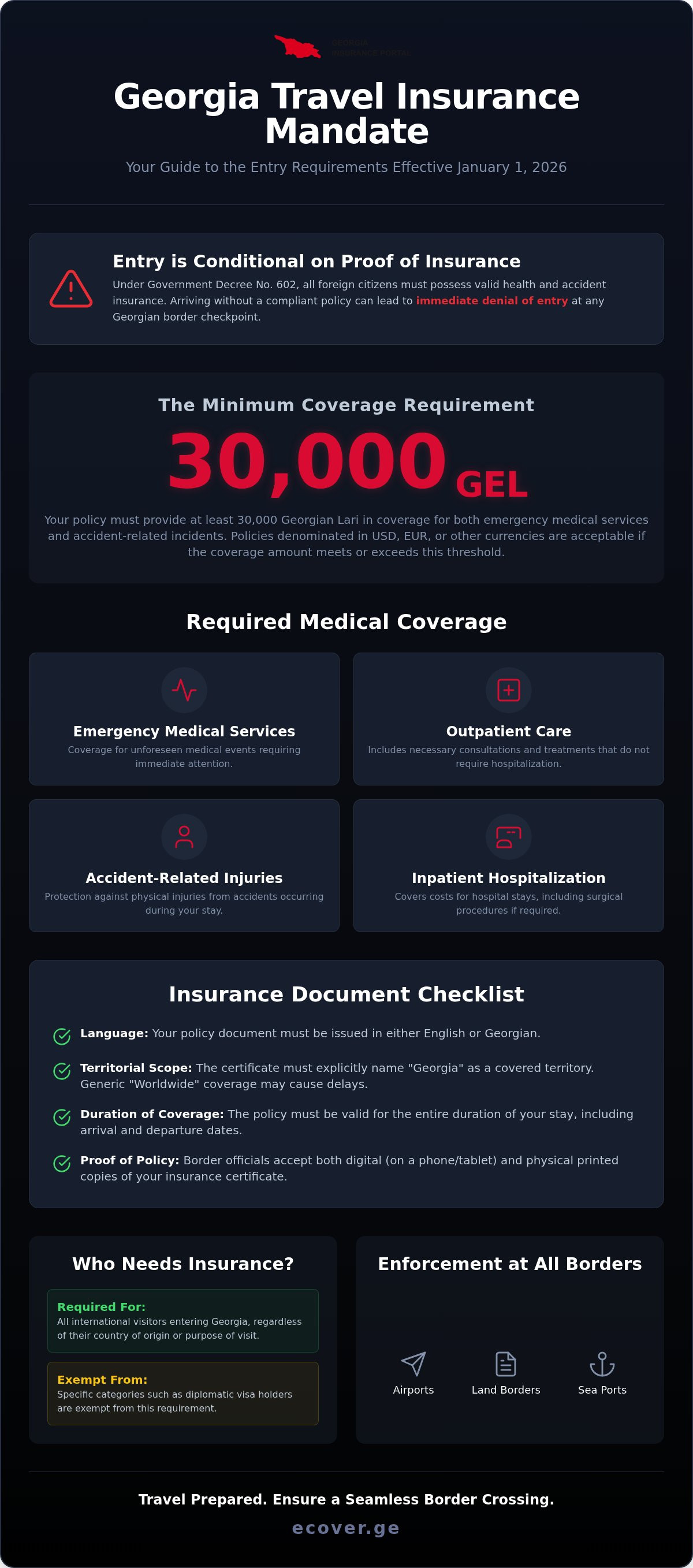
The legal landscape for visitors to Georgia has changed significantly. Starting January 1, 2026, every foreign citizen entering the country must possess valid health coverage. This requirement is rooted in the Law of Georgia "On Tourism" and is formally regulated by Decree No. 602 of the Government of Georgia. If you cannot provide proof of a compliant policy at a border checkpoint, you risk immediate denial of entry or administrative fines. Border officials now view mandatory medical insurance for Georgia travel as a non-negotiable entry requirement. Your policy must be issued in either English or Georgian and clearly state that it covers the territory of Georgia for your entire stay.
Why did Georgia introduce mandatory insurance?
This policy shift focuses on two primary objectives: visitor safety and economic sustainability. Georgia has seen a rapid increase in international arrivals, and the government is committed to maintaining high standards of care for every guest. By requiring private insurance, the state ensures that travelers have access to medical services without creating a financial burden on the Georgian state healthcare system. It aligns the country with global tourism norms. When you carry a valid policy, you aren't just following a rule; you're ensuring that local health facilities can treat you efficiently without logistical or financial delays. It's a proactive measure designed to protect both the visitor and the host nation.
Key dates and implementation phases
Full enforcement of the mandate begins exactly on January 1, 2026. If your trip starts on or after this date, your documentation must be in order before you reach the border. For those already within Georgia before the deadline whose stay extends into 2026, compliance is still expected to avoid issues with local authorities. The rules apply to all types of border crossings, including:
- Air travel: Airlines may check for insurance during the check-in process before you board.
- Land borders: Checkpoints at Sarpi, Sadakhlo, and Red Bridge require physical or digital proof.
- Sea ports: Arrivals via the Black Sea are subject to the same strict verification protocols.
Because the mandate is now active, you should treat mandatory medical insurance for Georgia travel as a priority. Waiting until you arrive at the border is risky, as not all crossing points offer facilities to purchase insurance on-site. If you arrive without a policy, you'll likely face delays that could disrupt your entire travel schedule.
Specific Coverage Requirements: The 30,000 GEL Rule
The 30,000 GEL (Georgian Lari) requirement is the cornerstone of the new regulations. This specific financial threshold ensures that every visitor has sufficient backing for unexpected medical events. According to the official notification by the Ministry of Foreign Affairs, your policy must clearly state this limit to be considered valid at the border. If your current policy uses a different currency, such as USD or EUR, the coverage must meet or exceed the 30,000 GEL equivalent at the time of entry. You'll need to verify that your insurer uses a conversion rate that remains compliant with the law throughout your stay.
Beyond the financial limit, the policy's metadata is equally important. Your certificate must explicitly list "Georgia" as a covered territory; a generic "Worldwide" or "Europe" tag might cause delays if the country isn't specifically named. Additionally, all documentation must be presented in either English or Georgian. If your policy is in another language, you'll need a certified translation to satisfy border police. When securing mandatory medical insurance for Georgia travel, you must confirm that the plan covers both health and accident-related risks to ensure full compliance.
What exactly does the 30,000 GEL cover?
This sum isn't just a random figure; it's calculated to cover a specific range of medical interventions. The mandate requires that your insurance provides for emergency medical services and necessary outpatient care. If your condition requires a hospital stay, the policy must cover inpatient hospitalization and surgical procedures. It's also vital that the plan includes accident-related injuries sustained during your stay. Whether you're hiking in the mountains or walking through the capital, the insurance must protect against both sudden illness and physical accidents. You can quickly verify if a policy meets these standards by reviewing a compliant Georgia travel insurance certificate before you buy.
Mandatory policy information for 2026
Border officials will scrutinize the details of your document to ensure it's genuine and active. The insurance certificate must explicitly state that the full insurance premium has been paid by the policyholder. This sentence prevents the use of unpaid or "pending" policies to gain entry. The document must also provide clear identification of the insurer and the insured party, including full names as they appear on your passport. Finally, the coverage dates must be precise. Your policy's start and end dates must match the full duration of your trip, including the days you arrive and depart. If your coverage ends even one day before your scheduled flight out, you may face compliance issues at the border.
Who Needs Insurance? Exemptions and Special Categories
The general rule for entry is straightforward: if you are a foreign national visiting Georgia for tourism, business, or personal reasons, you must comply with the mandate. This applies to anyone staying for at least one night but no longer than one year. However, as the U.S. Embassy in Georgia confirms insurance mandate, there are specific categories of individuals who are legally exempt from this requirement. Identifying your status correctly before arrival prevents unnecessary costs and administrative confusion at the border.
Exemptions primarily apply to those with official or diplomatic status. This includes holders of diplomatic and special visas, individuals with diplomatic, official, service, or special passports, and accredited employees of diplomatic missions along with their family members. Additionally, persons whose entry is covered by international treaties or drivers involved in international road freight are not required to present proof of insurance. If you fall into one of these groups, ensure you have your official credentials ready for inspection to verify your exempt status.
If you hold Georgian citizenship or a permanent residency permit, you aren't classified as a tourist under local law and don't need this specific coverage. Dual citizens entering on a foreign passport should carry their Georgian ID to quickly resolve any questions at the border. For everyone else, mandatory medical insurance for Georgia travel remains a strict prerequisite for crossing the border. Failure to provide a valid policy could result in delays or a formal denial of entry.
Requirements for International Students
Foreign students enrolled in Georgian universities face a different set of administrative needs. While a standard tourist policy might work for your initial arrival, you'll need a specialized plan to maintain your legal status during your studies. Student insurance often provides broader coverage tailored to long-term residency and university requirements. To understand how to align your coverage with your academic permit, read our guide on Student Health Insurance in Georgia.
Digital Nomads and Long-Term Visitors
If you're visiting as a digital nomad or under the "Remotely from Georgia" initiative, your compliance needs are unique. Standard travel policies often expire after 90 days, which can lead to a lapse in coverage that violates the 2026 mandate. If your stay extends beyond this period, you must secure a policy that specifically allows for long-term residency. This ensures you remain protected and legally compliant throughout your entire stay in the country. For more details on choosing the right plan for an extended journey, consult our Digital Nomad Insurance for Georgia guide.
Border Entry Procedures: Proving Your Insurance
The verification of mandatory medical insurance for Georgia travel is now a standard part of the entry process. Unlike the early days of the mandate where checks might have been inconsistent, 2026 protocols are systematic and digitally integrated. When you approach the passport control desk at Tbilisi, Kutaisi, or Batumi airports, expect the Border Police officer to request your insurance document immediately after your passport. Don't rely on rumors that checks are random; the system is designed to ensure every visitor has the required financial backing for medical emergencies.
Electronic PDF certificates are the primary format accepted at all air, land, and sea borders. You don't need to carry a physical paper document, provided you can display the digital version clearly on your smartphone or tablet. However, you shouldn't rely on roaming data or airport Wi-Fi to access your email at the last second. Download the certificate for offline access or take a screenshot of the main policy page to avoid delays. If you can't produce the document because of a dead battery or lack of signal, you'll be moved to a secondary inspection area until the policy is verified, which can take hours.
If your insurance expires while you're still in Georgia, you're no longer in compliance with the national entry laws. This lapse can cause significant issues if you're involved in an accident or need emergency care. Always ensure your policy end date matches your actual departure day, not just your last full day of sightseeing. If you overstay your original plan, you must extend your policy or purchase a new one to remain legal.
How to present your proof of insurance
To ensure a fast crossing, have your document ready before you reach the front of the queue. Most compliant certificates feature a unique policy number or a QR code. The officer may scan this code to verify the policy's authenticity against the national insurance database. Speed up the process by turning up your phone's screen brightness so the scanner can read the code easily. Providing a clear, readable document allows the officer to verify your coverage in seconds. To avoid any technical issues at the gate, you can get your border-ready insurance certificate delivered instantly to your inbox.
Common mistakes to avoid at the border
One of the most frequent errors is bringing a policy that excludes activities you actually intend to do. If you plan to hike in the Caucasus or ski in Gudauri, your insurance must not exclude these "High-Risk Activities." Additionally, ensure the certificate isn't only available in a language other than English or Georgian; policies in French, German, or Arabic won't be accepted without a certified translation. Finally, double-check your arrival and departure dates. If your flight departs after midnight, your insurance must remain valid through that final calendar day to be considered compliant by border officials.
How to Obtain Compliant Georgia Travel Insurance
Securing mandatory medical insurance for Georgia travel shouldn't be a source of stress. While you could spend hours researching global providers, using a local Georgian broker like E-COVER offers a level of certainty that international plans often lack. Because our policies are specifically designed to meet the 2026 legal criteria, you don't have to worry about your certificate being rejected at the border for missing minor administrative details. We act as a bridge between you and the local regulatory environment, ensuring your documentation is perfect before you even board your flight. This proactive approach eliminates the fear of being turned away at passport control due to an insurance technicality.
The E-COVER Digital Process
Our platform is built for speed and efficiency. You don't need to upload physical documents or wait for manual verification. Instead, you simply enter your passport details and travel dates, and our system generates your certificate instantly. We support secure payment methods for international travelers, allowing you to complete the process from anywhere in the world. Once purchased, your policy is delivered via email and remains accessible 24/7 through your personal digital cabinet. This immediate delivery is crucial for those who need a border-ready document at the last minute to satisfy the 2026 mandate.
Why Local Coverage Beats Global Plans
Many travelers assume their existing global health plan is sufficient, but these generic policies often fail to meet the strict standards of the Georgia Mandatory Insurance Law 2026. A local policy from E-COVER is formatted specifically to satisfy Georgian Border Police requirements, including the mandatory premium payment confirmation and the 30,000 GEL limit. More importantly, local coverage provides direct billing with Georgian hospitals. If you need medical care, the facility can settle costs directly with the insurer, preventing you from having to pay thousands of GEL out-of-pocket and filing for reimbursement later. This direct connection to the local healthcare network provides a level of security that global plans simply can't match.
Local policies are also significantly more cost-effective. International "global" plans often bundle coverage you don't need for a short trip, driving up the price. Our policies focus strictly on what the Georgian government requires, providing affordable compliance without sacrificing quality of care. By choosing a licensed broker, you ensure that your investment in insurance is actually recognized by the state authorities, giving you peace of mind throughout your journey. Every policy we issue is guaranteed to meet the 30,000 GEL minimum and is available in the required English or Georgian formats.
Secure Your Journey to Georgia
Success at the border in 2026 depends on your preparation today. The Law of Georgia "On Tourism" requires every visitor to present a policy that meets the 30,000 GEL minimum and covers the entire duration of their stay. Choosing a plan that explicitly names Georgia and is issued in English or Georgian ensures you won't face unnecessary delays or fines at passport control. By understanding these mandates and verifying your documentation before you fly, you can focus on the unique experiences this country offers rather than administrative hurdles.
Don't leave your entry to chance with generic global plans that might not satisfy local officials. As a licensed Georgian insurance broker, E-COVER provides mandatory medical insurance for Georgia travel with a 100% border acceptance guarantee. You can complete the process in minutes and receive your certificate via instant email delivery. Get Your Compliant Georgia Travel Insurance Instantly and ensure your crossing is as smooth as possible. We look forward to welcoming you for a safe and stress-free adventure in Georgia.
Frequently Asked Questions
Is travel insurance mandatory for Georgia in 2026?
Yes, mandatory medical insurance for Georgia travel is a legal requirement for all foreign tourists as of January 1, 2026. This mandate, established by Government Decree No. 602, applies to every visitor staying for at least one night. You must present a valid policy to border officials upon arrival. Failure to comply with this regulation can result in a denial of entry at any air, land, or sea checkpoint across the country.
How much does mandatory medical insurance for Georgia cost?
The cost of a compliant policy depends on your age and the total duration of your stay in the country. While we don't quote specific prices here, local Georgian policies are generally more cost-effective than international global plans. These rates are designed to be affordable for short-term tourists and long-term visitors alike. You can obtain a precise quote by entering your travel dates into our digital issuance system for an instant calculation.
Can I use my existing global health insurance for Georgia entry?
You can use an existing policy only if it meets strict criteria. The document must explicitly list Georgia as a covered territory and state a minimum coverage of 30,000 GEL. Additionally, the certificate must be in English or Georgian and include proof that the premium is fully paid. If your global provider cannot issue a certificate meeting these specific regulatory standards, you should secure a dedicated local policy to ensure a smooth border crossing.
What is the minimum coverage amount required by Georgian law?
Georgian law requires a minimum coverage limit of 30,000 Georgian Lari (GEL) for health and accident insurance. If your policy is issued in another currency, such as US Dollars or Euros, the coverage must meet or exceed the 30,000 GEL threshold at the current exchange rate. Border officials will verify this amount on your insurance certificate. It's essential that this limit is clearly visible on your documentation to satisfy the entry requirements for all visitors.
What happens if I arrive at the Georgian border without insurance?
Arriving without proof of mandatory medical insurance for Georgia travel will likely result in a denial of entry. Border Police are instructed to verify coverage for all international arrivals starting in 2026. In some cases, you might face administrative fines before being allowed to purchase a policy on-site, though not all border crossings have these facilities. To avoid significant delays or being turned away, you should always secure your insurance certificate before starting your journey.
Does the mandatory insurance cover COVID-19 or extreme sports?
Standard compliant policies cover emergency medical expenses, which typically include treatments for sudden illnesses like COVID-19. However, coverage for high-risk activities or extreme sports, such as paragliding or off-piste skiing, usually requires a specific add-on or a specialized policy. If you plan to engage in adventure tourism in the Caucasus mountains, you must verify that your insurance explicitly includes these activities. Generic policies often exclude injuries sustained during high-risk sports unless specifically mentioned in the terms.
Do I need a physical printout of my insurance policy?
A physical printout is not required, as Georgian border officials accept electronic PDF certificates on mobile devices. However, you must ensure the document is saved for offline access. Relying on airport Wi-Fi or cellular data at the border is risky and can lead to delays if you cannot load the file. We recommend downloading the PDF to your phone or taking a clear screenshot of the policy details and QR code for quick verification.
Are children required to have their own mandatory insurance policy?
Yes, every individual entering Georgia, including infants and children, must have valid medical insurance. The mandate applies to all foreign citizens regardless of age. While children can often be included under a family policy, the insurance certificate must clearly list each child's name as an insured party. Ensure that the coverage limits apply to every person on the policy to meet the legal requirements for entry and protect your entire family during your stay.


