

Most international visitors need a passport to enter Georgia; an ID card is sufficient only for travelers covered by special arrangements. Under the Georgia travel regulations 2026, tourists must also have health and accident insurance covering at least 30,000 GEL from January 1, 2026. An ID card alone therefore doesn’t meet every entry requirement.
It’s understandable to want a clear answer before traveling, especially when entry requirements depend on your nationality and route. Knowing which documents may be requested at the border, and what your insurance policy must show, helps you prepare with confidence.
This guide explains when an ID card may be accepted, what passport and insurance requirements apply, and which supporting documents immigration officers may ask to see. It also covers practical border guidance so you can plan your arrival and know what to have ready.
Key Takeaways
- Most international visitors need a passport; an ID card works only under special arrangements for some travelers. Your nationality and route matter.
- From January 1, 2026, tourists need health and accident insurance covering at least 30,000 GEL for their full stay in Georgia.
- Keep your insurance document ready in English or Georgian, in printed or electronic form, and make sure it reflects your travel dates and covered risks.
- Border officers may ask for accommodation details, a return or onward ticket, proof of funds, and a basic itinerary, so keep these details accessible.
- Passport validity and border conditions can affect your plans; the guide explains what to consider before arrival and at Georgia’s land crossings.
Possible denial of entry without compliant insurance
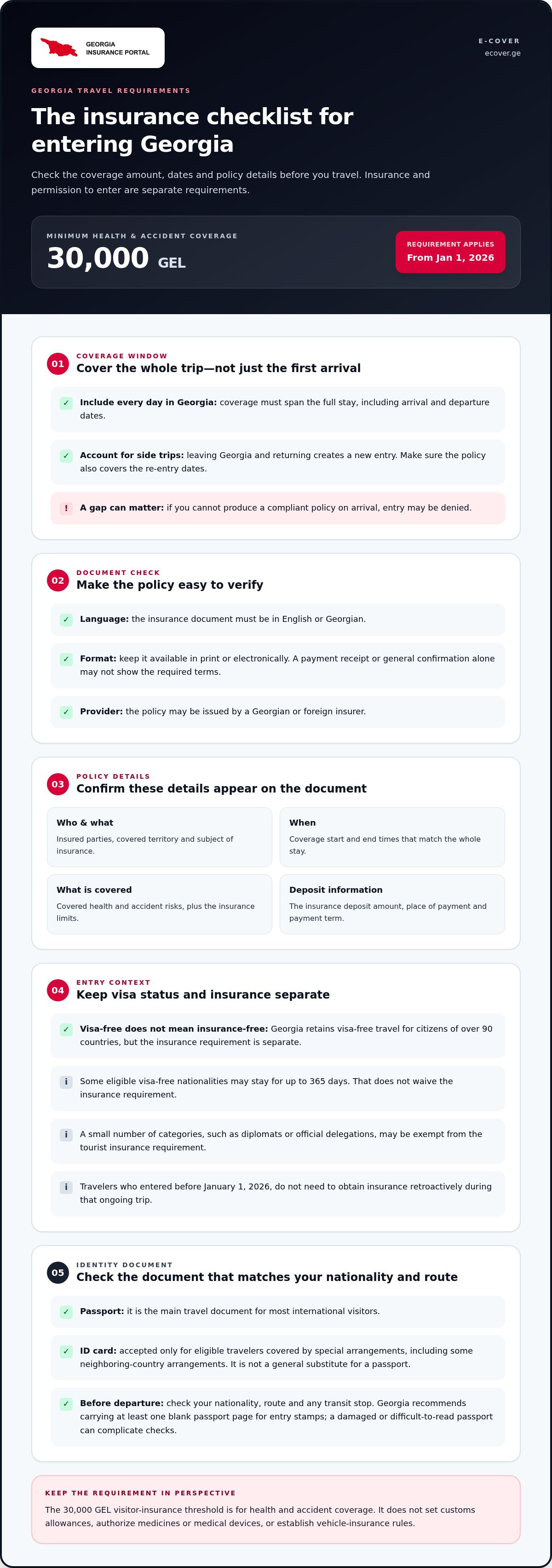
International visitors should check whether health and accident insurance is required for their trip to Georgia. The policy must cover the visitor’s entire stay, including arrival and departure dates. If a traveler cannot produce a compliant policy on arrival, entry may be denied. Visa-free status does not remove this insurance requirement, so travelers should treat immigration permission and insurance as separate entry conditions.
The minimum required coverage is 30,000 GEL. The policy may come from a Georgian or foreign insurer, and travelers may present it in printed or electronic form. Its documentation must be in English or Georgian. Check that the document itself shows the relevant terms, rather than relying only on a payment receipt or a general confirmation.
Georgia’s mandatory insurance policy must identify the insured parties, covered territory, and subject of insurance. It must also show the coverage start and end times, covered risks, and insurance limits. The document must state the insurance deposit amount, place of payment, and payment term. Check these details to make sure coverage applies to your entire stay, not just part of the trip.
- Coverage: health and accident risks, with at least 30,000 GEL in coverage.
- Dates: the full period in Georgia, including the return-entry dates after a trip abroad.
- Document: English or Georgian, available in print or electronically.
- Policy details: parties, territory, subject, covered risks, limits, and required deposit information.
Georgia retains visa-free travel for citizens of over 90 countries, but that exemption concerns visas, not insurance. Some visa-exempt nationalities may stay for up to 365 days. A visa-free traveler still needs compliant health and accident coverage from January 1, 2026. A small number of categories, such as diplomats or official delegations, may be exempt from the tourist insurance requirement.
For a U.S. traveler, a passport should remain valid for the full stay; most international visitors need a passport, while some neighboring countries have special ID-card arrangements. Georgia’s visa-free program covers citizens of over 90 countries, and some eligible nationalities may stay up to 365 days. Visa permission and insurance are separate: visa-free entry does not waive the 30,000 GEL insurance requirement.
Leaving Georgia and returning creates a new entry, so the policy must cover the return dates as well. For example, a traveler whose policy ends before returning from a side trip needs coverage for the re-entry period. Travelers who entered before January 1, 2026, do not need to obtain insurance retroactively during that ongoing trip.
Customs allowances and duty-free limits concern goods, not the 30,000 GEL health and accident insurance requirement. That insurance threshold does not determine what goods travelers may bring into Georgia or declare at the border.
Prescription medicines, controlled drugs, and medical devices are separate from Georgia’s travel insurance requirement. A health and accident policy does not authorize you to bring those items across the border.
Likewise, the 30,000 GEL visitor-insurance requirement is not vehicle insurance. It does not establish driving-license, international driving permit, or motor-vehicle coverage rules for tourists in Georgia.
Arrival and airline document checks
For most international visitors, a passport is the main travel document for Georgia. Some neighboring countries have special arrangements that let eligible travelers use an ID card. This exception depends on nationality, so don’t treat an ID card as a general substitute for a passport. Before departure, check that your document matches your citizenship and route, including any transit stop.
Georgia recommends that travelers carry at least one blank passport page for entry stamps. Before leaving, check that a page is available and that your passport is in usable condition. If it has no blank page, arrange a suitable travel document before setting out. A passport that is damaged or difficult to read can also complicate checks.
At the airport, keep your passport or eligible ID card accessible during check-in and boarding. Airline staff may review your travel documents before departure. Keep the same document handy at the gate instead of packing it in checked luggage. For example, if you’re traveling under a neighboring-country arrangement, present the eligible ID card consistently.
Keep your identity document separate from supporting travel records. Store your flight details, accommodation information, and insurance document together in a carry-on folder or secure digital file. This makes it easier to find the right item if airline staff or border officers ask. A readable electronic copy is convenient, while printed documents can serve as a backup if your device loses power.
Tbilisi International Airport is Georgia’s main airport and a primary arrival point for international travelers. If your flight lands there, follow the signs to passport control after leaving the aircraft. Have your document ready before reaching the queue. Families can keep each traveler’s document accessible rather than searching through several bags at the counter.
Prepare for document checks without assuming airline staff and immigration officers have the same role. The airline handles departure procedures; Georgian border officers assess entry. A boarding pass does not replace a passport or eligible ID card, and a visa exemption does not establish identity. Keep your travel document available throughout both stages.
- Before leaving: confirm which identity document applies to your nationality and route.
- At check-in: keep that document accessible, not in checked baggage.
- For passport holders: carry at least one blank page for entry stamps, as Georgia recommends.
- On arrival: follow signs to passport control and present the same valid travel document.
These simple steps help make check-in and arrival more orderly. A traveler arriving at Tbilisi International Airport with an accessible passport, a blank page, and supporting records can respond promptly if asked. If your journey includes a transit country, check its document requirements separately from Georgia’s entry rules, since each stop may involve its own checks.
Documents immigration officers may request
At Georgia’s border, immigration officers may ask about practical details of your visit. Be prepared to show accommodation information, an onward or return ticket, proof of sufficient funds, and a basic itinerary. These documents help explain where you’ll stay, how you plan to leave, and how your trip is arranged. Keep them accessible rather than buried in checked luggage.
Accommodation details: Have the name and address of your hotel, guesthouse, or host ready. A booking confirmation makes this information easy to show. If you’re staying with a friend, keep the host’s address available. Make sure the details match your actual plans, for example, don’t give a hotel address if you’ve arranged a private stay elsewhere.
Return or onward travel: Keep your departure booking available as a digital record or printed copy. A return ticket shows your planned departure from Georgia, while an onward ticket can show travel to another destination. If your itinerary has several legs, save the relevant booking details together so you can explain your route clearly.
Proof of funds: Officers may ask for evidence that you can support yourself during your visit. Keep relevant financial records, such as a bank statement or other evidence of available funds, accessible. The information should be readable and reflect your current travel circumstances. Don’t rely on a single account screen you can’t access, or leave essential records on a device you can’t unlock. For UK travelers organizing their trip budgets or exploring personal financing options in advance, I Need Cash provides helpful financial guides to help manage borrowing and credit.
Basic itinerary: Prepare a short outline of your intended stops, accommodation, and travel dates. It doesn’t need to be an elaborate tour plan. For example, you could list your arrival in Tbilisi, your stay there, and your planned departure from Georgia. A simple outline helps you answer questions consistently and connect your plans to the accommodation and ticket details you carry.
- Save accommodation names, addresses, and booking records together.
- Keep return or onward ticket details accessible on arrival.
- Have financial records ready to show available funds.
- Use a short itinerary that matches your bookings and travel dates.
Digital copies make records easier to find, while printed documents provide a backup if your phone battery runs low. Store files so you can open them without an internet connection. A practical approach is to keep your ticket, lodging confirmation, financial evidence, and itinerary in one folder. Before departure, make sure names and dates are legible. For entrepreneurs and business travelers managing documents on the go, resources like The CEO Creative provide custom stationery and branded office essentials that help keep physical files organized.
Answer questions directly and show the document that supports your answer. If an officer asks where you’ll stay, provide your accommodation details; if asked about departure, show the relevant ticket. Keeping records organized helps you explain your visit without mixing up a hotel booking and onward travel or presenting unrelated files.
Passport validity and condition
Georgia recommends that a traveler’s passport remain valid for the full duration of the stay. In practical terms, check that its expiry date falls after your planned departure from Georgia. If your trip ends on October 18, for example, the passport should not expire before that date. This is the stated validity guidance, not a separate six-month rule.
Start with the passport’s personal details page. Confirm that your name matches the name on your flight booking and other travel records. Before leaving for the airport, check the photograph, passport number, and expiry date. If a booking uses a different spelling or omits a name, resolve the mismatch with the airline before traveling. Clear, consistent details help staff match the document to the passenger.
Next, inspect the physical document in good light. Look for a detached cover, water damage, torn pages, or marks that obscure the photograph or printed details. Don’t cover damage with tape or write on the passport. If it’s damaged, contact the issuing authority about replacement before departure. A damaged page can make identity details harder to read at check-in or during border inspection.
Plan around the dates of your whole journey, not just your initial arrival. If you leave Georgia and return later, compare your passport expiry date with your final departure date. Changes to your itinerary may also affect how long your passport needs to remain valid. Recheck the document if you extend your stay or change your return flight.
Keep your passport within reach during check-in, boarding, and arrival. Don’t pack it in checked luggage. Store a separate copy of its details securely so you can refer to the passport number if the original is misplaced. A copy is a backup record, not a substitute for presenting your travel document.
- Expiry date: compare it with your planned final departure from Georgia.
- Personal details: match the name and document information against your booking.
- Condition: inspect the cover, photograph, and printed pages for damage or unclear text.
- Access: carry the original passport in your hand luggage, not checked baggage.
For U.S. travelers, plan for your passport to remain valid throughout your visit. If it expires during your intended stay, arrange a valid replacement before departure rather than relying on an early return. This check is especially useful if your travel dates are flexible or you might extend your stay.
Finally, review your passport shortly before departure. Compare its expiry date with your latest itinerary, confirm that its details remain readable, and keep it accessible for the journey. These checks help prevent a date mismatch or damaged document from becoming an avoidable obstacle on the way to Georgia.
Tourist safety and border guidance
Georgia’s land crossings connect the country with Armenia, Turkey, Russia, and Azerbaijan. Check your route before traveling, as border operating conditions can change.
Local laws and public behavior
Local laws and rules for public behavior apply in shared spaces, including rules around alcohol and smoking. Knowing the applicable rules can help you avoid disputes or penalties during your visit.
For alcohol, smoking, and behavior in public, don’t assume the rules are the same as at home. Avoid smoking where signs prohibit it, follow venue instructions, and behave respectfully in public places. These are practical precautions, not a substitute for the specific rules that apply where you’re visiting.
Before visiting a venue or public site, read posted notices and follow staff directions. If a rule is unclear, ask a staff member responsible for the area before acting. Don’t drink and drive, and avoid behavior that disturbs others. These steps are useful, but this guide doesn’t set out specific legal limits or penalties for alcohol, smoking, or public conduct.
Travel to Abkhazia and South Ossetia
Travel to Abkhazia and South Ossetia requires careful attention to current official guidance and applicable Georgian rules. Plans involving these regions may raise border and legal questions.
Before including either region in your itinerary, review current government notices about access, permitted routes, and legal consequences. Don’t assume that a route shown on a map is an authorized crossing. Keep your planned route within the guidance that applies to your travel documents and circumstances. This section does not establish entry procedures or legal consequences for either region.
Georgia’s named land crossings include Sadakhlo on the Armenia border, Sarpi near Batumi on the Turkey border, and Kazbegi / Upper Lars on the Russia border. Red Bridge connects Georgia and Azerbaijan, and its operating conditions may change. These crossings are separate from travel planning for Abkhazia and South Ossetia. Before departure, confirm that your intended route matches official guidance.
Official sources for current regulations
For current entry, border, and public-safety rules, consult official Georgian government notices. This is important because crossing conditions, including those at Red Bridge, may change.
Before departure, look for current notices from Georgian government bodies responsible for border procedures and travel regulations. Compare the guidance with your itinerary, entry point, and planned crossing. For example, if you’re using Sarpi, review information relevant to the Georgia-Turkey crossing rather than relying on general route advice.
Use official notices for legal requirements and practical border updates, then keep the relevant information accessible during travel. For health and accident protection during your stay, review travel insurance options alongside your document preparations.
E-COVER: Travel Insurance Policies
E-COVER offers Travel Insurance Policies for visitors preparing for a stay in Georgia. Starting January 2026, Georgia requires international travelers to have mandatory health insurance, so choosing a policy that meets entry requirements is an important part of trip preparation. E-COVER provides comprehensive coverage for foreign visitors to meet these legal requirements.
Before traveling, compare your policy document with Georgia’s requirements, including covered risks, territory, coverage dates, and limits. Keep the insurance document accessible in English or Georgian, in printed or electronic form. Students, long-term travelers, and digital nomads can also explore Student Insurance, long term travel insurance policies, and Digital Nomad Insurance for their travel needs.
For information about coverage options, visit ecover.ge.
Make your final preparations with confidence
Turn your plans into a clear departure routine: keep essential travel records accessible, make sure each detail matches your itinerary, and leave time to resolve document issues before travel day. A calm, organized preparation process can make unexpected requests easier to handle. Keep Georgia travel regulations for 2026 in view as you finalize your arrangements, especially if your route or travel dates change.
E-COVER offers travel insurance policies, student insurance, and long-term travel insurance policies for different travel plans. When choosing a policy, check that the coverage dates include your entry and departure days, and that the policy meets Georgia’s requirements. Keep the document with your other travel records.
If you’re ready to discuss travel insurance, contact E-COVER about coverage options. A little preparation now can help you set out for Georgia feeling organized and ready for the journey.
Frequently Asked Questions
Can I enter Georgia with only an ID card?
International visitors usually need a passport; an ID card is accepted only under special arrangements for some neighboring countries. If you’re traveling from the United States, plan to present your passport rather than relying on an ID card. Check that it remains valid through your stay and has a blank page available for an entry stamp. Your boarding pass does not replace your travel document.
Is Georgia safe for tourists?
Travel safety depends on your itinerary, current conditions, and the places you visit. Plan each route using current official guidance, especially for land crossings, as operating conditions can change. For example, conditions at Red Bridge, the crossing between Georgia and Azerbaijan, may change. Keep your accommodation and travel details accessible, and follow posted instructions at border points and public locations.
The New Law: What Changes on January 1, 2026?
Starting January 2026, the Georgian government requires all international travelers to have mandatory health insurance. The policy must cover the full stay, meet the minimum coverage requirement, and have documentation in English or Georgian. Visa-free entry doesn’t remove the insurance requirement. Before departure, compare the policy dates with your itinerary so they include the day you enter and the day you leave Georgia.
What documents should I keep ready for immigration?
Keep your travel document, accommodation details, return or onward ticket, proof of sufficient funds, and a basic itinerary accessible. For example, save your hotel confirmation and departure booking together in a phone folder that you can access offline. A printed copy can serve as a backup. Make sure names and dates match your actual plans so you can show the relevant document promptly if asked.
What if you’re already in Georgia?
If you entered Georgia before January 1, 2026, you don’t need to obtain insurance retroactively during that ongoing trip. A different situation applies if you leave Georgia and later return: your insurance must cover the return entry and the remaining stay. Before leaving, compare your policy dates with the re-entry and departure dates, and arrange coverage for any uncovered period before returning.
Who Can Visit Georgia Without a Visa?
Citizens of over 90 nationalities can travel to Georgia without a visa. Some visa-exempt nationalities may stay for up to 365 days, but the permitted period depends on nationality. Visa-free access doesn’t replace other entry conditions, including required insurance for tourists from January 1, 2026. Confirm that the visa-free rules applicable to your passport cover your intended stay before finalizing your travel dates.
Do travelers need travel insurance to enter Georgia in 2026, and what coverage is required?
Yes. Under Georgia’s 2026 travel regulations, tourists need health and accident insurance with at least 30,000 GEL in coverage for their entire stay. The policy document must be in English or Georgian and can be presented electronically or in print. E-COVER’s policy requirements state that coverage must be purchased before or at entry, with dates covering both the arrival and departure days.
What are the current safety risks, travel advisories, and restricted areas in Georgia in 2026?
Use current official Georgian government travel and border notices for route-specific guidance. The available border information identifies Sadakhlo on the Armenia border, Sarpi on the Turkey border, Kazbegi / Upper Lars on the Russia border, and Red Bridge on the Azerbaijan border; conditions at Red Bridge may change. For plans involving Abkhazia or South Ossetia, consult current official guidance before choosing a route or making travel arrangements.


