

For visiting parents, travel insurance in Georgia is a requirement, not just a precaution. Since January 1, 2026, tourists entering Georgia must have valid health and accident insurance covering at least 30,000 GEL for their stay. Georgia visitor insurance for parents applies regardless of age or nationality.
When arranging a visit to Georgia for your parents, you’ll want to consider their travel plans and health needs while making sure they meet the border requirements. The policy must comply with Georgia’s entry rules and suit the traveler’s circumstances and length of stay.
This guide explains who needs insurance, how age and pre-existing conditions can affect coverage and prices, and what to look for in options for parents and other visiting relatives. You’ll also learn how the coverage process works and where to turn for travel medical insurance designed for foreign visitors to Georgia.
Key Takeaways
- Tourists entering Georgia need valid health and accident insurance for their entire stay, with at least 30,000 GEL in coverage.
- Compare policies for older travelers by looking at age limits, medical coverage, and how pre-existing conditions are treated.
- Acute-onset benefits have specific eligibility rules, so understand what the policy means by a sudden medical emergency before choosing coverage.
- Insurance prices vary with factors such as age, trip length, health history, and selected coverage; compare the policy details, not price alone.
- Match the policy to each relative’s travel plans and needs, including whether they need short-term or longer-term travel coverage.
Who Needs Visitors Insurance in Georgia?
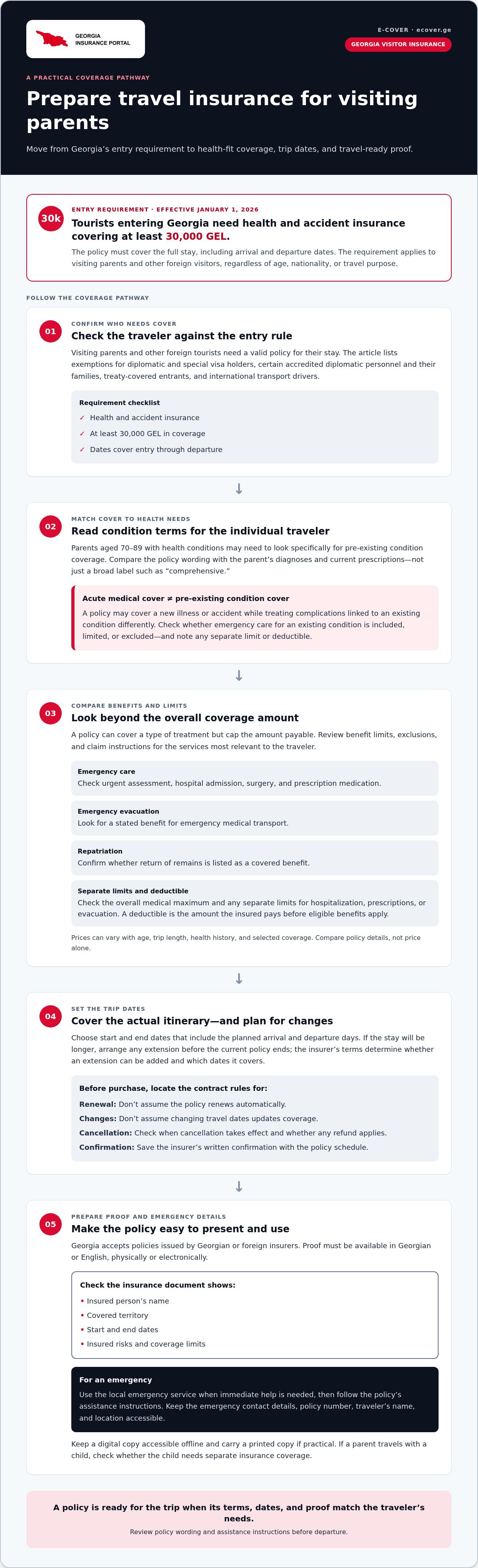
Tourists entering Georgia need valid health and accident insurance starting January 1, 2026. The policy must cover the full stay, including arrival and departure dates, with coverage of at least 30,000 GEL. This applies to visiting parents and other foreign visitors, regardless of nationality or travel purpose. Diplomatic and special visa holders, certain accredited diplomatic personnel and families, treaty-covered entrants, and international transport drivers are exempt.
Plans that include emergency medical expenses, hospital stays, surgery, prescription medication, emergency medical evacuation, and repatriation of remains address the main risks of a medical emergency. Coverage limits still matter: a policy may cover a type of treatment but cap the amount payable. Review each benefit’s limit, exclusions, and claim instructions before travel. Lost luggage may also be included, but it’s separate from medical coverage.
These are examples of medical costs, not insurance prices. A higher overall limit can help protect against expensive treatment, while separate limits may apply to hospital care, prescriptions, or evacuation.
- Emergency care: Check how the policy handles urgent assessment, hospital admission, surgery, and prescriptions.
- Evacuation: Look for a stated benefit for emergency medical transport.
- Repatriation: Confirm whether return of remains is listed as a covered benefit.
- Assistance: Save the policy’s emergency contact details before departure.
For a medical emergency, use the local emergency service when immediate help is needed, then follow the policy’s assistance instructions. Call the medical assistance hotline printed in the policy documents or on the insurance card, and keep the policy number, traveler’s name, and location ready. The hotline can explain the insurer’s process; the policy terms determine which expenses are covered.
Georgia accepts policies issued by Georgian or foreign insurers. Travelers must be able to present proof in Georgian or English, either physically or electronically. Before departure, confirm the document shows the insured person’s name, covered territory, start and end dates, insured risks, and coverage limits. A parent traveling with a child should check whether the child needs separate insurance coverage.
Keep the digital policy accessible offline, and carry a printed copy if practical. Check that the coverage dates include the full stay, from the day of entry through the day of departure. These steps help visiting relatives present proof at the border and find emergency contact information quickly.
Coverage for older travelers with health conditions
Parents aged 70-89 who have health conditions may need to look specifically for pre-existing condition coverage. Age and medical history can affect which policy terms apply, so compare the wording for each condition rather than relying on a broad label such as “comprehensive.” For example, a parent managing a long-term condition should check whether related emergency treatment is included, restricted, or excluded.
Read the policy’s definitions and exclusions to understand how it treats pre-existing conditions, treatment, and medication. Compare the terms with your parent’s medical history and current prescriptions. A condition may be excluded or limited under the policy, so review the exact wording rather than relying on a broad description of coverage.
Acute medical coverage and pre-existing condition coverage are not interchangeable. A policy may cover a new illness or accident while treating complications linked to an existing condition differently. Check whether the policy describes emergency care for an existing condition, and identify any separate limit, deductible, or exclusion that applies. This helps families assess how much of a possible claim could remain their responsibility.
Parents can purchase visitor insurance for Georgia before entering the country. Choose dates that cover the planned trip, then review the policy schedule and benefits before completing the purchase. Enrolling early gives the family time to compare condition wording and prepare the required insurance document for travel.
Coverage periods should match the actual itinerary, not just the main holiday dates. For example, include planned arrival and departure days when selecting the start and end dates. If a parent plans to stay longer, arrange an extension before the current policy ends. Treat an extension as a separate step, since the insurer’s terms determine whether it can be added and what dates it covers.
Renewal, extension, and cancellation rules depend on the contract. Before purchase, locate the sections explaining how to request a change, when cancellation takes effect, and whether any refund applies. Don’t assume a policy renews automatically or that changing travel dates updates coverage. Save the insurer’s written confirmation alongside the policy schedule.
Compare limits and deductibles together. A coverage limit is the maximum payable under a benefit, while a deductible is the amount the insured pays before eligible benefits apply. Check the overall medical maximum and any separate limits for hospitalization, prescriptions, or evacuation. A lower deductible may change the premium, while a lower benefit limit can leave more exposure for costly care.
- Check condition terms: Match the parent’s diagnoses and medicines against exclusions and eligibility wording.
- Set dates: Align the schedule with the full itinerary and request any extension before coverage ends.
- Compare benefits: Review limits and deductibles for the medical services most relevant to the traveler.
For a Georgia trip, compare travel insurance policy options against the parent’s age, health history, travel dates, and required coverage document.
Acute-onset pre-existing condition benefits
Do not assume that a policy covering emergency medical treatment will cover routine care for a pre-existing condition, such as a scheduled appointment or regular prescription refill. If your parent has diabetes or a heart condition, read the policy’s terms and exclusions before buying. The wording determines which situations are covered.
Eligibility depends on the contract’s wording. Review how it defines a pre-existing condition, what it means by “acute onset,” and whether the condition must have been stable before departure. Check any age limits, medical-history requirements, waiting periods, and benefit caps stated in the policy. Parents aged 70-89 with health conditions should pay particular attention to these terms when comparing travel health insurance.
Separate the benefit limit from the plan’s overall medical maximum. A policy can state an overall coverage amount while applying a lower limit to acute-onset treatment. The deductible also affects the amount the traveler pays for eligible expenses. Compare both figures with the policy’s exclusions, then consider how a hospital visit or emergency medication would be handled under the contract.
Use these steps to assess the wording:
- Identify the condition: List the parent’s diagnoses, symptoms, and current medications.
- Find the definition: Locate the acute-onset and pre-existing-condition clauses in the policy document.
- Check the boundaries: Note exclusions, age restrictions, deductibles, and any separate benefit limit.
- Keep records: Save the policy schedule and emergency contact details with the traveler’s medical information.
If a parent’s existing condition worsens during a trip, the policy terms determine whether the event is covered. A planned checkup or routine treatment is a different situation. Read the policy wording carefully rather than assuming that general emergency coverage includes every condition-related expense.
Acute-onset benefits don’t replace comprehensive medical coverage. Check whether the plan also addresses unrelated accidents and new illnesses, hospital care, prescriptions, and emergency evacuation. Review how the covered territory and policy duration match the foreign visitor’s itinerary. If travel dates change, compare the revised duration with the policy dates so the traveler isn’t relying on coverage outside its stated period.
Keep the insurance document accessible for presentation at the border, along with its assistance information. A parent or accompanying relative can prepare a short summary of diagnoses and medicines to share with medical professionals in an emergency. The policy terms determine which benefits apply.
Choose a policy that meets Georgia’s entry requirements and fits the traveler’s plans. Compare the covered services, exclusions, dates, and terms, especially if your parent has an existing condition. A broad description of coverage is not a substitute for reading the policy.
Age-based visitor insurance prices
Age can affect a visitor insurance quote because policies may use age bands when setting premiums. A parent in one age band may receive a different quote from a younger relative, even for the same Georgia travel dates. The age used for pricing and eligibility is defined by the policy, so enter each traveler’s details accurately. Never assume two relatives can share one price or one policy.
The price depends on the traveler’s case and is provided after a quote request; key factors include age, trip duration, medical history, selected limits, and deductible. Comparing quotes is useful only when the benefits and dates match. A lower premium paired with a smaller emergency medical limit or higher deductible may leave the traveler responsible for more eligible expenses.
Trip duration is another practical factor. A parent visiting Georgia for a short family stay needs dates that match that itinerary, while a longer visit requires coverage for the extended period. Compare policies using the same start and end dates. If one quote covers fewer days, its lower total doesn’t provide a like-for-like comparison.
If your parent has a diagnosed condition or takes regular medication, review the policy terms and exclusions before buying. The policy covers specified emergency medical services, but its terms determine whether expenses related to an existing condition are eligible. Don’t assume that a general description of medical coverage includes every condition.
Compare the quote details in a consistent order:
- Age and eligibility: Enter the traveler’s correct age and review any age-related policy conditions.
- Dates: Use the same travel duration for each comparison.
- Medical benefits: Compare emergency medical coverage and relevant condition terms.
- Out-of-pocket share: Check the deductible and any separate benefit limits.
- Other benefits: Note whether evacuation, prescriptions, or accident treatment are included.
For example, compare two quotes for the same parent, itinerary, and medical needs. If one has a different deductible or emergency medical limit, the premium alone won’t show which provides the more appropriate protection. Record those differences beside each quote, then review the policy schedule and exclusions before purchase.
Insurance coverage should also meet Georgia’s entry requirement. The policy needs to cover the full stay and provide at least 30,000 GEL in health and accident coverage. Confirm that each international traveler’s insurance document shows the correct name, territory, dates, and limits. A clear comparison helps families weigh age-based pricing against medical protection and avoid choosing solely by the lowest quote.
Insurance options for visiting parents and relatives
Start with each traveler’s status and itinerary. From January 1, 2026, foreign visitors entering Georgia generally need mandatory health and accident insurance, regardless of nationality or travel purpose. A visiting parent, sibling, or adult child should have a policy that meets the entry rule and matches their own travel dates. Accredited diplomatic personnel and family members, diplomatic and special visa holders, certain treaty-covered entrants, and international transport drivers are exempt.
For a parent, compare travel medical insurance benefits with age and health needs. Check the policy’s treatment of emergency medical expenses, hospital stays, surgery, prescriptions, evacuation, and repatriation. A relative with a pre-existing condition should also review its specific terms and limits. Don’t assume that a policy covering accidents automatically covers every illness or condition-related emergency.
Relatives traveling together still need clear proof for each insured person. For children traveling with family, check that the insurance arrangements clearly cover each child. For adults, check that the policy document identifies the insured traveler and shows the correct coverage dates and limits. This prevents confusion if family members arrive on different dates or follow separate itineraries.
To compare options, use the same checklist for every family member:
- Travel dates: Match coverage to the full stay, including arrival and departure.
- Medical needs: Review emergency benefits, exclusions, and relevant condition terms.
- Limits: Confirm health and accident coverage meets the required minimum of 30,000 GEL.
- Proof: Keep the policy in Georgian or English, in physical or electronic form.
- Policy details: Check insured parties, covered territory, dates, risks, limits, and premium terms.
Travel insurance must meet Georgia’s entry requirements, whether issued by a Georgian or foreign insurer. Check that the document shows the traveler’s name, coverage dates, covered territory, and required policy details. A digital copy can be presented at the border, so save it where the traveler can access it offline. A printed copy can also be useful if a phone is unavailable.
For example, if a parent stays longer than other relatives, compare policies using that parent’s full itinerary rather than the group’s shorter dates. If a child travels with them, arrange the child’s individual policy too. These steps help each foreign visitor carry compliant proof that fits their own trip and medical needs.
Use the family checklist to compare visitor travel insurance options for each relative’s dates, medical needs, and required coverage.
E-COVER: Travel Insurance Policies
E-COVER offers travel insurance policies for foreign visitors preparing to travel in Georgia. If your parent needs a policy for a family visit, compare the coverage terms with their age, health needs, travel dates, and Georgia’s entry requirements. Review the policy document to understand covered medical emergencies, benefit limits, and any exclusions before purchase.
For relatives staying longer, long term travel insurance policies may be relevant. Students and digital nomads can also explore the corresponding insurance options for their travel circumstances. Select coverage that fits the individual traveler and keep the policy document accessible during the trip.
Visit ecover.ge to explore travel insurance options for your family’s Georgia visit.
Make the Next Step Part of the Travel Plan
Before finalizing your family’s travel plans, note each traveler’s dates and insurance needs. A separate policy should match each person’s itinerary, and the documents should be easy to access during the trip. Planning this way makes Georgia visitor insurance for parents easier to arrange and coordinate with relatives’ travel plans.
E-COVER offers Travel Insurance Policies, Student Insurance, and long term travel insurance policies for different travel situations. Choose the option that fits the traveler’s plans, then review its terms alongside the itinerary and health needs.
Take the next step when you’re ready: contact E-COVER about visitor insurance. A clear plan helps your family prepare for the visit with confidence.
Frequently Asked Questions
What Should I Do in case of an Emergency?
Get urgent local medical help first, then follow the emergency instructions in the policy documents. Keep the insurer’s assistance contact, policy number, and traveler’s location available for the call. For example, a relative accompanying a parent to hospital can share those details and the parent’s medication list. Save the policy PDF offline before travel so it remains accessible if mobile data is unavailable.
Who can purchase this insurance?
Foreign visitors traveling to Georgia, including tourists, business travelers, students, and digital nomads, can purchase travel insurance policies. Starting January 1, 2026, health and accident insurance is mandatory for foreign visitors entering Georgia, subject to the stated exemptions. When arranging Georgia visitor insurance for parents, use each traveler’s correct personal details and itinerary. A child traveling to Georgia needs an individual policy.
What visitor health insurance plans are available for parents visiting Georgia, USA?
Georgia here means the country, not the U.S. state. Parents visiting Georgia can look at travel medical insurance policies, while long-term travel insurance policies may suit an extended visit. E-COVER also offers Student Insurance for eligible student travelers. Compare the policy’s covered benefits, dates, and territory, and check that its documentation is suitable for presentation during the trip.
How much does visitor insurance for parents visiting Georgia cost per day or month?
The price depends on the individual case and is given after a quote request. Factors include the traveler’s age, trip duration, selected coverage, and deductible. For a useful comparison, enter the same dates and traveler details for each quote, then compare the benefits and limits alongside the premium. A monthly estimate can differ from a daily rate because the covered duration changes the total.
What medical coverage limits and benefits should parents choose for a Georgia visit?
Choose a policy with an aggregate health and accident coverage limit of at least 30,000 GEL. Review whether its benefits include ambulance services, emergency medical treatment, urgent hospitalization, medical evacuation, repatriation, urgent dental treatment, and COVID-19-related medical expenses. Check the deductible and the insurer’s maximum payable amount per claim. For example, a high aggregate limit doesn’t automatically mean every benefit has the same sublimit.
Does visitor insurance cover pre-existing conditions for parents visiting Georgia?
Coverage for an existing condition depends on the policy wording, so review its specific terms before purchase. Look for definitions, exclusions, and any acute-onset benefit, then distinguish emergency treatment from routine care or scheduled treatment. For example, a parent taking regular medication should understand whether the policy addresses an unexpected complication, prescription replacement, or neither. Don’t treat general emergency coverage as automatic coverage for every pre-existing condition.
What are the eligibility rules and age limits for visitor insurance plans?
Eligibility follows the individual policy’s terms, and no single age limit should be assumed across plans. Enter the traveler’s date of birth accurately and read the policy’s eligibility conditions before buying. A parent’s age and medical history can affect which terms apply. For Georgia entry, the policy must also meet the required coverage and documentation rules, regardless of whether the traveler is visiting family or traveling for another purpose.
How do visitor insurance providers compare for parents traveling to Georgia?
Compare policy documents rather than provider names alone. Check the aggregate limit, per-claim limit, deductible, covered emergencies, exclusions, policy duration, and the languages used in the document. Also compare how the policy is delivered and which assistance details it provides. For example, place two policies side by side and see whether both cover the same travel dates and emergency benefits before comparing their premiums.


