

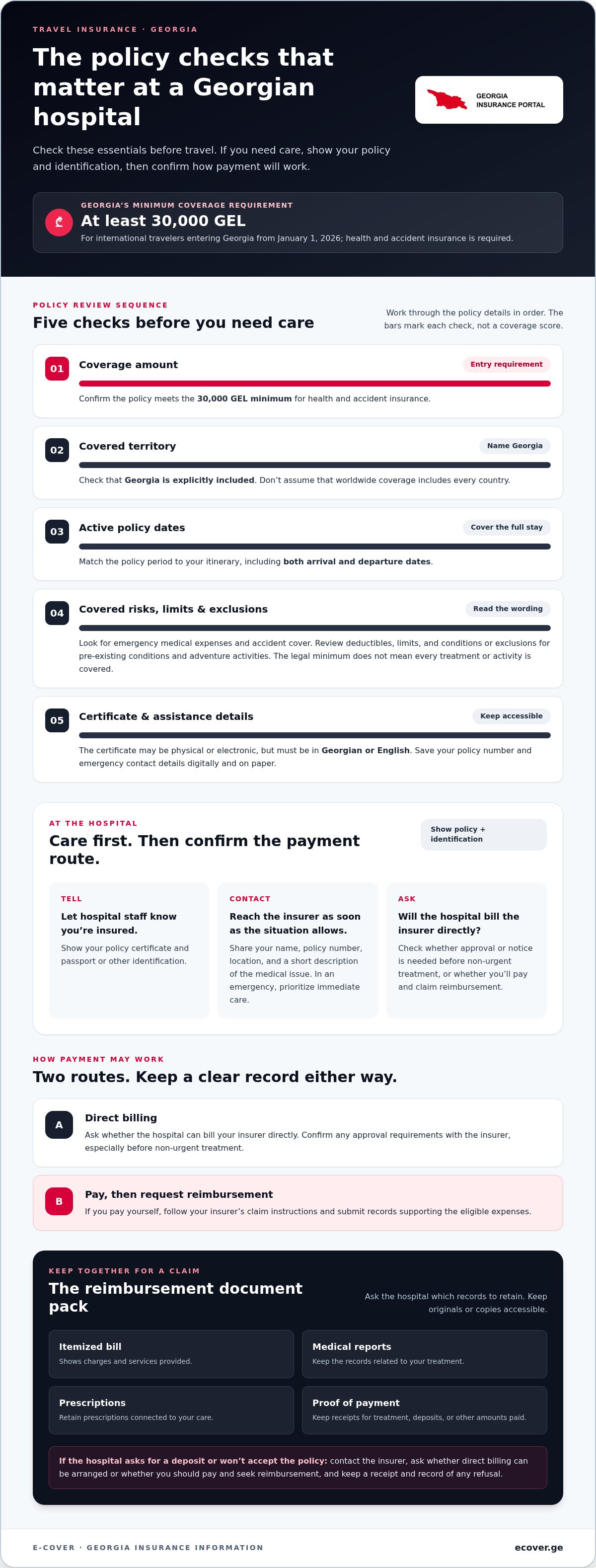
Starting January 1, 2026, international travelers to Georgia must have health and accident insurance with coverage of at least 30 000 GEL. To understand how to use travel insurance at a Georgian hospital, contact your insurer, show your policy and identification, and ask whether the hospital can bill the insurer directly or whether you’ll need to pay and claim reimbursement.
It’s sensible to keep your policy and the insurer’s emergency contact details close, both digitally and on paper. Check that the policy covers Georgia and the full length of your stay, including your arrival and departure dates. If you need care, tell the hospital you’re insured and contact the insurer as soon as the situation allows; for reimbursement, keep the itemized bill, medical reports, prescriptions and proof of payment.
This guide explains what to check in your policy, what to do when you arrive at a hospital, and how direct billing and reimbursement may work. Follow the steps in order so you know what documents to show and what to ask about payment while focusing on getting the care you need.
Key Takeaways
- Review your certificate for the covered territory, dates, insured risks and coverage limits so you can spot gaps before seeking care.
- Save your policy and emergency contact details where you can reach them quickly, including if you can’t access the internet.
- For reimbursement, keep medical reports, itemized invoices, prescriptions and proof of payment together, then follow your insurer’s claim instructions.
- Ask the insurer about direct billing and any required approval before non-urgent treatment, so you understand the payment process at the hospital.
Checking policy territory and trip dates
Policy territory means the countries where your insurance coverage applies. Confirm that Georgia is named, rather than assuming global cover includes every country. A plan limited to your home country may offer little or no protection outside it. Trip dates are the period when the policy is active. Match them to your full stay, including arrival and departure dates, so a hospital visit on either travel day falls within the insured period.
For stays beginning January 1, 2026, international travelers entering Georgia must hold health and accident insurance with coverage of at least 30 000 GEL. The policy may come from a Georgian or foreign insurer. Georgia’s requirement is established under the Law of Georgia “On Tourism.” The document can be physical or electronic, but it must be in Georgian or English. Check the language and dates before travelling.
Insured risks are the medical events and expenses the policy covers. Check that your policy identifies its contract parties, covered territory, coverage dates, insured risks, limits, and premium payment details. Compare these terms with your itinerary and the care you may need. If you are a student, make sure your policy covers treatment in Georgia for the full period of your stay.
- Country: Confirm Georgia is within the covered territory.
- Dates: Include every day from arrival through departure.
- Medical insurance: Look for emergency medical expenses and accident cover.
- Limits: Check that the stated coverage meets Georgia’s 30 000 GEL minimum.
- Document: Keep the Georgian- or English-language certificate accessible.
Exclusions are situations or treatments the policy does not cover, or covers only under stated conditions. Pre-existing conditions and adventure activities may be excluded or restricted by the policy wording, so read those clauses and any activity-specific terms. The legal minimum does not, by itself, mean every treatment or activity is covered. These checks make it easier to understand how to use travel insurance at a Georgian hospital if you need care.
Keeping policy and emergency contact information handy
An emergency contact is the insurer’s assistance number or contact channel for urgent policy questions. Save it in your phone and offline notes, and keep a printed copy with your travel documents. Some travel medical insurance plans include 24/7 global assistance; use the contact details shown in your own policy. If you can’t get through by phone, try another listed channel, such as email.
Contact the assistance provider from Georgia using the number or method printed on your policy certificate or insurance card. Share your name, policy number, current location, and a short description of the medical issue. Ask what information the hospital needs and whether the insurer requires notice before treatment. In an emergency, prioritize immediate medical care, then contact the insurer as soon as you can.
A hospital document pack is the identification and insurance paperwork staff may need to register you and process a claim. Bring your passport or other identification, your policy certificate, and the insurer’s contact details. Keep digital copies on your phone and an offline backup. If you take regular medication, carry its packaging or a written list of its name and dosage.
A deductible is the amount you must pay toward an eligible claim before insurance contributes. Check your policy for its deductible and any limits on emergency medical expenses. Evacuation means medically arranged transport to another facility or location. Check whether your policy includes it and how to request assistance. Reimbursement is money returned after you pay eligible costs and submit a claim.
- Before leaving: Save the certificate, contact details, and policy number offline.
- At the hospital: Show identification and the insurance document, then ask which records to retain.
- After treatment: Keep reports, prescriptions, itemized bills, and payment receipts together.
For future trips, compare travel insurance coverage with your itinerary and assistance needs before purchasing.
Paying for care and requesting reimbursement
Payment depends on whether the hospital bills your insurer directly or asks you to pay. If you pay, keep every document needed to support a reimbursement claim.
Hospital and Ambulance Costs
Hospital costs are charges for assessment and treatment, while ambulance costs cover medical transport. Ask for an itemized bill showing the services provided. Before non-urgent care, contact your insurer to ask which expenses are covered and whether treatment needs approval.
Deposits and Insurance Refusals
A deposit is an advance payment requested before a hospital provides or completes treatment. If a Georgian hospital asks for one or does not accept your insurance, call the assistance contact shown on your policy and explain the hospital’s requirements. Ask whether direct billing can be arranged or whether you need to pay and seek reimbursement. Request a receipt for any deposit and keep a record of the amount paid.
In an emergency, prioritize necessary care. Show your policy certificate and identification, and ask hospital staff for an itemized statement. If the hospital refuses the policy, ask what payment methods it accepts and retain any refusal or payment record. These details help explain the circumstances to the insurer when submitting a claim.
Reimbursement Requests
A reimbursement request is a claim asking your insurer to repay eligible medical expenses you paid yourself. Follow the insurer’s claim process and submit the completed form with the itemized invoice, proof of payment, medical report, and prescriptions. Include your policy number and treatment date. Keep copies of all documents and correspondence about approval or the hospital’s payment request.
Check that names and dates match across the documents before sending them. If the insurer requests additional records, provide the relevant hospital paperwork and keep a copy of your reply. For international visitors, repatriation means medically arranged transport back to the home country; it is separate from local treatment costs. Review the policy terms to see whether it covers repatriation and how to request assistance.
Direct billing at hospitals abroad
Direct billing means the hospital seeks payment from your insurer instead of charging you the full bill upfront. Whether it is available depends on the hospital, your policy, and any required approval.
Pre-Authorization for Care
Pre-authorization is insurer approval for specified treatment before it begins. For emergency care in Georgia, seek urgent medical attention first, then contact the insurer as soon as possible. For planned or non-emergency treatment, call the assistance number before your appointment and ask whether approval is required. Give the insurer the hospital’s name, proposed treatment, and your policy details.
Whether approval is needed depends on your policy and treatment. Ask the assistance team to explain any approval steps, and note the instructions, including who at the hospital should receive them.
Insurer-Approved Hospitals
An insurer-approved hospital is a facility the insurer can coordinate with for covered care or direct billing. To find one in Tbilisi or elsewhere in Georgia, call the assistance contact on your policy and give your current location. Ask which nearby hospitals can handle your treatment and whether they can bill the insurer directly.
Direct billing may be available at some hospitals, but it is not automatic. Confirm the hospital’s name, the care being arranged, and any payment you may need to make. If the insurer identifies a suitable facility, ask how to share your policy certificate with its admissions team.
Private and public hospitals may both provide treatment, but insurance coverage depends on your policy’s terms, covered expenses, and any facility or treatment limits. Medical evacuation is separate from hospital treatment, so check whether your policy includes it and how to request assistance.
Keep the policy and assistance contact accessible throughout your trip, whether its duration is brief or extended. If you need help arranging care abroad, prepare your travel insurance for Georgia before departure.
E-COVER: Travel Insurance Policies
E-COVER offers Travel Insurance Policies for foreign visitors preparing for medical care in Georgia. Starting January 2026, international travelers must have health insurance, so review your policy’s territory, dates, and coverage requirements before departure. The right documents can also help you explain your insurance arrangements when speaking with a hospital or assistance team.
Choose an option suited to your travel situation: Student Insurance for study-related travel, long term travel insurance policies for extended stays, or Digital Nomad Insurance for location-independent travel. These options give travelers different starting points for arranging insurance around their plans in Georgia. If your future journeys expand into broader global adventures to explore what are the seven wonders of the world, having dependable travel coverage in place remains just as essential.
If you’re preparing for a trip or reviewing your cover, visit ecover.ge to explore E-COVER’s insurance options or contact the company.
Make Your Next Trip Easier to Manage
Your next step is to make insurance part of your travel routine before departure, not paperwork you search for under pressure. Knowing how to use travel insurance at a Georgian hospital starts with choosing cover that fits why you’re travelling and how long you’ll stay, then keeping policy details accessible throughout the trip. E-COVER offers Travel Insurance Policies, Student Insurance, and long term travel insurance policies for different travel circumstances. Choose the category that matches your plans, and read its policy terms so you understand the cover and claims process relevant to you. Before you go, decide who will carry access to the policy and how a travel companion can find the assistance details if needed. A clear plan can help you communicate efficiently if an unexpected medical issue interrupts your stay. If you’re ready to explore insurance for your trip, contact E-COVER for travel insurance help. Prepare ahead, travel with confidence, and keep your attention on the experiences waiting in Georgia.
Frequently Asked Questions
Do Georgian hospitals accept direct billing from U.S. travel insurance companies?
Some Georgian hospitals may arrange direct billing, but acceptance depends on the hospital’s arrangements with your insurer and your policy terms. A U.S. insurance card alone doesn’t mean the hospital can bill the company directly. Before treatment, call the assistance number and ask whether the specific facility can coordinate payment. If it can’t, ask how to document your out-of-pocket payment for a claim.
How do I pay upfront and file a travel insurance claim for hospital treatment in Georgia?
Pay using a method the hospital accepts, then ask for an itemized invoice and an official payment receipt before leaving. Submit the claim through the insurer’s stated channel, such as its online portal or claims email, and include your policy details and treatment records. Save a copy of every file and note your claim reference. Follow the policy’s filing deadline and respond promptly to requests for further information.


