

For international visitors, the minimum coverage for Georgia health insurance is comprehensive health coverage that meets the country’s entry requirement. Starting January 2026, all international travelers must have health insurance when traveling to Georgia.
Choosing a policy is not just a paperwork decision: the coverage matters if you need medical care during your stay. The right policy must meet Georgia’s entry requirement and fit your trip, whether you are visiting briefly or staying longer.
This guide explains Georgia’s minimum coverage requirement, what to check in a policy, and how to choose insurance for your trip. You’ll learn how coverage limits and policy terms affect your decision, so you can prepare with a clear understanding of the rule and the protection provided.
Key Takeaways
- Separate Georgia’s rules for resident health plans from the insurance requirement for international visitors, since they apply to different situations.
- Understand how coverage limits affect what a policy may pay, then weigh those limits against the protection you need.
- Review who can enroll in Georgia health coverage and how qualifying events may affect enrollment timing.
- If you’re traveling to Georgia from abroad, choose travel medical insurance that meets the requirement taking effect in January 2026.
Choosing coverage limits
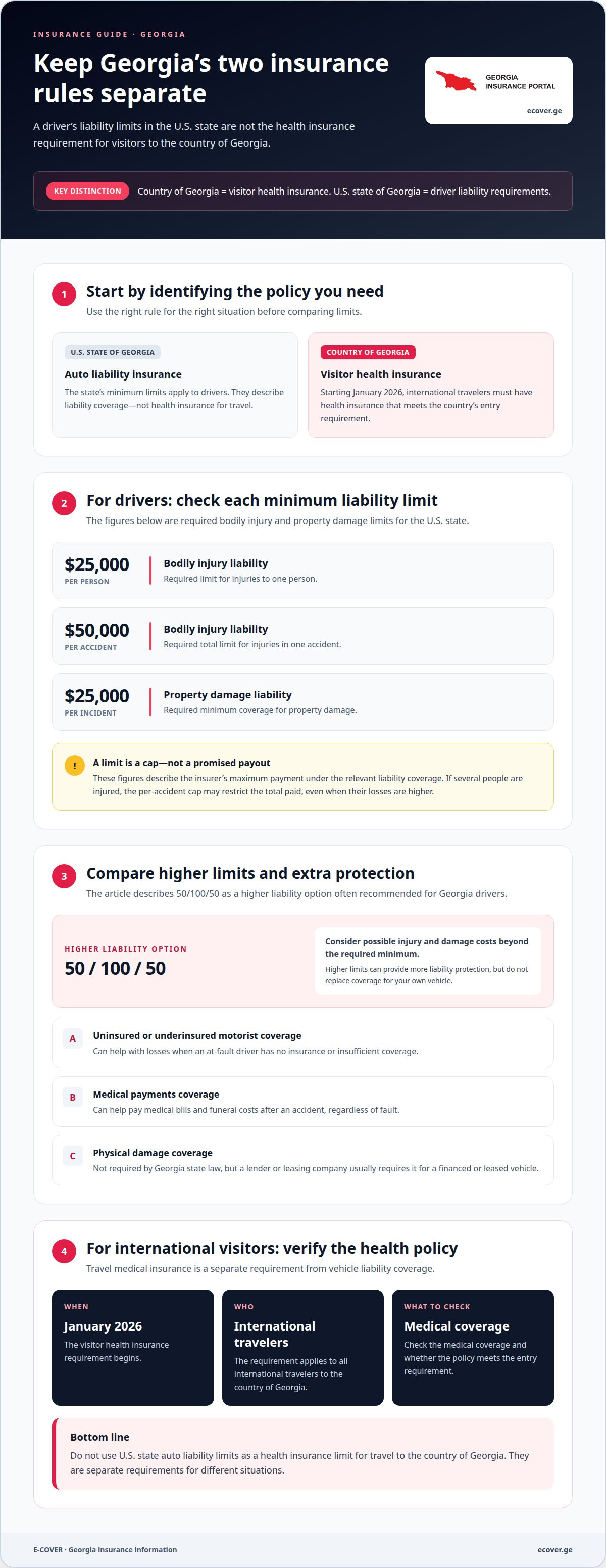
First, distinguish health insurance for visitors from auto liability insurance in the U.S. state of Georgia. The state’s minimum liability limits apply to drivers, not to health policies for travel to the country of Georgia. Starting January 2026, international travelers to Georgia must have health insurance. Auto insurance limits and health insurance requirements are separate, so compare each policy with its own requirements.
For drivers in the U.S. state, the required bodily injury liability limits are $25,000 per person and $50,000 per accident. Property damage liability must cover at least $25,000 per incident. These limits describe the insurer’s maximum payment under the relevant liability coverage, not a guaranteed payment to every person after a crash. If several people are injured, the per-accident cap may restrict the total paid, even when each person’s losses are higher.
A 50/100/50 limit is a higher liability option often recommended for Georgia drivers. Consider the possible cost of injuries and damage beyond the required minimum when comparing limits. Higher limits can provide more liability protection, but they don’t replace coverage for your own vehicle.
- Uninsured or underinsured motorist coverage can help with losses when an at-fault driver has no insurance or insufficient coverage.
- Medical payments coverage can help pay medical bills and funeral costs after an accident, regardless of fault.
- Physical damage coverage is not required by Georgia state law, but a lender or leasing company usually requires it for a financed or leased vehicle.
When comparing health policies for travel, check both the medical coverage and whether the policy meets Georgia’s entry requirement. The minimum coverage for Georgia health insurance is not a vehicle liability limit: these are separate requirements, so do not confuse them when choosing a policy.
Eligibility to enroll in Georgia health insurance
Eligibility depends on which Georgia you mean. Georgia Access covers Qualified Health Plans for eligible Georgia residents in the U.S. state. To enroll, a person must be a Georgia resident and a U.S. citizen, national, or lawfully present immigrant. These rules concern state health plans, not the insurance requirement for international visitors to the country of Georgia.
For U.S. state residents, enrollment timing is a separate consideration. People generally enroll in a Qualified Health Plan during the annual Open Enrollment period. A qualifying life event may make someone eligible for a Special Enrollment Period; simply wanting to change plans outside annual enrollment is not enough.
Catastrophic Plans have a separate age rule. Catastrophic Plans have eligibility criteria that may differ from those for other health plans. Meeting the age condition alone does not replace the general Qualified Health Plan eligibility rules. Check both categories of eligibility when considering this plan type.
Georgia Pathways to Coverage is a distinct option with its own criteria. Residents have been able to apply since July 1, 2023. Applicants must be between 19 and 64 years old, have household income up to 100% of the Federal Poverty Level, and complete at least 80 hours per month of qualifying activities. Applicants must also provide proof of qualifying activities for the most recent 4 weeks within the 8 weeks before applying.
- Age: Applicants must be 19 to 64 years old.
- Income: Household income must be up to 100% of the Federal Poverty Level.
- Activities: At least 80 qualifying hours per month are required.
- Hospital stays: At initial application, each inpatient hospital or short-term skilled nursing facility stay day may count as 4 hours toward the monthly activity requirement.
Pathways members must report changes in circumstances to the State within 10 days. International visitors planning a trip to the country of Georgia need a different type of cover: travel medical insurance for Georgia addresses that separate travel requirement.
Does Georgia have a state health insurance mandate or penalty for being uninsured?
The two jurisdictions have different insurance rules and purposes. The country of Georgia’s visitor insurance requirement does not apply to residents enrolling in health plans in the U.S. state. Identify which Georgia your trip or insurance decision concerns before applying a rule.
Starting January 2026, the Georgian government requires all international travelers to have health insurance. This is an entry-related requirement for visitors to the country. It does not establish a penalty for uninsured residents of the U.S. state, and it should not be treated as one.
For residents of the U.S. state, health or dental coverage enrollment generally takes place during annual Open Enrollment, unless a person qualifies for a Special Enrollment Period. Eligibility for that period depends on a qualifying life event; being uninsured alone does not establish eligibility.
The distinction matters in practice. A resident of the U.S. state considering a Qualified Health Plan needs to consider market eligibility and enrollment periods. An international traveler entering the country of Georgia must meet its visitor insurance requirement. Neither situation is about auto liability insurance, which applies to drivers, not health coverage.
- U.S. state resident: Review the applicable enrollment period and whether a qualifying life event supports a Special Enrollment Period.
- International visitor: Arrange health insurance for travel to the country of Georgia, where the requirement begins in January 2026.
- Penalty question: Don’t interpret the visitor requirement as a penalty imposed on uninsured residents of the U.S. state.
In short, the January 2026 rule concerns international travelers to the country of Georgia. It is distinct from the U.S. state’s health-plan enrollment process and from driver insurance requirements.
As of 2023, 19% of Georgia drivers were uninsured. Georgia drivers must have liability insurance to drive on the state's public roads and highways.
What are the minimum essential coverage requirements for health insurance?
“Minimum essential coverage” and Georgia’s visitor insurance requirement refer to different contexts. For residents of the U.S. state, the research available here does not establish a specific list of minimum essential health benefits. For international travelers to the country of Georgia, the confirmed rule is that health insurance is mandatory starting January 2026. The requirement is not the state’s auto liability minimum.
For a visitor, the practical requirement is to hold health insurance that meets Georgia’s entry rules. Comprehensive coverage for foreign visitors is intended to meet that legal requirement. This is different from selecting a U.S. state health plan or interpreting “minimum essential coverage” as a particular list of services.
Before a trip, read the policy wording and compare it with your itinerary. Confirm that the insured person’s details are correct, and that the policy period covers the full planned stay. For example, if your travel dates change, make sure the insurance dates still match. Keep the policy documents accessible during travel so you can refer to the terms when needed.
Review the coverage description, exclusions, and claims process rather than relying only on a policy title. Check how the document describes medical treatment and what steps it gives for seeking assistance. These details help you understand the protection you have selected. They do not replace Georgia’s entry requirement, and they should not be confused with liability coverage for driving in the U.S. state.
- Identify the jurisdiction: Separate U.S. state health-plan terminology from the country of Georgia’s visitor requirement.
- Match the trip: Compare the policy’s insured person and coverage dates with your travel arrangements.
- Read the terms: Review medical coverage, exclusions, and the claims instructions in the policy document.
For travel to Georgia, explore travel medical insurance for Georgia designed to meet the entry requirement beginning January 2026.
For visitors to the country of Georgia, health insurance is mandatory starting January 2026, and the policy must meet the country’s entry rules. This visitor requirement is separate from U.S. state health-plan terminology; comprehensive visitor coverage is intended to meet it.
E-COVER: Travel Insurance Policies
E-COVER offers travel insurance policies for foreign visitors traveling to Georgia. Starting January 2026, international travelers must have health insurance, so arranging suitable cover is part of preparing for the trip. E-COVER’s comprehensive coverage is designed to meet the country’s entry requirement, and policies are available online.
Choose the option that fits your travel circumstances. A student visiting Georgia can consider Student Insurance, while a longer stay may suit a long term travel insurance policy. Digital Nomad Insurance is another option for people traveling while working remotely. Review the policy details and dates against your plans so your documents reflect your stay.
For travel insurance for Georgia, visit ecover.ge to explore E-COVER’s policies.
Make your next coverage decision with confidence
Your next decision is not simply whether a policy meets a minimum. It’s whether the paperwork and protection match how you’ll spend your time in Georgia. Before choosing, compare your travel purpose and dates with the policy wording. This review helps you identify mismatches before departure, rather than during your journey.
Treat minimum coverage for Georgia health insurance as a starting point, not a substitute for reading the policy terms. A sound choice depends on understanding which jurisdiction’s rules apply, what the policy says it covers, and which documents you need to keep accessible. If your travel arrangements change, revisit the dates and details so your insurance information stays aligned with your plans.
Include this comparison in your trip preparation alongside other travel documents. Aim to understand the policy you select and keep its details easy to access. To discuss your travel insurance needs, contact E-COVER. A considered choice can help you prepare for your Georgia trip with greater clarity.
Frequently Asked Questions
What is the minimum health insurance coverage required by law in Georgia?
For visitors to the country of Georgia, the policy’s aggregate coverage limit must be at least 30,000 GEL. It must cover a minimum of 4 days and be issued in both Georgian and English. The policy dates must include the day you enter and the day you depart. Buy it before entry or at the moment of entry, not after arrival.
What are the risks and out-of-pocket costs of choosing a low-coverage health plan in Georgia?
A plan below the required aggregate limit may not meet the entry requirement for the country of Georgia. If an eligible claim exceeds the policy’s applicable limit, you may need to pay the uncovered amount yourself. Also review the deductible, exclusions, and covered services before choosing. For example, a treatment outside the policy’s terms may not be reimbursed, even when the policy is active.


