

Holding a premium worldwide travel policy is no longer a guarantee that you will clear passport control. Under Government Regulation No. 602 and the Georgia new insurance law for travelers 2026, foreign visitors entering the country must present statutory health and accident coverage that satisfies exact state regulations. If your paperwork lacks the required policy terms, border officers have the legal authority to deny entry at arrival checkpoints.
It is completely natural to feel uncertain about whether your existing global insurance satisfies these strict statutory rules. You shouldn't have to parse dense legislative text just to prevent travel disruptions. In this compliance guide, you will learn the mandatory minimum coverage limits, including the 30,000 GEL medical and emergency requirement, and discover the exact documentation border officials demand upon arrival. We will also outline how to verify or secure a fully compliant, border-ready insurance certificate before you depart.
Key Takeaways
- Understand the statutory scope of the Georgia new insurance law for travelers 2026, including mandatory health and accident mandates applied across all border checkpoints.
- Identify the non-negotiable minimum coverage thresholds required for emergency inpatient hospitalizations, outpatient procedures, and urgent medical consultations.
- Learn why standard credit card coverage and generic foreign policies often fail border inspections due to missing policy language and currency specifications.
- Master border verification protocols by preparing legally recognized digital certificates and paper copies in accepted official languages.
- Discover how obtaining a nationally licensed policy through E-COVER guarantees full regulatory compliance and seamless border entry.
Understanding the Georgia New Insurance Law for Travelers in 2026
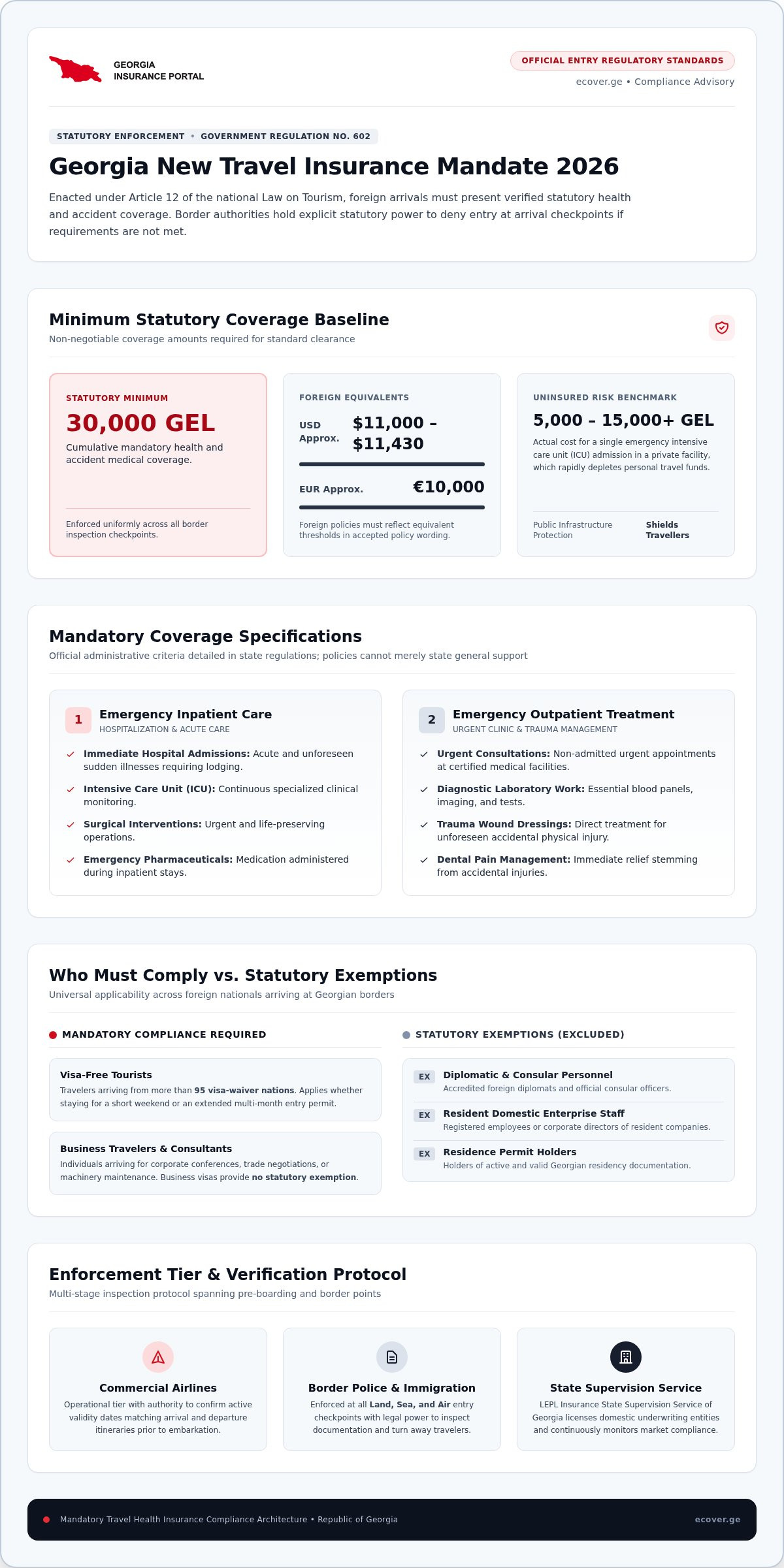
The regulatory framework governing inbound foreign travel has fundamentally shifted. Under the Georgia new insurance law for travelers 2026, foreign visitors must hold valid health and accident coverage throughout their stay. Enacted under Government Regulation No. 602, which implements Article 12 of the national Law on Tourism, this legislation removes previous suspension clauses and establishes mandatory insurance verification at all land, sea, and air border entry points.
The state instituted this protocol to insulate the domestic medical infrastructure from unpaid emergency bills. Because the expansion of Tourism in Georgia brings millions of international visitors annually, treating non-resident patients without pre-arranged coverage placed an unsustainable burden on public resources. A single emergency hospitalization in an intensive care unit can cost anywhere from 5,000 GEL to over 15,000 GEL, while routine outpatient diagnostics quickly deplete personal travel funds. Requiring insurance shields travelers from catastrophic private clinic charges while guaranteeing immediate access to quality medical treatment nationwide.
The Legal Framework Behind the 2026 Entry Mandate
Regulation No. 602 serves as the operative enforcement instrument for tourism health standards. Overall regulatory oversight falls under the LEPL Insurance State Supervision Service of Georgia, which licenses domestic underwriting entities and monitors market compliance. Border police, immigration officials, and commercial airline staff operate as the enforcement tier. These authorities possess explicit statutory power to inspect documentation, confirm active validity dates matching your arrival and departure itinerary, and turn away travelers who present incomplete coverage.
Who Must Comply: Applicable Categories of International Visitors
Compliance obligations apply universally across nearly all incoming foreign nationals, regardless of their nationality or entry channel:
- Visa-Free Tourists: Travelers entering under bilateral visa-waiver arrangements from more than 95 nations must present verified policies, whether staying for a weekend or utilizing an extended multi-month entry permit.
- Business Travelers and Consultants: Individuals arriving for short-term corporate conferences, equipment maintenance, or trade negotiations must maintain standard tourist-compliant policies, as business visas offer no statutory exemption.
- Exempted Categories: The mandate excludes accredited diplomats, consular staff, registered employees or corporate directors of resident domestic enterprises, and valid residence permit holders.
If you plan to arrive as a researcher, long-term remote professional, or exchange scholar, review our Georgia mandatory insurance law guide to ensure your documentation aligns with statutory border guidelines.
Mandatory Coverage Criteria: What Your Policy Must Include by Law
Passing border clearance requires meeting precise statutory minimums rather than carrying broad, non-specific travel plans. Under the Georgia new insurance law for travelers 2026, foreign visitors must present an insurance policy that provides at least 30,000 Georgian Lari (GEL) in cumulative medical coverage, which roughly equals $11,000 to $11,430 USD or €10,000. Border inspection teams cross-reference incoming certificates against this exact statutory baseline to ensure international travelers can settle acute healthcare charges.
Emergency Inpatient and Outpatient Treatment Standards
Your documentation cannot simply state emergency medical support; it must explicitly encompass both inpatient and outpatient services. Under the official administrative criteria detailed in the U.S. Embassy in Georgia announcement, statutory compliance mandates clear allocation for:
- Emergency Inpatient Care: Immediate hospital admissions, intensive care unit monitoring, surgical interventions, and emergency pharmaceutical administration resulting from acute, sudden illnesses.
- Emergency Outpatient Treatment: Urgent clinic consultations, diagnostic laboratory work, trauma wound dressings, and emergency dental pain management stemming directly from unforeseen accidental physical injury.
Policies omitting outpatient treatment or categorizing basic physician evaluations as elective will fail regulatory review upon arrival.
Medical Repatriation and Emergency Evacuation Clauses
Statutory standards strictly require coverage for emergency medical transport and repatriation back to the visitor's country of permanent residence. Border control inspects documentation to confirm that in the event of severe traumatic injury, terminal illness, or mortal remains transit, private insurers cover transportation costs without public expenditure. You can review the complete coverage architecture in our Georgia travel medical policy breakdown.
Duration Matching and Validity Rules for Entry
Your policy validity must span every single calendar day of your stay, starting from the arrival date and concluding on your scheduled departure date. If your return flight leaves at 1:00 AM on a Friday, your insurance certificate must extend through that entire calendar day. Border authorities will not admit travelers whose policies expire even 24 hours prior to their planned departure.
If you need to ensure complete calendar matching with verified border acceptance, you can secure certified travel insurance policies online that automatically generate statutory compliance records for your exact travel dates.
Standard International Policies vs. Georgia-Compliant Insurance
Many foreign visitors assume that their existing international health plans or premium credit card coverages will satisfy immigration authorities upon arrival. Under the Georgia new insurance law for travelers 2026, general declarations of global medical coverage are insufficient. While foreign policies are legally permissible if they meet every statutory requirement, standard commercial plans frequently fail border document audits due to structural clauses and documentation mismatches.
| Evaluation Criteria | Standard International Policy | Georgia-Compliant Underwriting |
|---|---|---|
| Minimum Benefit Expression | Often denominated in USD/EUR without referencing domestic statutory baselines. | Explicitly guarantees minimum coverage meeting the statutory 30,000 GEL threshold. |
| Language & Document Format | Frequently issued only in foreign languages without certified translations. | Issued immediately in standardized English or Georgian formats required by law. |
| Inpatient/Outpatient Mandate | Commonly restricts outpatient clinic visits or imposes high upfront deductibles. | Guarantees complete coverage for both acute hospitalization and outpatient emergency care. |
| Claim Settlement Path | Reimbursement-based; requires traveler to pay out-of-pocket and submit foreign claims. | Direct settlement networks coordinating with domestic medical providers nationwide. |
Evaluating Existing Worldwide and Credit Card Coverage
Automated credit card insurance routinely falters during official border control inspections. Cardholder policies rarely issue a formal, personalized certificate that lists the traveler's exact arrival and departure window alongside itemized coverage schedules. Instead, they provide generic terms booklets. Border agents cannot verify these documents in real time. High out-of-pocket deductibles and strict exclusions regarding accident emergency care also disqualify many commercial policies from meeting state entry guidelines.
The Advantage of State-Supervised Compliant Policies
Obtaining coverage issued through locally authorized channels removes procedural friction at passport control checkpoints. Policies supervised by the LEPL Insurance State Supervision Service of Georgia carry direct institutional recognition. Border officials recognize the layout, statutory validation stamps, and standardized English text instantly. Additionally, if an emergency arises, state-compliant policies connect to nationwide private medical provider networks, preventing complicated foreign reimbursement battles. For an in-depth assessment of qualifying provisions, consult our comprehensive health insurance for tourists in Georgia analysis.
Border Verification Procedures and Documentation Protocol
Understanding entry gate mechanics ensures you clear passport control without administrative delays. With enforcement active under the Georgia new insurance law for travelers 2026, immigration control teams inspect medical documentation across every international airport, land border crossing, and maritime terminal. Border officers systematically confirm that coverage is active, authentic, and compliant before stamping entry permissions.
Step-by-Step Arrival Inspection Checklist
When presenting your credentials at the immigration booth, officers follow a standardized document intake sequence:
- Travel Document Presentation: Hand over your valid international passport alongside any required electronic visa or entry waiver confirmation.
- Policy Record Inspection: Provide your official insurance declaration page displaying the active policy number, issuing underwriter, and stated coverage limits.
- Identity Reconciliation: Ensure the policy certificate matches your passport details perfectly, including full legal spelling, date of birth, and nationality.
Acceptable Policy Languages and Digital Verification
Immigration authorities accept policy documentation in English or Georgian. If your policy is drafted in another language, you must carry an officially certified translation, as documents in other languages are rejected. Both physical paper printouts and electronic documents presented on a smartphone or tablet satisfy border requirements.
Officers frequently scan QR codes printed directly on verified certificates to confirm live validity within national registry systems. Because airport Wi-Fi and mobile roaming connections can fail upon landing, save an authenticated PDF copy locally to your mobile device and keep a physical paper backup in your carry-on luggage.
Consequences of Arriving Without Mandated Coverage
Lacking verifiable documentation carries immediate legal consequences. Under border police regulations, visitors without compliant insurance face formal entry denial. In such cases, the carrying commercial airline bears the statutory responsibility to return the passenger to their point of origin on the next available flight. For actionable contingency steps if you encounter verification complications, consult our mandatory Georgia travel insurance guide.
Avoid travel disruptions at the checkpoint. You can verify your border-ready insurance online today to secure an officially recognized digital certificate before you board your flight.
Securing an Approved Policy: Seamless Digital Compliance with E-COVER
Meeting the statutory criteria under the Georgia new insurance law for travelers 2026 does not require complicated administrative procedures. Rather than sorting through foreign insurance policies that might omit required emergency clauses, international visitors can utilize E-COVER. Operating as a direct digital bridge to state-mandated border compliance, this online platform streamlines insurance procurement into an automated, error-free process.
Digital Issuance Built for Official Border Standards
Every policy certificate generated through E-COVER complies with national regulatory directives. The platform operates under LLC Insurance Broker WeInsure, licensed by the LEPL Insurance State Supervision Service of Georgia (License N012063). This national institutional oversight provides foreign travelers with authoritative backing:
- Guaranteed Border Acceptance: State border police and airport immigration desks recognize the standardized layout, registration numbers, and statutory policy clauses instantly.
- Instant Documentation: The automated system issues your official bilingual policy certificate immediately upon checkout, allowing you to secure valid coverage minutes before boarding.
- Integrated Verification: Each policy includes scannable elements that border inspectors use to verify active underwriting status in official registry systems without manual phone calls.
Selecting the Right Coverage for Your Travel Profile
Different international visitors require distinct durations and policy structures. E-COVER offers tailored tiers designed specifically around foreign travel patterns across the nation:
- Short-Term Tourist Coverage: Designed for standard vacations, business trips, and family visits, ensuring complete duration matching for stays spanning days or weeks.
- Student Insurance: Configured for international university students attending local academic programs, meeting long-term institutional and statutory medical guidelines.
- Remote Work Coverage: Tailored for location-independent professionals utilizing extended entry permits. If you plan an extended stay, explore our dedicated guide to digital nomad insurance for Georgia to structure prolonged protection properly.
- Long Term Travel Insurance Policies: Comprehensive coverage structured for extended stays up to the full 365-day visa-free allowance without gaps in protection.
You do not need to risk entry delays or costly border complications. Protect your travel itinerary and obtain certified instant travel insurance for Georgia before you depart.
Prepare Your Documents for Seamless Border Clearance
Entering the country with confidence requires meeting every regulatory detail established by the Georgia new insurance law for travelers 2026. Remember that generic worldwide policies and credit card perks often leave out critical statutory requirements. To avoid denied entry or administrative complications at airport checkpoints, ensure your policy explicitly covers emergency inpatient and outpatient services, satisfies the 30,000 GEL threshold, and spans your entire stay.
You don't need to leave your border clearance to chance. Operating under LLC Insurance Broker WeInsure, E-COVER is licensed by the LEPL Insurance State Supervision Service of Georgia (License N012063). The digital platform delivers instant policy certificate generation that meets 100% of national entry mandates, offering comprehensive coverage designed for tourists, long-term remote workers, and university students across the nation.
Finalize your arrival checklist before departure. Secure your verified 2026 Georgia travel insurance certificate online now, print your confirmation, and look forward to an exceptional, worry-free trip.
Frequently Asked Questions
Is travel insurance legally mandatory for all foreign visitors entering Georgia in 2026?
Yes, medical and accident coverage is compulsory for all foreign tourists entering the country. Under the Georgia new insurance law for travelers 2026, the mandate applies across every air, land, and sea border checkpoint. This requirement includes citizens arriving from over 95 visa-exempt countries. Only accredited diplomatic staff, registered domestic company employees, and legal residence permit holders remain exempt from mandatory policy inspections.
Can I use my existing international credit card travel insurance to enter Georgia?
You can use credit card coverage only if the provider issues an official, individualized certificate demonstrating compliance with state mandates. Most card benefits fail border reviews because they lack explicit emergency outpatient terms, don't state coverage in recognized equivalent amounts, or carry high deductibles. If your credit card document lacks clear bilingual policy terms and explicit medical repatriation coverage, border police can reject it.
What happens if I arrive at the Georgian border without mandatory travel insurance?
Arriving without verifiable, compliant insurance will lead to entry denial at passport control. Border authorities possess the statutory power to turn away non-compliant passengers immediately. Under international civil aviation rules, the transporting airline must fly you back to your departure destination at your own expense. Airlines also inspect policies during airport check-in to prevent boarding passengers who lack approved documentation.
What minimum medical coverage limits are required under the 2026 Georgia insurance law?
The policy must provide an aggregate minimum coverage of 30,000 Georgian Lari (GEL), which is roughly equivalent to $11,000 to $11,430 USD or €10,000. Under the Georgia new insurance law for travelers 2026, this threshold must cover urgent inpatient hospitalization, outpatient treatment for sudden illness or injury, and emergency repatriation. Plans that omit outpatient care or medical transit do not satisfy the statutory threshold.
Does the mandatory travel insurance need to be printed, or is a digital certificate acceptable?
Border authorities accept both authenticated digital certificates on smartphones and printed paper copies. The certificate must be issued in either English or Georgian, displaying your full name matching your passport alongside a valid policy number. While immigration officers can scan digital QR codes directly from your screen, carrying an offline PDF and a printed backup prevents delays caused by device battery failure or poor roaming connectivity.
Are digital nomads and international students subject to the same insurance law in 2026?
Yes, location-independent workers, remote professionals, and foreign students must maintain continuous compliant insurance. A tourist policy only protects short visits, so individuals remaining for extended periods must carry dedicated student insurance or digital nomad insurance. Their documentation must match their entire stay length inside the country, ensuring that long-term academic studies or remote working arrangements remain fully covered without coverage lapses.
How quickly can I obtain an official border-compliant insurance certificate online?
You can secure an official, state-recognized insurance policy instantly online through E-COVER. Because the platform operates under LLC Insurance Broker WeInsure, licensed by the LEPL Insurance State Supervision Service of Georgia (License N012063), every issued policy guarantees border recognition. The automated system generates a downloadable, bilingual certificate with scannable verification elements within minutes, allowing you to establish complete legal compliance right before departure.


