

Imagine you're trekking through the breathtaking Georgian highlands when a loose stone leads to a sudden, painful fall. You've likely spent months planning this adventure, and the last thing you want to worry about is whether a local clinic meets your standards or if you'll face unexpected debt. It's natural to feel uneasy about the financial reality of an injury and the new legal requirements for visitors in 2026. Understanding the potential cost of breaking a leg in Georgia is no longer just about personal budgeting; it's now a critical part of your travel preparation.
This guide provides a transparent breakdown of medical expenses and explains how to satisfy the January 2026 mandatory health insurance law. We'll examine typical private clinic fees, the specific coverage limits required by the Georgian government, and how to ensure your policy guarantees a stress-free entry at the border. Whether you're here for the vibrant culture or the rugged mountain trails, having the right information ensures that a medical mishap won't turn into a logistical or financial disaster. We'll help you follow the regulations so you can focus on your journey with absolute peace of mind.
Key Takeaways
- Learn the difference between public and private healthcare facilities in the Republic of Georgia to ensure you receive the highest standard of orthopaedic care.
- Get a clear breakdown of the estimated out-of-pocket cost of breaking a leg in Georgia, including surgery and diagnostic imaging at top-tier private clinics.
- Understand the legal requirements of the January 2026 mandatory health insurance law to avoid entry delays or complications at the border.
- Discover how to verify that your insurance policy meets the specific coverage limits and government regulations required for all international visitors.
- Find out how to obtain an instant, state-compliant insurance certificate online to secure your trip and provide peace of mind for mountain activities.
Medical Landscape: Treating a Broken Leg in the Republic of Georgia
The Republic of Georgia has undergone significant medical reforms to support its growing tourism sector. It's vital to distinguish this destination from the U.S. state of the same name; here, you're entering a country with a unique healthcare system in the Republic of Georgia that blends public heritage with modern private investment. While the public sector remains essential for the local population, international visitors almost exclusively utilize the private medical network. This distinction is crucial when considering the potential cost of breaking a leg in Georgia, as private clinics offer the high-tech diagnostic equipment and English-speaking specialists that travelers expect.
A broken leg is a common travel risk, especially for those drawn to the country's rugged landscapes. By 2026, the medical infrastructure has reached a point where such injuries are highly manageable, provided you have the correct documentation. The January 2026 mandate requires all visitors to hold compliant insurance, which streamlines the transition from the scene of an accident to a specialist's care. This legal framework ensures that medical facilities can begin treatment immediately without the administrative friction often found in foreign healthcare settings.
Healthcare Standards for International Visitors
Private medical centers in major hubs are equipped with Western-standard orthopaedic departments. If you sustain a fracture, you'll find that these facilities prioritize international patients through dedicated insurance coordination desks. Quality of care is generally high. Many Georgian physicians have received training abroad, particularly in Europe, and bring that expertise to local practice. English-speaking staff are the standard in private emergency rooms. This reduces the stress of communicating complex medical histories during a crisis and ensures you understand every step of your treatment plan.
Initial Emergency Response and Triage
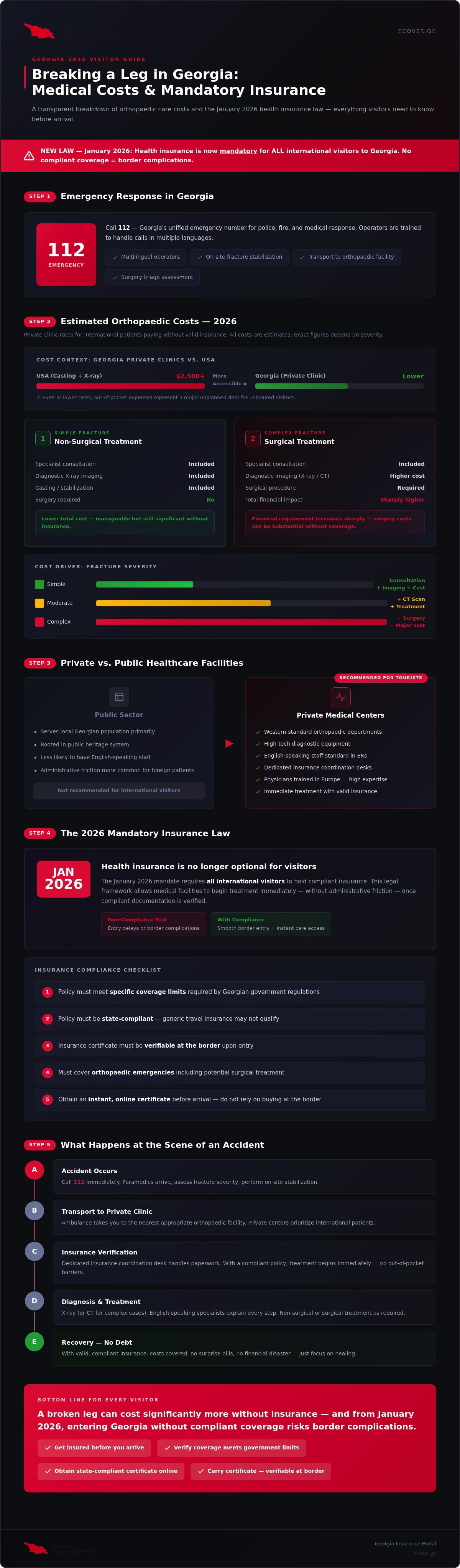
If an accident occurs, your primary point of contact is the 112 emergency service. This unified system coordinates police, fire, and medical responses across the country. Operators are trained to handle calls in multiple languages, ensuring that help is dispatched efficiently regardless of where you are. Once the ambulance arrives, paramedics perform on-site stabilization. If a fracture is suspected, you'll be transported to the nearest appropriate facility equipped for orthopaedic care. Triage procedures are methodical; medical staff will assess the severity of the break to determine if immediate surgery is required or if the injury can be managed with stabilization and casting. This efficient response is a cornerstone of the national medical network's commitment to visitor safety.
Estimated Costs of Orthopaedic Care in Georgia (2026)
Understanding the financial impact of a medical emergency is essential for any traveler. While medical rates in this region are generally more affordable than Western European or US averages, "cash" prices at private facilities are structured specifically for international patients. The actual cost of breaking a leg in Georgia depends heavily on the severity of the fracture and the required level of intervention. According to World Health Organization data on Georgia's health system, the country has seen significant private sector growth, which maintains high clinical standards but also results in premium pricing for those without valid coverage. Since the January 2026 mandate requires all visitors to hold compliant insurance, these costs should ideally be managed by your provider rather than your personal savings.
Compared to the US, where casting and X-rays can exceed $2,500, Georgian private clinics offer a more accessible price point. However, for a visitor paying out-of-pocket, the expenses still represent a major unplanned debt. If your injury involves a simple fracture, your bill will cover the consultation, diagnostic imaging, and materials. If the break is complex, the financial requirement increases sharply due to surgical needs. Securing a travel insurance policy before you arrive ensures that you aren't forced to navigate these financial hurdles during a medical crisis.
Diagnostic and Treatment Price Ranges
Initial consultations at private orthopaedic centers are the first step in your care. You'll pay for the specialist's expertise and the diagnostic imaging required to confirm the extent of the damage. X-rays are the standard, but the price increases if the doctor requires multiple angles or a CT scan to assess joint involvement. For a simple fracture, the cost includes the professional application of a plaster or fiberglass cast. Surgical intervention for compound fractures is significantly more expensive. These cases involve operating room fees, anesthesia, and the cost of specialized hardware like titanium plates or screws.
Ancillary Medical Expenses
Don't overlook the secondary costs that accumulate during the recovery process. These items are often billed separately from the main procedure and can include:
- Medications: Pain management and prescription anti-inflammatories are necessary for comfortable recovery.
- Mobility Aids: Crutches, walking boots, and knee braces are rarely included in the base treatment price.
- Follow-up Care: You'll need additional appointments for cast adjustments or to monitor surgical healing.
- Rehabilitation: If the injury is severe, you might require physical therapy sessions to regain mobility before you're cleared for travel.
These "hidden" costs can add up quickly. By following the 2026 legal requirements for insurance, you avoid the stress of tracking individual line items while you focus on your health.
Private vs. Public Facilities: Choosing the Right Care
Deciding where to receive treatment is a critical step that directly impacts your recovery experience. Most international visitors opt for private medical centers because these facilities are specifically designed to cater to foreign patients. While the public system provides essential services, it often faces higher patient volumes and longer wait times for non-emergency procedures. If you're concerned about the total cost of breaking a leg in Georgia, you should know that private clinics offer transparent billing structures that align with international insurance standards. This clarity is especially important given the 2026 mandate, which requires visitors to hold a valid policy. You can find more details in our comprehensive guide on health insurance for tourists in Georgia.
Billing practices for non-residents differ from those for Georgian citizens. In the public system, foreigners are typically charged at "out-of-pocket" rates that, while regulated, don't benefit from the same subsidies as local residents. Private facilities, on the other hand, operate on a fee-for-service model. They're equipped to handle direct billing with insurance providers, which prevents you from having to pay large sums upfront. If you choose a public facility, be prepared for administrative processes that may not be as streamlined for English speakers, potentially complicating the documentation needed for your insurance claim.
The Private Healthcare Advantage
Private clinics provide immediate access to state-of-the-art orthopaedic technology. If your injury requires an MRI or a complex CT scan to assess joint damage, private centers typically have this equipment on-site with minimal wait times. These facilities also maintain a high density of specialists, ensuring that an orthopaedic surgeon is available for consultation shortly after your arrival. The administrative staff in these centers are accustomed to working with international providers, making the process of verifying your coverage and filing a claim much more efficient.
When to Utilize Public Medical Services
There are specific scenarios where public medical services are the most practical choice. If an accident happens in a remote mountainous area, the nearest public hospital is often the only facility capable of providing emergency stabilization. These hospitals follow standard protocols for admissions and are vital for initial triage. While you might seek a transfer to a private facility for long-term care or surgery, the public sector's role in immediate trauma response is indispensable. For minor fractures that only require basic stabilization, a public clinic can be a cost-effective alternative, though you should weigh this against the potential for longer wait times and limited English-speaking support.
The 2026 Mandate: Why Insurance is No Longer Optional
As of January 2026, the legal framework for visiting the Republic of Georgia has fundamentally changed. Travel medical insurance is now a mandatory requirement for all international visitors entering the country. This legislation was implemented to ensure that every traveler has immediate access to high-quality care without placing a strain on the national healthcare infrastructure. If you plan to visit this year, you must possess a policy that meets specific government standards before you reach the border. This law effectively eliminates the financial uncertainty regarding the cost of breaking a leg in Georgia, as compliant policies are designed to cover the high-stakes expenses associated with orthopaedic emergencies. You can review the full details of these regulations in our guide to the Georgia mandatory insurance law.
Arriving at the border without valid proof of coverage leads to immediate logistical complications. Border authorities are strictly enforcing this mandate, and failure to present a compliant certificate can result in entry denial or significant delays at passport control. Beyond the legal necessity, this mandate serves as a critical safety net. It prevents visitors from facing the full out-of-pocket cost of breaking a leg in Georgia, which we previously established can be substantial at private clinics. To ensure a seamless entry, you can obtain a state-compliant insurance certificate online before your flight departs.
Border Entry Requirements for 2026
Passport control officers now require specific documentation to grant entry. Your insurance certificate must be issued by a recognized provider and clearly state that it meets the 2026 minimum coverage limits for accidents and emergencies. Georgian border authorities utilize a digital verification system to cross-reference policies against the national registry of licensed insurers. If your documentation is incomplete or doesn't meet the state-mandated coverage thresholds, you'll be required to rectify the situation before proceeding. It's best to carry a digital copy on your phone and a printed backup to avoid any technical hurdles during the verification process.
Financial Protection Against Accidents
Mandatory insurance does more than satisfy a legal requirement; it caps your financial exposure. Under the new law, a compliant 2026 policy ensures that the cost of surgery, hospitalization, and diagnostic imaging is handled by the insurer. Relying on a 'cash pay' strategy is now a high-risk approach that's no longer legally viable for entry. By securing a policy that is licensed by the LEPL Insurance State Supervision Service of Georgia, you gain the peace of mind that your treatment will begin immediately without the need for upfront personal funds. This system protects your travel budget and ensures that a physical injury doesn't lead to long-term financial trauma.
Securing Compliant Coverage with E-COVER
E-COVER acts as your essential facilitator in meeting the 2026 legal requirements for entry. As an insurer licensed by the LEPL Insurance State Supervision Service of Georgia, we provide policies that are fully compliant with the national health mandate. While the potential cost of breaking a leg in Georgia can be high at private clinics, our coverage ensures that these financial burdens are professionally managed. We focus on providing a seamless transition from the border to the medical center, allowing you to enjoy your journey with total security. For a deeper look at the specific benefits included in our plans, you can read our Georgia travel medical policy guide.
Our role is to bridge the gap between international visitors and the local regulatory environment. By choosing a locally licensed provider, you ensure that your documentation is instantly recognized by border authorities and medical staff alike. This recognition is vital during a crisis, as it allows for immediate treatment without the administrative delays often associated with foreign, non-compliant policies. We handle the technical details of the 2026 law so you can focus on your recovery and travel experience.
Instant Online Issuance Process
Obtaining your mandatory coverage is a straightforward digital process designed for efficiency. You simply enter your travel dates and personal details into our secure online portal. Once you complete the payment, the system generates your official insurance certificate as a PDF file. This happens instantly. This speed is vital for travelers who are already at the border or those who have made last-minute plans. You should save the digital certificate on your mobile device for immediate presentation at passport control. If you lose your digital copy, you can access our mobile-friendly platform to retrieve your documentation at any time.
Claims and Support for Broken Leg Injuries
If an accident occurs, our support team is available to guide you through the medical network. You must contact us as soon as possible after sustaining an injury to initiate the claims process. For orthopaedic injuries like a broken leg, we prioritize direct billing with our partner private clinics. This means the facility bills us directly, which eliminates the need for you to pay large sums out-of-pocket. If you receive care at a facility outside our direct network, you'll need to provide specific documentation for reimbursement. This includes the official medical report, diagnostic results, and all itemized receipts. Having these documents ready ensures that we can process your claim without delay, protecting you from the unexpected financial impact of your injury.
Prepare for a Seamless Georgian Adventure
Understanding the financial and legal landscape is the first step toward a successful trip. While private medical facilities provide high standards of orthopaedic care, the out-of-pocket cost of breaking a leg in Georgia can disrupt even the most well-planned budget. Since the January 2026 mandate makes travel medical insurance a firm requirement for entry, securing a compliant policy is no longer just a recommendation; it's a legal necessity for crossing the border.
You can avoid logistical hurdles and protect your finances by choosing a locally licensed provider. E-COVER offers policies that are 100% compliant with 2026 border requirements and licensed by the Insurance State Supervision Service of Georgia. Our system ensures instant policy issuance so you can satisfy the law even if you're already on your way. Get your mandatory 2026 Georgian travel insurance instantly and focus on the incredible experiences that wait for you in this beautiful country. We're here to help you navigate the regulations so you can travel with confidence.
Frequently Asked Questions
Is medical insurance mandatory for all visitors to Georgia in 2026?
Yes. Starting January 2026, the Georgian government requires all international travelers to hold mandatory health insurance for the duration of their stay. This is a strict legal requirement for entry at all border crossings. E-COVER provides policies that meet the specific coverage limits and standards mandated by the state. If you don't have a compliant certificate, you may be denied entry or face significant logistical delays during the passport control process.
What is the average cost to treat a broken leg in Georgia without insurance?
The cost of breaking a leg in Georgia depends on the severity of the fracture and the facility you choose. At a private clinic, a simple fracture requiring X-rays and casting can cost several hundred dollars. If your injury requires surgery or a hospital stay, the expenses can quickly rise into the thousands. Without insurance, you are responsible for these out-of-pocket costs. Having a compliant policy ensures your medical bills are handled by your provider.
Will my standard global travel insurance be accepted at the Georgian border?
Your global policy will only be accepted if it meets the exact minimum coverage limits and legal standards set by the Georgian government for 2026. Border authorities cross-reference certificates against a national registry of licensed providers. Many standard international plans don't automatically align with these local requirements. Using a locally licensed broker like E-COVER guarantees that your insurance is 100% compliant, allowing you to pass through passport control without any administrative hurdles or verification issues.
Are Georgian hospitals equipped for complex orthopaedic surgeries?
Yes, Georgia's private medical network features modern facilities that are fully equipped for complex orthopaedic procedures. Many surgeons in these centers have received international training and utilize Western-standard diagnostic technology. These clinics are capable of performing advanced surgeries, including internal fixation with plates and screws. Most international visitors prefer these private facilities because they offer streamlined administrative processes, high-quality care, and English-speaking specialists who can guide you through every stage of your recovery process.
How do I prove I have the mandatory health insurance at the border?
You prove your coverage by presenting an official insurance certificate at the border. This document must be issued by a licensed provider and include your policy number and coverage dates. Border authorities use a digital system to verify that your insurance meets the 2026 state mandates. It's highly recommended to keep a digital copy on your phone and carry a printed version as a backup. E-COVER provides instant certificates that are specifically designed for quick border verification.
Does E-COVER insurance cover medical repatriation if I break my leg?
Our travel medical insurance policies are designed to satisfy the comprehensive coverage requirements set by the Georgian government for 2026. This includes emergency medical assistance and stabilization for orthopaedic injuries. You should check your specific policy documents for details regarding medical evacuation or repatriation services. Our primary goal is to ensure you receive immediate care at top-tier facilities while remaining in full compliance with national laws, protecting you from the high expenses associated with emergency treatment.
Can I buy the mandatory insurance after I have already arrived in Georgia?
You can purchase an E-COVER policy online at any time, but you must have it before you pass through passport control. The 2026 law requires all visitors to present proof of insurance as a condition of entry into the country. If you arrive at the border without coverage, you can use our mobile-friendly platform to obtain an instant certificate. However, securing your policy before you travel is the most efficient way to ensure a stress-free entry.
What should I do first if I suspect I have broken a bone in Georgia?
If you suspect a fracture, you should immediately call 112, which is Georgia's unified emergency service. They will dispatch an ambulance to transport you to the nearest appropriate medical facility. After you receive initial triage, you must contact E-COVER to report the accident. We will coordinate with the hospital to manage the billing process. You should keep all medical reports and receipts, as these are necessary for processing your claim and verifying your treatment details.


