

Imagine standing at the immigration desk with your passport in hand, only to be told you cannot pass because your international health policy doesn't meet the new state standards. Many travelers are surprised to find themselves denied entry to Georgia no insurance that meets the 2026 mandate is considered valid by border police. Even seasoned digital nomads with reputable global coverage are finding their documents rejected because they don't carry a certificate that satisfies specific local regulations.
It's frustrating to plan a journey only to hit a legal wall at the final step. We understand that navigating administrative shifts feels overwhelming, especially when your travel plans are at stake. This guide explains exactly why officials are turning people away and how you can secure a policy that meets the strict 2026 legal requirements. You'll find a clear checklist of what the border police look for during inspections and a straightforward path to fixing non-compliance before you even board your flight.
Key Takeaways
- Understand the 2026 legal mandate to ensure you aren't denied entry to Georgia no insurance that fails state-specific standards will be accepted by border police.
- Learn the critical differences between generic global travel plans and the state-compliant coverage required by the LEPL Insurance State Supervision Service.
- Prepare for the official inspection by knowing which document formats and coverage details the Georgian Border Police expect to see.
- Follow a pre-departure checklist to verify that your insurance limits and dates align with the mandatory 2026 regulations.
- Discover how to obtain a compliant digital certificate in under two minutes if you need to resolve a documentation gap at the checkpoint.
The 2026 Mandate: Why Travelers are Denied Entry to Georgia
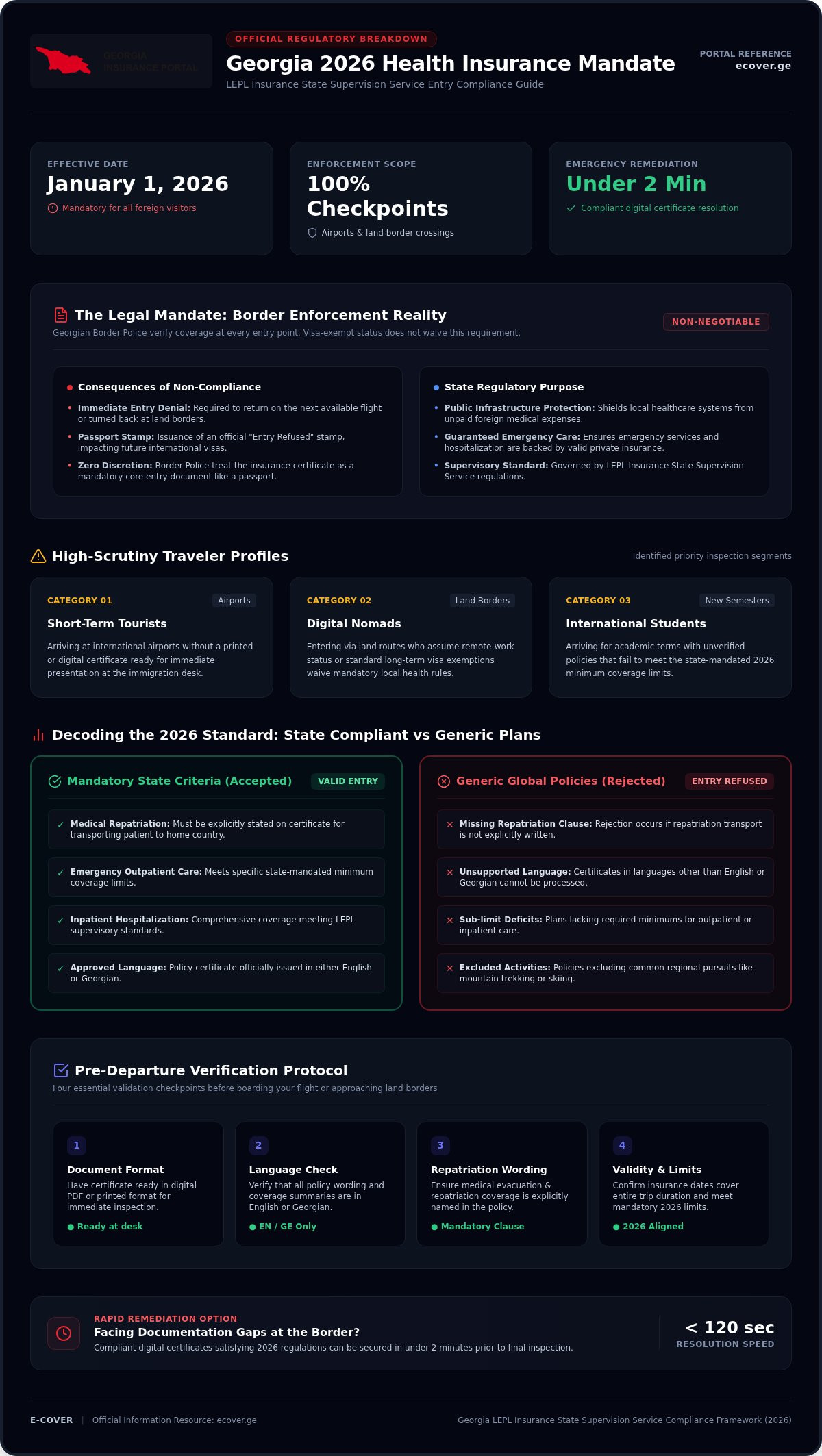
Effective January 1, 2026, Georgia is implementing a strict health insurance mandate for all foreign visitors. This isn't a suggestion. It's a mandatory legal requirement that applies to every foreign national crossing the border, regardless of their country of origin or visa status. While previous years might have felt more relaxed, the new decree gives Border Police full authority to verify documentation at every checkpoint. If you're found without a policy that meets the state's specific criteria, you face being denied entry to Georgia no insurance is a non-negotiable barrier to crossing the threshold.
This shift aligns with global travel insurance requirements where nations seek to protect their public infrastructure from unpaid medical bills. In Georgia, "denied entry" means you'll be required to return to your point of origin on the next available flight or turn back at the land border. It's a logistical and financial nightmare that is entirely preventable with the right paperwork. The Border Police treat the insurance certificate as a core entry document, just as essential as your passport itself.
A common mistake travelers make is assuming that visa-free status implies a bypass of all entry requirements. This isn't the case. Whether you're arriving from a visa-exempt nation or traveling on a pre-approved visa, the mandate applies to you equally. If you can't present a certificate that matches the specific 2026 state standards, officials have the full legal authority to stop your journey immediately. Being denied entry to Georgia no insurance in hand is now a standard administrative procedure for non-compliant visitors.
The Legal Basis for Insurance-Based Rejection
The Georgian government decree was established to ensure every visitor has access to quality medical care without straining the local healthcare system. By requiring visitors to carry their own coverage, the state ensures that emergency services and hospital stays are funded by private insurers rather than public tax revenue. If a traveler can't prove they have this safety net, officials have a legal obligation to refuse entry. This often results in an "Entry Refused" stamp in the passport, which can complicate future international travel plans and visa applications.
Who is Most at Risk of Being Turned Away?
While the law applies to everyone, certain groups are more likely to face scrutiny during the arrival process. Border officials often prioritize checks on those intending to stay for longer durations or those entering via land routes. You are particularly at risk if you fall into these categories:
- Short-term tourists: Arriving at international airports without a printed or digital certificate ready for immediate inspection.
- Digital nomads: Entering via land borders who assume their remote-work status or long-term visa exemption removes the need for local health mandates.
- International students: Arriving for the new semester without verified insurance that meets the 2026 state minimum coverage limits.
Decoding the 2026 Requirements: Why Your Policy Might Fail
Many travelers believe any international policy is sufficient for entry. This is a common misconception. It often results in being denied entry to Georgia no insurance that meets the 2026 state-specific criteria is simply not accepted by border officials. The LEPL Insurance State Supervision Service of Georgia has established strict minimum coverage limits that differ from standard global policies. While a general plan might cover you for basic travel mishaps, it may not include the mandatory minimums for emergency outpatient care or inpatient hospitalization required by Georgian law.
When choosing a compliant travel insurance policy, you must ensure it specifically addresses medical repatriation. This is a non-negotiable requirement for 2026. If your policy certificate doesn't explicitly state coverage for transporting you back to your home country for medical reasons, border police will likely reject it. These administrative details are what separate a valid entry document from a reason for rejection.
Common Reasons International Policies are Rejected
Even if your policy has high coverage limits, it can still fail the border check. One primary reason is the language of the certificate. Officials require documentation in either English or Georgian. If your policy is in another language, it's effectively invisible to the system. Additionally, many global policies exclude high-risk activities like mountain trekking or skiing, which are central to the Georgian tourism experience. If your insurance doesn't cover these activities, it may be deemed insufficient for your stay. Checking your coverage details against a Georgia travel medical policy guide is the most effective way to avoid these pitfalls.
The Verification Process at the Border
Border agents don't just glance at your papers. They use digital databases to verify the validity and active status of your insurance. Your policy must be active from the very first minute you land or cross the land border. If there's a gap between your arrival time and the policy start time, you risk being denied entry to Georgia no insurance coverage at the moment of inspection means you're non-compliant. To ensure your documentation is instantly recognized by local authorities, you can view state-licensed options that provide immediate digital certificates. These policies are designed to sync with the state’s verification systems, providing a seamless transition through immigration.
The Border Checkpoint Experience: What to Expect
When you approach the immigration booth, the officer's primary task is to verify your identity and your eligibility to enter. After you present your passport, the standard procedure involves a direct request for your health insurance documentation. This is where many travelers encounter friction. If your documents aren't readily available or don't meet the 2026 standards, you risk being denied entry to Georgia no insurance is a common trigger for immediate refusal at the gate. The process is brisk, and officers expect clear, compliant proof without delay.
Regarding format, the Georgian Border Police accept both physical and digital proof. While a digital PDF on your smartphone is usually sufficient, it's wise to have a printed copy as a backup. Electronic devices can run out of battery or lose signal at critical moments. If the officer can't view the policy details, they cannot verify your coverage. Having a physical document ensures that the verification process remains smooth regardless of technical hurdles.
If your policy appears unfamiliar or lacks clear Georgian or English text, you might be pulled aside for secondary inspection. This isn't necessarily a cause for alarm, but it does mean your entry will be delayed. During this time, officials will cross-reference your policy number and coverage limits with their internal database. If the policy is found to be non-compliant, the consequences are immediate. You'll either be required to purchase a state-approved policy on the spot or, in some cases, face immediate deportation back to your point of origin.
Step-by-Step Border Inspection Workflow
- Initial Request: The officer asks for your passport and health insurance certificate immediately upon arrival.
- Date Verification: The agent checks that your policy is active on the day of entry and remains valid for your entire intended stay.
- Coverage Review: The official verifies that the policy meets the 2026 state-mandated limits for emergency and inpatient care.
- Final Approval: Once the certificate is validated, you receive your entry stamp and proceed to baggage claim.
Handling Language Barriers During Inspection
Language gaps can turn a routine check into a stressful ordeal. This is why having a policy from a recognized local provider like E-COVER is a significant advantage. Because these policies are issued under the license of LLC Insurance Broker WeInsure and supervised by the state, border agents recognize the format and branding instantly. There's no need for translation or lengthy explanations. If an agent questions your documentation, simply point to the official license information on the certificate. This immediate recognition helps you avoid being denied entry to Georgia no insurance confusion and ensures you move through the checkpoint with minimal friction.
Preventing Rejection: A Pre-Departure Compliance Checklist
Avoiding a stressful situation at the border requires proactive steps. If you arrive prepared, you'll pass through immigration in minutes. If you don't, you risk being denied entry to Georgia no insurance that matches local law is a major red flag for agents. The 2026 mandate is strict, and border officials have little room for discretion. Use this checklist to verify your status before you board your flight.
- Verify Policy Dates: Your insurance must cover every single day you're in the country. If your policy expires even one day before your departure, it's considered invalid for entry.
- Confirm Coverage Limits: Ensure your policy meets or exceeds the 2026 state minimums for hospitalization and outpatient care. Generic plans often fall short of these specific figures.
- Print a Hard Copy: While digital certificates are accepted, a physical backup is essential. If your phone battery dies or you can't access your email at the checkpoint, you won't be able to prove compliance.
- Ensure State Registration: Your policy should be issued by a provider that syncs with Georgian state systems. This allows the border police to verify your coverage instantly in their database.
Is Your Global Policy 2026-Compliant?
Many international plans lack the specific wording required by Georgian authorities. You should cross-reference your current documents with the latest Georgia travel insurance requirements to see if you're truly protected. If your global provider doesn't offer a specific certificate for Georgia, it's safer to buy a secondary, local policy. This health insurance for tourists in Georgia checklist can help you identify gaps in your current coverage before you reach the immigration desk.
Special Considerations for Long-Term Visitors
Students and digital nomads face higher scrutiny because they stay longer. If you're studying, consult the student health insurance Georgia guide to understand local academic mandates. One critical detail is that recurring monthly policies are often rejected at the border. Officials prefer a single certificate covering the entire duration of your stay. If you don't have this, you might be denied entry to Georgia no insurance provider can guarantee entry unless their policy matches your visa duration exactly. To ensure your trip stays on track, you can secure a fully compliant travel insurance policy in just a few clicks.
Instant Remediation: Securing Insurance at the Border
If you're standing at the immigration desk and realize your current policy is insufficient, don't panic. While you face being denied entry to Georgia no insurance in hand, there's a practical way to resolve the issue without leaving the checkpoint. You can use your mobile data or the terminal Wi-Fi to purchase a compliant policy immediately. This last-minute remediation is often the only thing standing between a successful entry and being sent back on the next available flight. It's a high-pressure moment, but the solution is entirely digital and accessible from your phone.
Digital issuance is the key to this process. Because the 2026 mandate requires specific coverage, you need a document that officials can verify on the spot. E-COVER provides instant digital certificates via email in under two minutes. This speed is critical when an officer is waiting for proof. Once you receive the PDF, it’s immediately recognized by the state’s internal verification systems. Since the policy is issued under a license supervised by the LEPL Insurance State Supervision Service, it carries the necessary administrative weight to satisfy border requirements instantly.
How to Buy E-COVER Insurance on Your Phone
The purchase process is designed for travelers in high-pressure situations. You don't need to fill out lengthy forms or wait for a manual review. Simply follow these three steps: enter your passport and personal details, select your travel dates, and complete the payment. The system accepts all major international credit and debit cards, ensuring you aren't blocked by local payment restrictions. This efficiency makes it the preferred choice for those needing mandatory Georgia travel insurance that meets every legal standard for 2026.
Finalizing Your Entry After Purchase
As soon as the transaction is complete, check your inbox for the digital certificate. You can present this PDF directly to the border officer on your screen. Since the policy is state-aligned, the officer can quickly cross-reference the policy number in their database to confirm it's active. Once they verify the coverage limits, you'll receive your entry stamp and can proceed to baggage claim. This instant fix ensures you aren't denied entry to Georgia no insurance problems will no longer stand in your way. You can then start your journey with complete peace of mind, knowing you're legally protected and fully compliant with the new laws. It's the most reliable way to turn a potential travel disaster into a minor logistical delay.
Ensure Your Georgian Journey Begins Without Delay
The 2026 insurance laws represent a significant shift in how the state manages visitor safety and public resources. By understanding the specific coverage limits for hospitalization and repatriation, you can avoid the logistical hurdles that lead to travelers being denied entry to Georgia no insurance issues are easily preventable with the right documentation. Remember that border agents require state-aligned certificates that are instantly verifiable in their local database.
Compliance doesn't have to be complicated. You can secure your 2026 compliant health insurance for Georgia now and receive a policy that is fully licensed by the Insurance State Supervision Service of Georgia. With instant digital policy issuance, you'll have the exact proof required for a stress-free entry. Taking this small step today ensures you can focus on the beauty of your destination rather than administrative paperwork at the immigration desk. We look forward to welcoming you to a safe and secure stay.
Frequently Asked Questions
Can I really be denied entry to Georgia for not having insurance in 2026?
Yes. Effective January 1, 2026, the Georgian government requires all foreign visitors to have mandatory health insurance. Border Police have the legal authority to request proof upon arrival. Failure to produce a compliant certificate will result in being denied entry to Georgia no insurance is considered a breach of entry protocols. This rule applies to everyone, including those from visa-exempt countries, making it essential to have your digital or physical certificate ready for inspection.
Does Georgia accept international insurance like SafetyWing or World Nomads?
It depends on the specific policy details. While these providers offer global coverage, your certificate must explicitly meet the 2026 state-mandated minimums and include medical repatriation. Many international policies are rejected because they lack a clear English or Georgian certificate that syncs with the state's verification systems. It's safer to use a state-licensed provider like E-COVER to ensure your documentation is recognized immediately by border officials without the need for manual translation or lengthy verification.
What is the minimum medical coverage required to enter Georgia in 2026?
The exact minimum coverage limits for 2026 are finalized by the LEPL Insurance State Supervision Service of Georgia. Policies must include emergency outpatient care, inpatient hospitalization, and medical repatriation. You should verify that your policy meets these specific state minimums before travel. Using a local, licensed broker ensures your plan is automatically updated to reflect any regulatory changes made by the state authorities, protecting you from administrative rejection at the border checkpoint during the arrival process.
Is there an age limit for the mandatory health insurance policy?
No, the mandate applies to all foreign visitors regardless of age. Every traveler, including children and seniors, must possess an individual or group insurance certificate that covers the entire duration of their stay. While premium costs might vary based on the traveler's age, the legal requirement for coverage remains the same for everyone entering the country under the 2026 mandate. Ensure that each member of your traveling party has a valid certificate ready for the officer to review.
Can I buy the mandatory insurance after I have already arrived at the border?
Yes, you can purchase insurance at the checkpoint using your mobile device. E-COVER provides instant digital certificates via email in under two minutes, allowing you to rectify a compliance issue before being formally processed. However, you cannot clear immigration until you present a valid certificate. Purchasing your policy before you land is the most efficient way to avoid being denied entry to Georgia no insurance proof ready for inspection can lead to significant and stressful travel delays.
What happens if my trip is longer than my insurance coverage period?
Your entry will likely be refused or limited. The Border Police verify your insurance dates against your intended stay or visa duration. If your policy expires before your planned departure, it's considered non-compliant. You must ensure your coverage spans every single day of your visit. If you decide to extend your stay while in the country, you must renew your policy to maintain legal status and avoid fines or issues when you eventually depart through immigration.
Do I need insurance if I am just transiting through Georgia?
If you stay within the international transit area of the airport, you generally don't need insurance. However, if you intend to pass through passport control to enter the country, even for a few hours, the 2026 mandate applies. Any traveler who crosses the official state border must present a valid health insurance certificate to the Border Police to satisfy legal entry requirements. This includes short layovers where you plan to leave the airport for local sightseeing or overnight rest.
Is the insurance requirement the same for land borders and airports?
Yes, the 2026 mandate is a national law that applies at all official points of entry. Whether you're arriving by air or crossing a land border, the inspection process remains consistent. Border agents at all locations have access to the same verification databases and the authority to deny entry to anyone failing to produce a compliant insurance certificate. This ensures that every visitor has access to medical care regardless of how they choose to enter the country's territory during their journey.


