

Your generic international travel policy might seem sufficient on paper, but entering the country of Georgia without verified statutory coverage can halt your journey before you even clear departure checks. Under Government Ordinance No. 602, foreign professionals face uncompromising border enforcement rather than flexible recommendations. Securing compliant Georgia health insurance for remote workers is now an absolute legal requirement, backed by mandatory document inspections and border entry fines starting at 300 GEL for non-compliant arrivals.
Sorting through foreign administrative mandates can easily cause friction, particularly when distinguishing between standard international certificates and strict national entry rules. We understand the worry of facing unexpected medical expenses or foreign bureaucratic delays. This 2026 guide walks you through every statutory requirement, including the mandatory 30,000 GEL coverage threshold for emergency treatment and repatriation, helping you evaluate compliant policy options with total certainty. You'll examine accepted English-language policy formats, learn how to obtain an instantly issued certificate, and ensure uninterrupted medical protection across your extended stay nationwide.
Key Takeaways
- Understand mandatory 2026 statutory entry regulations requiring verified emergency treatment and repatriation cover for your full duration of stay.
- Discover how securing verified Georgia health insurance for remote workers eliminates the risk of airport boarding denials and border entry penalties nationwide.
- Evaluate the practical differences between international travel plans and state-licensed policies, especially regarding out-of-pocket claims and direct billing access.
- Learn the step-by-step process to secure an instantly issued, bilingual digital policy certificate that satisfies strict border checks prior to departure.
- Identify how foreign professionals transition from baseline entry compliance to comprehensive, long-term medical protection across national private clinic networks.
Understanding Healthcare Requirements for Remote Workers in Georgia
Relocating your workstation to the country of Georgia offers incredible lifestyle flexibility, but online research often causes confusion. Many guides mistakenly conflate the sovereign nation in the South Caucasus with the U.S. state of Georgia, leaving remote professionals unprepared for national immigration requirements. The healthcare system in Georgia relies heavily on a privatized medical model where the state-funded Universal Healthcare Program excludes foreign nationals entirely. Remote contractors and digital nomads entering the country bear full financial responsibility for any hospital visits or medical procedures. To protect travelers and the national medical infrastructure, authorities enforce strict entry mandates. Securing compliant Georgia health insurance for remote workers is no longer optional; it's a legal prerequisite for your entire stay nationwide.
The 2026 Mandatory Insurance Framework for International Visitors
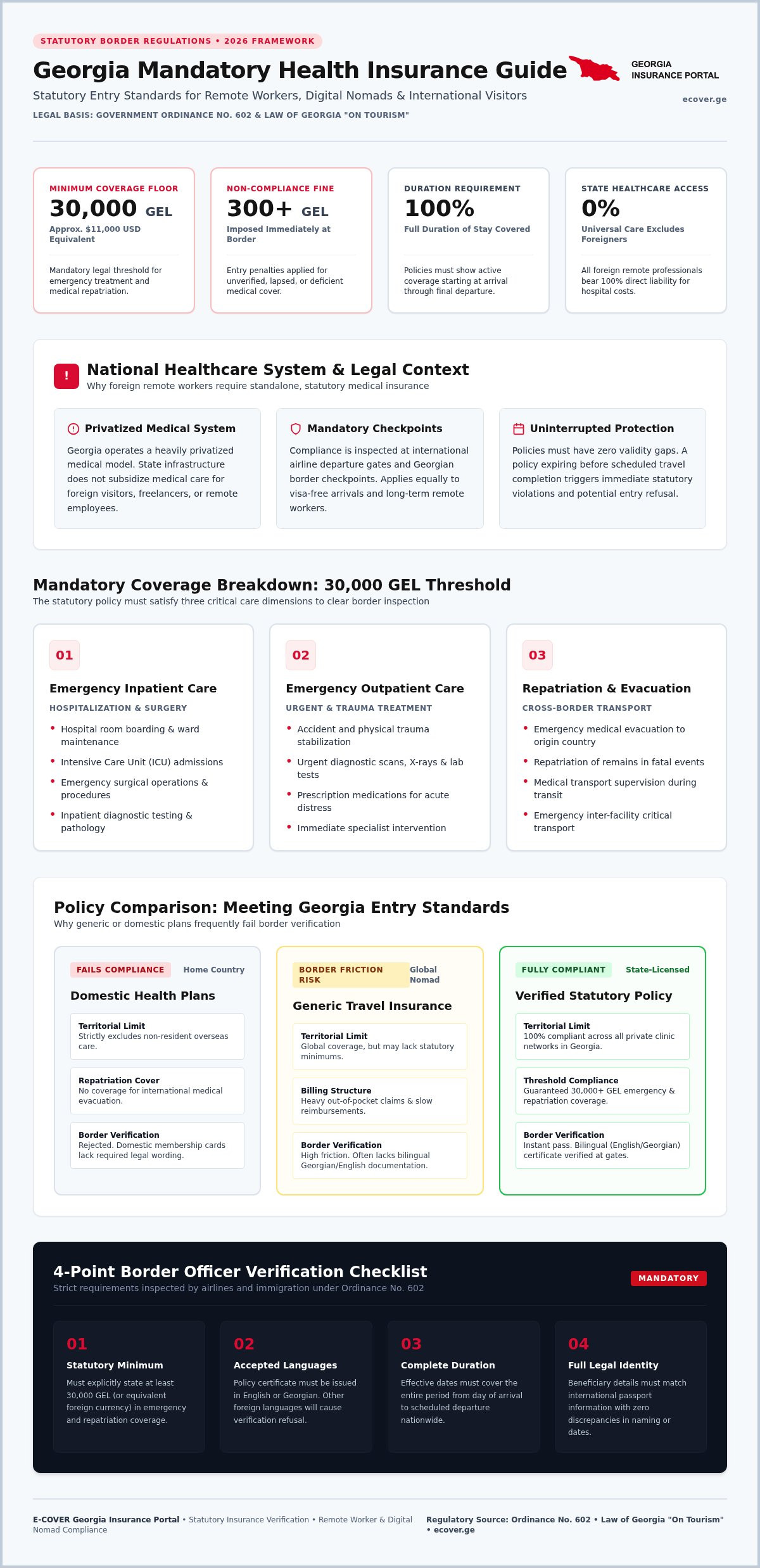
Under Government Regulation No. 602 and the Law of Georgia "On Tourism," every non-resident entering the country must present valid emergency medical and accident coverage. This mandate applies to tourists, self-employed freelancers, and long-term remote workers alike, regardless of whether you enter under a visa-free regime. For a detailed breakdown of the legal framework, review our analysis of the Georgia mandatory insurance law. Border authorities and international airlines enforce these rules directly at departure gates and entry checkpoints. If you arrive without a verifiable policy that covers your full duration of travel, immigration officials can deny entry or impose immediate administrative penalties.
Why Traditional Domestic Health Policies Fall Short Abroad
Many remote professionals assume their home-country employer benefits or domestic private plans will protect them abroad. In practice, traditional domestic policies rarely satisfy national border control for several reasons:
- Territorial Restrictions: Domestic health policies typically restrict inpatient and outpatient cover to your home nation, excluding overseas treatments.
- Repatriation Gaps: Routine domestic plans almost never cover international medical evacuation or emergency repatriation back to your origin country.
- Border Verification Failures: Border officers require explicit documentation in English or Georgian stating statutory coverage minimums, your full legal name, and active policy dates. Standard insurance cards or domestic member portal printouts do not meet these verification standards.
Failing to present dedicated Georgia health insurance for remote workers leaves you exposed to immediate border complications and catastrophic out-of-pocket medical bills.
Core Coverage Criteria: What Every Remote Worker Policy Must Include
Securing proper protection requires looking past generic travel perks and examining exact statutory criteria. Meeting the baseline for Georgia health insurance for remote workers means fulfilling specific coverage mandates established by national authorities. A valid policy must provide complete financial protection against acute medical events, avoiding the common coverage gaps that disqualify standard foreign traveler policies.
Emergency Inpatient and Outpatient Care Standards
Statutory regulations require a minimum coverage floor of 30,000 GEL (roughly $11,000 USD) per individual. As outlined in the U.S. Embassy alert on Georgian health insurance requirements, this mandatory sum ensures visitors cover emergency treatments without straining local public resources. Compliant policies must cover emergency inpatient care, including hospital room boarding, surgical operations, intensive care, and critical diagnostic testing. Urgent outpatient care, trauma treatments, and doctor-prescribed medications for acute distress must also fall under the covered benefits. You can review the baseline standards in our detailed breakdown of mandatory Georgia travel insurance before selecting a plan.
Medical Repatriation and Evacuation Protections
Severe injuries and complex illnesses often require specialized transit, making repatriation provisions a mandatory legal requirement rather than an optional add-on. Your policy must explicitly fund emergency medical evacuation to qualified facilities and emergency repatriation back to your country of citizenship. Without certified repatriation coverage, cross-border emergency transfers require lengthy administrative authorizations and substantial out-of-pocket payments. Remote professionals should verify that their plan includes no restrictive transit exclusions that could halt emergency travel.
Policy Verification and Border Documentation Requirements
Immigration officials and airline check-in staff inspect policy paperwork against strict national standards. Your document must clearly state your full legal name matching your passport, policy start and end dates covering your entire intended stay, explicit nationwide territorial validity, and the 30,000 GEL liability limit. Border inspection staff cross-check certificates against digital insurance registers to prevent fraudulent or unaccredited submissions. Policy certificates must be written in English or Georgian. If you're arranging your stay, selecting verified digital nomad insurance ensures your documentation clears border inspections immediately.
Comparing Health Insurance Options: Global Nomad Plans vs. Local Broker Policies
Choosing the right coverage model shapes your day-to-day healthcare experience across the country. Remote professionals generally weigh two distinct routes: international multi-country plans or policies issued by nationally licensed brokers. While both models aim to provide medical protection, their practical execution, claims handling, and regulatory acceptance at border gates differ substantially. Selecting the most effective Georgia health insurance for remote workers means understanding how these plans operate when you actually need medical care.
Evaluating Multi-Country Digital Nomad Subscription Insurance
Global nomad subscriptions appeal to location-independent workers because they offer seamless cross-border mobility. You can move between countries without terminating your coverage. However, these products often introduce hidden administrative friction. Many global policies operate strictly on a pay-and-claim model, forcing you to fund costly inpatient treatments upfront in local currency before requesting reimbursement weeks later. They also introduce currency conversion losses between foreign currencies and the Georgian Lari. If you're exploring subscription models, review our guide to digital nomad insurance for Georgia to ensure your international policy certificate contains the exact statutory language required by border inspection.
Advantages of Policies Issued by Nationally Regulated Brokers
Securing a policy through a domestic brokerage licensed by the LEPL Insurance State Supervision Service provides clear legal standing. Local brokers work under national insurance supervision frameworks, eliminating compliance doubts at border checkpoints. More importantly, domestic policies link directly into national private hospital systems. Rather than paying upfront and collecting translated discharge summaries, policyholders can access direct billing arrangements across major medical networks. According to data highlighted in the World Health Organization Georgia profile, private out-of-pocket spending remains a defining aspect of the country's medical landscape. Nationally integrated policies protect foreign telecommuters from unexpected clinic invoices by facilitating direct settlement between insurers and healthcare providers.
Key Decision Criteria for Extended Remote Work Stays
Evaluating long-term options comes down to three operational factors:
- Deductible Mechanics: Global nomad plans often carry deductibles per claim or policy period, whereas locally regulated options frequently feature zero-deductible structures for emergency interventions.
- Policy Extensions: If you take advantage of the 365-day visa-free regime, your policy must extend seamlessly online without requiring an exit run across international borders.
- Claim Support: When sudden emergencies arise, accessing responsive support aligned with your local time zone prevents stressful administrative delays.
Balancing these criteria ensures your Georgia health insurance for remote workers delivers genuine clinical security rather than just passing the initial border check.
Step-by-Step Guide to Securing Compliant Health Insurance Online
Acquiring certified coverage doesn't require bureaucratic hurdles or local registration documents. International remote professionals can complete the entire process digitally prior to departure. By following a clear, structured sequence, you can secure fully compliant Georgia health insurance for remote workers in minutes, ensuring complete alignment with national immigration criteria before your flight departs.
Selecting Plan Duration and Aligning Coverage Dates
Your policy must match your travel trajectory exactly. When calculating policy duration, establish your start date as your scheduled arrival day and set your termination date to encompass your full intended period in the country. If you plan to utilize the full 365-day visa-free allowance, select long term travel insurance policies or continuous digital nomad insurance to avoid administrative lapses. Mid-stay expirations create legal non-compliance, leaving you vulnerable to spot-check fines or sudden out-of-pocket medical liabilities.
Completing Digital Purchase and Verifying Certificate Integrity
Online issuance platforms eliminate paperwork by generating immediate, verifiable documentation. The purchase requires straightforward information:
- Biographic Match: Enter your full legal name, date of birth, and passport number exactly as they appear in your travel documents to prevent border mismatches.
- Mandatory Coverage Selection: Choose a policy tier explicitly formatted to satisfy statutory emergency inpatient and repatriation minimums.
- Broker Credential Confirmation: Check that your issued certificate displays official licensing markers, such as registration under LLC Insurance Broker WeInsure (licensed by the LEPL Insurance State Supervision Service under License N012063).
Once generated, inspect the digital document to verify that the policy number, coverage period, territorial validity, and legal liability limits are rendered clearly in English.
Carrying and Presenting Proof at Border Control
Airline gate agents and immigration border officers perform rigorous pre-entry document audits. Store an offline digital PDF version on your mobile device, but always carry two printed physical copies in your carry-on luggage. Border personnel inspect documents quickly, and presenting an official, English-language policy certificate with unambiguous broker identifiers prevents secondary inspection delays. You can secure your compliant digital nomad policy online today to guarantee uninterrupted clearance at all national border entry points.
Long-Term Considerations for Living and Working Remotely in Georgia
Settling into an extended stay requires transitioning your mindset from short-term travel compliance to sustainable medical risk management. Because non-residents remain ineligible for public healthcare programs, foreign freelancers must manage ongoing clinical access through the private healthcare market. Securing comprehensive Georgia health insurance for remote workers protects your personal health and shields your professional income from sudden medical expenditures.
Accessing Medical Facilities Across the Country
Private hospital systems and modern medical centers deliver high-quality clinical services nationwide. When seeking treatment, present your physical passport along with your active insurance policy certificate at the reception desk. Depending on your chosen policy structure, facilities coordinate payments through two primary pathways:
- Direct Billing: Approved medical centers settle approved emergency procedures, hospital stays, and surgical care directly with the underwriter, leaving you responsible only for agreed contractual deductibles.
- Pay-and-Claim Reimbursement: You pay the clinic directly for consultations, diagnostics, or prescribed medications, collecting itemized invoices and translated medical reports to submit for post-treatment claims reimbursement.
Handling Policy Renewals and Extended Stay Transitions
Maintaining uninterrupted legal status across multi-month or year-long stays demands proactive schedule management. If you plan to extend your telecommuting setup under the 365-day visa-free regime or transition toward formal residency permits, continuous coverage records are essential. Immigration officers and administrative reviewers evaluate historical policy records for coverage lapses. Always initiate policy renewals at least one week before your existing certificate expires. If you renew or replace your international passport during your stay, update your insurance records promptly to ensure your documentation remains valid.
Securing Reliable Protection with E-COVER
Eliminating regulatory guesswork requires partnering with an established domestic intermediary. E-COVER operates under LLC Insurance Broker WeInsure, officially licensed by the LEPL Insurance State Supervision Service of Georgia under License N012063. This national regulatory backing ensures that every certificate satisfies statutory entry conditions and private medical admittance standards. Whether you need flexible travel insurance policies or specialized digital nomad insurance for extended remote tenures, instant digital delivery guarantees certified protection without bureaucratic friction. Explore your coverage options and Secure Your Compliant Remote Worker Insurance before departing on your journey.
Secure Your Border-Ready Protection for Remote Work in Georgia
Establishing your remote workstation across the country requires aligning your travel preparations with mandatory national entry laws. Fulfilling the statutory 30,000 GEL coverage threshold for emergency treatment and medical repatriation protects your physical well-being while preventing unexpected border fines or boarding refusals. Securing verified Georgia health insurance for remote workers ensures you satisfy immigration checkpoints smoothly and maintain dependable financial protection across private medical facilities nationwide.
Don't let foreign regulatory paperwork disrupt your relocation plans. Through E-COVER, operated by LLC Insurance Broker WeInsure (ID Code 205250967) and licensed by the LEPL Insurance State Supervision Service of Georgia (License N012063), you receive instant certificate delivery fully compliant with 2026 border entry regulations. Take the final step to protect your health, satisfy immigration authorities, and Secure Your Compliant Remote Worker Insurance so you can focus on your professional journey with complete peace of mind.
Frequently Asked Questions
Is health insurance legally mandatory for remote workers entering Georgia in 2026?
Yes, health insurance is legally mandatory under Government Regulation No. 602 and the Law of Georgia "On Tourism" for all international visitors entering the country. Remote professionals and digital nomads entering under visa-free entry rules must maintain valid coverage for their entire stay. Airline check-in agents and border officials verify policies before permitting entry, and arriving without verified insurance can result in immediate boarding denial or administrative fines.
What specific medical coverage amounts does the 2026 Georgian entry law require?
The law establishes a mandatory minimum coverage limit of 30,000 GEL (roughly $11,000 USD) per traveler. This statutory limit must cover emergency inpatient hospitalization, accidental trauma care, urgent outpatient treatment, and emergency medical repatriation. Securing Georgia health insurance for remote workers that meets or exceeds this 30,000 GEL threshold ensures complete entry compliance and shields you from substantial private clinic bills nationwide.
Can I use standard international digital nomad travel insurance to enter Georgia?
You can use an international policy only if it explicitly satisfies every statutory Georgian requirement. The insurance certificate must be written in English or Georgian, specify coverage within Georgia, list your passport details, and provide at least 30,000 GEL for emergency care and repatriation. Generic travel policies or credit card cover lacking these explicit terms often fail border inspections, leading to boarding denials at departure gates.
How do border officers verify foreign remote worker health insurance policies upon arrival?
Immigration officers review your policy certificate during border inspection, either from a printed physical copy or an electronic PDF on your smartphone. They inspect the document to confirm your legal name matches your passport, verify active dates covering your complete stay, and check for the mandatory 30,000 GEL coverage limit. Officials also review broker licensing credentials on certificates to confirm authenticity and prevent fraudulent submissions.
Can I extend my health insurance policy online while remaining in Georgia?
Yes, you can easily renew or extend compliant policies online without leaving the country. If you decide to prolong your stay under the 365-day visa-free allowance or prepare for residency applications, keeping continuous coverage is legally essential. Through online brokers like E-COVER, you can purchase long term travel insurance policies or digital nomad insurance renewals instantly, generating an updated certificate immediately to maintain uninterrupted legal compliance.
Does the mandatory health insurance policy cover routine doctor visits or only emergencies?
Mandatory baseline policies focus strictly on emergency medical care, acute illness, trauma treatment, and medical repatriation. Standard compliance policies generally exclude routine wellness checkups, elective procedures, and pre-existing chronic condition management. Remote contractors who need extensive outpatient visits or prescription copays can choose specialized digital nomad insurance tiers that incorporate broader clinic consultations alongside the legally required emergency inpatient provisions.
What documents do I need to purchase a remote worker policy through E-COVER?
Purchasing compliant Georgia health insurance for remote workers through E-COVER requires only your basic travel information and international passport details. You don't need local residency documents, domestic tax numbers, or physical paperwork. Simply enter your full legal name, date of birth, passport number, and travel dates on the digital platform. E-COVER issues your official policy certificate immediately online under LLC Insurance Broker WeInsure (License N012063).


