

Did you know that foreign visitors in Georgia receive exactly 0% state healthcare coverage under the national health program? While the country is famous for its hospitality, the reality of the medical system is strictly private and, as of January 1, 2026, legally tied to your insurance status. It's completely normal to feel anxious about foreigner hospital access in Georgia, especially with the confusion surrounding the new mandatory insurance laws and the fear of language barriers in public wards. You want to focus on the culture and scenery, not whether a clinic will accept your policy at the door.
This guide eliminates the guesswork by explaining exactly how to manage the Georgian healthcare system under the latest regulations. We'll show you how to satisfy the 30,000 GEL coverage mandate and which private facilities offer the best English speaking care. You'll learn the difference between public and private billing, how to avoid upfront cost traps, and the steps to ensure your hospital admission is seamless. By the end of this article, you'll have the confidence to explore the country knowing you're fully compliant and protected.
Key Takeaways
- Understand the distinction between public and private facilities to ensure you access high-quality medical care without language barriers.
- Comply with the 2026 legal mandate by securing a health insurance policy that meets the government's minimum coverage requirements for all visitors.
- Learn how foreigner hospital access in Georgia is managed through specific admission protocols and the requirement for upfront payment or insurance verification.
- Navigate medical emergencies efficiently by using the national 112 dispatch system and presenting your passport alongside a compliant medical policy.
- Secure an instantly issued, government-recognized digital insurance certificate to avoid logistical complications at the border and during hospital visits.
Understanding the Healthcare System in Georgia for Foreigners
Georgia, the nation at the crossroads of Europe and Asia, operates a healthcare model that differs significantly from Western state-funded systems. Understanding the privatized healthcare infrastructure in Georgia is the first step to ensuring you aren't caught off guard during a medical event. The system is split between public institutions and a vast network of private providers. While access is open to all, your experience will depend heavily on your insurance status and your ability to navigate these two distinct tiers.
The Distinction Between Public and Private Medical Care
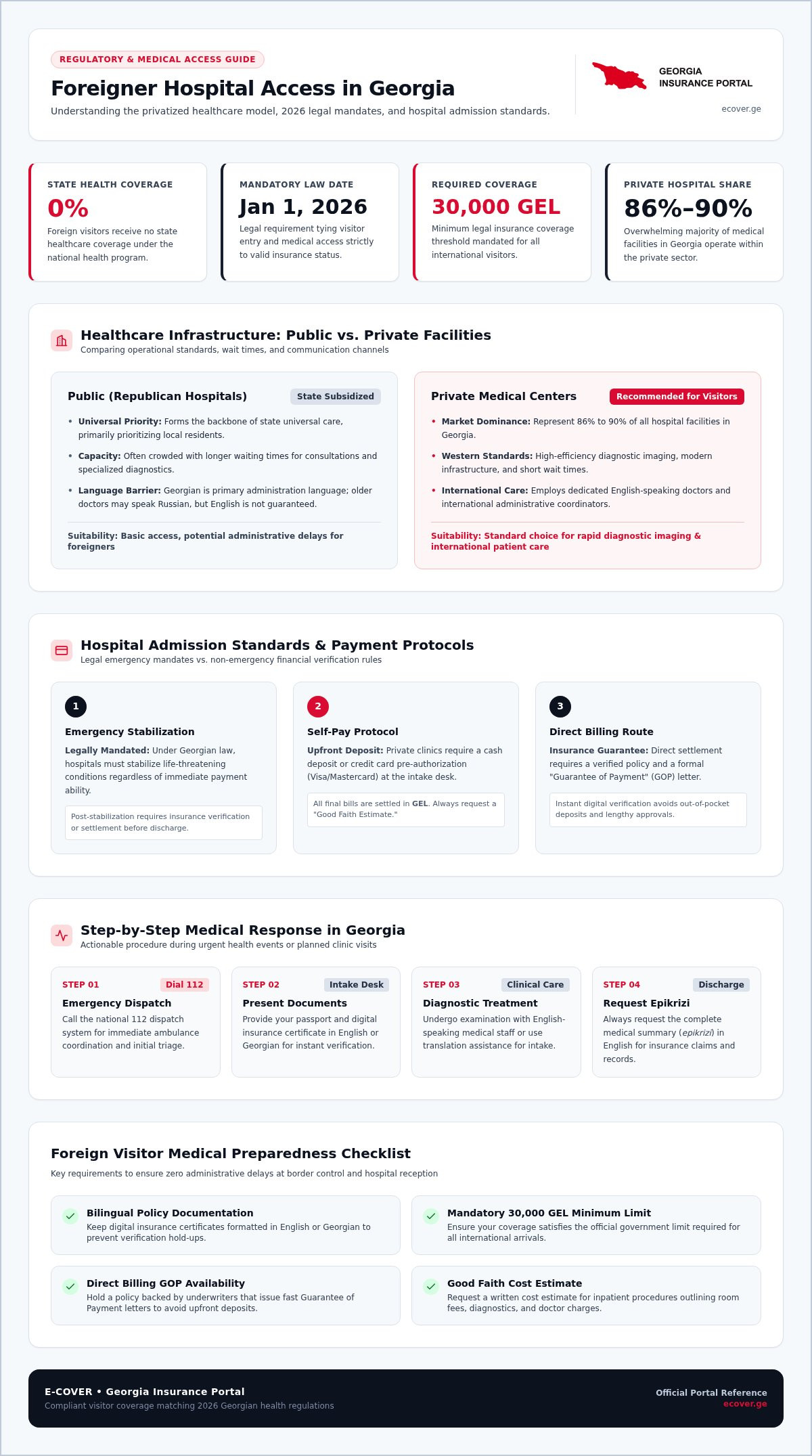
Public hospitals, often referred to as Republican Hospitals, form the backbone of the state's universal healthcare for citizens. Foreigners can use these facilities, but they are often crowded and prioritize local residents under state subsidy programs. In contrast, private medical centers function as high-efficiency hubs with Western-standard diagnostics. Because roughly 86% to 90% of hospitals in the country are privately owned, international visitors usually find better resource availability and shorter wait times in the private sector. If you require specialized care or diagnostic imaging, private clinics are the standard choice for reliable foreigner hospital access in Georgia.
Language and Communication in Georgian Hospitals
Communication is a common hurdle in public wards. While older medical professionals often speak Russian, Georgian is the primary language of administration. In public hospitals, English-speaking staff aren't always guaranteed, which can lead to significant anxiety during an emergency. Private facilities mitigate this risk by employing English-speaking doctors and administrative coordinators who specifically handle international patients. If you don't speak the local language, these private clinics offer a much smoother path to treatment.
To ensure a smooth process, you should follow these steps:
- Keep a digital copy of your insurance certificate in English or Georgian.
- Use translation apps for basic intake forms if a coordinator isn't immediately available.
- Request all medical summaries, known locally as an epikrizi, in English for future reimbursement claims.
Effective foreigner hospital access in Georgia relies on your ability to present clear documentation. If your paperwork is in a language other than English or Georgian, you'll likely face delays while the hospital verifies your coverage limits. Being prepared with bilingual documents isn't just a convenience; it's a necessity for rapid admission.
Hospital Admission Standards and Payment Models
Securing foreigner hospital access in Georgia for non-emergency care requires immediate financial verification. Unlike some Western systems where billing occurs weeks after treatment, Georgian facilities expect proof of coverage or a cash deposit at the intake desk. If you arrive for a planned consultation or elective procedure, the administrative staff will ask for your insurance certificate or a credit card before you see a physician. This protocol ensures that the privatized medical infrastructure remains sustainable while providing high-quality care to international patients.
It's vital to understand that emergency stabilization is legally mandated under Georgian law. If you're in a life-threatening condition, hospitals must stabilize you regardless of your immediate ability to pay. However, once your condition is no longer critical, the facility will require a payment plan or insurance details to cover the costs incurred during your stay. Without a verified policy, you may be asked to settle the balance before discharge.
Self-Pay Protocols for International Patients
If you don't have a recognized policy, you'll follow the self-pay model. Most private hospitals require a significant deposit before admission for inpatient care. While international credit cards like Visa and Mastercard are widely accepted, all final billing is processed in Georgian Lari (GEL). You should always request a "Good Faith Estimate" before any major intervention. This document outlines the projected costs for diagnostics, room fees, and surgical procedures, helping you avoid unexpected financial strain during your recovery.
Direct Billing with Compliant Insurance
The most efficient way to manage foreigner hospital access in Georgia is through direct billing. Major private clinics work with various underwriters, but this requires a "Guarantee of Payment" (GOP) letter. Securing this letter from a foreign insurer can take hours or even days, often forcing you to pay upfront. The new mandatory health insurance regulation for visitors, effective January 1, 2026, aims to streamline this by requiring a minimum of 30,000 GEL in coverage.
Local Georgian insurance policies are typically registered in a national database, allowing hospital registrars to verify your coverage in seconds. This digital integration removes the need for manual GOP verification, ensuring you get care without administrative delays. You can view compliant policy options to ensure your coverage is recognized immediately by hospital administrators across the country. Choosing a policy that is pre-verified by the LEPL Insurance State Supervision Service provides a layer of security that global travel policies often lack in a local clinical setting.
The 2026 Mandatory Health Insurance Law for Visitors
Starting January 1, 2026, the legal landscape for entering the country changed significantly. All international visitors are now required by law to hold valid health and accident insurance for the entire duration of their stay. This isn't just a recommendation; it's a statutory requirement under the Law of Georgia "On Tourism." Border officials and medical facilities now utilize a centralized digital system to verify policy validity in real-time. This ensures that foreigner hospital access in Georgia is backed by guaranteed financial coverage, preventing the logistical bottlenecks that previously occurred when insurance status was uncertain.
If you fail to comply with this mandate, the consequences are immediate. Travelers without a valid policy may face administrative fines at border checkpoints. More importantly, airlines are increasingly checking for proof of insurance during the boarding process to avoid repatriation liability. You must ensure your documentation is either printed or available digitally in English or Georgian to satisfy these compliance checks.
Why Georgia Implemented the 2026 Mandate
The transition to mandatory insurance serves several critical purposes. Historically, a high percentage of medical costs for uninsured travelers remained unpaid, creating a significant strain on the national budget. By requiring coverage, the government ensures that hospitals are fairly compensated for the high-quality care they provide. Additionally, this mandate aligns Georgia with European safety standards, positioning the country as a secure and responsible destination. For the traveler, it removes the risk of financial ruin in the event of a catastrophic accident. According to the FCDO travel health guidance for Georgia, visitors without reciprocal agreements are expected to pay for all treatment, making this law a protective measure for both the state and the visitor.
Minimum Coverage Requirements for Admission
To be considered compliant, your policy must meet specific criteria defined by Georgian law. The minimum coverage threshold is set at 30,000 GEL (approximately $11,000 USD). This amount must explicitly cover emergency outpatient services, inpatient hospitalization, and accident-related injuries. If your policy doesn't meet these specific limits, you won't satisfy the entry requirements.
A key addition to the 2026 rules is the requirement for medical repatriation. This ensures that if a visitor requires specialized long-term care in their home country, the logistics and costs are handled by the insurer. You can find a detailed breakdown of these specific policy requirements in our Mandatory Georgia Travel Insurance: 2026 Entry Guide. Compliance is verified at every entry point, whether you arrive by air, land, or sea. If you don't have a digital or printed certificate, you risk significant delays in your travel plans and your foreigner hospital access in Georgia for non-emergency needs.
Step-by-Step: Managing a Medical Emergency in Georgia
In a medical crisis, your focus must shift from general travel to immediate administrative and clinical compliance. Managing a crisis effectively ensures that foreigner hospital access in Georgia remains uninterrupted and financially covered. If you or a companion requires urgent care, you must follow a specific sequence of actions to satisfy both medical needs and the 2026 legal mandates. Following these steps helps avoid the stress of navigating a foreign system during an emergency.
Using the 112 Dispatch System
The first step in any life-threatening situation is to dial 112. This is the unified national emergency number that connects you to police, fire, and ambulance services. Unlike many regional services, 112 operators are specifically trained to handle calls in English and Russian. When you call, you must provide your exact location, the nature of the illness or injury, and your nationality. This data allows the dispatcher to prioritize your case and determine the appropriate medical facility for transport.
The ambulance response time in urban centers is typically efficient, but the destination hospital is often decided by the triage level and the nearest available specialized unit. If you're conscious, you may request a specific private facility, but the paramedics' primary goal is stabilization. Once you arrive at the emergency department, the administrative transition begins, and the facility will require your identification and coverage details.
Documentation Required for Hospital Admission
Upon arrival at the hospital, you must present your passport and your Georgia travel medical policy immediately. Since the 2026 law took effect, hospitals use your policy number to verify coverage through the national database. While digital certificates are standard, having a printed backup is a highly recommended safety measure in case of device failure or connectivity issues. This documentation is the key to bypassing high upfront cash deposits for emergency treatment.
After the initial stabilization, you or a representative must contact your insurance provider to initiate the Guarantee of Payment (GOP) process. This ensures the hospital bills the insurer directly rather than requiring you to settle the balance upon discharge. You can review the specific documentation standards in our guide on the Georgia Mandatory Insurance Law: 2026 Requirements for International Visitors. To ensure you have all necessary paperwork ready before an emergency occurs, get your compliant policy online today. This proactive step ensures your foreigner hospital access in Georgia is handled with professional efficiency.
Finally, always retain every medical report, lab result, and itemized receipt. Even with direct billing, these documents are essential if you need to file a supplemental claim or provide records to your primary physician back home. Requesting these in English at the time of discharge will save you significant administrative effort later.
Securing Compliant Coverage with E-COVER
Managing the administrative requirements of the 2026 mandate doesn't have to be a complex process. E-COVER provides the government-mandated travel medical insurance required for all foreigners entering the country, ensuring your foreigner hospital access in Georgia is legally and financially secured before you arrive. Our platform is licensed by the LEPL Insurance State Supervision Service of Georgia, which means every policy we issue is recognized by national hospitals and border authorities. By choosing a locally licensed provider, you eliminate the risk of having your documentation rejected at the hospital intake desk or the border checkpoint.
Instant Issuance for Last-Minute Travelers
If you're already at the airport or planning a last-minute trip, you need a solution that works in real-time. Our online application process is designed for efficiency, requiring only your passport details and travel dates. Once you complete the purchase, we send your digital insurance certificate to your email immediately. This instant delivery is critical for 2026 border entry compliance, as you can present the PDF directly from your smartphone to immigration officers or airline staff.
Your coverage begins the moment you cross the national border, providing a continuous safety net for the duration of your stay. Because our policies are pre-verified against state requirements, they include the necessary limits for emergency care and medical repatriation. It's a pragmatic approach to travel safety; you satisfy the law in minutes and gain the security of knowing that any required medical intervention is backed by a compliant underwriter. This immediate recognition is what makes foreigner hospital access in Georgia a streamlined experience rather than an administrative hurdle.
Dedicated Support for Foreign Patients
We act as a knowledgeable facilitator between you and the local medical environment. If you find yourself in a clinical setting, our team provides the administrative support needed to communicate effectively with hospital billing departments. We understand that navigating insurance claims in a foreign language is stressful, so we focus on ensuring your policy is verified quickly to allow for direct billing whenever possible. This bridge between the visitor and the provider is essential for maintaining a stress-free journey.
Our policies are also tailored to the specific needs of different traveler profiles. Whether you're a digital nomad staying for several months or a student starting a degree program, we ensure your coverage aligns with your residency status. For those pursuing education, you can review our Student Health Insurance in Georgia: The Complete 2026 Requirements Guide to understand how your hospital access differs from that of a standard tourist. By securing your policy through E-COVER, you're not just buying a document; you're ensuring that your healthcare needs are managed by experts who understand the nuances of Georgian law.
Prepare for a Secure and Compliant Visit to Georgia
Navigating the Georgian healthcare landscape requires a balance of cultural curiosity and administrative diligence. The 2026 mandate ensures every visitor is protected, but successful foreigner hospital access in Georgia ultimately depends on having the right documentation ready at the point of care. By prioritizing private facilities and understanding the 112 emergency system, you've already taken the most important steps toward a safe journey. Remember that your insurance certificate is your primary tool for bypassing high upfront deposits and ensuring immediate medical attention whenever it's needed.
E-COVER simplifies this preparation by providing policies licensed by the LEPL Insurance State Supervision Service of Georgia. We offer instant policy issuance and a 100% 2026 compliance guarantee, so you won't face delays at the border or during hospital intake. You can complete the entire process in minutes and receive your digital certificate via email immediately. Don't leave your security to chance; secure your documentation before you fly. Get Your Mandatory 2026 Georgia Travel Insurance Now. Georgia is waiting to welcome you with its world-famous hospitality, and we're here to make sure your visit remains as stress-free and secure as possible.
Frequently Asked Questions
Is hospital care free for foreigners in Georgia?
Hospital care is not free for international visitors. Foreign tourists and non-resident expats receive 0% state coverage under the Universal Health Care Program. You're responsible for 100% of medical costs, which must be funded out-of-pocket or through private insurance. Because hospital privatization rates are between 86% and 90%, facilities operate on a commercial basis and require payment or a verified policy for admission.
What is the emergency number for medical help in Georgia?
The unified national emergency number is 112. You can dial this toll-free 24/7 from any mobile device, even without credit or a local SIM card. This number connects you to the Public Safety Command Center, which dispatches police, fire, ambulance, and mountain rescue services. Operators are trained to assist in English and Russian. For specific medical inquiries, the Ministry of Health also operates a hotline at 1505.
Does my international travel insurance work in Georgian hospitals?
While some international policies are accepted, many hospitals operate on a pay-first basis for foreign underwriters. To ensure seamless foreigner hospital access in Georgia, you should carry a policy recognized by the LEPL Insurance State Supervision Service. Local providers like E-COVER allow facilities to verify coverage instantly through a national database, which often bypasses the need for large upfront cash deposits or complex Guarantee of Payment letters.
What happens if I enter Georgia without the mandatory 2026 insurance?
Entering without the mandatory 2026 insurance leads to significant logistical hurdles. Border officials have the authority to issue administrative fines to non-compliant travelers. Additionally, international airlines regularly check for proof of the 30,000 GEL coverage during check-in to avoid repatriation liability. If you can't present a valid digital or physical certificate at border control, you risk being denied entry until you obtain a compliant policy.
Are Georgian hospitals equipped with English-speaking doctors?
English-speaking medical professionals are common in major private hospitals and international clinics. However, public facilities are often staffed by doctors who predominantly speak Georgian or Russian. If you require specialized care, seeking treatment at private centers is recommended. These institutions prioritize English-speaking administrative and medical staff to facilitate communication and ensure that foreigner hospital access in Georgia remains efficient for international patients.
Can I buy the mandatory health insurance after arriving in Georgia?
You can purchase insurance online after arrival, but there are no physical kiosks or government desks at airports or land checkpoints. It's highly recommended to secure your policy before you travel to avoid issues with airline boarding or border control. E-COVER provides instant digital certificates that you can buy on your smartphone. This ensures you meet the 30,000 GEL requirement before you reach the immigration desk.
Do Georgian hospitals accept credit cards for medical bills?
Most private hospitals and clinics accept international credit cards, including Visa and Mastercard. However, all billing is processed in the local currency, Georgian Lari. If you're using an uninsured service, you'll likely need to pay a deposit upon admission. Public hospitals in remote areas may have limited card processing capabilities, so carrying some cash is advisable. Always request an itemized billing invoice in English for your records.
What is the difference between public and private hospitals for a tourist?
Public hospitals focus on citizen coverage and are often underfunded, leading to longer wait times and potential language barriers. Private hospitals are the primary choice for tourists because they offer Western-standard diagnostics and English-speaking coordinators. While private care is more expensive, clinical costs remain lower than in Western Europe. Private facilities also have more experience handling direct billing with insurance providers, making the administrative process much faster.


