

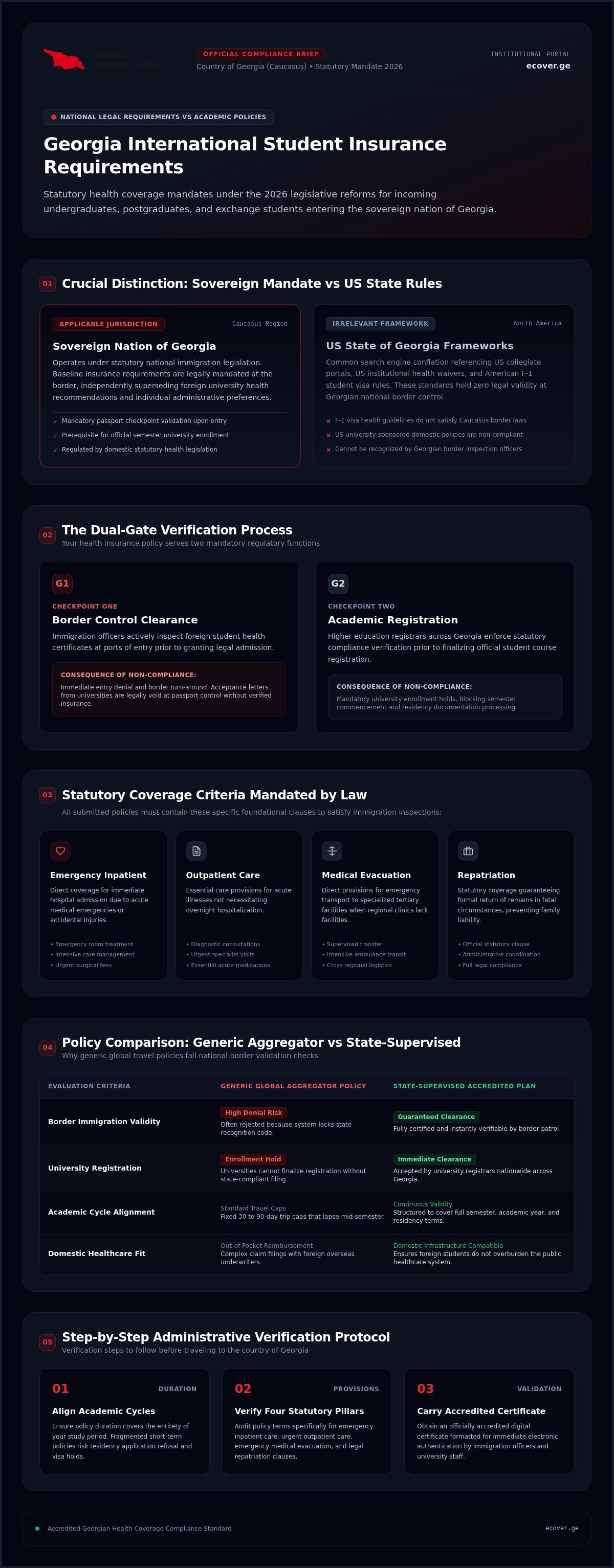
Purchasing generic travel coverage from a random aggregator will not protect your academic plans if it fails to satisfy statutory border mandates. Understanding the exact Georgia international student insurance requirements is the decisive factor between a seamless arrival and facing border rejection or university enrollment holds.
If you're frustrated by conflicting information, you aren't alone. Online searches constantly conflate the American state with the sovereign nation of Georgia, leaving incoming international students stranded between irrelevant advice and rigorous administrative protocols. The fear of arriving with non-compliant paperwork is completely valid, especially when entry regulations demand absolute legal precision.
This comprehensive guide helps you master every mandatory health insurance requirement for studying in the country of Georgia in 2026 to ensure smooth visa approval and university enrollment. We'll examine the statutory coverage minimums mandated by national legislation, clarify policy verification procedures, and show you how to secure an accredited certificate recognized nationwide.
Key Takeaways
- Distinguish sovereign Georgian statutory mandates from foreign university health guidelines to ensure your policy satisfies national entry laws.
- Complying with Georgia international student insurance requirements requires specific coverage provisions, including emergency inpatient care, outpatient treatment, medical evacuation, and repatriation.
- Discover why generic global travel policies frequently fail border validation checks and how state-supervised coverage prevents entry denial.
- Follow an administrative verification checklist to align your policy duration with both academic enrollment cycles and student residency protocols.
- Learn how to secure an officially accredited digital certificate that provides immediate legal validity recognized by border officials and university registrars nationwide.
Understanding the 2026 Georgian National Insurance Mandate for Students
A web search for student health requirements often buries students under US collegiate portals, citing American state plans and F-1 visa regulations. If you're relocating to the sovereign nation of Georgia in the Caucasus, those American frameworks are completely irrelevant. The statutory Georgia mandatory insurance law establishes national baseline obligations that operate independently from academic administrative preferences.
Historically, foreign arrivals treated travel coverage as an optional safeguard. That assumption changed with the 2026 legislative reforms. Under current border protocols, border control officers actively verify valid health coverage at immigration checkpoints before granting entry. Navigating the Georgia international student insurance requirements requires a shift in perspective. Your policy serves a dual purpose: satisfying legal border admission and granting clearance for academic enrollment.
If your policy fails national benchmarks, universities cannot finalize your student registration. Worse, border officials will turn you away before you step foot outside the port of arrival.
National Border Regulations vs Academic Policies
Entry laws apply uniformly across the entire nation of Georgia, setting statutory minimums that supersede institutional guidance. While foreign institutions might offer discretionary enrollment waivers, Georgian border control answers exclusively to national legislation. Higher education institutions throughout the country enforce these government insurance directives prior to semester registration. Arriving without verified, compliant paperwork risks immediate entry refusal at national checkpoints, rendering your university acceptance letter useless at passport control.
Scope of the 2026 Health Insurance Legislation
The 2026 legislation applies to all incoming foreign nationals, including full-degree international undergraduates, postgraduates, and exchange participants. The statutory mandate guarantees that non-residents do not overburden the domestic healthcare infrastructure. While the universal health care system in Georgia provides state-funded medical services to citizens, international students must maintain dedicated private coverage covering their stay.
Compliant coverage requires distinct structural criteria:
- Continuous policy validity covering your full academic duration.
- Baseline provisions for unexpected acute illnesses and emergency conditions.
- State-recognized certification that administrative officers can validate instantly.
Understanding these Georgia international student insurance requirements before scheduling your travel eliminates administrative holds, securing a smooth transition directly into your academic studies.
Mandatory Coverage Criteria for International Student Policies
Securing an arbitrary travel certificate won't guarantee compliance at the border. Border inspection officers examine incoming foreign students against strict statutory coverage criteria established under national entry legislation. To satisfy the Georgia international student insurance requirements, your policy must supply comprehensive medical protection rather than superficial travel perks.
Every submitted policy must contain specific foundational clauses to pass administrative muster. Missing even one statutory provision can result in denied entry or suspended university enrollment.
Inpatient and Emergency Medical Provisions
Under national regulations, student policies must guarantee direct coverage for immediate hospital admission due to acute medical emergencies or sudden accidental injuries. Your coverage cannot exclude emergency trauma care or intensive care stabilization. You can review detailed provisions and thresholds in our comprehensive guide to student health insurance Georgia.
Key inpatient elements must include:
- Full emergency room treatment and intensive care management.
- Urgent surgical interventions and associated operating theater fees.
- Critical diagnostic imaging, laboratory tests, and specialist consultations.
- Prescription medications administered during emergency treatment.
Evacuation, Repatriation, and Ancillary Care
Statutory entry regulations demand that international policies include medical transport safeguards. Should an acute condition exceed local treatment capacities, your policy must cover emergency medical evacuation to a specialized facility. The framework also dictates mandatory coverage for the repatriation of mortal remains. Without these clauses explicitly visible in your policy schedule, immigration officials will decline verification. Basic urgent outpatient consultations and immediate dental relief for acute pain are also essential ancillary protections for academic living.
Policy Language and Documentation Requirements
Compliance depends heavily on how your insurance documentation is presented. Immigration officers and university registrars require specific presentation standards to confirm legitimacy immediately:
- Certificates must be issued in either English or the official state language.
- Full policyholder identity details, matching your passport exactly, must be clearly visible.
- Coverage periods must show active validity spanning the entire country without regional exclusions.
If you need reliable coverage that checks every administrative box before you board your flight, securing a verified policy via ecover.ge ensures immediate compliance with every domestic mandate.
Comparing Coverage Options: International Policies vs Locally Licensed Plans
Selecting the right policy structure is often where international students encounter unexpected hurdles. When planning your academic relocation, you essentially face two paths: buying an offshore global travel package or securing locally licensed domestic coverage. While an international policy from your home country might appear comprehensive on paper, it frequently fails when tested against statutory scrutiny. Understanding how these formats diverge in practice ensures you satisfy the Georgia international student insurance requirements without administrative friction.
The core issue lies in regulatory alignment. Global policies operate under foreign legal frameworks, whereas domestic border guards and university registrars require documentation governed by local supervisory statutes.
The Pitfalls of Unverified Global Travel Cover
Many foreign plans rely on complex out-of-pocket reimbursement models. If you fall ill, you must settle expensive medical invoices upfront before filing protracted claims overseas. More critically, global providers routinely omit the mandatory emergency evacuation and statutory repatriation clauses dictated by Georgian immigration law. Foreign language certificates or generic policy schedules lack official verification mechanisms, causing immigration border control to reject them immediately. You can cross-reference standard compliance benchmarks in our review of mandatory Georgia travel insurance.
Benefits of State-Supervised Domestic Insurance
Locally licensed coverage eliminates bureaucratic uncertainty by operating directly under domestic jurisdiction. Choosing a domestic provider offers distinct administrative advantages:
- Direct oversight by the Insurance State Supervision Service of Georgia, ensuring total statutory legitimacy.
- Instant electronic policy validation recognizable by border inspection officers nationwide.
- Guaranteed acceptance by university admissions officers, removing holds during semester enrollment.
- Direct billing agreements with medical provider networks across the country, preventing heavy out-of-pocket costs.
Fulfilling the Georgia international student insurance requirements through a locally supervised framework guarantees that your certificate is treated as an official legal document rather than an unverified foreign claim. This distinction prevents border turning-points and keeps your academic progress entirely on schedule.
Step-by-Step Insurance Compliance Checklist for Academic Registration
Securing your medical coverage involves more than ticking a bureaucratic box; it demands precise administrative synchronization. Your policy timeline must mirror your academic schedule perfectly. When you coordinate your travel dates, visa validity, and university matriculation, adhering to every aspect of the Georgia international student insurance requirements prevents costly procedural setbacks.
Follow this chronological verification sequence to guarantee smooth transitions from pre-departure planning to full on-campus registration.
Pre-Arrival Preparation and Policy Purchase
Never postpone purchasing your medical policy until you land. Purchase dedicated Student Insurance prior to departing your home country so your validation credentials exist in national registries ahead of travel. Your policy start date must match or precede your scheduled entry date. Border officers scrutinize these timestamps carefully. Keep digital copies stored on your mobile device, but also print at least two physical copies of your bilingual insurance certificate to show at passport checkpoints.
Navigating University Administrative Submission
Passing border inspection is only step one. Once inside the country, you must present certified coverage documentation during mandatory faculty orientation or registrar verification. Administrative faculties examine your policy metadata to ensure your personal details correspond precisely with your passport and official enrollment files. Your policy structure should mirror the standards detailed in our analysis of a compliant Georgia travel medical policy.
Complete these post-arrival administrative checkpoints:
- Submit your officially validated policy certificate directly to the university international student office.
- Confirm your coverage dates protect your status throughout the complete academic term without mid-semester expiration gaps.
- Maintain active insurance records required when transitioning from initial visitor clearance to an academic temporary residence permit.
- Renew your student coverage well in advance of semester renewal deadlines to prevent administrative holds on course registration.
Allowing your coverage to lapse during your studies compromises your legal residency status and exposes you to substantial fines. To eliminate administrative guesswork and lock in fully compliant documentation before departure, buy your student insurance online to receive an officially registered certificate immediately.
Securing Compliant Student Insurance Through Official Channels
Fulfilling mandatory health regulations shouldn't involve administrative delays or complex bureaucratic hurdles. Modern digital platforms streamline this entire process, issuing verifiable policy documents in minutes. When dealing with national entry protocols and university registrars, purchasing through an accredited intermediary ensures your documentation is recognized immediately across the country.
Working with an officially licensed broker eliminates the risk of counterfeit policies or administrative rejections. E-COVER operates under LLC Insurance Broker WeInsure, licensed by the LEPL Insurance State Supervision Service of Georgia (License N012063). This regulatory status bridges the gap between arriving students and domestic legal requirements, ensuring every policy satisfies statutory entry mandates.
Digital Issuance and Institutional Recognition
Instant digital issuance provides immediate peace of mind for incoming scholars. Once you finalize your details, the system generates an official certificate equipped with state-recognized validation markers. You don't have to wait days for manual processing or postal delivery. Immigration checkpoints and academic registrars nationwide rely on these standardized digital certificates to verify coverage instantly. Validating your status electronically removes friction during passport inspection and eliminates document holds during faculty registration.
Legitimate certificates feature specific verification elements that authorities check:
- Official state broker licensing credentials and policy registration numbers.
- Clear bilingual policy phrasing accessible to border personnel and admissions officers.
- Explicit declarations confirming coverage for emergency hospitalization, evacuation, and repatriation.
Seamless Protection for Your Academic Journey
Higher education programs often span multiple years, making ongoing compliance just as important as your initial border crossing. Student Insurance policies structured specifically for academic durations allow for simple extensions before each semester. Because regulations can evolve, working through a state-supervised channel guarantees that any policy renewal automatically reflects the latest legal standards.
Meeting the statutory Georgia international student insurance requirements protects both your health and your legal right to study. Take the uncertainty out of your relocation, avoid border complications, and secure compliant student insurance today to ensure your academic journey starts on solid legal ground.
Prepare Your Documentation for a Seamless Academic Arrival
Embarking on your university degree abroad is an exciting milestone that requires strict administrative precision. Fulfilling the statutory Georgia international student insurance requirements means choosing coverage that explicitly complies with 2026 national border entry regulations. Relying on generic overseas travel plans risks border rejection and delays your semester matriculation, whereas verified domestic protection secures both legal entry and academic clearance.
E-COVER provides absolute peace of mind as an online platform under LLC Insurance Broker WeInsure, licensed by the LEPL Insurance State Supervision Service of Georgia (License N012063). With guaranteed compliance and instant digital certificate issuance accepted by universities nationwide, you don't have to stress over complex bureaucratic validation. Secure your officially compliant Georgian student insurance policy online today, and step onto campus fully prepared for a successful, rewarding academic journey.
Frequently Asked Questions
Is health insurance legally mandatory for all international students entering Georgia in 2026?
Yes, health insurance is legally required for all international students entering the country under the 2026 national entry legislation. Border authorities check for verified policies at entry ports before granting clearance. Meeting Georgia international student insurance requirements isn't optional; it's a statutory prerequisite for legal admission and prevents immediate border refusal. Additionally, higher education institutions across Georgia cannot finalize your semester enrollment without active, verified medical documentation on file.
Can I use travel health insurance purchased in my home country for my Georgian student visa?
You can technically present foreign insurance, but most international policies get rejected during border inspection or academic registration. Foreign plans frequently lack mandatory statutory clauses such as dedicated medical repatriation, emergency transport, or domestic direct billing. If your home-country policy isn't issued in English or Georgian, or lacks official validation recognized by domestic supervisory authorities, officials will not accept it for student residency verification.
What specific medical benefits must be included in a compliant Georgian student policy?
A compliant policy must cover emergency inpatient hospitalization, acute outpatient care, trauma treatment, and essential prescription medications administered during urgent treatment. In addition, national entry rules mandate explicit coverage for emergency medical evacuation to specialized facilities and repatriation of mortal remains. If a policy schedule omits these specific provisions or restricts coverage geographically, it won't satisfy statutory standards.
Do Georgian universities provide automatic health insurance coverage upon enrollment?
No, Georgian higher education institutions do not automatically provide or bill you for medical insurance upon admission. Students are individually responsible for securing compliant coverage before arriving in the country. Universities require you to present an official, valid certificate during faculty orientation or registrar verification. Without showing proof of independent, state-recognized coverage, administrative holds will prevent you from completing course registration and attending classes.
What happens at border control if my insurance policy does not meet 2026 requirements?
Border control officers will refuse your entry into the country if your policy fails statutory checks. Arriving with expired, partial, or unverified foreign documents triggers immediate administrative scrutiny. You risk facing entry denial at the port checkpoint or being instructed to secure compliant coverage on the spot before passport clearance. Having valid documentation beforehand prevents travel disruptions and guarantees smooth entry.
How far in advance of traveling to Georgia should an international student purchase insurance?
You should purchase your policy at least one to two weeks before your scheduled departure date. Buying ahead ensures your certificate is generated, registered, and ready for digital submission during visa review or border screening. Your policy's effective start date must match or precede your actual arrival date in Georgia. Early acquisition also gives you ample time to print physical copies for your travel records.
Does the mandatory health insurance policy cover multi-year degree programs across Georgia?
Standard policies align with specific academic semesters or annual terms, requiring renewal for multi-year degree programs. Satisfying the Georgia international student insurance requirements over several years simply means extending your coverage continuously before each academic term begins. Maintaining uninterrupted validity is vital; letting your policy lapse can jeopardize your student residency status and lead to administrative registration holds at your university.


