

As of January 1, 2026, arriving at a Georgian border crossing without a compliant insurance certificate is no longer an option for international visitors. Under Government Ordinance No. 602, every traveler must present proof of coverage that meets strict legal minimums or face immediate administrative fines. If you're feeling confused by the new mandate, you aren't alone. It's difficult to find policies that clearly state they meet the required 30,000 GEL limit for emergency medical care and repatriation. This article will help you navigate the 2026 requirements and secure the exact emergency evacuation insurance Georgia demands for legal entry.
You'll learn how to obtain a border-compliant certificate that protects you from the high costs of air ambulances while satisfying local law. We will provide a step-by-step breakdown of the mandatory minimums and the fastest way to get your documentation ready before you fly. By the end of this guide, you'll have the clarity needed to ensure your trip is both legally sound and financially secure.
Key Takeaways
- Understand the mandatory insurance requirements effective January 1, 2026, to ensure legal entry and avoid administrative fines at the border.
- Learn how to secure compliant emergency evacuation insurance Georgia by meeting the 30,000 GEL minimum limit for medical transport and repatriation.
- Identify the common coverage gaps in standard global policies and how to verify that your documentation is accepted by Georgian border authorities.
- Assess your personal risk factors to choose an evacuation limit that provides adequate financial protection against high-cost air ambulance services.
- Discover how to obtain an instant, licensed insurance certificate online to satisfy all 2026 legal mandates before you board your flight.
Georgia's 2026 Insurance Mandate: Why Evacuation Coverage is Essential
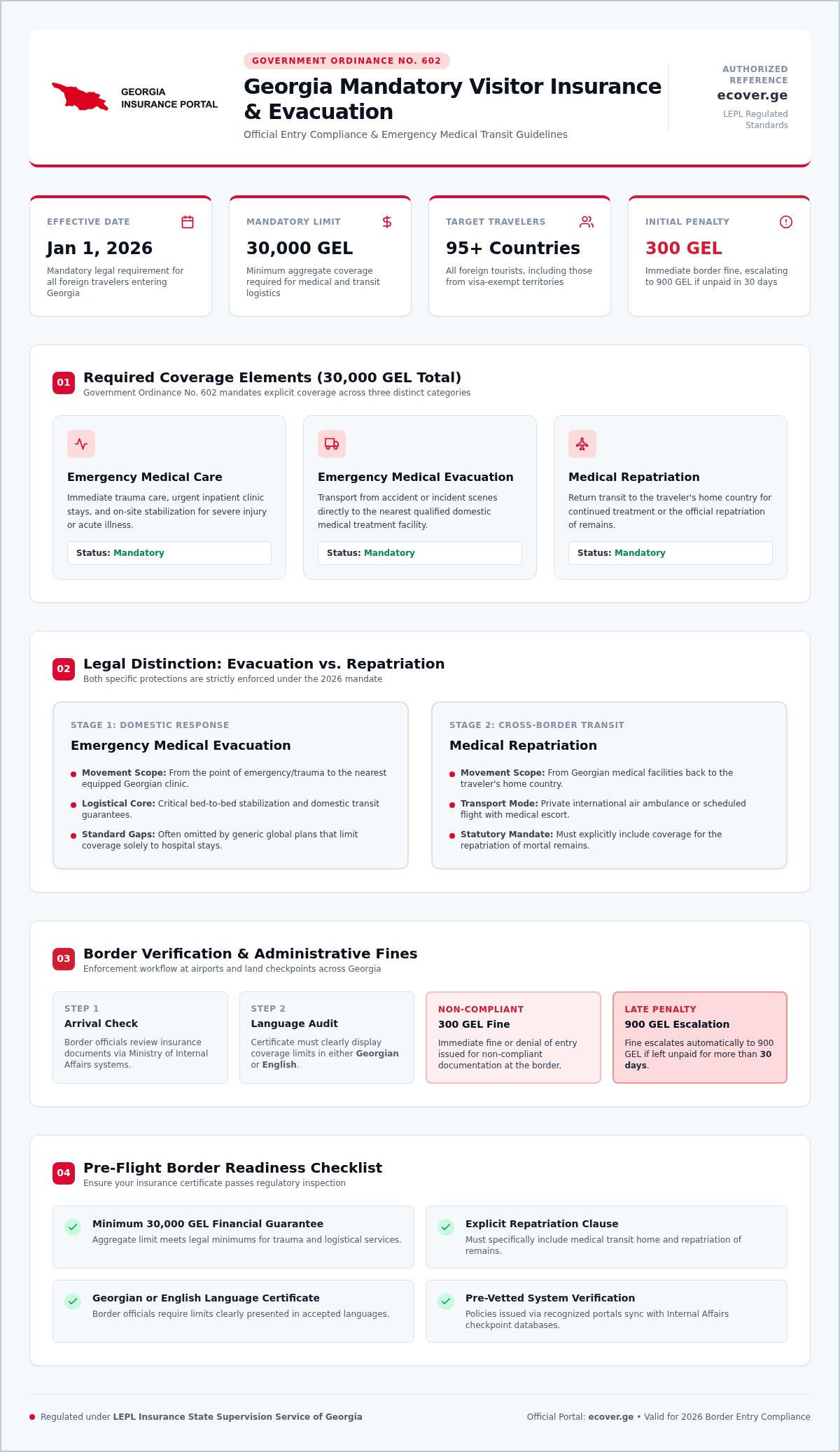
Effective January 1, 2026, Georgia has implemented a mandatory health insurance requirement for all foreign visitors. This shift, codified under Government Ordinance No. 602, means that entry is contingent upon possessing a valid policy. Central to this mandate is the requirement for emergency medical evacuation, which ensures that patients can be transported to appropriate facilities or repatriated in the event of severe illness or injury. The LEPL Insurance State Supervision Service of Georgia regulates these policies. Their oversight ensures that every authorized plan provides a direct financial guarantee to local medical providers, preventing logistical delays during a crisis.
The January 2026 Mandatory Insurance Law
The new regulations apply to all foreign nationals entering for tourism, including those from the 95+ visa-exempt countries. To be legally compliant, your emergency evacuation insurance Georgia must provide a minimum aggregate coverage of 30,000 GEL. This amount is designed to cover not just immediate medical care but also the complex logistics of medical transport. Standard health insurance often excludes these specific clauses, focusing only on hospital stays. However, the 2026 law requires explicit coverage for repatriation of remains and emergency transport within the country. If your policy doesn't explicitly list these items, border authorities may deem it insufficient for entry.
Border Compliance and Verification Procedures
Border officials at airports and land checkpoints now perform rigorous checks on insurance documentation. A generic policy from an international provider often fails this test if it doesn't clearly display the coverage limits in Georgian or English. If you arrive without a compliant certificate, you risk being denied entry or facing an immediate fine of 300 GEL. This fine escalates to 900 GEL if it isn't paid within 30 days. To avoid these logistical hurdles, it's essential to use a recognized provider that issues certificates pre-vetted for 2026 compliance. Using a localized broker like E-COVER ensures your documentation is instantly recognized by the Ministry of Internal Affairs systems, facilitating a seamless border crossing.
The transition to mandatory insurance reflects Georgia's commitment to visitor safety and the sustainability of its healthcare system. By requiring visitors to carry high-limit evacuation coverage, the government ensures that trauma care and emergency transfers don't become a personal financial catastrophe for the traveler. It's no longer just about personal safety; it's a matter of administrative compliance that starts the moment you reach the check-in desk at the airport.
Key Components of Emergency Medical Evacuation and Repatriation
Georgia's 2026 mandate requires more than just coverage for a doctor's visit. It demands a logistical safety net. If you suffer a serious injury, the costs of medical transit can quickly exceed the price of the trip itself. Selecting the right emergency evacuation insurance Georgia ensures you aren't left with an unpayable bill in a crisis. Understanding these specific components is the first step toward total compliance and personal security.
Emergency Evacuation vs. Medical Repatriation
Many travelers use these terms interchangeably, but they serve different legal and medical purposes. Emergency medical evacuation involves moving a patient from the site of an accident to the nearest qualified medical facility. In contrast, medical repatriation is the process of returning a patient to their home country for long term care. Depending on the severity of the condition, this might involve a private air ambulance or a commercial flight with a medical escort. Both elements are essential for full compliance with the Georgia mandatory insurance law. Without a policy that explicitly includes both, you may find yourself stabilized in a local clinic but unable to afford the specialized transport required to get home. International air ambulance services often cost tens of thousands of dollars out of pocket. This is why the mandatory visitor insurance and repatriation requirements focus so heavily on these logistical guarantees.
Stabilization and Bed-to-Bed Services
Medical stabilization is the prerequisite for safe transport, ensuring the patient's condition is steady enough to survive the journey. Once stable, the most comprehensive policies offer bed-to-bed service. This means the insurance provider coordinates the entire transfer, from the hospital bed in Georgia to the receiving facility in your home country. A 24/7 assistance coordinator manages these details, including ground ambulances, flight nurses, and medical equipment. They act as the bridge between Georgian medical staff and the flight crew, ensuring no gaps in care occur during transit. This professional oversight is what prevents administrative errors from delaying life saving transport.
While uncomfortable to consider, coverage for the repatriation of mortal remains is a non-negotiable requirement for 2026 entry. The Georgian government mandates this to ensure that legal and logistical costs are covered by the insurer rather than becoming a burden on the state or the family. If your certificate doesn't clearly state this coverage, border officials may reject your documentation. You can verify your coverage details online to ensure your policy meets every administrative hurdle before you arrive. Selecting a policy that covers these complex needs is the only way to meet the 2026 standards. Your emergency evacuation insurance Georgia certificate must be clear, concise, and ready for inspection.
Comparing Coverage: Standard Travel Plans vs. Georgia-Compliant Policies
Many travelers assume their existing credit card or annual travel plan provides the sufficient emergency evacuation insurance Georgia requires for 2026. However, a significant "Compliance Gap" exists between global standards and local mandates. Standard plans often operate on a reimbursement basis. This means you must pay the air ambulance costs upfront and claim the money back later. Given that international evacuations can cost between $30,000 and $100,000 USD, this model is impractical for most visitors. Georgia-compliant policies prioritize direct billing, where the insurer pays the medical provider directly to ensure immediate action.
According to CDC guidelines on medical evacuation insurance, the logistical and clinical requirements of aeromedical transit are highly specialized. Policies that meet the 2026 Georgian standard are designed to handle these complexities within the local healthcare infrastructure. Language barriers and administrative differences can delay transport if your provider doesn't have a direct link to local trauma centers. Local expertise ensures that the transition from a Georgian hospital to an evacuation flight is seamless and professionally managed.
Mandatory Limits for 2026 Visitors
To enter Georgia after January 1, 2026, your policy must show a minimum aggregate limit of 30,000 GEL, which is approximately $11,000 USD. This is a legal threshold verified at the border and by airline check-in staff. You should look for specific wording in your Georgia travel medical policy that explicitly itemizes evacuation and repatriation. Fixed benefit plans, which pay a set daily amount regardless of actual costs, usually fail the compliance test. They don't provide the financial guarantee required for high-stakes medical transport.
Local Network and Assistance in Georgia
Local coordination speeds up the evacuation approval process significantly. International third-party brokers often lack direct communication channels with Georgian medical facilities, leading to delays during the verification of coverage. E-COVER is licensed by the LEPL Insurance State Supervision Service (License N012063) and operates directly within the Georgian regulatory environment. This status allows for immediate coordination with local doctors and border authorities. When every hour counts, having a provider that speaks the language and understands the local medical infrastructure ensures your evacuation is triggered without administrative friction. This direct connection is why localized policies are preferred over generic global plans that may not be recognized by local officials.
Buying Guide: How to Select the Right Evacuation Limit
Selecting the appropriate coverage limit requires a balance between meeting legal mandates and accounting for your specific travel profile. While the 2026 law sets a baseline, your personal health history and age are primary factors in determining if that minimum is sufficient. If you're an older traveler or have chronic conditions, the complexity of a medical transfer increases, often requiring more specialized equipment or medical staff during transit. You must also account for the geography of your trip. Georgia's remote mountain terrain presents logistical challenges that significantly drive up the cost of helicopter rescues or specialized ground transport compared to urban transfers.
Group and family plans require careful management of individual limits. When traveling with a spouse or children, ensure that the evacuation cap applies per person rather than as a shared aggregate for the whole group. If one family member requires a high cost air ambulance, a shared limit could leave the rest of the family uninsured for the remainder of the trip. Always check the fine print for exclusions related to pre-existing conditions. If your policy doesn't explicitly cover evacuations triggered by a known health issue, you risk a claim denial during a crisis.
Activity-Based Coverage Needs
Adventure seekers must be particularly vigilant when reviewing policy terms. Standard emergency evacuation insurance Georgia policies often exclude "high risk" activities such as mountaineering, off-piste skiing, or paragliding. If you plan to explore the Greater Caucasus, you must ensure your policy includes an adventure sports rider. This specific clause guarantees that a rescue from a remote mountain trail is covered under the same clinical terms as a transfer from a metropolitan clinic. Without this rider, the cost of a private mountain rescue could become a direct out of pocket expense. For broader safety advice, you can review our guide on health insurance for tourists in Georgia.
Policy Duration and Coverage Extensions
Your policy must match the entire duration of your stay to avoid logistical complications at the border. If your travel dates change or you decide to stay longer, you must update your documentation immediately. Arriving with a policy that expires even one day before your scheduled departure can lead to administrative fines or entry denial by border police. It's essential to use a provider that offers instant access to policy updates, allowing you to extend your coverage while you're still in the country. This flexibility ensures you remain legally compliant even if your itinerary shifts.
Ensuring your policy is tailored to your specific risks is the most effective way to avoid financial surprises. You can secure your custom 2026 compliant policy online and receive your certificate instantly. By selecting a limit that reflects your activities and health needs, you move beyond simple legal compliance and gain genuine peace of mind for your journey.
Securing Instant, Border-Ready Evacuation Insurance with E-COVER
Starting January 1, 2026, arriving at the Georgian border without a compliant insurance certificate can lead to immediate entry denial or a 300 GEL fine. E-COVER acts as a direct intermediary, providing emergency evacuation insurance Georgia that is fully recognized by the Ministry of Internal Affairs and border police. While generic international brokers often have delayed delivery times, our platform is designed for immediate results. You receive a digital certificate that clearly displays the mandatory 30,000 GEL coverage limits in both English and Georgian, ensuring no language barriers delay your entry.
The 3-Step Online Issuance Process
Obtaining a legally compliant policy shouldn't be a complex administrative burden. Our streamlined portal allows you to secure coverage in under three minutes through three simple steps:
- Input Travel Details: Enter your arrival and departure dates along with your passport information to generate an accurate quote.
- Complete Secure Payment: Use any major credit or debit card to finalize your premium payment instantly.
- Receive Digital Certificate: A PDF copy of your policy is sent to your email address within seconds of payment.
This rapid turnaround ensures you meet the strict criteria of the Georgia mandatory insurance law before you board your flight. You can present this certificate on your mobile device or as a physical printout at any of Georgia's land or air checkpoints. Having instant proof of coverage is essential for last minute travelers or those who find their existing global policies are rejected by airline check-in staff.
Peace of Mind with Local Support
The true value of a policy is realized during a medical crisis. If you require urgent transport or stabilization, our 24/7 assistance team provides a direct lifeline. E-COVER is licensed by the LEPL Insurance State Supervision Service (License N012063), which grants us the authority to coordinate directly with Georgian medical facilities and emergency services. We don't just provide a document; we provide an active support network that understands the local healthcare infrastructure. If an evacuation is triggered, our coordinators manage the logistics with local health authorities to ensure rapid action without the delays common to third-party international brokers.
Don't leave your entry to chance. By choosing a localized provider, you ensure that your documentation is border-ready and your medical needs are pre-vetted by experts. You can secure your 2026 mandatory health insurance now and focus on your journey with the confidence that you are fully compliant with Georgian law.
Secure Your Seamless Entry into Georgia for 2026
As the January 1, 2026 mandate approaches, ensuring your documentation meets every legal requirement is the most important step in your travel preparation. You now understand that a compliant policy must provide a minimum of 30,000 GEL in coverage for medical emergencies and repatriation. Relying on generic international plans often leads to administrative delays or fines at the border because they lack the specific language required by Georgian authorities. By securing specialized emergency evacuation insurance Georgia, you protect yourself against the high costs of medical transport and ensure a smooth arrival.
E-COVER provides the direct path to compliance. Our policies are licensed by the LEPL Insurance State Supervision Service, offering a 100% border compliance guarantee and instant digital delivery. You can obtain your official certificate in minutes and focus on the hospitality and beauty that await you.
Get Your Mandatory 2026 Georgia Travel Insurance Certificate Instantly
We look forward to welcoming you to Georgia with the peace of mind that comes from being fully prepared for a stress-free journey.
Frequently Asked Questions
Is emergency evacuation insurance actually mandatory for Georgia in 2026?
Yes, effective January 1, 2026, all foreign visitors must possess health insurance that includes coverage for emergency medical evacuation and repatriation. This legal requirement is codified under Government Ordinance No. 602. If you fail to present a compliant policy at the border, you may be denied entry or face an administrative fine of 300 GEL. The policy must provide at least 30,000 GEL in aggregate coverage to satisfy border authorities.
What is the difference between medical evacuation and repatriation in Georgia?
Medical evacuation involves transporting a patient from an accident site to the nearest capable medical facility within Georgia. Repatriation refers to the clinical process of returning a patient to their home country or the return of mortal remains. Both components are strictly required under the 2026 mandate. Having emergency evacuation insurance Georgia ensures these complex logistics are coordinated and paid for by the insurer rather than becoming a personal financial burden.
How much does emergency evacuation insurance for Georgia cost?
The cost of a policy depends on the duration of your stay and the age of the insured travelers. While specific rates vary based on individual risk factors, these plans are designed to be an affordable component of your travel preparations. It's essential to prioritize meeting the 30,000 GEL legal minimum rather than just looking for the lowest price. Non-compliant policies will be rejected at the border, potentially leading to much higher costs in fines.
Will my credit card's travel insurance be accepted at the Georgian border?
Credit card insurance is only accepted if you can provide an official certificate that explicitly mentions Georgia and lists the 30,000 GEL minimum coverage limits. Many standard credit card statements lack this specific detail, which often leads to rejection by border officials. To ensure a seamless entry, it's recommended to obtain a dedicated certificate from a licensed provider that specifically states it meets the 2026 government requirements for medical and evacuation coverage.
What happens if I need an air ambulance but don't have evacuation insurance?
Without insurance, you're responsible for the full out of pocket cost of an air ambulance, which can range from $30,000 to over $100,000 USD depending on your home destination. Medical facilities in Georgia generally require a financial guarantee before triggering an evacuation flight. If you can't pay upfront, your transfer may be delayed, which can have serious health consequences. This is why emergency evacuation insurance Georgia is now a mandatory entry requirement.
Can I buy my mandatory health insurance after I arrive at the Georgian border?
You must have a valid policy before you reach the border checkpoint. Airline staff are instructed to verify your insurance certificate during the check-in process, and they can deny boarding if you don't have it. While you can technically purchase a policy online using your phone while at the border, it's much safer to secure your documentation in advance. This prevents technical delays or administrative complications that could interrupt your entry into the country.
Does E-COVER's policy meet the specific 2026 legal requirements for evacuation?
Yes, every policy issued by E-COVER is specifically designed to meet the January 2026 government mandates. As a broker licensed by the LEPL Insurance State Supervision Service (License N012063), we ensure our certificates are 100% border compliant. Our documentation includes the required 30,000 GEL limits and is provided in both English and Georgian. This allows for immediate verification by border police and the Ministry of Internal Affairs systems upon your arrival.
What information is required to get an instant insurance certificate for Georgia?
To generate your instant certificate, you only need to provide your full name as it appears on your passport, your date of birth, and your passport number. You must also specify your exact arrival and departure dates to ensure the coverage period matches your stay. Once you complete the secure online payment, the digital certificate is delivered to your email address within seconds. You can then present this document digitally or in print at the border.


